- Product Description Description
- Table of Contents TOC
- List of Table & Figure LOT
- Get Free Sample PDF Sample PDF
Market Size, 2025
$63.87 BnMarket Estimate, 2026
$67.18 BnMarket Forecast, 2034
$100.71 BnCAGR, 2026–2034
5.19%Executive Summary: North America Fertilizer Market
- Market Scope: Comprehensive North America fertilizer market analysis covering product categories, application forms, delivery methods, end-user crop segments, regional country leadership frameworks, and precision agriculture standards across the continent.
- Market Valuation: Valued at USD 63.87 billion (2025), estimated at USD 67.18 billion (2026), and projected to reach USD 100.71 billion by 2034, registering a robust CAGR of 5.19% (2026–2034).
- Primary Growth Drivers: Increasing demand for high-yield crops due to population growth and food security concerns, alongside widespread adoption of precision farming techniques enhancing nutrient use efficiency. Key industry trends include expansion of organic and bio-based fertilizers backed by government incentives, technological advancements in controlled-release/smart fertilizers, and a strategic shift toward sustainable agricultural practices.
Key Market Segment Metrics (2026–2034)
| Category | Leading Segment (2025 Position) | Fastest-Growing Segment |
|---|---|---|
| By Product & Form | Straight fertilizers segment (dominated with a 62.5% share); Conventional fertilizers form (held largest share) | Complex fertilizers segment (CAGR of 5.8%) and specialty fertilizers segment (highest CAGR of 6.2%) |
| By Application & End User | Soil application method (66.4% share); Field crops end-user segment (held largest share at 65%) | Fertigation delivery method (fastest CAGR of 7.1%) and horticultural crops (CAGR of 6.4%) |
| By Technology & Innovation | Standard conventional nutrient formulas and traditional broadcasting application | Controlled-release/smart fertilizers, digital nutrient platforms, and carbon-negative nitrogen |
| By Region / Country | United States (led the market with a 55.4% share in 2025, followed by Canada and Mexico) | Advanced precision agricultural hubs across the United States and Canadian provinces |
Major Market Players & Market Structure
Market Structure: Highly competitive North American agricultural inputs sector driven by digital platform innovations (such as Nutrien’s real-time nutrient recommendation launch), manufacturing capacity expansions (Yara’s Louisiana plant growth), and sustainable product introductions like carbon-negative nitrogen fertilizers (CF Industries).
Key Companies: CF Industries Holdings, Inc., Haifa Group, ICL Group Ltd, Koch Industries Inc., Nutrien Ltd, Yara International ASA, The Mosaic Company, K+S Potash Canada, Novozymes, and Lallemand Inc.
North America Fertilizer Market Size
The North American fertilizers market was valued at USD 63.87 billion in 2026 and is anticipated to reach a valuation of USD 67.18 billion in 2026 and USD 100.71 billion by 2034, growing at a CAGR of 5.19%, from 2026 to 2034.
Fertilizer is a nutrient-rich substance used to enhance soil fertility and promote agricultural productivity across the United States, Canada, and Mexico. This market is primarily segmented into nitrogenous, phosphatic, and potassic fertilizers, each catering to specific crop needs and soil conditions. With agriculture remaining a cornerstone of the regional economy, especially in the U.S., where a large number of farms operate on vast acreages, the demand for efficient and sustainable soil nutrition solutions continues to evolve. In Canada, the adoption of precision farming techniques has increased the need for customized fertilizer blends. Meanwhile, Mexico's growing emphasis on food security and export-oriented agriculture has further strengthened its domestic fertilizer usage. The market is also influenced by environmental regulations and sustainability trends, particularly in the U.S., where nutrient runoff and water contamination concerns have prompted shifts toward controlled-release and organic alternatives.
MARKET DRIVERS
Increasing Demand for High-Yield Crops Due to Population Growth and Food Security Concerns
The rising demand for high-yield crops, driven by population growth and heightened focus on food security, is one of the primary drivers fueling the North American fertilizer market. As per the U.S. Census Bureau, the U.S. population surpassed 335 million in 2025, contributing to an expanding domestic demand for food grains, vegetables, and animal feed. To meet this demand, farmers are increasingly adopting intensive farming practices that rely heavily on nutrient supplementation through fertilizers. For instance, corn, a major staple and biofuel crop in the U.S., requires significant nitrogen input to maintain yield levels. According to the USDA, corn acreage in the U.S. reached 92 million acres in 2023, with nitrogen fertilizer application averaging around 140 pounds per acre. Similarly, in Canada, the growing population and increasing dietary shifts toward protein-rich foods have boosted demand for feed crops like canola and soybeans, which in turn has elevated fertilizer use. These developments show how demographic pressures and food requirements are directly influencing fertilizer consumption patterns across North America.
Adoption of Precision Farming Techniques Enhancing Nutrient Use Efficiency
The widespread adoption of precision farming technologies that optimize nutrient application and improve overall farm productivity is another critical driver of the North American fertilizer market. Precision agriculture integrates GPS mapping, soil sensors, and variable rate technology (VRT) to tailor fertilizer inputs according to specific field conditions. This technological shift has not only reduced waste but also increased the demand for specialized fertilizers such as controlled-release and stabilized nitrogen products. Furthermore, the U.S. Environmental Protection Agency (EPA) estimates that precision application methods have cut nitrogen losses by up to 20%, aligning with regulatory goals while supporting market expansion. These advancements reflect how innovation in agricultural technology is reshaping fertilizer demand and driving market growth in North America.
MARKET RESTRAINTS
Regulatory Restrictions on Fertilizer Usage Due to Environmental Concerns
Environmental regulations represent a significant restraint on the North American fertilizer market, particularly due to growing concerns over nutrient runoff and water pollution. Excessive use of nitrogen- and phosphorus-based fertilizers has been linked to eutrophication in water bodies, prompting stringent policies aimed at curbing their application. In the U.S., the Environmental Protection Agency (EPA) has implemented several initiatives under the Clean Water Act to limit nutrient discharge into rivers and lakes. Additionally, states like California and Wisconsin have introduced mandatory nutrient management plans for farmers, restricting the timing and volume of fertilizer applications. In Canada, Environment and Climate Change Canada has mandated reductions in phosphorus use in certain agricultural zones to protect the Great Lakes ecosystem. So, these policies pose a notable constraint on market expansion.
Volatility in Raw Material Prices Affects Production Costs
Price volatility in raw materials essential for fertilizer manufacturing poses a major economic challenge to the North American fertilizer market. Key inputs such as natural gas for nitrogen fertilizers, phosphate rock for phosphatic fertilizers, and potash for potassium-based products experience frequent price fluctuations due to geopolitical tensions, supply chain disruptions, and energy market dynamics. According to the U.S. Energy Information Administration (EIA), natural gas prices in the U.S. surged in 2022 following global supply shocks caused by the Russia-Ukraine conflict, significantly raising the cost of ammonia and urea production. Similarly, in Canada, which is one of the world’s largest potash producers, domestic fertilizer companies faced an increase in production costs during the same period due to higher mining and transportation expenses, as reported by Natural Resources Canada. These cost increases are often passed on to farmers, leading to reduced application rates or shifts toward alternative nutrient sources. Such economic pressures continue to constrain the growth trajectory of the North American fertilizer market despite underlying demand fundamentals.
MARKET OPPORTUNITY
Expansion of Organic and Bio-Based Fertilizer Applications
The growing shift toward sustainable agriculture is opening new avenues for the North American fertilizer market, particularly in the domain of organic and bio-based fertilizers. Consumer preference for chemical-free food products, coupled with government incentives promoting eco-friendly farming, is driving demand for alternatives to conventional synthetic fertilizers. Moreover, the U.S. Department of Agriculture (USDA) has allocated over $300 million under the Inflation Reduction Act to support regenerative agriculture practices, including the use of biofertilizers. Companies such as Novozymes and Lallemand Inc. have expanded their North American operations to meet the rising demand for microbial inoculants and plant growth promoters.
Technological Advancements in Controlled-Release and Smart Fertilizers
Advancements in fertilizer formulation and delivery systems are creating significant opportunities for innovation and market expansion in North America. Controlled-release fertilizers (CRFs) and smart fertilizers equipped with sensor-based nutrient release mechanisms are gaining traction among progressive farmers aiming to enhance efficiency and reduce environmental impact. Major agrochemical firms like Yara International and The Mosaic Company have introduced enhanced-efficiency fertilizers tailored for North American soils and cropping systems. In the U.S., the adoption of polymer-coated urea has increased annually since 2020. These products allow for gradual nutrient release aligned with plant uptake cycles, minimizing leaching and improving yield outcomes. In Canada, provincial agricultural agencies have endorsed the use of nitrification inhibitors and slow-release nitrogen products to comply with emissions reduction targets under the federal government’s climate action plan.
MARKET CHALLENGES
Supply Chain Disruptions Impacting Fertilizer Availability and Pricing
Supply chain instability remains a pressing challenge for the North American fertilizer market, affecting both availability and affordability for end-users. The sector relies heavily on global trade for raw materials and finished products, making it vulnerable to logistical bottlenecks, labor shortages, and geopolitical conflicts. For example, in 2022, prolonged port congestion at West Coast terminals delayed shipments of imported potash and phosphate fertilizers, causing temporary shortages in key agricultural states like Iowa and Illinois. These disruptions not only inflate costs but also undermine long-term planning for farmers who depend on timely access to fertilizers for planting cycles.
Declining Arable Land Per Capita and Intensifying Land Use Pressures
The declining availability of arable land per capita, combined with intensifying competition for land use, is a fundamental structural challenge facing the North American fertilizer market. Urbanization, infrastructure development, and conservation mandates are gradually reducing the amount of cultivable land available for commercial agriculture. According to the U.S. Department of Agriculture (USDA), the U.S. lost approximately 24 million acres of farmland between 1992 and 2012, with a continued decline observed in recent years. In 2023, the average arable land per person in the U.S. stood at about 0.45 hectares, down from 0.52 hectares in 2010. Also, there is growing pressure to allocate land for renewable energy projects, carbon sequestration, and wildlife preservation, further constraining agricultural space. This shrinking resource base forces farmers to maximize output from existing plots, often relying on intensified fertilizer use. However, excessive nutrient application without proper rotation or soil recovery can degrade land quality over time, creating a cycle of diminishing returns.
REPORT COVERAGE
| REPORT METRIC | DETAILS |
| Market Size Available | 2025 to 2034 |
| Base Year | 2025 |
| Forecast Period | 2026 to 2034 |
| CAGR | 5.19% |
| Segments Covered | By Type, Form, Application Mode, and Region. |
| Various Analyses Covered | Global, Regional, Country-Level Analysis, Segment-Level Analysis, DROC, PESTLE Analysis, Porter’s Five Forces Analysis, Competitive Landscape, Analyst Overview of Investment Opportunities |
| Regions Covered | The United States, Canada, Mexico, Rest of North America. |
| Market Leaders Profiled | CF Industries Holdings, Inc., Haifa Group, ICL Group Ltd, Koch Industries Inc., Nutrien Ltd, Sociedad Quimica y Minera de Chile SA, The Andersons Inc., The Mosaic Company, Wilbur-Ellis Company LLC, Yara International ASA. |
SEGMENTAL ANALYSIS
By Type Insights
Straight Fertilizers
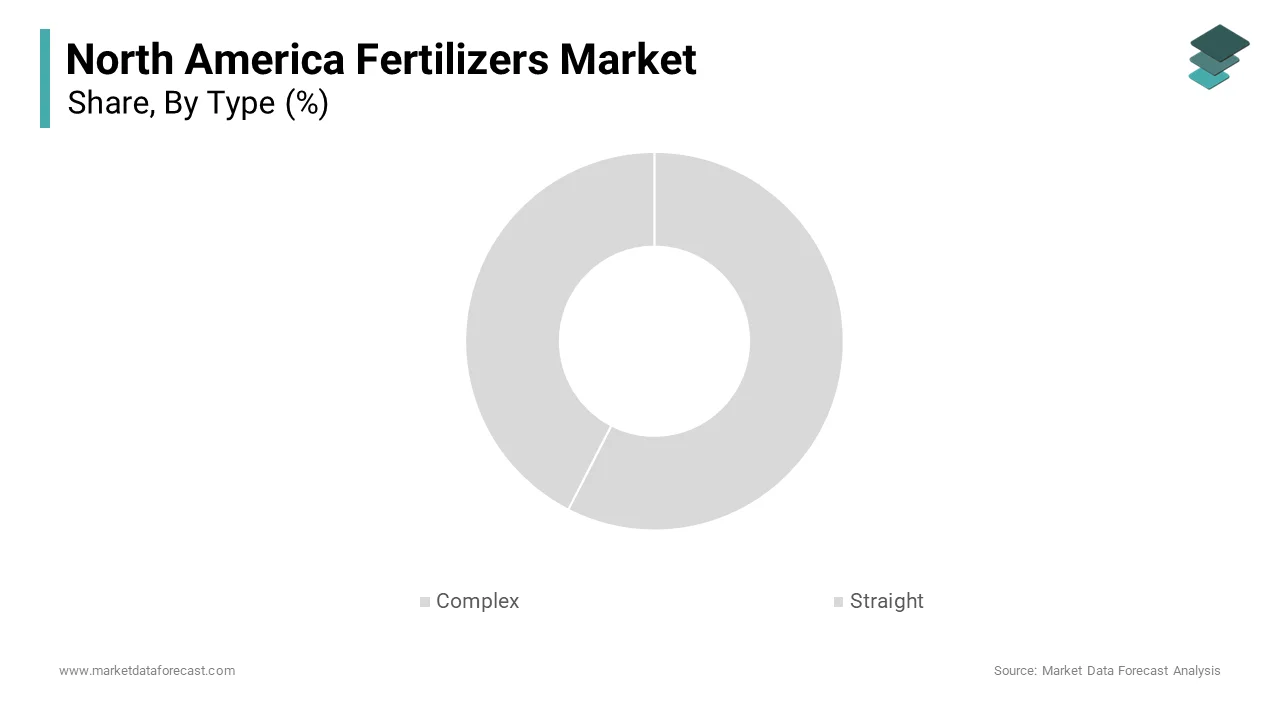
The straight fertilizers segment dominated the North American fertilizer market by accounting for 62.5% the total value in 2025. The region's vast acreage under commodity crops like corn, soybeans, and wheat, which have well-established nutrient application guidelines favoring individual macronutrients, is primarily driving the dominance of the straight fertilizers segment. These fertilizers provide a single primary nutrient—either nitrogen (N), phosphorus (P), or potassium (K)—and are widely used across staple crops that require targeted nutrient supplementation. According to the Fertilizer Institute, the U.S. alone consumed over 12 million metric tons of nitrogen-based straight fertilizers in 2023, driven largely by corn and wheat production. In Canada, the Prairie provinces rely heavily on monoammonium phosphate (MAP) and urea, as per Agriculture and Agri-Food Canada, with Saskatchewan alone applying over 2 million metric tons annually. Additionally, the ease of procurement and cost-effectiveness of straight fertilizers make them preferable among large-scale commercial farmers seeking predictable yield outcomes.
Complex Fertilizers
The complex fertilizers segment, which contains two or more essential nutrients in a single granule, is emerging as the fastest-growing segment in the North America fertilizer market and is projected to expand at a CAGR of 5.8% between 2025 and 2033. Increasing adoption of balanced nutrient management practices, especially among specialty crop producers and greenhouse operators who require precise and uniform nutrient distribution, is fuelling the rapid development of the complex fertilizers segment. Moreover, advancements in formulation technologies, including coated and multi-nutrient granules, have enhanced product performance, driving preference among precision agriculture adopters. Canadian agricultural extension programs have also been promoting the use of complex fertilizers to reduce application frequency and labor costs, further supporting market expansion.
By Form Insights
Conventional Fertilizers
The conventional fertilizers segment remained the largest form in the North America fertilizer market by capturing a substantial portion of the total share in 2025. The extensive cultivation of field crops like corn, wheat, and canola, where standardized nutrient applications are integral to yield optimization, is closely tied to the dominance of the conventional fertilizers segment. Furthermore, major grain-producing states such as Iowa, Illinois, and Nebraska continue to drive demand due to their high dependence on mass-applied fertilization techniques. These include widely used products such as urea, ammonium nitrate, superphosphate, and muriate of potash, which are favored for their affordability and compatibility with traditional farming methods. According to the U.S. Geological Survey (USGS), the United States consumed approximately 11.8 million metric tons of nitrogen fertilizers in 2023, primarily in the form of conventional urea and anhydrous ammonia.
Specialty Fertilizers
The specialty fertilizers segment is witnessing the highest growth rate in the North America fertilizer market and is expected to grow at a CAGR of 6.2% through 2033. The surge in demand is linked to expanding horticultural and greenhouse operations, particularly in states like Florida, California, and Oregon, where precise nutrient delivery is crucial for high-value crops such as strawberries, tomatoes, and ornamental plants. These products include controlled-release fertilizers (CRFs), water-soluble fertilizers (WSFs), bio-stimulants, and micronutrient-enriched formulations designed to enhance plant health and environmental sustainability.
By Application Mode Insights
Soil Application
The soil application segment remained the dominant method of fertilizer delivery in the North American fertilizer market by commanding a share of 66.4% in 2025. The widespread use of granular and bulk-blended fertilizers, along with mechanized spreader equipment, reinforces the preference for soil application among large-scale row crop producers. This traditional approach involves broadcasting, side-dressing, or incorporating fertilizers directly into the soil to support root absorption and long-term nutrient availability. Additionally, as per the National Association of Conservation Districts, soil testing initiatives have improved nutrient placement accuracy, enhancing the efficacy of this method.
Fertigation
The fertigation segment is currently the fastest-growing application method in the North American fertilizer market and is projected to expand at a CAGR of 7.1% from 2025 to 2033. The increasing integration of drip and micro-irrigation systems, supported by smart farming technologies, has significantly boosted the popularity of fertigation. This technique involves delivering fertilizers through irrigation systems, allowing for precise and efficient nutrient distribution directly to the plant root zone. According to the U.S. Department of Agriculture (USDA), over 18% of irrigated farmland in the U.S. now utilizes fertigation, with states like California, Arizona, and Texas leading adoption due to water conservation needs and intensive high-value crop production. In Canada, as per the British Columbia Ministry of Agriculture, over 60% of greenhouse and nursery operations employ fertigation to optimize water and nutrient use.
By Crop Insights
Field Crops
The field crops segment represents the largest segment in the North America fertilizer market, accounting for approximately 65% of total consumption in 2025. This category includes staple grains such as corn, wheat, soybeans, and canola, which require substantial nutrient inputs to sustain high yields across millions of acres. Lie, the Prairie provinces, particularly Saskatchewan and Alberta, remain central to this demand due to their expansive grain production areas. Given the strategic importance of field crops to national food security and export economies, fertilizer application remains deeply embedded in agronomic practices across the region.
Horticultural Crops
The horticultural crops segment, including fruits, vegetables, and nuts, is emerging as the fastest-growing fertilizer-consuming segment in North America and is projected to grow at a CAGR of 6.4% through 2033. The growth of the horticultural crops segment is driven by rising consumer demand for fresh produce, coupled with the intensification of protected and vertical farming systems that require precise nutrient management. According to the U.S. Department of Agriculture (USDA), the value of U.S. horticultural production exceeded $26 billion in 2023, with California, Florida, and Washington leading in high-value crop output. In California alone, over 2.5 million acres of land were dedicated to fruit and nut cultivation, requiring tailored fertilizer solutions to meet specific soil and plant needs. Additionally, the growing trend toward organic certification in horticulture has spurred demand for bio-based and slow-release fertilizers, further boosting this segment’s market momentum.
COUNTRY ANALYSIS
United States Fertilizers Market Analysis
The United States held the dominant position in the North American fertilizer market by accounting for 55.4% of total regional revenue in 2025. As the world’s largest exporter of agricultural commodities, the U.S. relies heavily on fertilizers to maintain high productivity across its vast farmlands. The Midwest Corn Belt, led by states like Iowa, Illinois, and Nebraska, remains the epicenter of nutrient-intensive farming. Additionally, the rise of precision agriculture and digital soil mapping has enabled more efficient fertilizer application, reducing waste while maintaining yield targets. With strong agrochemical manufacturing capabilities and a robust distribution network, the U.S. continues to lead the regional fertilizer landscape.
Canada Fertilizers Market Analysis
Canada is a key player in the North American fertilizer market. As one of the world’s top exporters of canola, pulses, and wheat, Canada's agricultural sector is highly dependent on nutrient inputs to sustain soil fertility and crop yields. Notably, Saskatchewan is home to the majority of the world’s potash reserves, making Canada a key player not only in domestic fertilizer consumption but also in global exports. Additionally, Environment and Climate Change Canada has been promoting sustainable nutrient management strategies, including reduced application rates and enhanced efficiency fertilizers, to align with climate goals. These developments show Canada’s dual role as a major fertilizer consumer and producer within North America.
Mexico Fertilizers Market Analysis
Mexico occupies a notable position in the North American fertilizer market. While smaller than the U.S. and Canada, Mexico’s fertilizer demand is steadily growing due to its focus on food security and agricultural exports. The country’s reliance on imported fertilizers, particularly nitrogen-based products from the U.S., has intensified due to domestic production constraints. In response, the Mexican government has launched initiatives to improve soil health and promote balanced nutrient use, as reported by the Colef Foundation. Additionally, the expansion of greenhouse and protected agriculture in regions like Sinaloa and Baja California has increased demand for specialty fertilizers, particularly water-soluble and micronutrient formulations. Despite logistical challenges and fluctuating import costs, Mexico’s fertilizer market is gaining traction as part of broader efforts to modernize and sustain agricultural productivity.
COMPETITIVE LANDSCAPE
Competition in the North American fertilizer market is characterized by a mix of large integrated producers, specialty fertilizer manufacturers, and regional distributors vying for dominance across various segments. While a few major players control a significant portion of the market, smaller firms are gaining traction by focusing on niche products such as bio-based and controlled-release fertilizers. The competitive landscape is shaped by factors including technological advancements, sustainability initiatives, and strategic expansions. Companies are increasingly leveraging digital agriculture platforms to differentiate their offerings and provide data-driven nutrient management solutions. Additionally, environmental regulations and fluctuating input costs are compelling firms to innovate continuously and diversify their product portfolios. The growing emphasis on sustainable farming practices is also pushing competitors to develop eco-friendly alternatives, further intensifying rivalry. As demand for high-yield and resource-efficient agriculture rises, competition is expected to remain robust, with companies striving to balance profitability, innovation, and environmental responsibility.
KEY MARKET PLAYERS
These are the market players that are dominating the North American fertilizer market.
- CF Industries Holdings, Inc.
- Haifa Group
- ICL Group Ltd
- Koch Industries Inc.
- Nutrien Ltd
- Sociedad Quimica y Minera de Chile SA
- The Andersons Inc
- The Mosaic Company
- Wilbur-Ellis Company LLC
- Yara International ASA.
Top Players In The Market
- The Mosaic Company is a leading global producer and distributor of concentrated phosphate and potash fertilizers. With a strong presence across North America, the company plays a pivotal role in supplying essential nutrients to support agricultural productivity. The company operates some of the largest potash and phosphate mines in Canada and the U.S., ensuring a steady supply chain for domestic and international markets. It invests heavily in sustainable mining technologies and nutrient management solutions that align with evolving environmental standards.
- Yara International is a Norwegian multinational chemical company that has established itself as a major player in the North American fertilizer market. Known for its leadership in nitrogen-based fertilizers, Yara offers innovative and environmentally responsible products tailored for diverse cropping systems. In North America, the company focuses on enhancing nutrient efficiency through digital farming tools and precision agriculture solutions, helping farmers optimize yields while reducing environmental footprints.
- Nutrien is the world’s largest producer and retailer of crop nutrients and services, with extensive operations across North America. The company integrates mining, production, distribution, and retail to offer a comprehensive value chain approach. Nutrien supports farmers through agronomy expertise, customized fertilizer blends, and digital platforms that improve decision-making. Its robust infrastructure and commitment to innovation make it a dominant force in both domestic and global fertilizer markets.
Top Strategies Used By Key Market Participants
- One of the primary strategies employed by key players in the North American fertilizer market is product innovation and dthe evelopment of enhanced-efficiency fertilizers. Companies are increasingly investing in research to create formulations that improve nutrient uptake, reduce environmental impact, and align with precision agriculture practices. These innovations allow manufacturers to cater to evolving regulatory standards and consumer preferences for sustainable inputs.
- Another key strategy is vertical integration and backward integration to secure raw material supply and stabilize production costs. Major players are expanding their mining and processing capabilities to ensure consistent access to essential nutrients like potash, phosphate, and nitrogen. This approach enhances cost-efficiency and reduces dependency on external suppliers, especially amid global supply chain disruptions.
- Strategic acquisitions and partnerships also play a crucial role in strengthening market position. Companies are acquiring regional distributors, agronomy centers, and digital agriculture firms to expand their customer base and service offerings. These moves help in improving last-mile delivery, enhancing farmer engagement, and integrating digital tools into fertilizer application processes.
RECENT MARKET NEWS
- In January 2025, Nutrien launched a new digital platform designed to provide real-time nutrient recommendations based on soil health data, enhancing precision agriculture adoption among North American farmers.
- In March 2025, Yara International expanded its production capacity at its nitrogen plant in Louisiana, aiming to meet rising demand for low-emission fertilizer solutions tailored for specialty crops.
- In June 2025, The Mosaic Company announced a strategic partnership with a leading agritech firm to integrate satellite-based analytics into its nutrient planning tools, offering growers more accurate field-level insights.
- In September 2025, CF Industries introduced a line of carbon-negative nitrogen fertilizers, positioning itself at the forefront of sustainable nutrient production in response to tightening environmental policies.
- In November 2025, K+S Potash Canada initiated a major upgrade to its Bethune mine processing facility, aiming to enhance efficiency and reduce water usage, reinforcing its role as a key supplier in North America.
MARKET SEGMENTATION
This research report on the North American fertilizers market is segmented and sub-segmented into the following categories.
By Type
- Complex
- Straight
- Micronutrients
- Boron
- Copper
- Iron
- Manganese
- Molybdenum
- Zinc
- Others
- Nitrogenous
- Ammonium Nitrate
- Anhydrous Ammonia
- Urea
- Others
- Phosphatic
- DAP
- MAP
- SSP
- TSP
- Others
- Potassic
- MoP
- SoP
- Others
- Secondary Macronutrients
- Calcium
- Magnesium
- Sulfur
By Form
- Conventional
- Speciality
- CRF
- Liquid Fertilizer
- SRF
- Water Soluble
By Application Mode
- Fertigation
- Foliar
- Soil
By Crop Type
- Field Crops
- Horticultural Crops
- Turf & Ornamental
By Country
- The USA
- Canada
- Mexico