- Product Description Description
- Table of Contents TOC
- List of Table & Figure LOT
- Get Free Sample PDF Sample PDF
Market Size, 2025
$3.70 BnMarket Estimate, 2026
$3.86 BnMarket Forecast, 2034
$5.44 BnCAGR, 2026–2034
4.39%North America Gasoline Gensets Market Size
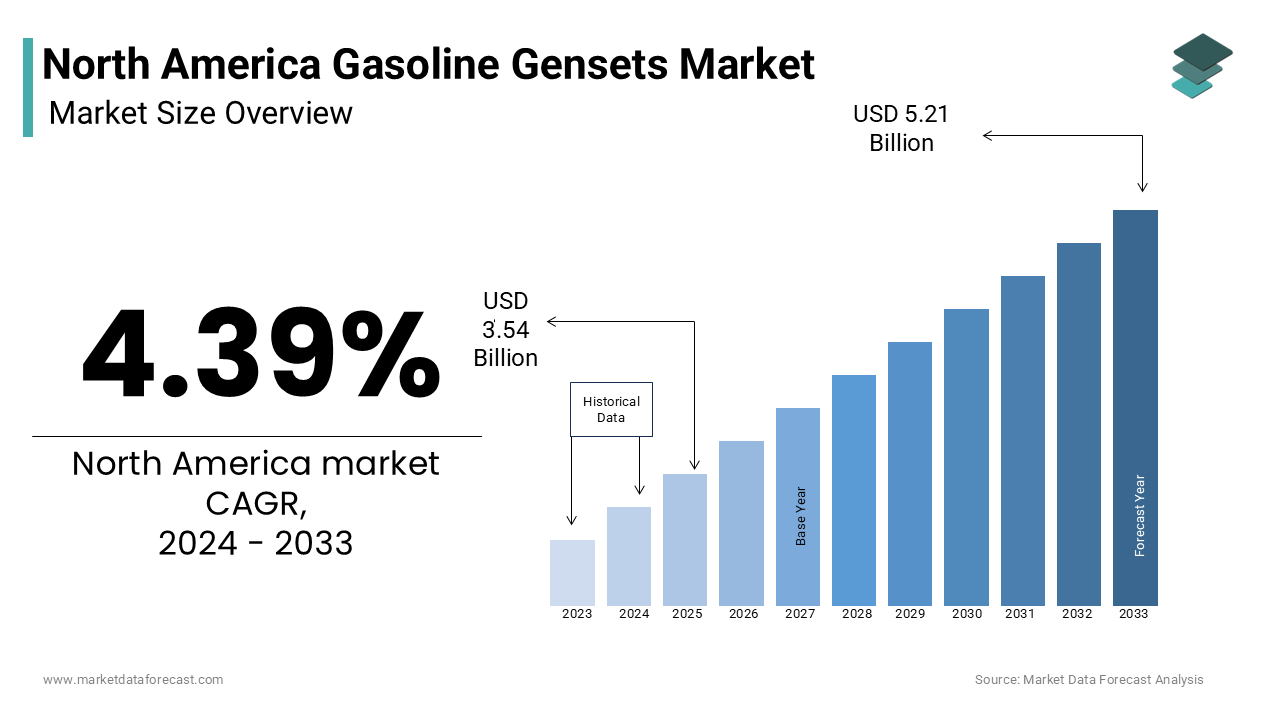
The North America gasoline gensets market size was valued at USD 3.70 billion in 2025 and is anticipated to reach USD 3.86 billion in 2026 from USD 5.44 billion by 2034, growing at a CAGR of 4.39% during the forecast period from 2026 to 2034.
A gasoline genset, or portable generator, refers to an engine-generator combination that converts gasoline into electrical energy, offering a flexible and relatively cost-effective power source during outages or in off-grid applications. The prevalence of extreme weather events has further amplified demand, with the National Oceanic and Atmospheric Administration (NOAA) recording over 17 weather-related disasters in the U.S. in 2023, each causing more than $1 billion in damages. These incidents have heightened awareness around energy resilience and spurred investments in decentralized power solutions. Additionally, technological advancements in engine efficiency and emission control standards have contributed to the evolution of cleaner and more efficient gasoline gensets compliant with Environmental Protection Agency (EPA) regulations.
MARKET DRIVERS
Increasing Frequency of Power Outages Due to Extreme Weather Events
The rising incidence of power outages caused by extreme weather conditions has emerged as a principal driver for the North America gasoline gensets market. According to the Department of Energy, the United States experienced 3,414 major power outages affecting more than 50,000 customers in 2023 alone. Hurricanes, wildfires, ice storms, and flooding have become more frequent and intense, disrupting grid infrastructure and compelling end-users to seek alternative power sources. For instance, Hurricane Idalia in August 2023 left over 400,000 customers without electricity across Florida and Georgia, prompting a surge in portable generator sales. The American Society of Civil Engineers (ASCE) notes that nearly 40% of the U.S. electric grid infrastructure is over 50 years old, making it increasingly vulnerable to failures. As climate change exacerbates weather volatility, the demand for reliable backup power solutions continues to grow.
Growing Residential Construction and Homeownership Rates
The expansion of the residential construction sector in North America is significantly contributing to the increased demand for gasoline gensets. As per the U.S. Census Bureau, housing starts in the United States reached 1.6 million units in 2023, marking a 9.2% increase compared to the previous year. This growth is largely driven by population expansion, urbanization, and rising homeownership rates, particularly in suburban and rural areas where grid reliability may be limited. Homeowners increasingly view gensets as essential home infrastructure in regions susceptible to seasonal outages. Furthermore, the trend of home electrification and increased reliance on smart home technologies has amplified the need for uninterrupted power.
MARKET RESTRAINTS
Stringent Environmental Regulations and Emission Standards
The imposition of stringent environmental regulations aimed at curbing emissions from internal combustion engines is restricting the growth of the North America gasoline gensets market. The Environmental Protection Agency (EPA) enforces rigorous emission standards under the Clean Air Act, which mandates that all gasoline-powered generators sold in the U.S. meet specific thresholds for carbon monoxide, nitrogen oxides, and hydrocarbon emissions. These regulations have led to increased compliance costs for manufacturers, resulting in higher retail prices for consumers. According to the EPA’s 2023 Emissions Inventory Report, stationary and portable gasoline engines contribute approximately 2.1% of total hydrocarbon emissions in the U.S., prompting further scrutiny and potential tightening of norms.
High Operational and Maintenance Costs
The gasoline gensets are associated with significant operational and maintenance expenses, which act as a deterrent to widespread adoption among budget-conscious users. These costs include oil changes, spark plug replacements, carburetor cleaning, and periodic engine tune-ups. Furthermore, gasoline’s volatility and susceptibility to degradation over time necessitate the use of fuel stabilizers, adding to the total cost of ownership. A study by the National Renewable Energy Laboratory (NREL) revealed that gasoline gensets exhibit a 15–20% higher maintenance burden compared to propane-powered alternatives due to fuel-related engine wear. In rural and off-grid applications, where gensets are operated intermittently, fuel degradation becomes a recurring issue, leading to engine malfunction and costly repairs.
MARKET OPPORTUNITIES
Expansion of Off-Grid and Remote Applications
The expanding use of these systems in off-grid and remote applications is creating new opportunities for the growth of the North America gasoline gensets market. The U.S. Bureau of Labor Statistics reports that the mining and oil & gas extraction sectors have seen a 5.3% annual employment growth in remote regions over the past two years, driving demand for temporary power infrastructure. Gasoline gensets are particularly suited for these environments due to their portability, ease of transport, and compatibility with widely available fuel. According to the Canadian Association of Petroleum Producers (CAPP), over 70% of oil and gas operations in Canada occur in remote locations, where grid connectivity is either absent or unreliable. Furthermore, recreational activities such as camping, RV travel, and outdoor events have seen a resurgence post-pandemic, creating a parallel market for lightweight, consumer-grade gensets.
Integration with Smart Grid and IoT Technologies
The integration of gasoline gensets with smart grid technologies and Internet of Things (IoT) is prompting the growth of the North America gasoline gensets market. According to the Electric Power Research Institute (EPRI), over 60% of new genset installations in North America by 2025 will feature smart connectivity for remote monitoring and control. These systems enable real-time performance tracking, predictive maintenance alerts, and automated load management, enhancing operational efficiency and reducing downtime. In the residential sector, smart gensets are being designed to seamlessly integrate with home energy management systems, allowing users to monitor power consumption and optimize generator usage via smartphone applications. According to a 2023 report by the Smart Electric Power Alliance (SEPA), approximately 28% of North American utilities are investing in distributed energy resource management systems (DERMS), which can incorporate gensets as part of a broader energy strategy. Additionally, the rise of microgrids in commercial and industrial sectors is creating demand for intelligent genset solutions that can operate autonomously or in coordination with solar and battery systems.
MARKET CHALLENGES
Supply Chain Disruptions and Component Shortages
The supply chain disruptions and shortages of components due to the global pandemic and ongoing geopolitical tensions is likely to hinder the growth of the North America gasoline gensets market. The semiconductor shortage, which began in 2020, has had a cascading effect on the production of electronic control units, inverters, and monitoring systems used in modern gensets. According to the Semiconductor Industry Association (SIA), North America accounted for only 12% of global semiconductor manufacturing capacity in 2023, making the region heavily reliant on imports from Asia. This dependency has led to production delays and increased costs for genset manufacturers. Furthermore, the conflict in Eastern Europe has disrupted the supply of key raw materials such as aluminum and copper, which are essential for generator construction. According to the U.S. Geological Survey, 45% of copper imports in 2023 originated from countries affected by trade restrictions and logistical bottlenecks. These disruptions have led to extended lead times and inventory shortages, particularly for mid-range and high-capacity gensets. Small manufacturers and distributors have been disproportionately affected, with many reporting a 20–30% decline in product availability during peak demand seasons. These supply-side constraints are expected to persist in the near term, limiting market responsiveness and constraining growth potential.
Competition from Alternative Power Solutions
The experiencing intensified competition from alternative power solutions, including solar generators, battery storage systems, and propane-powered gensets is additionally to limit the growth of the North America gasoline gensets market. The declining cost of solar photovoltaic (PV) systems and lithium-ion batteries has made renewable energy solutions increasingly attractive, particularly among environmentally conscious consumers. According to the International Renewable Energy Agency (IRENA), the global weighted average cost of electricity from solar PV fell by 85% between 2010 and 2023, making solar-plus-storage systems economically viable for residential and small commercial users. Propane and natural gas gensets also pose a competitive threat, especially in regions with established fuel infrastructure.
SEGMENTAL ANALYSIS
By Power Rating Insights
The 2 kW – 5 kW power rating segment dominated the North American gasoline gensets market by 42.3% of the share in 2025. The increasing frequency of extreme weather events such as hurricanes and winter storms has heightened the need for reliable residential backup power. For example, the 2021 Texas winter storm left over 4.5 million households without electricity, which is spurring demand for small-scale generators. The compact size and portability of these gensets make them ideal for recreational and DIY applications. The U.S. outdoor recreation industry, valued at $120 billion in 2022 (Outdoor Industry Association), supports this trend, as portable generators are often used for camping, tailgating, and remote job sites.
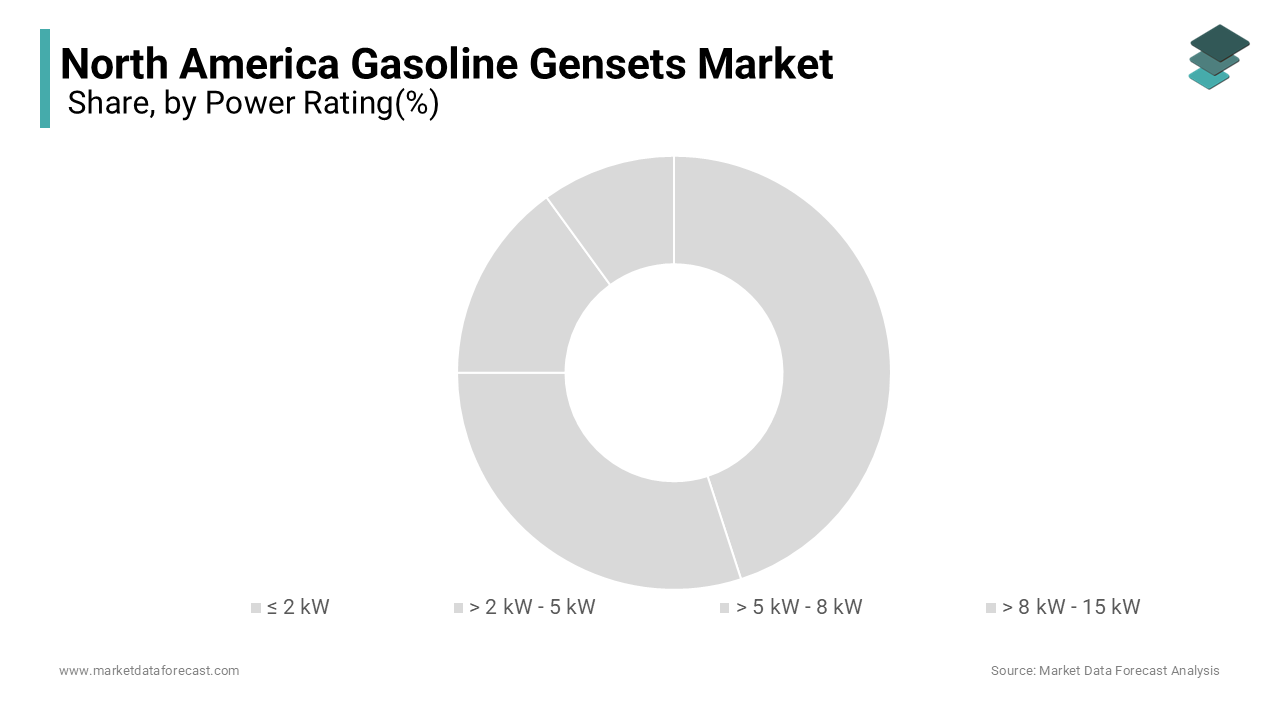
The >8 kW – 15 kW segment is projected to grow with a CAGR of 5.8% during the forecast period. According to the Small Business Administration (SBA), over 30 million small businesses operate in the U.S., many of which are investing in backup power solutions post-pandemic to avoid operational losses. The 2023 National Fire Protection Association (NFPA) report noted that 90% of businesses without a disaster recovery plan, including power backup, fail within two years of a major outage. The U.S. Census Bureau reported that homeownership rates reached 65.5% in 2023, with many homeowners investing in whole-home backup solutions. Larger homes, especially those exceeding 3,000 square feet, often require gensets in the 10 kW–15 kW range to power multiple appliances simultaneously. The U.S. construction market is booming, with total construction spending reaching $1.9 trillion in 2023 (U.S. Census Bureau).
By Phase Insights
The single-phase gensets segment held a dominant share of the North American gasoline gensets market in 2025. The U.S. Department of Energy reports that over 90% of American homes rely on single-phase power supply. As a result, gensets in this category are inherently aligned with existing infrastructure, reducing installation complexity and costs. Single-phase generators are less expensive to manufacture and maintain compared to their three-phase counterparts. According to the National Electrical Manufacturers Association (NEMA), the affordability of single-phase systems contributes to their 70% adoption rate among small-scale users. Single-phase gensets are generally lighter and more portable, aligning with consumer needs for emergency and recreational use.
The three-phase gensets segment is anticipated to register a CAGR of 6.1% from 2025 to 203. As North America sees a resurgence in manufacturing and small-scale industrial activities, the demand for stable, high-capacity power is increasing. The U.S. Bureau of Labor Statistics reported that manufacturing employment increased by 350,000 in 2023. These facilities often use three-phase gensets to ensure uninterrupted power. Additionally, infrastructure investments under the Infrastructure Investment and Jobs Act (IIJA) are boosting demand for construction site power solutions, which often require three-phase generators. Three-phase systems offer better power efficiency and are scalable for larger loads. According to the IEEE Power & Energy Society, three-phase systems can deliver up to 150% more power than single-phase systems of the same current rating, which is making them ideal for businesses seeking long-term power solutions.
By End Use Insights
The residential segment held 55.4% of the North American gasoline gensets market share in 2025. The frequency of natural disasters in North America has surged in recent years. The National Oceanic and Atmospheric Administration (NOAA) recorded 28 weather and climate disasters in the U.S. in 2023, each causing over $1 billion in damages. Gasoline gensets are more affordable than diesel or natural gas alternatives, with entry-level models priced under $500. This affordability, combined with easy availability in home improvement stores and online platforms that makes them a preferred choice for homeowners.
The construction segment is emerging with a CAGR of 6.3% during the forecast period. The Infrastructure Investment and Jobs Act (IIJA) allocated over $1.2 trillion for infrastructure development in the U.S., including roads, bridges, and broadband. Construction projects often take place in remote locations with no access to grid power, necessitating the use of portable gensets. Construction sites require reliable power for lighting, tools, and equipment. Gasoline gensets in the 6 kW to 15 kW range are commonly used due to their portability and ease of operation. The equipment rental market, which includes generators, is growing rapidly.
REGIONAL ANALYSIS
United States Gasoline Gensets Market Insights
The United States was the top performer of the North American gasoline gensets market by accounting for 85.3% of share in 2025. The U.S. experiences frequent power outages due to extreme weather. In 2023, the Department of Energy reported over 3,300 major power outages, affecting millions of households. This has led to increased adoption of residential backup generators, particularly in hurricane-prone states like Florida and Texas. The U.S. outdoor recreation industry, valued at $120 billion in 2022, continues to drive demand for portable gensets.
Canada Gasoline Gensets Market Insights
Canada was positioned second with 15.3% of the North American gasoline gensets market share in 2024. Canada’s extreme winter conditions often lead to power outages, especially in rural and remote areas. Natural Resources Canada reported that over 300,000 households experienced power outages lasting more than 24 hours in 2023. This has increased the demand for portable and standby generators, particularly in provinces like Alberta and British Columbia.
COMPETITIVE LANDSCAPE
The North America gasoline gensets market exhibits intense competitive dynamics characterized by the presence of established multinational corporations alongside regional manufacturers and emerging technology-driven companies. Market competition is primarily driven by product differentiation, pricing strategies, brand reputation, and distribution capabilities. Leading players compete through continuous innovation, focusing on developing quieter, more fuel-efficient, and environmentally compliant generators that meet evolving consumer expectations. The competitive landscape is further complicated by the increasing popularity of alternative power solutions such as solar generators and battery storage systems, which are capturing market share from traditional gasoline gensets. Companies are also competing on service quality, warranty offerings, and customer support to build long-term relationships and ensure customer retention. Regional variations in market preferences, regulatory requirements, and climate conditions create additional competitive complexities, requiring companies to tailor their strategies to specific geographic markets. The entry of technology companies and startups focusing on smart power solutions has introduced new competitive dimensions, emphasizing digital integration and user experience.
KEY MARKET PLAYERS
The key market players in the North America Gasoline Gensets Market include
- Generac Power Systems
- Honda Motor Co., Ltd.
- Briggs & Stratton Corporation
- Yamaha Motor Corporation
- Champion Power Equipment
- Kohler Co.
- Cummins Inc.
- Westinghouse Electric Corporation
- Pulsar Products Inc.
- DuroMax Power Equipment
Top Players in the North America Gasoline Gensets Market
Generac Holdings Inc.
Generac Holdings Inc. is the top player in the North America gasoline gensets market, renowned for its extensive portfolio of residential, commercial, and industrial power solutions. The company has consistently focused on innovation and technological advancement, developing smart-enabled generators that integrate seamlessly with modern energy management systems. Their commitment to quality and reliability has established them as a preferred choice among contractors, homeowners, and businesses seeking dependable backup power. Generac's robust distribution network and strong brand recognition have enabled them to capture significant market share across the United States and Canada. The company's emphasis on customer-centric solutions and continuous product development has positioned them at the forefront of the industry, driving market trends and setting performance benchmarks.
Briggs & Stratton Corporation
Briggs & Stratton Corporation is another player in the North America gasoline gensets market by leveraging over a century of engineering expertise in power generation technology. The company has built a reputation for manufacturing durable and efficient gasoline engines that power countless generator models across various applications. Their focus on innovation has led to the development of advanced features including automatic transfer switches, digital controls, and enhanced fuel efficiency systems. Briggs & Stratton's extensive dealer network and strong partnerships with major retailers have facilitated widespread market penetration.
Caterpillar Inc.
Caterpillar Inc. is positioned at the top through its comprehensive range of power generation solutions designed for diverse industrial applications. The company's expertise in heavy-duty engineering has translated into robust generator sets that deliver exceptional performance in demanding environments. Caterpillar's commitment to technological innovation is evident in their development of intelligent power systems that offer remote monitoring, predictive maintenance, and seamless integration with existing infrastructure. Their global manufacturing capabilities and extensive service network provide customers with reliable support and maintenance solutions. The company's focus on sustainability and fuel efficiency has positioned them as a preferred choice for large-scale commercial and industrial applications, where reliability and performance are paramount considerations.
Top Strategies Used by Key Market Participants
Product Innovation and Technological Integration Leading players in the North America gasoline gensets market have prioritized product innovation by incorporating advanced technologies such as smart connectivity, automated controls, and enhanced emission reduction systems. Companies are developing generators with IoT capabilities that enable remote monitoring, predictive maintenance, and integration with home energy management systems. This strategic focus on technological advancement allows manufacturers to differentiate their offerings and meet evolving consumer demands for intelligent, efficient power solutions. The integration of digital platforms and mobile applications has further enhanced user experience, providing customers with real-time performance data and operational control.
Strategic Partnerships and Distribution Network Expansion Key market participants have actively pursued strategic partnerships with retailers, distributors, and technology providers to expand their market reach and enhance customer accessibility. These collaborations enable companies to leverage existing distribution channels, reduce time-to-market, and improve after-sales service capabilities. Manufacturers are also forming alliances with construction companies, utility providers, and emergency response organizations to secure bulk orders and long-term contracts. Additionally, partnerships with fuel suppliers and maintenance service providers create comprehensive ecosystem solutions that add value for end-users while strengthening market position.
Sustainability Initiatives and Regulatory Compliance Focus Market leaders are implementing comprehensive sustainability strategies that focus on developing environmentally friendly generator solutions while maintaining compliance with increasingly stringent emission regulations. Companies are investing in research and development to create cleaner-burning engines, improve fuel efficiency, and reduce overall environmental impact. This approach includes developing hybrid systems that combine gasoline generation with renewable energy sources and battery storage.
RECENT MARKET DEVELOPMENTS
- In March 2024, Generac Holdings Inc. launched its new line of smart-enabled residential gasoline generators featuring integrated Wi-Fi connectivity and mobile application control by enhancing user experience and remote monitoring capabilities.
- In July 2024, Briggs & Stratton Corporation announced a strategic partnership with Home Depot to expand retail distribution of their premium gasoline generator models across North American stores, improving market accessibility.
- In January 2024, Caterpillar Inc. introduced advanced emission control technology in their gasoline genset portfolio to comply with updated EPA regulations, which is strengthening their position in environmentally conscious market segments.
- In September 2023, Generac Holdings Inc. acquired a specialized digital controls manufacturer to enhance their smart generator technology capabilities and accelerate product development timelines.
- In November 2023, Briggs & Stratton Corporation established a new regional service center in Texas to improve customer support and maintenance services for gasoline genset users in the southern United States.
MARKET SEGMENTATION
This research report on the North America Gasoline Gensets Market is segmented and sub-segmented based on categories.
By Power Rating
- ≤ 2 kW
- > 2 kW - 5 kW
- > 5 kW - 8 kW
- > 8 kW - 15 kW
By Phase
- Single phase
- Three phase
By End Use
- Residential
- Commercial
- Construction
By Country
- U.S.
- Canada
- Rest of North America