- Product Description Description
- Table of Contents TOC
- List of Table & Figure LOT
- Get Free Sample PDF Sample PDF
Market Size, 2025
$4.34 BnMarket Estimate, 2026
$4.56 BnMarket Forecast, 2034
$6.78 BnCAGR, 2026–2034
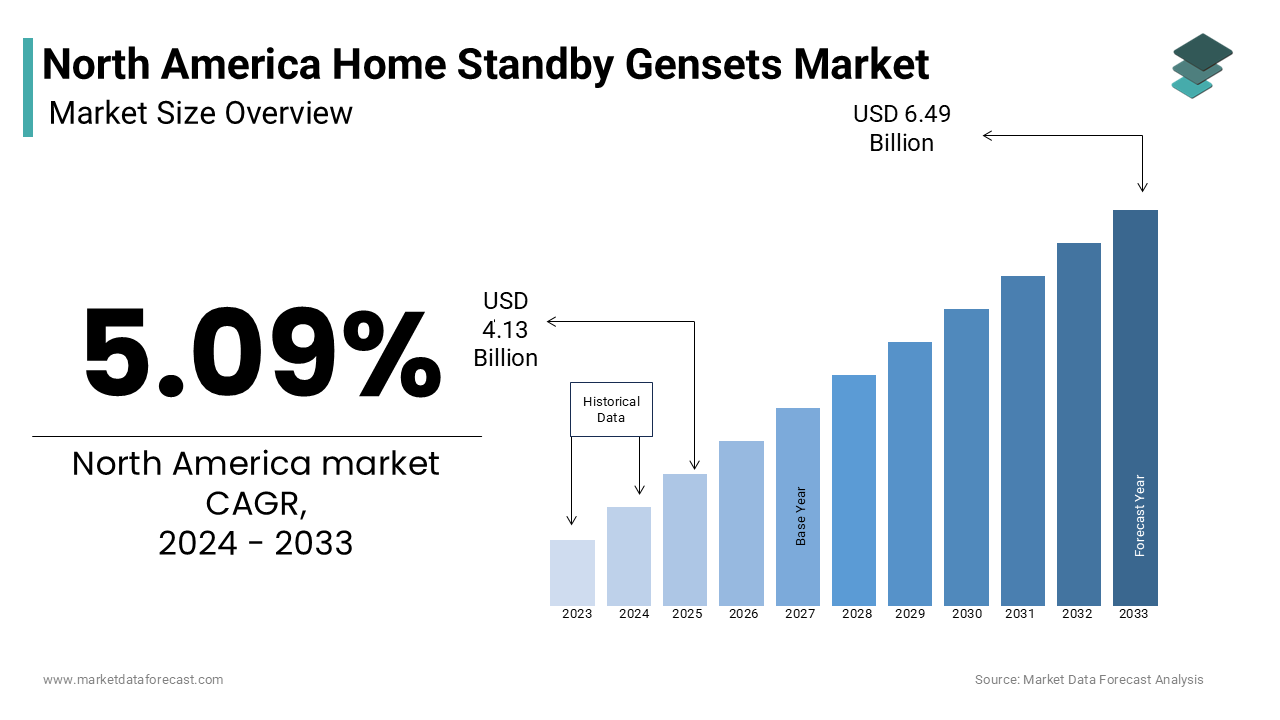
5.09%North America Home Standby Gensets Market Size
The North America home standby gensets market size was valued at USD 4.34 billion in 2025 and is anticipated to reach USD 4.56 billion in 2026 from USD 6.78 billion by 2034, growing at a CAGR of 5.09% during the forecast period from 2026 to 2034.
The home standby gensets are permanently installed electrical power generation systems designed to provide automatic backup power during utility outages. These systems typically range from 8 kilowatts to 150 kilowatts and are engineered to seamlessly activate within seconds of power loss, ensuring continuous electricity supply to residential properties. The operational framework involves sophisticated automatic transfer switches, fuel systems, and control panels that integrate with existing electrical infrastructure while maintaining compliance with national electrical codes and environmental regulations.
MARKET DRIVERS
Increasing Frequency and Duration of Power Outages
The escalating frequency and duration of power outages is boosting the growth of the North America home standby gensets market growth. The U.S. Energy Information Administration reports that American utility customers experienced an average of 243 minutes of power outages in 2023, representing a 35% increase from 2015 levels. This deterioration in grid reliability particularly affects rural and suburban communities where overhead power lines remain vulnerable to wind, ice, and vegetation interference. Climate change has amplified severe weather patterns that contribute to widespread power disruptions. The National Oceanic and Atmospheric Administration documented 28 weather and climate disasters exceeding $1 billion in damages during 2023, with hurricanes, wildfires, and severe storms causing extensive electrical infrastructure damage. Hurricane Idalia alone resulted in power outages affecting 2.1 million customers across Florida and Georgia, with restoration periods averaging 8.4 days according to the Edison Electric Institute. Extended outage durations create significant economic and safety implications for residential consumers, particularly during extreme temperature conditions.
Rising Homeownership and New Residential Construction
The expanding homeownership base and robust new residential construction activity as property owners increasingly prioritize energy security and comfort assurance is further to fuel the growth of the North America home standby gensets market. The U.S. Census Bureau reports that homeownership rates reached 65.5% in 2023, with first-time homebuyers representing 32% of total residential purchases, indicating strong market penetration opportunities for backup power solutions in emerging property segments. New residential construction demonstrates consistent growth momentum, with the U.S. Department of Housing and Urban Development recording 1.58 million housing units authorized for construction in 2023, representing a 9% increase from the previous year. Custom home construction particularly drives standby generator adoption, as luxury residential projects increasingly incorporate comprehensive backup power systems as standard features rather than optional upgrades. Builder-installed generator systems represent an emerging market segment that leverages volume purchasing agreements and integrated installation processes to reduce consumer acquisition costs. Additionally, municipal building codes in disaster-prone regions increasingly mandate backup power provisions for residential systems.
MARKET RESTRAINTS
High Initial Capital Investment and Installation Costs
The substantial initial capital investment and complex installation requirements associated with widespread adoption among consumers are limiting the growth of the North America home standby gensets market. Standby generator systems typically require upfront investments ranging from $3,000 to $15,000, excluding installation costs that can add an additional $1,500 to $5,000 depending on site preparation, electrical modifications, and permit requirements. The National Association of Home Builders reports that total installed costs for residential standby generators exceed 15% of average annual homeowner income for middle-income households, creating affordability constraints that limit market penetration. Installation complexity introduces additional cost and time considerations that deter consumer adoption. Professional installation requires certified electricians, licensed contractors, and municipal inspections that extend project timelines to 2-4 weeks. Fuel system requirements further escalate capital expenditures, particularly for natural gas-powered units that necessitate dedicated gas line installations or propane tank infrastructure. Natural gas standby generators require minimum 1-inch supply lines with pressure regulators, while propane systems mandate ASME-certified storage tanks that range from 100 to 500 gallons depending on runtime requirements. Moreover, ongoing maintenance and operational costs create long-term financial commitments that influence purchase decisions.
Noise Pollution Regulations and Environmental Compliance
The noise pollution regulations and environmental compliance requirements impose significant restraints growth of the North America home standby gensets market. Municipal noise ordinances typically restrict standby generator sound levels to 65-75 decibels at property boundaries, necessitating advanced sound attenuation technologies and strategic placement considerations that increase installation complexity and costs. Emission control regulations further constrain generator design and operation, particularly in environmentally sensitive regions such as California and the Northeast Corridor. The California Air Resources Board mandates that new standby generators meet stringent emission standards equivalent to Tier 4 diesel engines, requiring catalytic converters, diesel particulate filters, and selective catalytic reduction systems that add $2,000-$4,000 to unit costs. Weather enclosure requirements introduce additional design constraints and cost considerations, particularly in regions with extreme temperature variations or severe weather exposure. National Electrical Code Article 445 requires standby generators in flood-prone areas to be elevated above base flood elevation, while hurricane-prone regions mandate impact-resistant enclosures and enhanced anchoring systems. Furthermore, permitting and inspection processes add time and cost barriers to standby generator installations. Environmental impact assessments, noise studies, and zoning approvals are required in many jurisdictions, extending project timelines by 4-12 weeks according to the International Code Council.
MARKET OPPORTUNITIES
Integration with Renewable Energy and Smart Grid Technologies
The home standby gensets with renewable energy systems and smart grid technologies present significant growth opportunities for the North America home standby gensets market by enabling enhanced energy independence and grid support capabilities. Solar photovoltaic system installations have increased exponentially, with the Solar Energy Industries Association reporting 3.7 gigawatts of residential solar capacity added in 2023, creating demand for hybrid power management systems that integrate standby generators with renewable energy storage. Smart grid integration capabilities enable standby generators to participate in demand response programs and grid stabilization services that create additional revenue streams for residential owners. The Electric Power Research Institute estimates that residential standby generators with smart grid connectivity can provide $200-$500 annually in grid support payments through frequency regulation, voltage support, and peak shaving services. Advanced energy management systems facilitate seamless integration between standby generators, battery storage, and renewable energy sources through intelligent switching algorithms and load prioritization protocols. Modern systems can automatically shift between power sources based on cost optimization, environmental conditions, and user preferences while maintaining load continuity. Furthermore, utility-scale microgrid development initiatives create opportunities for residential standby generators to participate in community energy resilience programs. Pilot projects in California, New York, and Ontario demonstrate how aggregated residential standby generators can provide grid support during emergencies while maintaining individual property backup capabilities.
Expansion into Rural and Remote Market Segments
The substantial growth opportunities for the growth of the North America home standby gensets market are expected with expansion into rural and remote residential areas. Remote communities in Alaska, northern Canada, and isolated agricultural regions experience frequent power outages due to extreme weather conditions, wildlife interference, and infrastructure maintenance challenges. The Alaska Energy Authority reports that rural Alaskan communities experience an average of 18 power outages annually, with restoration periods often exceeding two weeks during winter months. These reliability gaps create sustained demand for robust standby generator systems that can operate in harsh environmental conditions while providing extended runtime capabilities for essential residential services. Off-grid residential developments represent an emerging market segment that combines standby generator technology with renewable energy integration to create comprehensive power solutions. Additionally, government initiatives supporting rural energy independence create market opportunities through grant programs and tax incentives that reduce consumer acquisition costs.
MARKET CHALLENGES
Supply Chain Disruptions and Component Shortages
The persistent supply chain disruptions and component shortages that constrain production capacity and increase lead times are likely to restrain the growth of the North America home standby gensets market. Global semiconductor shortages have particularly impacted electronic control systems, automatic transfer switches, and monitoring devices that are essential components of modern standby generator systems. Engine component supply chains remain vulnerable to manufacturing disruptions and raw material price volatility that affect production scheduling and cost management. Engine components such as fuel injection systems, turbochargers, and emission control devices are sourced from specialized suppliers concentrated in specific geographic regions. Supply chain complexity increases with regulatory compliance requirements that mandate specific component certifications and testing protocols for different regional markets. Standby generators sold in California require EPA-compliant engines and CARB-certified emission systems, while Canadian markets mandate CSA-approved electrical components and cold-weather operation certifications.
Skilled Labor Shortage and Installation Capacity Constraints
The lack of skilled labor shortages and installation capacity is likely to degrade the growth of the North America home standby gensets market. Training and certification requirements for standby generator installation create additional barriers to workforce expansion, as technicians must obtain specialized certifications in electrical systems, engine operation, and safety protocols. The International Association of Electrical Inspectors indicates that standby generator installer certification programs require 120-180 hours of specialized training, while ongoing education requirements mandate annual recertification and technology updates that limit workforce availability and increase labor costs. These qualification requirements, while essential for safety and performance standards, constrain the pool of available installation professionals. Moreover, the aging workforce within the electrical contracting industry creates succession planning challenges that threaten long-term service delivery capabilities.
SEGMENTAL ANALYSIS
By Power Output Insights
The less than 50 kW power output segment dominated the North America home standby gensets market by accounting for a dominant share in 2025 with the fundamental requirement for residential backup power solutions that can adequately serve typical single-family home electrical loads while maintaining cost-effectiveness and installation simplicity for average homeowners. Standby generators in this power range are specifically designed to automatically provide emergency electrical power during utility outages, protecting household systems including heating, cooling, refrigeration, lighting, and essential appliances that constitute the majority of residential electrical demand. The fundamental alignment between less than 50 kW standby generators and typical residential electrical requirements has emerged as the primary catalyst driving this segment's market dominance, as the majority of North American single-family homes require backup power systems that can support essential electrical loads without excessive capacity that would increase costs and installation complexity unnecessarily. According to the U.S. Energy Information Administration, the average North American single-family home consumes approximately 10,715 kilowatt-hours annually, with peak demand during emergencies typically ranging from 15-25 kW when essential systems including HVAC, refrigeration, water heating, and lighting are operating simultaneously. The integration of less than 50 kW systems with existing residential electrical infrastructure has minimized compatibility issues and installation complications, with the National Electrical Manufacturers Association noting that 95% of residential electrical panels can accommodate standby generator transfer switches and load management systems for this power range without major modifications. The established warranty and service infrastructure for less than 50 kW systems has provided consumers with confidence in long-term reliability and support availability, with major manufacturers offering comprehensive coverage and readily available replacement parts for popular residential generator models.
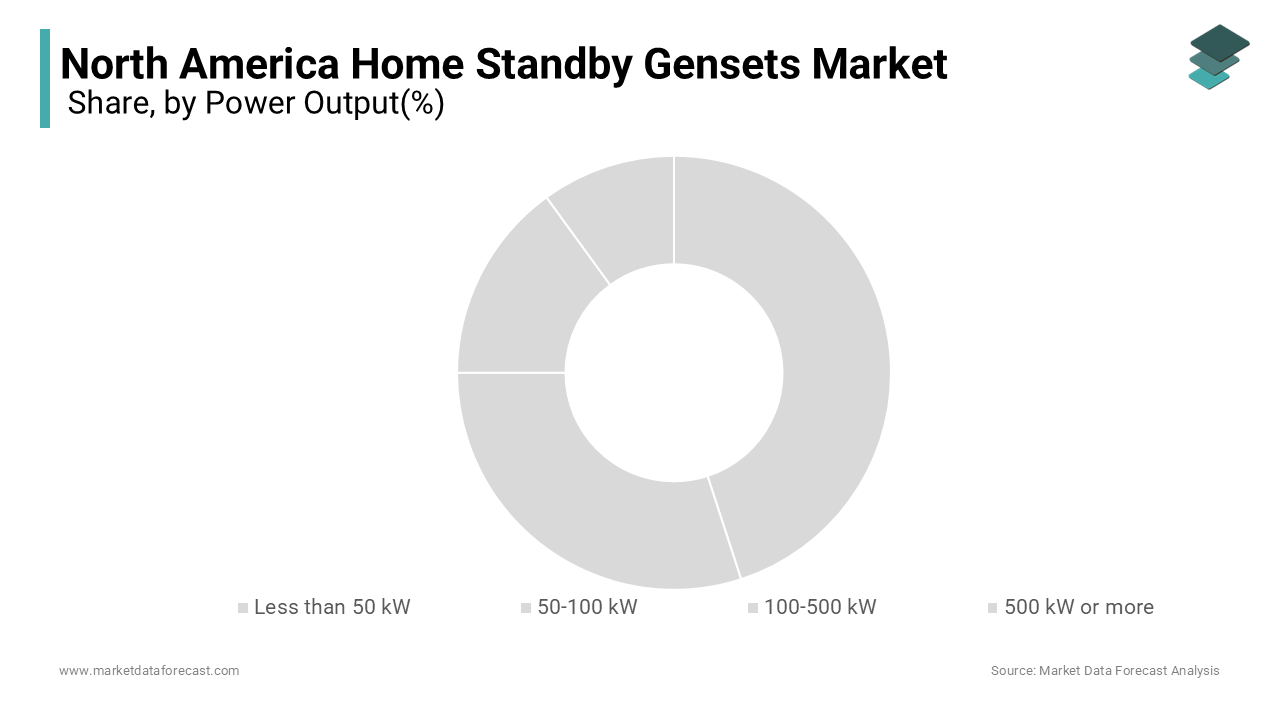
The 100-500 kW power output segment is anticipated to register a CAGR of 12.4% from 2026 to 2034 with the increasing demand for high-capacity standby power systems driven by larger residential properties, luxury home construction trends, and the need for comprehensive electrical backup that can support extensive household electrical demands including whole-house air conditioning, electric vehicle charging, home theaters, and luxury appliance integration. The expansion of luxury residential construction and increasing demand for high-end market solutions has emerged as the primary catalyst driving the rapid growth of 100-500 kW standby generators, as affluent homeowners, custom home builders, and high-end renovation projects seek premium backup power systems that can support extensive electrical demands, provide superior performance characteristics, and complement sophisticated home design aesthetics.
By Fuel Type Insights
The natural gas fuel type segment dominated the North America home standby gensets market by accounting for 45.3% of the share in 2025 with natural gas-powered standby generators representing the preferred choice for the majority of North American residential applications due to their superior convenience, reliability, and widespread availability of natural gas infrastructure across residential developments. According to the U.S. Energy Information Administration, residential natural gas costs approximately $12-15 per thousand cubic feet in most North American markets, translating to operating costs that are 40-60% lower than gasoline standby generators and 25-35% less than propane systems for equivalent power output and runtime requirements. The convergence of federal energy efficiency standards with natural gas technology advantages has intensified market dominance, with the Department of Energy reporting that natural gas standby generators achieve fuel efficiency ratings of 32-38% compared to 28-32% for gasoline systems and 30-35% for propane units, resulting in superior overall cost-effectiveness and reduced fuel consumption during extended outages.
The hybrid (gasoline/propane) fuel type segment is swiftly emerging with a CAGR of 15.8% from 2026 to 2034. The enhanced fuel security and supply reliability benefits of hybrid standby generators has emerged as the primary factor driving the growth of the segment. According to the Federal Emergency Management Agency, fuel supply disruptions affected 28% of North American regions during major weather events in 2023, with gasoline shortages lasting an average of 7-10 days and propane deliveries delayed by 5-7 days, creating significant demand for hybrid standby generators that can maintain power during fuel supply interruptions. The integration of hybrid standby generators with smart fuel management systems has created opportunities for automated fuel switching and optimization that maximize runtime and minimize fuel costs while ensuring continuous power availability during extended outages.
By Cooling Type Insights
The air-cooled cooling type segment dominated the North America home standby gensets market in 2025. The simplicity of air-cooled design and manufacturing processes has enabled manufacturers to achieve economies of scale that translate into competitive pricing structures, while the minimal infrastructure requirements ensure accessible installation and maintenance support across North America without specialized plumbing or cooling system expertise. The extensive dealer network and retail distribution channels for air-cooled generators have ensured widespread availability and competitive pricing across home improvement centers, electrical supply houses, and HVAC contractor networks, with the National Association of Home Builders noting that 92% of new residential construction projects incorporated standard air-cooled standby generators due to builder preferences for cost-effective, reliable solutions. The simplicity of installation procedures and minimal infrastructure requirements for air-cooled systems have reduced labor costs and project timelines, with the Air Conditioning Contractors of America reporting that air-cooled generator installations require 6-8 hours compared to 10-14 hours for water-cooled systems, resulting in significant cost savings for homeowners and contractors.
The water-cooled cooling type segment is expected to grow with a CAGR of 9.6% from 2026 to 2034 with the increasing demand for high-capacity standby power systems that require liquid cooling for optimal performance and the growing recognition among homeowners of the efficiency and noise reduction benefits that water-cooled generators provide for premium residential applications. The superior efficiency and performance advantages of water-cooled standby generators has emerged as the primary catalyst driving their rapid market growth, as these systems provide enhanced fuel efficiency, reduced operating temperatures, and improved power output consistency that appeal to homeowners seeking premium backup power solutions for larger residential properties and high-demand electrical applications. The convergence of larger home sizes with increased electrical consumption has created sustained demand for high-capacity standby generators that benefit from liquid cooling efficiency advantages to maintain optimal operating temperatures and maximize fuel utilization during extended emergencies. According to the National Renewable Energy Laboratory, water-cooled standby generators demonstrate 8-12% better fuel efficiency compared to air-cooled systems due to more effective heat dissipation and consistent engine operating temperatures that optimize combustion efficiency and reduce fuel consumption during extended outages.
REGIONAL ANALYSIS
United States Home Standby Gensets Market Insights
The United States was the top performer in the North America home standby gensets market with 91.2% of the share in 2025, with the United States' standby generator market dominance reflecting the country's position as the epicenter of residential construction activity and the convergence of diverse energy infrastructure with consumer demand for reliable, cost-effective backup power solutions. The extensive natural gas distribution network serving over 72 million residential customers has created ideal market conditions for natural gas standby generator adoption, while the widespread availability of electrical service and fuel delivery infrastructure has supported diverse technology adoption and market expansion. The presence of major standby generator manufacturers including Generac, Briggs & Stratton, and Kohler within U.S. borders has created a robust domestic manufacturing base that supports innovation, maintains competitive pricing, and ensures reliable supply chain operations for residential backup power equipment. The integration of utility rebate programs with consumer demand for energy-efficient solutions has created market opportunities for advanced standby generator technologies, with the Database of State Incentives for Renewables & Efficiency (DSIRE) reporting that over 42 U.S. states offer financial incentives for residential standby generator installations that meet specific efficiency criteria and support emergency preparedness goals. The convergence of smart home technology adoption with standby generator innovation has created opportunities for connected backup power systems that provide remote monitoring, automatic start capabilities, and integration with home energy management systems that enhance user convenience and operational reliability. The presence of diverse climate conditions across U.S. regions has created varied technology preferences and market opportunities, with northern states favoring larger capacity systems for heating applications and southern states showing increased adoption of air-cooled systems for year-round reliability optimization.
Canada Home Standby Gensets Market Insights
Canada home standby gensets market was positioned next with 8.8% of the share in 2025. This significant market position reflects Canada's growing residential construction sector, strategic importance as a North American energy partner, and increasing recognition of backup power reliability as a national priority that drives investment in advanced standby generator solutions and sustainable technology adoption. The convergence of Canada's diverse climate conditions with varied energy availability has created unique market requirements and technology preferences that distinguish the Canadian market from other North American regions and support specialized product development and market opportunities. The presence of diverse provincial energy markets and regulatory frameworks has created varied technology preferences and market opportunities, with western provinces favoring natural gas systems for cost-effectiveness and eastern provinces showing increased adoption of propane and hybrid technologies for fuel security and reliability optimization. The integration of residential standby generators with broader energy management systems has created opportunities for comprehensive home automation solutions that optimize power usage, track consumption patterns, and participate in utility demand response programs that provide financial benefits to homeowners.
COMPETITIVE LANDSCAPE
The North America home standby gensets market exhibits highly competitive dynamics characterized by established industry leaders, emerging technology-focused entrants, and specialized regional players vying for market share across diverse customer segments. Market competition intensifies through continuous product innovation, pricing strategies, and service differentiation that target specific consumer needs and preferences. Established manufacturers leverage brand recognition, extensive distribution networks, and comprehensive service infrastructures to maintain competitive positions while defending against new entrants and technological disruptions.
Competitive differentiation occurs through product performance characteristics, installation quality, customer service excellence, and value-added features that address evolving consumer expectations for reliability, convenience, and integration capabilities. Companies compete based on engine efficiency, noise reduction technologies, smart connectivity features, and environmental compliance standards that influence purchasing decisions and brand loyalty. Regional market dynamics vary significantly based on local regulations, climate conditions, and consumer preferences that require customized product offerings and service approaches.
The competitive landscape continues evolving as participants adapt to changing market conditions, technological advancements, and regulatory developments that reshape industry dynamics. Consolidation activities, strategic partnerships, and acquisition strategies characterize the market as companies seek to expand capabilities, achieve operational synergies, and enhance competitive positioning. Competition extends beyond traditional boundaries as automotive manufacturers, technology companies, and renewable energy providers explore opportunities within the residential power generation sector while challenging established market participants through innovative business models and disruptive technologies.
KEY MARKET PLAYERS
The key market players in the North America Home Standby Gensets Market include
- Generac Power Systems
- Cummins Inc.
- Caterpillar Inc.
- Briggs & Stratton Corporation
- Kohler Co.
- Champion Power Equipment
- Eaton Corporation
- Atlas Copco
- Honeywell International Inc.
- Yamaha Motor Corporation
Top Players in the North America Home Standby Gensets Market
Generac Holdings Inc Generac Holdings Inc operates as the dominant force in the North America home standby gensets market, leveraging decades of engineering expertise and comprehensive product portfolios to maintain market leadership. The company's extensive manufacturing capabilities encompass residential, commercial, and industrial power generation solutions with particular strength in the residential standby generator segment. Their innovation focus centers on advanced engine technologies, intelligent control systems, and integrated monitoring platforms that enhance user experience and system reliability. Generac's distribution network spans thousands of dealers across North America, supported by robust customer service infrastructure and comprehensive warranty programs. Their commitment to research and development has established industry standards for noise reduction, fuel efficiency, and automatic transfer switch technologies that influence competitive dynamics and consumer expectations throughout the residential power generation sector.
Cummins Inc Cummins Inc. represents a global power generation leader with significant presence in the North America home standby gensets market through their specialized residential power division. The company brings extensive industrial engine expertise to residential applications, offering premium standby generators known for durability, performance, and longevity. Their product strategy emphasizes heavy-duty construction, advanced emission control systems, and comprehensive service support that appeals to discerning residential customers seeking commercial-grade reliability. Cummins leverages their global supply chain and manufacturing footprint to ensure consistent product availability and quality standards. Their technical support infrastructure includes factory-trained technicians, comprehensive parts distribution, and digital diagnostic capabilities that enhance customer satisfaction and system performance. The company's reputation for engineering excellence and commitment to environmental compliance positions them as preferred suppliers for high-end residential applications and custom installation projects.
Kohler Co Kohler Co-operates as a premium manufacturer in the North America home standby gensets market, distinguished by their integrated approach to residential power solutions and luxury home integration capabilities. The company's standby generators are designed with emphasis on quiet operation, aesthetic integration, and sophisticated control systems that complement high-end residential installations. Their engineering philosophy prioritizes seamless integration with home automation systems, smart grid technologies, and renewable energy sources that appeal to affluent homeowners and custom builders. Kohler's manufacturing facilities maintain stringent quality standards while incorporating advanced materials and precision engineering techniques that ensure superior performance and longevity. Their dealer network focuses on specialized installation services and comprehensive customer support that includes system design consultation, performance monitoring, and preventive maintenance programs tailored to individual customer requirements and preferences.
Top Strategies Used by Key Market Participants
Strategic Technology Innovation and Product Development Leading companies in the North America home standby gensets market prioritize continuous technology innovation and product development to differentiate their offerings and maintain competitive advantages. This strategy involves investing in advanced engine technologies that improve fuel efficiency, reduce emissions, and minimize operational noise levels. Companies develop intelligent control systems that integrate with smart home platforms, enabling remote monitoring, predictive maintenance, and automated performance optimization. Research and development efforts focus on alternative fuel capabilities, hybrid power integration, and enhanced user interface designs that simplify operation and improve customer experience. Additionally, manufacturers invest in materials science and manufacturing process improvements that enhance product durability, reduce maintenance requirements, and extend operational lifespans while supporting environmental compliance standards.
Strategic Distribution Network Expansion and Dealer Partnership Development Key market participants emphasize strategic distribution network expansion and comprehensive dealer partnership development to enhance market penetration and customer service capabilities. This approach involves establishing authorized dealer networks that provide local sales support, professional installation services, and ongoing maintenance programs tailored to regional market requirements. Companies invest in dealer training programs, technical support infrastructure, and inventory management systems that ensure consistent product availability and service quality standards. Strategic partnerships with homebuilders, electrical contractors, and renewable energy installers create integrated solution offerings that address comprehensive residential power needs. Additionally, manufacturers develop digital platforms and mobile applications that connect dealers with customers, streamline ordering processes, and provide real-time technical support that enhances overall service delivery effectiveness.
Customer Experience Optimization and Service Excellence Market leaders focus intensively on customer experience optimization and service excellence through comprehensive support programs and value-added services that extend beyond basic product sales. This strategy encompasses developing user-friendly installation processes, comprehensive warranty programs, and proactive maintenance services that ensure optimal system performance throughout product lifecycles. Companies invest in customer education resources, digital support platforms, and responsive service networks that address technical questions and operational concerns promptly. Remote monitoring capabilities enable predictive maintenance scheduling and performance optimization that reduces unexpected failures and extends equipment lifespans. Additionally, manufacturers develop financing options, trade-in programs, and upgrade pathways that make standby power solutions more accessible while creating ongoing customer relationships and recurring revenue opportunities.
RECENT MARKET DEVELOPMENTS
- In March 2024, Generac Holdings Inc. launched its new smart home integration platform that connects standby generators with popular home automation systems by enabling voice control compatibility and mobile app monitoring features that enhance user convenience and system functionality for residential customers.
- In December 2023, Cummins Inc. acquired a specialized noise reduction technology company to enhance its residential standby generator product line with advanced acoustic engineering capabilities, which is reducing operational sound levels while maintaining performance standards and improving residential installation acceptance.
- In October 2023, Kohler Co partnered with a leading solar energy company to develop hybrid standby generator systems that integrate with residential solar installations and battery storage solutions, creating comprehensive off-grid power management capabilities for luxury home markets.
- In July 2023, Generac Holdings Inc. expanded its nationwide dealer network by establishing 150 new authorized installation partnerships across rural and suburban markets by enhancing service coverage and reducing installation lead times while improving customer access to professional standby power solutions.
- In April 2023, Cummins Inc. introduced a comprehensive digital training platform for certified installer partners, providing online certification courses, technical support resources, and performance monitoring tools that enhance installation quality and service consistency across their North American dealer network.
MARKET SEGMENTATION
This research report on the North America Home Standby Gensets Market is segmented and sub-segmented based on categories.
By Power Output
- Less than 50 kW
- 50-100 kW
- 100-500 kW
- 500 kW or more
By Fuel Type
- Gasoline
- Diesel
- Natural Gas
- Propane
By Cooling Type
- Air-cooled
- Water-cooled
By Country
- U.S.
- Canada
- Rest of North America