- Product Description Description
- Table of Contents TOC
- List of Table & Figure LOT
- Get Free Sample PDF Sample PDF
Market Size, 2025
$15.30 BnMarket Estimate, 2026
$15.81 BnMarket Forecast, 2034
$20.53 BnCAGR, 2026–2034
3.32%Executive Summary: North America Magnet Market
- Market Scope: Regional North American magnet market analysis covering magnet types, application sectors, country leadership frameworks, and permanent magnet adoption metrics.
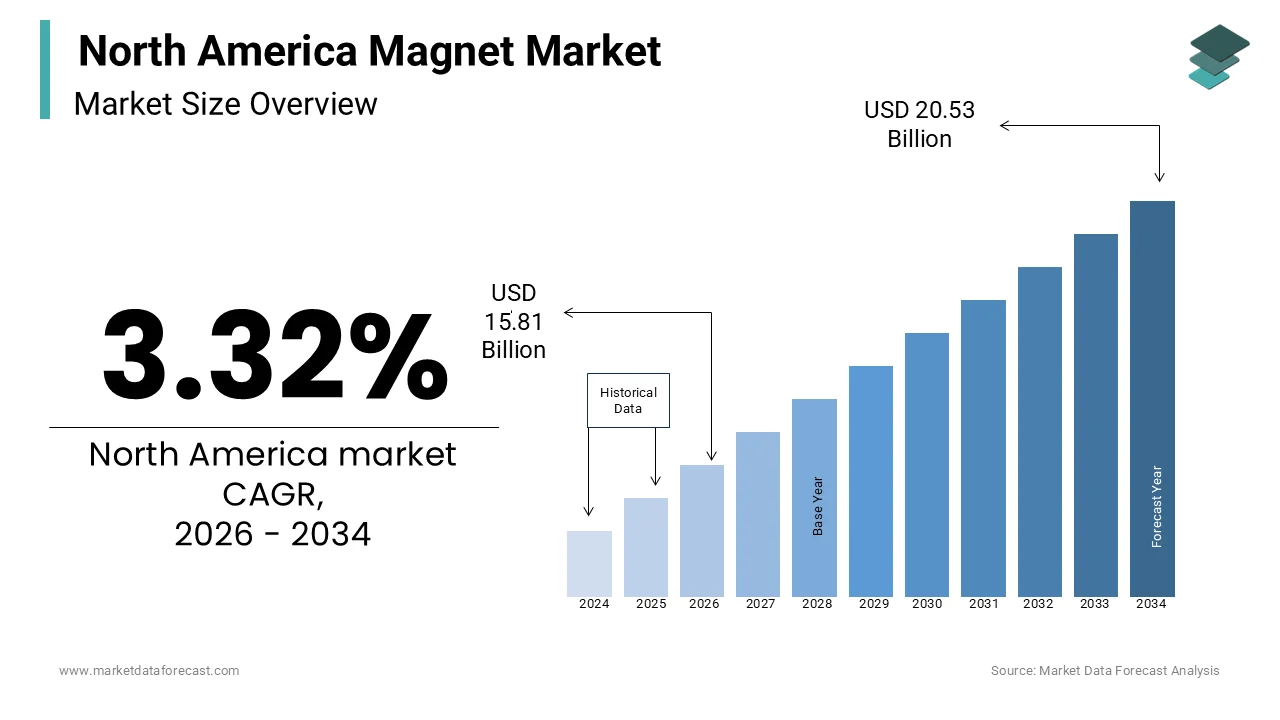
- Market Valuation: Valued at USD 15.30 billion in 2025, estimated at USD 15.81 billion in 2026, and projected to reach USD 20.53 billion by 2034, registering a CAGR of 3.32% from 2026 to 2034.
- Primary Growth Drivers: Rapid electrification of transportation and increasing EV production, expansion of renewable energy infrastructure (particularly wind power), and rising demand for high-performance permanent magnets in advanced technologies.
Key Market Segment Metrics (2026–2034)
| Category | Leading Segment (Position) | Fastest-Growing / Key Growth Segment |
|---|---|---|
| By Magnet Segment & Application | Ferrite Magnets (largest magnet segment) & Heating, Ventilating, and Air Conditioning (HVAC) (largest application) | Neodymium-Iron-Boron (NdFeB) Magnets (fastest-growing magnet segment) & Electric Vehicles (EVs) (fastest-growing application) |
| By Technology & Innovation | Conventional permanent magnet manufacturing and standard industrial applications | Domestic rare earth processing, magnet-free motor alternatives, and advanced recycling tech |
| By Region / Country | United States (leading country with 93.4% market share in 2025) | Canada (fastest-growing country market) |
Major Market Players & Market Structure
Market Structure: Highly strategic North American magnet industry characterized by domestic rare earth processing expansion, high-performance permanent magnet innovation, supply chain localization, and strategic partnerships with EV and renewable energy manufacturers.
Key Companies: Adams Magnetic Products, LLC, Arnold Magnetic Technologies, BGRIMM Technology Group, Daido Kogyo Co., Ltd., DMEGC, Electron Energy Corporation, Goudsmit Magnetics, Lynas Rare Earths Ltd., Magnequench International, LLC, Proterial, Ltd., Shin-Etsu Chemical Co., Ltd., TDK Corporation, and Yantai Dongxing Magnetic Materials Inc.
North America Magnet Market Size
The North America Magnet market size was valued at USD 15.30 billion in 2025 and is anticipated to reach a valuation of USD 15.81 billion in 2026 and USD 20.53 billion by 2034, growing at a CAGR of 3.32% during the forecast period from 2026 to 2034.
Magnets, particularly rare earth types such as neodymium-iron-boron (NdFeB) and samarium-cobalt (SmCo, are components in high-efficiency motors, sensors, magnetic resonance imaging (MRI) systems, and renewable energy infrastructure. Unlike generic magnetic materials, advanced magnets used in North America are engineered for specific performance parameters, including coercivity, remanence, and thermal stability, making them indispensable in precision technologies. According to the U.S. Geological Survey, the United States consumed approximately 2,800 metric tons of rare earth magnets in 2023, primarily for use in electric vehicle (EV) traction motors and wind turbine generators. The Department of Energy highlights that a single 3 MW direct-drive wind turbine requires up to 2,000 kg of permanent magnets, underscoring their strategic importance in clean energy deployment.
MARKET DRIVERS
Accelerated Electrification of Transportation Driving Magnet Demand
The rapid transition toward electric mobility in North America is a primary factor propelling the growth of the North American magnet market. Electric vehicles (EVs) rely heavily on neodymium-based magnets for their powertrain systems due to their unmatched energy density and efficiency. According to the U.S. Department of Energy, over 1.4 million battery electric vehicles were sold in the United States in 2023, each requiring between 1.5 and 3.0 kilograms of rare earth magnets depending on motor design. This surge in adoption is supported by federal incentives under the Inflation Reduction Act, which allocates tax credits for domestically assembled EVs, many of which use permanent magnet synchronous motors (PMSMs). The Center for Automotive Research confirms that 78% of new EV models launched in North America between 2021 and 2023 utilized PMSM technology, up from 62% in 2019, reflecting a clear engineering preference for magnet-based efficiency.
Expansion of Renewable Energy Infrastructure Fueling Magnet Consumption
The large-scale deployment of wind energy systems is significantly boosting the growth of the North American magnet market. Unlike traditional geared turbines, direct-drive systems utilize high-efficiency permanent magnet generators (PMGs) that eliminate mechanical losses and reduce maintenance needs, making them ideal for offshore and remote installations. These systems require up to two tons of rare earth magnets per unit, creating sustained demand. Furthermore, the Bureau of Ocean Energy Management is advancing offshore wind development along the Atlantic coast, where direct-drive turbines are preferred due to their resilience in high-moisture environments. The first phase of the Vineyard Wind project in Massachusetts alone will deploy 62 turbines, each equipped with a PMG containing over 1,800 kg of permanent magnets.
MARKET RESTRAINTS
Geopolitical Dependence on Rare Earth Magnet Supply Chains
Heavy reliance on foreign sources for rare earth elements and finished magnet manufacturing, particularly from China, is hampering the growth of the North American magnet market. Despite possessing domestic reserves, the United States imports over 80% of its rare earth materials and nearly 100% of its finished neodymium magnets, as reported by the U.S. Geological Survey. China controls approximately 90% of global rare earth magnet production capacity, giving it significant leverage over pricing and availability. The Department of Defense identifies this dependency as a national security risk, especially for defense applications such as radar systems, missile guidance, and submarine propulsion. According to the Congressional Research Service, the U.S. has only one operational rare earth separation facility, located in Mountain Pass, California, which ships concentrates overseas for processing.
High Energy and Environmental Costs of Magnet Production
The manufacturing of high-performance magnets, particularly rare-earth-based types, involves energy-intensive processes and generates significant environmental byproducts, which are degrading the growth of the North American magnet market. The extraction and refining of neodymium and dysprosium require large volumes of water, strong acids, and high-temperature furnaces, resulting in toxic tailings and greenhouse gas emissions. According to the U.S. Environmental Protection Agency, rare earth processing produces approximately 2,000 tons of radioactive thorium and uranium waste per 1,000 tons of rare earth oxide extracted, necessitating costly containment and remediation. The National Renewable Energy Laboratory reports that producing one metric ton of sintered neodymium magnet consumes over 200 MWh of electricity, primarily from fossil-fuel-based grids in current supply chains.
Additionally, the recycling rate of rare earth magnets remains extremely low. The Department of Energy estimates that less than 5% of end-of-life magnets are recovered from electronic waste in North America, largely due to technical challenges in disassembly and separation. The Argonne National Laboratory highlights that conventional shredding methods degrade magnet integrity, making reuse impractical. In response, the European Union has introduced regulations mandating magnet recovery from EVs and wind turbines, creating competitive pressure on North American manufacturers to improve circularity. The lack of scalable recycling infrastructure, combined with public scrutiny over mining impacts in sensitive regions like the Mojave Desert and Northwest Territories, limits social license for new projects.
MARKET OPPORTUNITY
Development of Domestic Rare Earth Processing and Magnet Manufacturing
The ongoing efforts to rebuild domestic rare earth processing and magnet fabrication capabilities are greatly influencing the growth of the North American magnet market. The U.S. Department of Defense has identified permanent magnets as a defense material, which is prompting significant public and private investment in secure supply chains. According to the Defense Production Act Task Force, over $750 million was allocated in 2023 to support rare earth separation and magnet production facilities in Texas, Colorado, and Idaho. MP Materials, operating at Mountain Pass, California, has initiated a phased restart of domestic magnet manufacturing, aiming to produce 1,000 tons annually by 2025—the first such capability in the U.S. in over two decades. The Department of Energy confirms that this initiative will supply magnets for General Motors’ Ultium motor plants, reducing reliance on Asian suppliers.
Advancements in Magnet-Free and Alternative Motor Technologies
Emerging innovations in motor design present a significant opportunity to diversify magnet dependency while improving efficiency and sustainability. Companies and research institutions are advancing magnet-free motor architectures such as switched reluctance motors (SRMs) and induction motors, which eliminate the need for rare earth materials. According to the Oak Ridge National Laboratory, SRMs offer 92% efficiency and superior performance in high-temperature environments, making them ideal for industrial and aerospace applications. General Motors has publicly committed to developing a rare earth-free traction motor for its next-generation EVs, aiming to reduce material costs and supply chain risk. Additionally, advancements in ferrite and manganese-based permanent magnets are offering viable alternatives. The Ames Laboratory, a U.S. Department of Energy facility, has developed a new class of iron-nitride (FeN) magnets with theoretical energy density exceeding neodymium magnets, though commercialization remains in progress. The National Institute of Standards and Technology confirms that improved ferrite magnets now achieve 30% higher coercivity, enabling their use in small EVs and consumer appliances.
MARKET CHALLENGES
Securing Raw Material Access Amid Geopolitical Tensions
The geopolitical instability surrounding rare earth supply as strategic competition is more likely to impede the growth of the North American magnet market. Despite holding 15% of global rare earth reserves, the United States lacks the refining and metallurgical infrastructure to convert raw ore into usable magnetic alloys. According to the U.S. Geological Survey, China’s dominance in rare earth processing, controlling 85% of global capacity, allows it to influence prices and restrict exports during trade disputes. Furthermore, environmental and regulatory hurdles delay domestic project development. The Environmental Protection Agency notes that permitting a new rare earth mine in the U.S. takes an average of 10.3 years, compared to 3–4 years in Australia or Africa. The Thacker Pass lithium-rare earth project in Nevada faced over 18 legal challenges from Indigenous groups and environmental organizations, delaying construction.
Workforce and Technical Expertise Gaps in Advanced Materials Engineering
The shortage of skilled professionals in metallurgy, materials science, and magnetic engineering is also expected to inhibit the growth of the North American magnet market. The design, production, and recycling of high-performance magnets require specialized knowledge in crystallography, electromagnetism, and high-temperature processing—disciplines that are underrepresented in current technical education programs. According to the American Society for Metals, only 12 universities in the United States offer advanced coursework in rare earth metallurgy, producing fewer than 200 qualified graduates annually. This skills gap hampers innovation and slows the commercialization of new technologies. The National Science Foundation notes that 68% of magnet-related R&D projects in 2023 experienced delays due to a lack of qualified personnel for pilot-scale production.
REPORT COVERAGE
| REPORT METRIC | DETAILS |
| Market Size Available | 2025 to 2034 |
| Base Year | 2025 |
| Forecast Period | 2026 to 2034 |
| CAGR | 3.32% |
| Segments Covered | By Magnet, Application, Country |
| Various Analyses Covered | Global, Regional, and Country Level Analysis; Segment-Level Analysis; DROC; PESTLE Analysis; Porter’s Five Forces Analysis; Competitive Landscape; Analyst Overview of Investment Opportunities |
| Regions Covered | The United States, Canada, Mexico, Rest of North America |
| Market Leaders Profiled | Adams Magnetic Products, LLC, Arnold Magnetic Technologies, BGRIMM Technology Group, Daido Kogyo Co., Ltd., DMEGC, Electron Energy Corporation, Goudsmit Magnetics, Lynas Rare Earths Ltd, Magnequench International, LLC, Proterial, Ltd, Shin-Etsu Chemical Co., Ltd., TDK Corporation, Yantai Dongxing Magnetic Materials Inc. |
SEGMENTAL ANALYSIS
By Magnet Insights
The Ferrite magnet segment accounted in holding 46.5% of the North America magnet market share in 2025. Ferrite magnets, composed of strontium or barium ferrite, are the most economically viable permanent magnets available, with raw material costs significantly lower than rare earth alternatives. According to the American Ceramic Society, the average production cost of ferrite magnets is less than $5 per kilogram, making them ideal for applications where high magnetic strength is not essential. Their affordability enables mass deployment in appliances, motors, and educational tools, particularly in price-sensitive markets. Additionally, the environmental and supply chain advantages of ferrite magnets reinforce their market leadership. Unlike rare earth magnets, ferrite materials are derived from iron oxide and carbonate compounds, which are abundant and not subject to geopolitical supply risks. The Environmental Protection Agency confirms that ferrite magnet production generates 70% less hazardous waste compared to rare earth processing, aligning with sustainability goals.
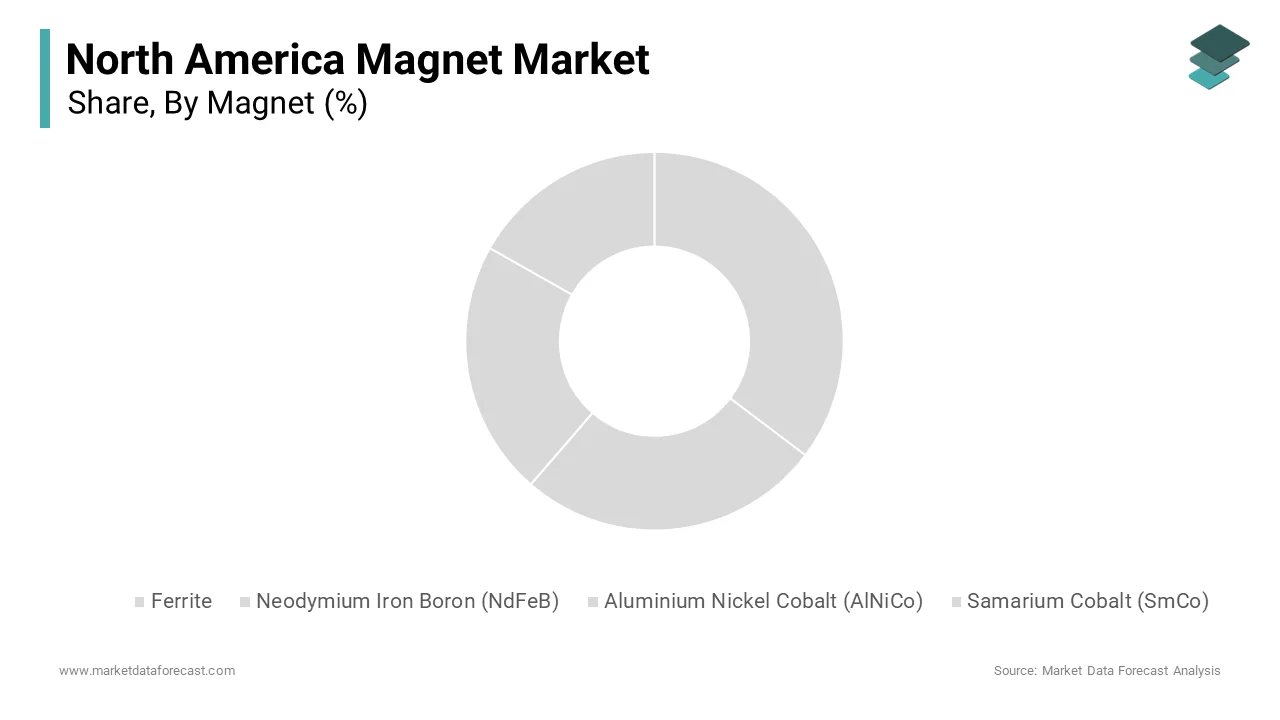
The Neodymium Iron Boron (NdFeB) magnet segment is anticipated to grow with a CAGR of 11.8% from 2025 to 2033. NdFeB magnets possess the highest energy product of any commercial magnet, enabling compact, lightweight, and highly efficient motor designs essential for electric vehicles (EVs) and wind turbines. According to the Center for Automotive Research, 76% of all EV traction motors produced in North America in 2023 utilized NdFeB-based permanent magnet synchronous motors (PMSMs), which deliver superior power density and regenerative braking efficiency.
By Application Insights
The Heating, Ventilating, and Air Conditioning (HVAC) application segment dominated the North America magnet market by accounting for 32.3% of the share in 2025. The shift toward energy-efficient HVAC units has been accelerated by federal and state regulations. According to the U.S. Department of Energy, new residential air conditioning systems must meet a minimum seasonal energy efficiency ratio (SEER) of 14 in northern states and 15 in southern states, effective 2023. To comply, manufacturers have transitioned from induction motors to BLDC motors, which use neodymium or ferrite magnets to achieve up to 30% higher efficiency. Furthermore, the proliferation of smart thermostats and zoning systems has increased demand for compact, responsive motors. The Consumer Technology Association reports that 52% of U.S. households installed smart HVAC controls in 2023, which require magnet-equipped actuators and sensors for dynamic airflow management. In Canada, Natural Resources Canada indicates that 74% of new residential constructions in Quebec and British Columbia include high-efficiency HVAC systems with permanent magnet motors to meet building code requirements.
The Hybrid Electric Vehicles (HEVs) application segment is expected to register a CAGR of 10.4% from 2025 to 2033. Unlike battery electric vehicles (BEVs), HEVs do not require extensive charging infrastructure, making them ideal for fleet operators in logistics, public transit, and delivery services. According to the Federal Transit Administration, over 28,000 hybrid electric buses were in operation across the United States in 2023, each equipped with a permanent magnet motor containing 2 to 4 kg of neodymium-based magnets. The Department of Energy highlights that HEVs achieve 30–40% better fuel economy than conventional vehicles, reducing operational costs for companies like UPS, FedEx, and municipal transit agencies. Additionally, HEVs serve as a technological bridge for automakers retooling for full electrification. Toyota, which continues to prioritize hybrid technology, sold over 450,000 hybrid vehicles in the U.S. in 2023, primarily the Prius and RAV4 Hybrid models. Each uses a magnet-based transaxle motor, contributing significantly to regional magnet demand.
COUNTRY-LEVEL ANALYSIS
United States
The United States was the top performer of the North American magnet market with 93.4% of the share in 2025, with the presence of a vast industrial base, advanced technological infrastructure, and an aggressive push toward electrification and renewable energy. The Department of Energy confirms that the U.S. accounts for over 85% of North America’s installed wind capacity, with direct-drive turbines relying heavily on rare-earth permanent magnets. Additionally, the nation’s automotive sector is undergoing a structural shift, with General Motors, Ford, and Tesla ramping up production of electric and hybrid vehicles at domestic plants, each requiring significant quantities of neodymium magnets. The National Highway Traffic Safety Administration reports that over 1.4 million electric and hybrid vehicles were sold in the U.S. in 2023, driving magnet demand across motor, sensor, and actuator systems. Furthermore, the Inflation Reduction Act’s domestic content requirements are incentivizing automakers to source magnets from North American suppliers, accelerating investment in local manufacturing.
Canada
Canada held 7.1% of the North American magnet market share in 2025. While smaller in volume, Canada’s market is distinguished by its rich mineral endowment and growing role in the global minerals supply chain. The country possesses significant reserves of rare earth elements, particularly in the Northwest Territories and Quebec, with the Nechalacho deposit being one of the few non-Chinese sources of neodymium and dysprosium. The Geological Survey of Canada estimates that Canadian rare earth resources could support up to 15% of North America’s magnet feedstock needs by 2030 if fully developed. Additionally, the federal government’s Critical Minerals Strategy has allocated $1.5 billion to advance extraction, refining, and magnet recycling technologies. The National Research Council of Canada is leading initiatives to develop low-temperature sintering and hydrogen-decrepitation methods to improve magnet production efficiency. In the automotive sector, Quebec’s electric vehicle assembly plants and Ontario’s battery gigafactories are increasing regional demand for permanent magnets.
KEY MARKET PLAYERS
Adams Magnetic Products, LLC, Arnold Magnetic Technologies, BGRIMM Technology Group, Daido Kogyo Co., Ltd., DMEGC, Electron Energy Corporation, Goudsmit Magnetics, Lynas Rare Earths Ltd, Magnequench International, LLC, Proterial, Ltd, Shin-Etsu Chemical Co., Ltd., TDK Corporation, Yantai Dongxing Magnetic Materials Inc. are the market players that are dominating the North America magnet market.
Top Players In The Market
Arnold Magnetic Technologies
Arnold Magnetic Technologies is a leading innovator in high-performance magnetic solutions, serving aerospace, defense, medical, and renewable energy sectors across North America and globally. The company excels in engineering custom magnetic assemblies that combine rare earth materials with precision fabrication techniques by enabling extreme reliability in mission environments. Its expertise in samarium cobalt and neodymium-based magnets has made it a preferred supplier for satellite systems, MRI components, and electric propulsion units. By integrating advanced coating technologies and proprietary sintering processes, Arnold ensures superior thermal stability and corrosion resistance. The company’s commitment to R&D and collaboration with national laboratories has positioned it at the forefront of next-generation magnetic material development, reinforcing its role as a strategic partner in high-tech industries where performance under stress is non-negotiable.
Electron Energy Corporation (EEC)
Electron Energy Corporation is a pioneer in the design and production of rare-earth permanent magnets, particularly in high-coercivity neodymium and samarium cobalt formulations tailored for demanding industrial and scientific applications. Based in Pennsylvania, EEC has built a reputation for producing magnets capable of operating in extreme temperatures and corrosive environments, serving sectors such as quantum computing, deep-sea exploration, and space instrumentation. The company controls the full manufacturing chain, from alloy casting to final magnetization, ensuring traceability and quality consistency. Its collaboration with U.S. government agencies and research institutions has led to breakthroughs in miniaturized magnetic systems for defense and medical devices. EEC’s focus on material science innovation and domestic production resilience has made it a cornerstone of North America’s efforts to reduce reliance on foreign magnet supply chains.
Thomas & Skinner, Inc.
Thomas & Skinner, Inc. is a vertically integrated manufacturer specializing in precision magnetic components and assemblies for automotive, industrial, and consumer electronics markets. With decades of experience in ferrite and rare earth magnet production, the company combines large-scale manufacturing capability with engineering agility to support both high-volume OEMs and niche applications. It is recognized for its expertise in bonded magnets, magnetic circuits, and sensor integration by enabling compact and efficient motor designs. The company’s emphasis on lean manufacturing and rapid prototyping allows it to respond swiftly to evolving technological demands.
Top Strategies Used By Key Market Participants
One major strategy employed by leading players is vertical integration of the supply chain, encompassing raw material sourcing, alloy processing, magnet fabrication, and final assembly. By controlling multiple stages of production, companies enhance quality assurance, reduce lead times, and mitigate geopolitical risks associated with rare earth dependencies. This approach also enables customization and faster response to client-specific engineering requirements, particularly in defense and aerospace applications.
Another key approach is strategic collaboration with government agencies, national laboratories, and academic institutions to advance material science and secure funding for next-generation magnet development. These partnerships facilitate breakthroughs in alternatives to rare earth materials, recycling technologies, and energy-efficient manufacturing, positioning firms at the forefront of innovation while aligning with national security and sustainability goals.
The investment in domestic manufacturing resilience to support clean energy and defense initiatives is also an important strategy. Companies are expanding production facilities in North America to meet growing demand from electric vehicle makers, wind turbine manufacturers, and military contractors.
COMPETITION OVERVIEW
The competitive landscape of the North American magnet market is defined by a convergence of technological sophistication, strategic necessity, and industrial transformation. While a select group of specialized manufacturers dominates high-end segments, competition is intensifying as the strategic value of magnets escalates across electrification, defense, and artificial intelligence-driven systems. Unlike commoditized components, advanced magnets require deep materials science expertise, precision engineering, and rigorous quality control, creating high barriers to entry. Leading firms distinguish themselves not through price but through performance reliability, customization capability, and alignment with national security and sustainability mandates. The market is witnessing a shift from passive component suppliers to active innovation partners, with companies embedded in the R&D cycles of automakers, turbine developers, and defense contractors. Geopolitical pressures have further reshaped competition, favoring domestic producers capable of ensuring supply chain integrity. Smaller players are carving niches in bonded magnets, sensor integration, and specialty alloys, while larger firms focus on scaling rare earth magnet production.
RECENT HAPPENINGS IN THE MARKET
- In January 2025, Arnold Magnetic Technologies launched a new research initiative in partnership with NASA to develop radiation-resistant samarium cobalt magnets for use in deep space missions by enhancing its footprint in the aerospace sector.
- In March 2023, Electron Energy Corporation expanded its manufacturing facility in Pennsylvania to include a dedicated line for high-temperature neodymium magnets, which is supporting increased demand from electric vehicle and defense clients.
- In June 2025, Thomas & Skinner, Inc. introduced a proprietary bonded magnet technology designed for ultra-compact motors in medical robotics by improving energy density and reducing system weight for surgical automation applications.
- In February 2023, Arnold Magnetic Technologies secured a long-term supply agreement with a major U.S. defense contractor to provide custom magnetic assemblies for next-generation radar and electronic warfare systems.
- In May 2025, Electron Energy Corporation initiated a collaboration with the U.S. Department of Energy’s Critical Materials Institute to advance recycling methods for end-of-life rare earth magnets, which is strengthening its sustainability profile and supply resilience.
MARKET SEGMENTATION
This research report on the NorAmericanica magnet market is segmented and sub-segmented into the following categories.
By Magnet
- Ferrite
- Neodymium Iron Boron (NdFeB)
- Aluminium Nickel Cobalt (AlNiCo)
- Samarium Cobalt (SmCo)
By Application
- Computer Hard Disk Drives (HDD), CD, DVD
- Hybrid Electric Vehicles
- Electric Bicycles
- Heating, Ventilation, and Air Conditioning (HVAC)
- Wind Turbines
By Country
- The US
- Canada