North America Material Handling Equipment Market Size, Share, Trends & Growth Forecast Report By Equipment Type (Transport Equipment, Jib Cranes, Bridge Cranes, Gantry Cranes, Others (Hammerhead, Telescopic, Crawler), Hand Trucks, Pallet Trucks, Lift Truck, Others (Pallet Jacks, Side Loaders, Walking Stackers), Conveyors, Cranes, Industrial Trucks, Automated Guided Vehicles (AGVs), Others (Hoppers, Reclaimers), Handling Equipment, Racking & Storage Equipment), Industry (Consumer Goods & Electronics, Automotive, Food & Beverages, Pharmaceutical, Construction, Mining, Semiconductors), and Country (United States, Canada, Mexico, Rest of North America) – Industry Analysis, 2026 to 2034
Market Size, 2025
$86.66 BnMarket Estimate, 2026
$91.70 BnMarket Forecast, 2034
$144.19 BnCAGR, 2026–2034
5.82%North America Material Handling Equipment Market Size
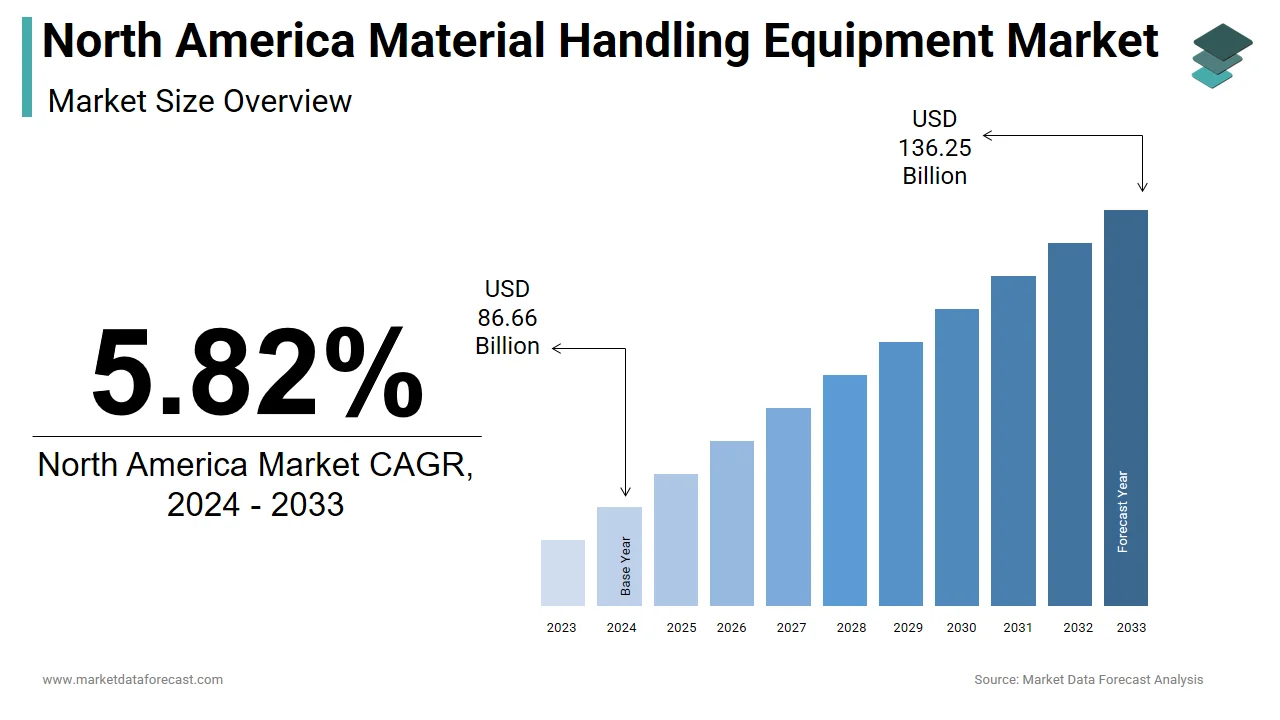
The North America material handling equipment market was valued at USD 86.66 billion in 2025, is estimated to reach USD 91.70 billion in 2026, and is projected to reach USD 144.19 billion by 2034, growing at a CAGR of 5.82% from 2026 to 2034.
The material handling equipment is an automated storage and retrieval system (AS/RS), conveyors, cranes, forklifts, palletizers, robotics, and warehouse management software. The industry is deeply embedded in manufacturing, logistics, e-commerce fulfillment, and retail distribution networks. The rise of smart warehouses, driven by artificial intelligence and IoT-enabled devices, has reshaped how companies manage inventory and streamline workflows. According to Deloitte's 2023 insights on industrial transformation, over 60% of U.S. manufacturers are investing in automation to reduce manual labor dependency and enhance throughput. Moreover, the expansion of e-commerce platforms like Amazon and Walmart has intensified demand for high-speed sorting and packaging solutions.
MARKET DRIVERS
Growth of E-Commerce and Last-Mile Delivery Infrastructure
The rapid expansion of e-commerce has significantly increased the demand for efficient material handling systems is accelerating the growth of the North America lithium compound market. As online shopping becomes more prevalent, companies are investing heavily in automated warehousing and distribution centers to meet consumer expectations for faster delivery times. Major logistics providers and retailers are expanding their fulfillment networks with high-tech warehouses that rely on advanced handling equipment to optimize space and labor. For example, Amazon has deployed over 350,000 mobile robots across its fulfillment centers to support picking, packing, and transporting tasks. This shift toward automation not only improves operational speed but also reduces human error and labor costs. As per McKinsey’s 2023 supply chain trends, over 70% of logistics managers in North America are prioritizing investments in automation to handle peak season demands more effectively.
Rising Adoption of Automation in Manufacturing and Logistics
Automation is increasingly being adopted across North American manufacturing and logistics sectors to improve productivity, reduce downtime, and enhance workplace safety. Manufacturers are integrating automated material handling systems such as autonomous mobile robots (AMRs), automated storage and retrieval systems (AS/RS), and intelligent conveyor systems to streamline production lines and optimize inventory flow. Companies are leveraging real-time data analytics and machine learning to monitor and adjust material movement dynamically. Additionally, the push for Industry 4.0 adoption, which emphasizes interconnected systems and smart factories, is further driving investment in next-generation handling equipment.
MARKET RESTRAINTS
High Initial Investment and Maintenance Costs
The widespread adoption of advanced material handling equipment in North America is the substantial upfront capital required for procurement and installation, which is impeding the growth of the North America lithium compound market. Automated systems such as robotic arms, conveyor networks, and AI-driven warehouse management tools often involve significant expenditures, particularly for small and medium-sized enterprises (SMEs). Industrial automation, nearly 45% of mid-sized manufacturers cited cost barriers as a major deterrent to upgrading their material handling infrastructure. Beyond initial deployment, ongoing maintenance and software upgrades also add to the financial burden. Complex systems require specialized technicians, spare parts, and periodic recalibration to ensure optimal performance. A study conducted by the Association for Advancing Automation revealed that maintenance expenses for automated handling systems can account for up to 20% of total operational costs over a five-year period. Furthermore, the risk of obsolescence due to rapid technological advancements makes long-term planning difficult.
Skilled Labor Shortage and Technical Complexity
The scarcity of skilled labor capable of operating and maintaining increasingly sophisticated systems is also hindering the growth of the North American material handling equipment market. However, the workforce has not kept pace with these evolving requirements. According to a 2023 report from the Manufacturing Institute, over 600,000 skilled manufacturing jobs remained unfilled in the U.S., many of which were related to automation and digital systems. Moreover, the technical complexity of modern material handling solutions, ranging from AI-powered conveyor systems to cloud-connected warehouse robots, requires continuous training and expertise. Many companies struggle to onboard personnel with the necessary competencies, which is leading to delays in implementation and inefficiencies in system utilization.
MARKET OPPORTUNITIES
Expansion of Smart Warehousing and Digital Supply Chain Integration
The emergence of smart warehousing and digitally integrated supply chains presents a transformative opportunity for the North American material handling equipment market. As reported by McKinsey in its 2023 logistics outlook, over 50% of North American logistics firms are investing in smart warehouse technologies to enhance visibility, accuracy, and responsiveness across their operations. Smart warehouses leverage advanced material handling equipment such as autonomous mobile robots (AMRs), RFID-based tracking systems, and AI-optimized conveyor belts to streamline inventory movement and order fulfillment. These systems allow for dynamic rerouting of goods, predictive maintenance of equipment, and adaptive workload balancing, significantly improving operational efficiency.
Increasing Demand for Energy-Efficient and Sustainable Handling Solutions
The growing environmental awareness and regulatory pressures are driving demand for energy-efficient and sustainable material handling equipment, which will substantially to enhance the growth of the North American material handling equipment market. Businesses are increasingly adopting green technologies to reduce carbon footprints, comply with emissions standards, and align with corporate sustainability goals. Material handling equipment manufacturers are responding by introducing electric-powered forklifts, regenerative braking systems, and solar-assisted charging stations. In addition, lightweight materials and improved motor designs are enhancing the energy efficiency of conveyors and automated transport systems. Government incentives, such as tax credits for clean energy adoption and stricter emissions regulations under EPA guidelines, are further accelerating this shift. Companies like KION Group and Toyota Material Handling have launched eco-friendly product lines specifically tailored for North American markets.
MARKET CHALLENGES
Supply Chain Disruptions and Component Shortages
Supply chain disruptions have emerged as a major challenge for the North American material handling equipment market, particularly in the wake of global semiconductor shortages and logistical bottlenecks. The industry relies heavily on precision components such as microcontrollers, sensors, and programmable logic controllers (PLCs) that are often sourced from international suppliers. These disruptions have been exacerbated by geopolitical tensions, trade restrictions, and transportation congestion at major ports. The U.S. Bureau of Transportation Statistics noted that container dwell times at West Coast ports remained elevated throughout much of 2023. As a result, companies have faced difficulties in fulfilling customer orders and managing project timelines. Additionally, rising freight costs have added pressure on profit margins. Many manufacturers have had to reconfigure supply chains, source alternative components, or delay product launches.
Cybersecurity Risks in Connected Handling Systems
Cybersecurity threats pose a growing concern for North American manufacturers and logistics providers as material handling equipment becomes increasingly digitized and interconnected. Modern systems incorporate IoT-enabled sensors, cloud-based monitoring, and AI-driven analytics, all of which expand the attack surface for potential cyber intrusions. According to IBM’s 2023 X-Force Threat Intelligence Index, the manufacturing sector was among the most targeted industries for ransomware attacks, with supply chain vulnerabilities being a primary entry point. Many companies lack robust cybersecurity protocols tailored for industrial IoT environments, leaving them exposed to sophisticated cyber threats. As noted by the National Institute of Standards and Technology (NIST), less than 40% of industrial firms have comprehensive cybersecurity frameworks in place for their automation systems. Additionally, legacy systems that cannot be easily updated or patched further exacerbate the problem. To mitigate these risks, organizations are investing in secure communication protocols, network segmentation, and employee training programs.
REPORT COVERAGE
| REPORT METRIC | DETAILS |
| Market Size Available | 2025 to 2034 |
| Base Year | 2025 |
| Forecast Period | 2026 to 2034 |
| Segments Covered | By Equipment Type, Industry, and Region. |
| Various Analyses Covered | Global, Regional and Country-Level Analysis, Segment-Level Analysis, Drivers, Restraints, Opportunities, Challenges; PESTLE Analysis; Porter’s Five Forces Analysis, Competitive Landscape, Analyst Overview of Investment Opportunities |
| Countries Covered | United States, Canada, Mexico, Rest of North America |
| Market Leaders Profiled | Daifuku Co., Ltd. (Japan), Liebherr Group (Switzerland), Schaefer System International Ltd. (Germany), Toyota Industries Corporation (Japan), Beumer Group (Germany), Jungheinrich AG (Germany), Godrej Group (India), Kion Group AG (Germany), Action Construction Equipment Ltd. (India), Hyster-Yale Materials Handling, Inc. (U.S.), Swisslog Holding AG (Germany), Crown Equipment Corporation (U.S.), Mitsubishi Logisnext Co., Ltd. (Japan), and KUKA AG (Germany).. |
SEGMENTAL ANALYSIS
By Equipment Type Insights
The transport equipment segment was the largest and held 37.5% of the North America material handling equipment market share in 2024, with the rapid growth of e-commerce and fulfillment center expansion. According to Statista, U.S. e-commerce sales exceeded $850 billion in 2023, necessitating efficient transportation systems within warehouses to manage high-volume order processing. Companies like Amazon and FedEx have significantly increased their deployment of conveyor belts and AGVs to streamline package sorting and reduce delivery times. Additionally, the expansion of third-party logistics (3PL) providers has boosted demand for transport equipment.
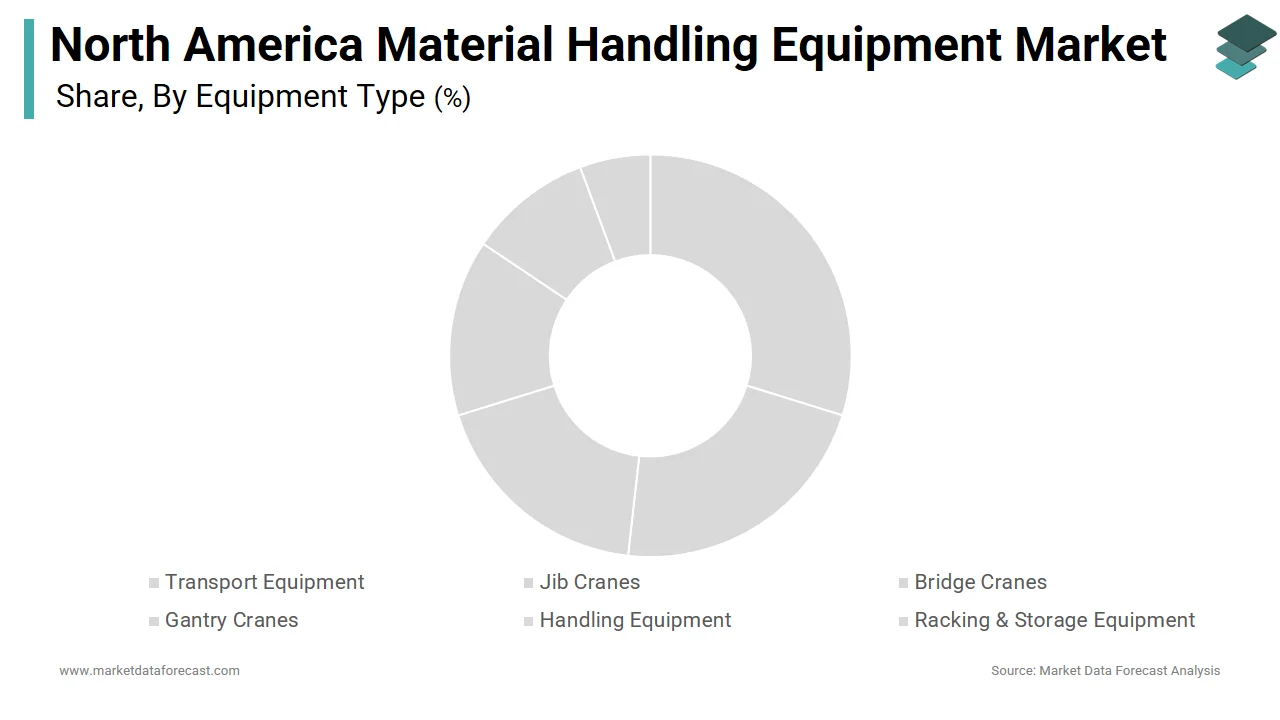
The handling equipment segment is projected to grow with a CAGR of 7.1% from 2026 to 2034, with the increasing adoption of robotics and collaborative robots (cobots) in production environments. These robotic arms are used for tasks such as pick-and-place, palletizing, and precise component assembly, especially in cleanroom settings. Additionally, the growth of micro-fulfillment centers in urban areas is fueling demand for compact, high-speed handling equipment. Furthermore, advancements in gripper technology and AI-driven vision systems are enabling more flexible and adaptive handling solutions. Companies like Soft Robotics Inc. and OnRobot have introduced soft-gripping systems capable of handling fragile items without damage, expanding the scope of handling equipment into new sectors.
By Industry Insights
The consumer goods and electronics industry segment was the largest and held 29.3% of the North America material handling equipment market share in 2024, with the expansion of e-commerce platforms and direct-to-consumer fulfillment models. According to Digital Commerce 360, Amazon alone accounted for over 40% of U.S. e-commerce sales in 2023, with the vast investments in warehouse automation and high-throughput material handling systems. These include automated sorters, shuttle systems, and robotic picking arms designed to handle a wide variety of SKUs efficiently. Another significant factor is the just-in-time manufacturing practices adopted by electronics producers. Moreover, the growth of omnichannel retail strategies is increasing the need for flexible handling solutions. Retailers like Walmart and Target have expanded their online fulfillment capabilities, integrating modular conveyor systems and mobile robots into existing distribution networks. Frost & Sullivan estimates that over 50% of North American retailers invested in smart handling technologies in 2023 to support hybrid fulfillment models.
The semiconductor manufacturing industry is expected to exhibit a CAGR of 8.4% during the forecast period, with the massive capital investment in domestic semiconductor production facilities. Additionally, the miniaturization of semiconductor components demands ultra-high precision handling equipment. SEMI reports that over 65% of new fabs being built globally in 2023 are focused on sub-7nm node manufacturing, which requires nanometer-level accuracy in material transport and placement. Another important factor is the integration of Industry 4.0 technologies in chip manufacturing. As described by McKinsey, semiconductor plants are adopting digital twins, predictive maintenance, and real-time asset tracking to optimize production flows.
COUNTRY-LEVEL ANALYSIS
United States Material Handling Equipment Market Insights
The United States was the largest and held 76.4% of the North America material handling equipment market share in 2024, with the dominance of e-commerce and fulfillment infrastructure. As reported by the U.S. Census Bureau, retail e-commerce sales reached $860 billion in 2023, leading to a surge in automated warehousing and high-speed material handling solutions. Major players such as Amazon, UPS, and FedEx have deployed thousands of automated storage and retrieval systems (AS/RS), conveyors, and autonomous guided vehicles (AGVs) to support rapid order fulfillment. Additionally, the presence of leading manufacturing hubs across automotive, aerospace, and electronics sectors supports robust demand. Urbanization and the expansion of micro-fulfillment centers in metropolitan areas are also shaping equipment demand.
Canada Material Handling Equipment Market Insights
Canada material handling equipment market held 16.2% of the share in 2024, with the expansion of cross-border trade and e-commerce fulfillment centers. Additionally, the automotive and aerospace manufacturing sectors continue to be key contributors. Another important factor is the government’s push toward smart manufacturing and Industry 4.0 adoption. Innovation, Science and Economic Development Canada launched several initiatives in 2023 to support automation upgrades in SMEs, encouraging the integration of AI-enabled material handling systems.
COMPETITIVE LANDSCAPE
The competition in the North America material handling equipment market is characterized by a dynamic mix of global leaders, regional manufacturers, and emerging technology-driven startups. Established players dominate due to their extensive product portfolios, deep industry relationships, and strong R&D capabilities. However, the market is witnessing increased competition from agile newcomers offering specialized automation solutions and modular handling systems tailored for niche applications. As demand surges for smart, energy-efficient, and highly adaptable equipment, companies are under pressure to continuously innovate and differentiate their offerings. Additionally, sustainability considerations and labor shortages are pushing firms to develop eco-friendly and autonomous handling alternatives. Strategic mergers, localized service networks, and enhanced after-sales support have become essential tools for maintaining dominance in this rapidly evolving landscape.
KEY MARKET PLAYERS
Noteworthy Companies dominating the North America material handling equipment market profiled in the report are
- Daifuku Co., Ltd.
- Liebherr Group
- Schaefer System International Ltd.
- Toyota Industries Corporation
- Beumer Group
- Jungheinrich AG
- Godrej Group
- Kion Group AG
- Action Construction Equipment Ltd.
- Hyster-Yale Materials Handling, Inc.
- Swisslog Holding AG
- Crown Equipment Corporation
- Mitsubishi Logis
TOP LEADING PLAYERS IN THE MARKET
- KION Group is a leading global supplier of industrial trucks and supply chain solutions, with a strong presence in North America through its brands such as Linde, STILL, and Dematic. The company offers a comprehensive range of material handling equipment, including forklifts, automated storage systems, and integrated warehouse solutions. KION's innovation in automation and digitalization has positioned it at the forefront of smart logistics technologies, influencing global trends in intelligent material flow and intralogistics.
- Toyota Material Handling is one of the largest providers of lift trucks and advanced material handling solutions in North America. Known for reliability and fuel-efficient designs, TMH integrates hybrid and electric technologies into its product lines to meet evolving industry demands. Its commitment to sustainability, customer-centric service models, and continuous technological upgrades has made it a preferred choice across manufacturing, distribution, and retail sectors globally.
- Egger System Logistics specializes in customized automated material handling and conveyor systems tailored for complex industrial environments. Egger plays an important role in shaping next-generation intralogistics solutions with a focus on precision engineering and modular system design. Its expertise in integrating AI-driven controls and flexible transport units supports high-efficiency operations in pharmaceuticals, semiconductors, and e-commerce fulfillment centers, which contributes significantly to global automation advancements.
TOP STRATEGIES USED BY KEY MARKET PARTICIPANTS
A primary strategy among leading players in the North America material handling equipment market is product innovation through digital integration, where companies are embedding IoT, artificial intelligence, and predictive analytics into their equipment to enhance performance and user experience. This approach allows real-time monitoring, remote diagnostics, and optimized maintenance scheduling, improving overall operational efficiency.
Another key approach is expanding service portfolios beyond hardware, with firms offering end-to-end solutions that include installation, maintenance, software support, and cloud-based management platforms. This shift from product-centric to solution-oriented offerings strengthens customer retention and enables long-term partnerships across industries.
Strategic acquisitions and partnerships are being leveraged to enhance technological capabilities and geographic reach. Companies are acquiring niche technology firms or forming alliances with software developers to accelerate time-to-market for new innovations and strengthen their foothold in emerging verticals such as micro-fulfillment and cleanroom handling.
RECENT MARKET DEVELOPMENTS
- In January 2024, KION Group launched an AI-powered fleet management platform designed to optimize warehouse operations by providing real-time insights into equipment utilization, maintenance needs, and workflow efficiency with its position in smart logistics solutions.
- In March 2024, Toyota Material Handling introduced a new line of hydrogen fuel cell-powered forklifts aimed at supporting zero-emission warehouse operations by aligning with growing corporate sustainability goals and regulatory mandates across North America.
- In June 2024, Egger System Logistics announced a strategic collaboration with a leading software provider to integrate AI-driven route optimization into its conveyor systems by enhancing adaptability and responsiveness in high-volume distribution centers.
- In August 2024, Hyster-Yale Materials Handling expanded its electric lift truck production capacity in Ohio to meet rising demand for emission-free material handling solutions from e-commerce and food processing industries.
- In October 2024, Jungheinrich USA unveiled a new generation of autonomous mobile robots (AMRs) capable of seamlessly integrating with existing warehouse infrastructure, which is marking a significant step toward scalable automation for mid-sized logistics operations.
MARKET SEGMENTATION
This North America material handling equipment market research report is segmented and sub-segmented into the following categories.
By Equipment Type
- Transport Equipment
- Roller
- Chain
- Wheel
- Others (Vertical, Screw Conveyor, Inclined Belt)
- Jib Cranes
- Bridge Cranes
- Gantry Cranes
- Others (Hammerhead, Telescopic, Crawler)
- Hand Trucks
- Pallet Trucks
- Lift Truck
- Others (Pallet Jacks, Side Loaders, Walking Stackers)
- Conveyors
- Cranes
- Industrial Trucks
- Automated Guided Vehicles (AGVs)
- Others (Hoppers, Reclaimers)
- Handling Equipment
- Dock Leveler
- Hoist
- Others (Rotary Index Table, Lift/Tilt/Turn Table, Parts Feeder, Balancer)
- Racking & Storage Equipment
- Automatic Storage/Retrieval System
- Selective Pallet Rack
- Others (Sliding Racks, Stacking Frames, Push-back Racks)
- Others (Unit Load Formation Equipment, Identification, and Control Equipment)
By Industry
- Consumer Goods & Electronics
- Automotive
- Food & Beverages
- Pharmaceutical
- Construction
- Mining
- Semiconductors
- Others (Aviation, Chemicals)
By Country
- United States
- Canada
- Mexico
- Rest of North America
Frequently Asked Questions
1. What are the main drivers for the North America Material Handling Equipment Market?
Key drivers include e-commerce expansion, rising automation needs, warehouse modernization, labor shortages, and a push for supply chain efficiency and resilience
2. Who are the leading manufacturers in the North America Material Handling Equipment Market?
Major players include Toyota Industries, KION Group, Hyster-Yale, Honeywell Intelligrated, Dematic, SSI Schaefer, Vanderlande, Daifuku, Swisslog, and BEUMER Group
3. How is automation impacting the North America Material Handling Equipment Market?
There is a rapid increase in adoption of robotics, automated guided vehicles, and AI-driven systems to improve accuracy, productivity, and safety, especially in e-commerce and 3PL warehouses
4. What role does the e-commerce sector play in the North America Material Handling Equipment Market?
E-commerce is a primary growth engine, driving demand for high-speed, automated material handling solutions to manage higher order volumes and faster fulfillment
5. Which industries are the main end-users in the North America Material Handling Equipment Market?
Key end-user sectors include e-commerce, retail, automotive, food & beverage, general manufacturing, pharmaceuticals, and logistics/distribution centers
6. What recent trends are shaping the North America Material Handling Equipment Market?
Notable trends include increasing use of autonomous mobile robots (AMRs), smart warehouse software, energy-efficient equipment, and modular automation systems
7. How does the labor market affect the North America Material Handling Equipment Market?
Labor shortages and rising labor costs push companies to adopt more automated and ergonomic material handling equipment
8. How is sustainability addressed in the North America Material Handling Equipment Market?
Manufacturers are developing energy-efficient machines, promoting recyclable materials, and implementing smart systems to reduce waste and environmental impact
9. What are the main challenges in the North America Material Handling Equipment Market?
Challenges include high upfront investment, integration complexity, skilled labor shortages, and the need for compatibility with legacy systems
10.What is the competitive landscape of the North America Material Handling Equipment Market?
The market is highly competitive, featuring global leaders and specialized regional firms, with continuous R&D, partnerships, and acquisitions driving innovation and differentiation
Related Reports
Access the study in MULTIPLE FORMATS
Purchase options starting from
$ 2000
Didn’t find what you’re looking for?
TALK TO OUR ANALYST TEAM
Need something within your budget?
NO WORRIES! WE GOT YOU COVERED!
Call us on: +1 888 702 9696 (U.S Toll Free)
Write to us: sales@marketdataforecast.com