- Product Description Description
- Table of Contents TOC
- List of Table & Figure LOT
- Get Free Sample PDF Sample PDF
Market Size, 2025
$463.52 MnMarket Estimate, 2026
$501.80 MnMarket Forecast, 2034
$946.84 MnCAGR, 2026–2034
8.26%North America Multi-Cooker Market Size, Growth, Trends & Forecast (2026–2034)
The North American multi-cooker market size was valued at USD 463.52 million in 2025, is estimated to reach USD 501.80 million in 2026, and is projected to scale up to USD 946.84 million by 2034, growing at a compound annual growth rate (CAGR) of 8.26% from 2026 to 2034. Driven by growing urban housing constraints, demand for time-efficient and energy-saving kitchen appliances, and continuous innovations in smart IoT-enabled cooking ecosystems, the regional market continues to expand steadily.
Key Executive Metrics (At-a-Glance)
- 2025 Base Valuation: USD 463.52 Million
- 2026 Current Valuation: USD 501.80 Million
- 2034 Forecast Valuation: USD 946.84 Million
- Compound Annual Growth Rate (CAGR): 8.26% (2026–2034)
- Top Performing Country: United States (Holds a dominant regional market share of 88.3% in 2025, propelled by high disposable incomes, digital retail infrastructure, and mainstream home-cooking culture).
Core Market Drivers
- Urbanization & Compact Living Spaces: Proliferation of smaller housing units and single/dual-member households accelerating demand for multi-functional space-saving appliances.
- Time Efficiency & Health Consciousness: Busy work schedules and consumer preference for rapid, nutrient-preserving meal preparation methods.
Primary Market Restraints & Challenges
- Safety & Pressure Apprehension: Consumer concerns regarding pressure-cooking mechanisms, historical malfunction reports, and educational gaps on usage.
- Appliance Saturation & Commoditization: Proliferation of similar SKUs creating aggressive price competition and high appliance redundancy in households.
North America Multi-Cooker Market Segmentation Highlights
| Segment Category | Largest Segment | Fastest-Growing / Key Segment |
|---|---|---|
| By Product Type | Round Multi-Cooker | Cube Multi-Cooker (12.6% CAGR) |
| By Application | Home Use | Restaurants (9.7% CAGR) |
| By Distribution Channel | Online Stores (58.3% share in 2025) | Electrical Goods Retailers (8.3% CAGR) |
| By Country | United States (88.3% share) | Canada (14.3% share) |
Major Industry Players Profiled
Key market competitors driving the North American multi-cooker landscape include Instant Brands (Instant Pot), Ninja (SharkNinja), Cuisinart, Crock-Pot, Breville, KitchenAid, Philips, Hamilton Beach, T-fal (Groupe SEB), and Zojirushi.
North America Multi-Cooker Market Size
The North America multi cooker market size was valued at USD 463.52 million in 2025 and is predicted to be worth USD 946.84 million by 2034, from USD 501.80 million in 2026 and grow at a CAGR of 8.26% from 2026 to 2034.
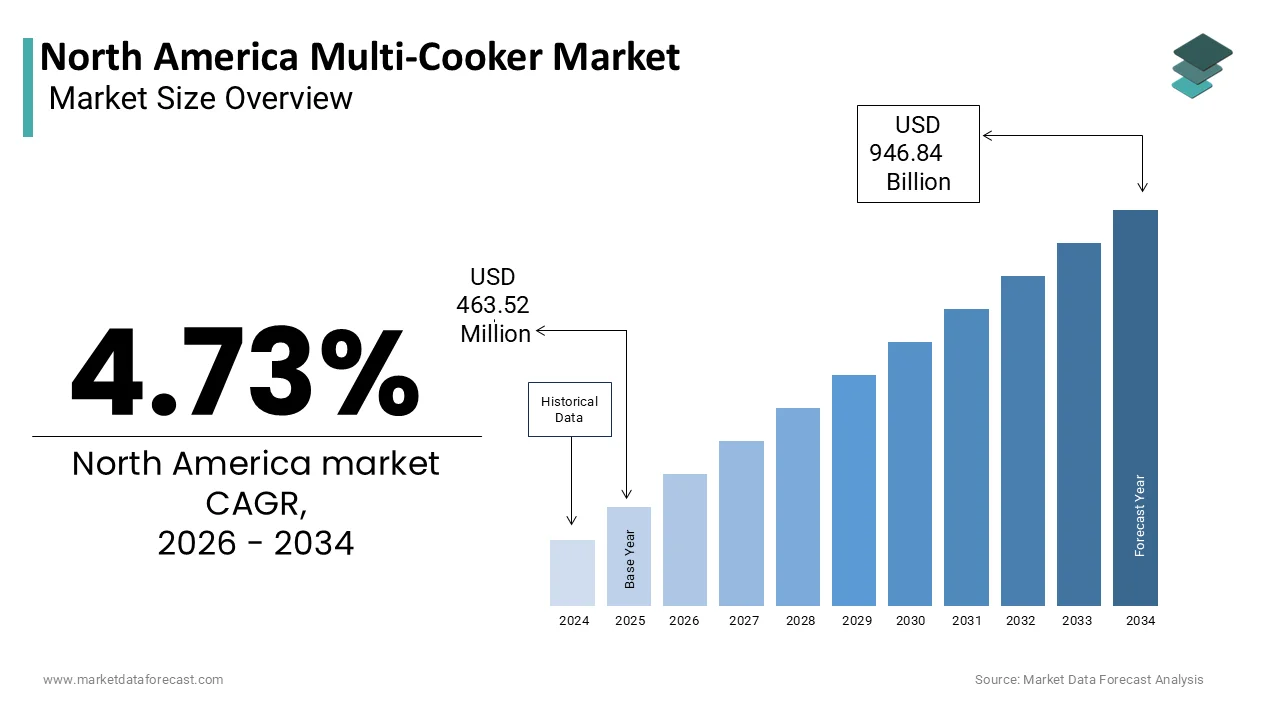
The multi-cooker is the ecosystem of electric kitchen appliances capable of performing multiple culinary functions, such as pressure cooking, slow cooking, steaming, sautéing, rice cooking, and yogurt making within a single countertop unit. As per the U.S. Energy Information Administration, residential electricity consumption for cooking accounted for 4.2% of total household energy use in 2023, with multi-cookers demonstrating up to 60% greater thermal efficiency compared to conventional stovetop methods. Furthermore, the U.S. Census Bureau indicates that 62% of households now consist of one or two individuals, a demographic shift favoring compact, versatile appliances that minimize cleanup and optimize space. These appliances also align with growing interest in home meal prep, as emphasized by the American Home Economics Association, which found that 71% of adults now prioritize cooking at home for health and cost reasons.
MARKET DRIVERS
Urbanization and the Rise of Compact Living Spaces
The accelerating trend of urbanization has redefined residential architecture and domestic appliance preferences, which is propelling the growth of the North America multi cooker market. As of 2023, 83% of Americans reside in urban or suburban areas, according to the U.S. Census Bureau, many occupying smaller housing units such as apartments, micro-lofts, and accessory dwelling units. Multi-cookers address this limitation by consolidating the roles of pressure cookers, rice cookers, slow cookers, and steamers into one compact device, thereby optimizing counter and storage space. This functionality is particularly valuable for single-person and dual-member households, which now constitute 58% of all U.S. homes, as noted by the Joint Center for Housing Studies at Harvard University. A 2023 survey by the National Association of Home Builders found that 67% of renters aged 25–34 consider appliance versatility a factor in kitchen satisfaction. The reduction in cleaning burden and energy use further enhances appeal in high-density living environments where utility costs are often passed on to tenants.
Growing Emphasis on Time-Efficient and Health-Conscious Meal Preparation
The modern lifestyles with demanding work schedules and heightened awareness of dietary wellness are prompting the growth of the North America multi cooker market. According to the U.S. Bureau of Labor Statistics, the average employed American spends only 38 minutes per day on food preparation, creating a need for rapid cooking solutions that do not compromise on health. Multi-cookers fulfill this need by reducing cooking times by up to 70% through pressurized environments, while preserving more vitamins and nutrients compared to prolonged boiling or frying. According to the American Society for Nutrition, pressure-cooked vegetables retain up to 90% of vitamin C, significantly higher than boiling, which can degrade up to 50%. Additionally, pre-programmed settings enable consistent results with minimal supervision, appealing to inexperienced cooks and busy professionals alike.
MARKET RESTRAINTS
Consumer Safety Concerns Related to Pressure Cooking Mechanisms
The safety perceptions surrounding pressure-based cooking are expected to restrict the growth of the North America multi cooker market. Although modern units are equipped with multiple fail-safes, including lid-lock systems, pressure release valves, and overheating protection,n public apprehension persists, particularly among older demographics and inexperienced cooks. According to the U.S. Consumer Product Safety Commission, over 1,200 incidents related to pressure cooker malfunctionoccurred s occurred between 2018 and 2022, including cases of steam burns and lid ejection. These incidents, though relatively rare in proportion to total units in use, receive amplified media coverage, reinforcing negative associations. As per a 2023 survey by the National Kitchen and Bath Association, 39% of non-owners cited fear of explosions or burns as a primary reason for avoiding multi-cookers. This perception is further exacerbated by the complexity of user manuals and inconsistent understanding of pressure release methods, quick vs. natural, which are leading to improper usage. Additionally, the noise generated during pressure release and the opaque nature of the cooking process reduce user confidence compared to conventional stovetop methods. While manufacturers have introduced quieter models and transparent lids, widespread educational gaps remain. According to the American Home Economics Association, only 28% of first-time buyers receive formal instruction on pressure cooking safety, leaving many to rely on online tutorials of variable reliability.
High Initial Purchase Cost and Perceived Redundancy in Appliance-Saturated Households
The upfront cost of premium multi-cookers is hampering the growth of the North America multi cooker market. High-end models with smart features, stainless steel construction, and expanded capacity can exceed $150, a figure that represents a substantial investment for budget-conscious households. According to the U.S. Bureau of Labor Statistics, the median household spent $72 annually on small kitchen appliances in 2023, making a single high-ticket item a notable deviation from routine spending. Moreover, many homes already possess dedicated slow cookers, rice cookers, or stovetop pressure cookers, leading consumers to question the necessity of consolidation. The National Association of Home Builders reports that 68% of U.S. kitchens contain three or more cooking-related small appliances, fostering a sense of redundancy. The Federal Reserve’s 2023 Survey of Consumer Finances indicates that 41% of households have reduced spending on home goods due to financial uncertainty. For manufacturers, this creates a challenge in articulating clear value differentiation beyond convenience.
MARKET OPPORTUNITIES
Expansion of Smart Integration and IoT-Enabled Cooking Ecosystems
The integration of multi-cookers into broader smart home ecosystems through enhanced functionality, user engagement, and data-driven personalization shall create new opportunities for the growth of the North American multi-cooker market. Leading manufacturers are increasingly embedding Wi-Fi and Bluetooth capabilities into their devices by enabling remote monitoring, voice control via assistants like Alexa and Google Assistant, and synchronization with mobile applications. As per the Consumer Technology Association, 42% of U.S. households now own at least one smart kitchen device, which is creating a receptive environment for connected multi-cookers. These appliances can now download firmware updates, receive real-time cooking adjustments, and access curated recipe databases tailored to dietary preferences such as keto, vegan, or low-sodium. Instant Brands, for instance, offers over 1.2 million recipe downloads annually through its app, fostering continuous user interaction beyond the point of sale. Furthermore, AI-driven learning algorithms can adapt cooking programs based on user behavior, such as preferred texture or doneness levels. According to the U.S. Department of Agriculture, 56% of consumers use digital tools to plan weekly meals, indicating strong alignment with smart cooking workflows.
Strategic Penetration into Underserved Demographic and Cultural Cooking Segments
The tailoring of multi-cooker offerings to underrepresented cultural cuisines and demographic groups whose traditional cooking methods align with the appliance’s capabilities is also prompting the growth of the North America multi-cooker market. North America’s increasingly diverse population, where 42% of residents identify with a racial or ethnic minority group, as per the U.S. Census Bureau, engages in culinary practices that often involve slow braising, stewing, and rice-based dishes, all of which are efficiently executed bymulti-cookerss. For instance, Latin American dishes like feijoada, Caribbean oxtail stew, and South Asian curries benefit from the precise temperature and pressure control offered by these devices.
MARKET CHALLENGES
Rapid Product Commoditization and Intense Brand Competition
The North American multi-cooker market growth is experiencing accelerated commoditization, with a proliferation of functionally similar devices from both established brands and low-cost entrants eroding differentiation and compressing profit margins. According to the Federal Trade Commission, over 1,200 unique multi-cooker SKUs were listed on major e-commerce platforms in 2023, many differing only in branding or minor design elements. This homogenization forces companies to compete primarily on price, which is leading to aggressive discounting and diminishing returns on innovation. Consumers, overwhelmed by choice, often default to the lowest-priced option, undermining investment in R&D. As per the U.S. Patent and Trademark Office, over 78% of multi-cooker-related patents filed between 2015 and 2020 have already expired or been circumvented. As a result, brand loyalty remains fragile, with 54% of users indicating they would switch brands for a $20 discount, as per a 2023 NielsenIQ consumer behavior study.
Short Product Lifespan and Sustainability Concerns in Electronic Waste Generation
The environmental impact of multi-cookers is prompting their relatively short operational lifespan, andtheir contribution to electronic waste is likely to impede the growth of the North American multi-cooker market. Most units are designed with non-replaceable components, including sealed heating elements and proprietary lids, making repairs impractical and leading to premature disposal. The Environmental Protection Agency estimates that small kitchen appliances account for 3.2 million tons of electronic waste annually in the U.S., with multi-cookers contributing an increasing share due to high turnover rates. Furthermore, the use of mixed materials in construction, such as plastic housings bonded to metal components, complicates recycling processes.
REPORT COVERAGE
| REPORT METRIC | DETAILS |
| Market Size Available | 2025 to 2034 |
| Base Year | 2025 |
| Forecast Period | 2026 to 2034 |
| Segments Covered | By Product Type, Application, Distribution Channel, and Region |
| Various Analyses Covered | Regional & Country Level Analysis, Segment-Level Analysis, DROC, PESTLE Analysis, Porter’s Five Forces Analysis, Competitive Landscape, Analyst Overview on Investment Opportunities |
| Regions Covered | The United States, Canada, Mexico, and the rest of North America |
| Market Leaders Profiled | Instant Brands (Instant Pot), Crock-Pot, Breville, KitchenAid, Philips, Ninja (SharkNinja), Hamilton Beach, T-fal (Groupe SEB), Zojirushi, Gourmia, Panasonic, Fagor, De’Longhi, Midea, Black+Decker, Aroma Housewares, and others |
SEGMENTAL ANALYSIS
By Product Type Insights
The round multi-cooker segment accounted for a prominent share of the North American multi-cooker market in 2025, with its deep alignment with traditional cooking ergonomics and widespread compatibility with existing kitchenware. As per the American Society of Mechanical Engineers, round chambers allow for more uniform steam dynamics during pressurized cooking, reducing hotspots and improving food texture. This functional superiority is particularly valued in households preparing stews, grains, and beans, which constitute over 55% ofmulti-cookerr usage, according to the U.S. Department of Agriculture’s Food Preparation Survey. Additionally, the round form factor has become synonymous with trusted brands like Instant Pot, which pioneered the modern multicooker movement and established consumer familiarity.
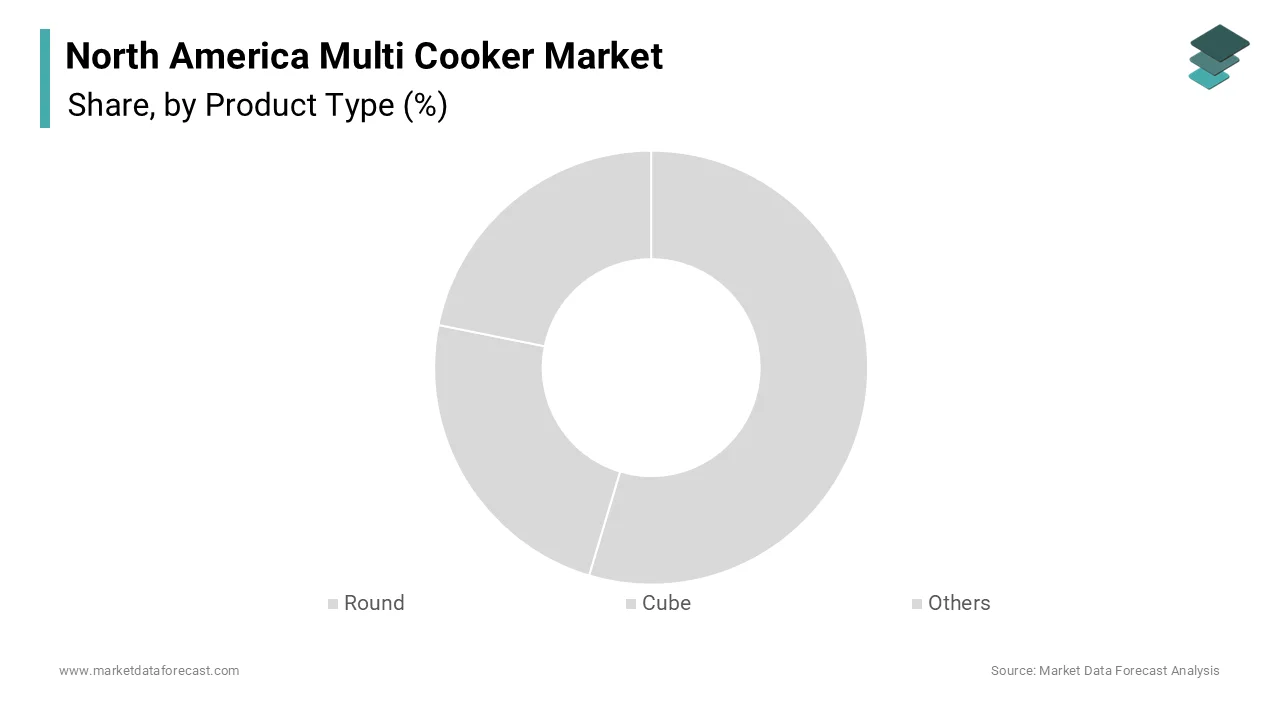
The cube multi-cooker segment is deemed to grow with a CAGR of 12.6% during the forecast period, with the evolving aesthetic preferences and integration into modern kitchen design paradigms. According to the American Institute of Architects, 68% of new kitchen renovations in 2023 prioritized “appliance visibility” as a design element, favoring devices that complement rather than conceal. Cube models are often produced by brands like Ninja and Cuisinar and are marketed as statement pieces, blending seamlessly with smart kitchen ecosystems and open-concept living spaces. Moreover, cube units frequently incorporate advanced features such as crisping lids, air frying, and dual-zone cooking, expanding their functional appeal beyond pressure-based preparation. According to the Food Marketing Institute, 47% of consumers purchasing high-end multi-cookers specifically seek hybrid cooking capabilities, a niche where cube designs dominate.
By Application Insights
The home use segment was the largest with a prominent share of the North American multi-cooker market in 2025, with the appliance’s role as a cornerstone of modern domestic food preparation, particularly in response to shifting household structures and lifestyle demands. Multi-cookers meet these needs by consolidating multiple functions into a single countertop unit, eliminating the need for large pots, slow cookers, and rice cookers. Additionally, the rise of remote work has altered daily routines, with 38% of employed Americans working from home at least part-time in 2023, as per the Bureau of Labor Statistics, increasing the frequency of midday meal preparation. Manufacturers have responded with user-friendly interfaces, pre-programmed settings, and mobile app integration, reinforcing the appliance’s role in everyday domestic life.
The restaurants segment is expected to grow with a CAGR of 9.7% in the coming years, with the increasing adoption of multi-cookers in commercial kitchens for batch preparation, consistency control, and labor optimization. According to the Culinary Institute of America, 58% of mid-scale restaurants now use multi-cookers for prep work by reducing cooktime by up to 65% and minimizing staff involvement. This efficiency is particularly valuable in fast-casual and cloud kitchen models, where speed and repeatability are important. Additionally, multi-cookers help maintain recipe standardization across multiple locations, a priority for franchise operations. The National Restaurant Association also notes that 43% of operators cite energy efficiency as a key factor in equipment selection, with multi-cookers consuming up to 40% less electricity than conventional ovens for equivalent tasks, according to the U.S. Energy Information Administration.
By Distribution Channel Insights
The online stores segment was the largest and held 58.3% of the North American multi-cooker market share in 2025, with the integration of consumer shopping behavior, digital product education, and e-commerce logistics efficiency. North American consumers increasingly rely on online platforms to compare features, read verified reviews, and access exclusive promotions before purchasing appliances. According to the U.S. Census Bureau, 82% of small kitchen appliance transactions in 2023 occurred via digital channels, with Amazon, BestBuy.com, and Walmart.com serving as primary gateways. The complexity of multi-cookery functionalities, such as programmable settings andsmart connectivityt,t necessitates detailed product descriptions and video demonstrations, which online retailers provide more comprehensively than in-store displays. Additionally, e-commerce enables direct access to niche and premium models that may not be stocked in physical stores, particularly those emphasizing sustainability or cultural cooking presets.
The electrical goods retailers segment is anticipated to grow with a CAGR of 8.3% during the forecast period, with a strategic reinvention of specialty retail spaces as experiential hubs rather than mere transaction points. Stores like Best Buy and The Brick have introduced in-store cooking demonstrations, interactive kiosks, and live chef collaborations to showcase multi-cook capabilities in real time. These retailers also offer immediate availability, professional setup assistance, and trade-in programs for old appliance services that e-commerce cannot replicate. The Institute for Consumer Satisfaction reports that 67% of customers value in-person technical advice when buying smart kitchen devices, particularly for connectivity and app integration. Furthermore, electrical goods retailers have formed exclusive partnerships with manufacturers to offer region-specific models, limited editions, and bundled accessories, creating a sense of scarcity and premium access.
REGIONAL ANALYSIS
United States MMulti-CookerMarket Insights
The United States was the top performer in the North America multi cooker market by accounting for 88.3% of the market share in 2025. The country’s high per capita disposable income, averaging $63,000 in 2023, as reported by the U.S. Bureau of Economic Analysis, enables widespread access to premium multi-cookers with smart features and hybrid cooking capabilities. The integration of these appliances into mainstream cooking culture was catalyzed by the Instant Pot phenomenon, which began in the U.S. and sparked a nationwide shift toward time-efficient, health-conscious meal preparation. According to the Centers for Disease Control and Prevention, 70% of American adults now cook at home to manage dietary health, a behavior amplified by the pandemic and sustained by evolving lifestyle demands. Additionally, the U.S. leads in e-commerce penetration for appliances, with over 80% of multi-cooker sales occurring through digital platforms, as per the Department of Commerce. The presence of major manufacturers, tech developers, and culinary influencers further consolidates its market dominance. Urbanization, single-person households, and the rise of smart homes collectively create a fertile environment for continued growth by ensuring the U.S. remains the epicenter of innovation and consumption in the multi-cooker landscape.
Canada Multi-Cooker Market Insights
Canada multi cooker market was positioned second by capturing 14.3% of the market share in 2025. As per the Canadian Housing and Mortgage Corporation, with an average household size of 2.4 persons and 67% of residents living in urban centers, there is a pronounced demand for space-saving, multifunctional kitchen devices. Canadians also demonstrate higher environmental awareness; Environment and Climate Change Canada reports that 61% of households prioritize energy-efficient appliances to reduce utility costs and carbon footprints. Multi-cookers align with this ethos by consuming up to 50% less electricity than conventional ovens for equivalent tasks. Retailers like The Brick and Canadian Tire have played a pivotal role in market education, offering in-store demos and bilingual support to enhance consumer confidence.
KEY MARKET PLAYERS AND COMPETITIVE LANDSCAPE
Key players in the North America Multi Cooker Market are Instant Brands (Instant Pot), Crock-Pot, Breville, KitchenAid, Philips, Ninja (SharkNinja), Hamilton Beach, T-fal (Groupe SEB), Zojirushi, Gourmia, Panasonic, Fagor, De’Longhi, Midea, Black+Decker, and Aroma Housewares.
The competitive environment in the North America multi cooker market is defined by a blend of innovation, brand loyalty, and strategic differentiation amid growing saturation. While the market was once revolutionized by a single dominant player, it now hosts a diverse array of brands vying for consumer attention through design, functionality, and digital integration. Established names leverage their reputation for reliability and performance, while newer entrants challenge conventions with bold hybrid features and sleek aesthetics. Retail presence, both online and in-store, plays a crucial role, with experiential marketing and digital content shaping purchase decisions. The rise of private-label and generic models adds pressure on pricing, pushing premium brands to justify their value through superior build quality, customer support, and ecosystem integration.
TOP PLAYERS IN THE MARKET
Instant Brands (formerly Instant Pot)
Instant Brands has redefined themulti-cookerr landscape by transforming a functional kitchen appliance into a cultural phenomenon. Through intuitive design, robust marketing, and deep community engagement, the company established the multi-cooker as an essential tool for modern home cooking. Its success lies in simplifying complex culinary processes while fostering a passionate user base through recipe sharing, social media interaction, and educational content. The company’s emphasis on reliability, ease of use, and health-conscious cooking has set a benchmark in the industry, making its name synonymous with the category itself.
Ninja (by SharkNinja)
Ninja has disrupted the multi-cooker market by merging high-performance engineering with lifestyle-centric innovation. The brand distinguishes itself through hybrid appliances that combine pressure cooking with air frying, searing, and dehydrating, appealing to consumers seeking versatility and culinary experimentation. Its bold design language and aggressive branding position multi-cookers not just as utilitarian tools but as dynamic kitchen hubs. Ninja’s integration of smart features and modular components has raised consumer expectations for functionality and adaptability. Globally, the brand has influenced product development strategies, encouraging competitors to expand beyond basic presets into multi-stage cooking systems, thereby reshaping how modern households interact with countertop appliances.
Cuisinart
Cuisinart has leveraged its legacy in premium kitchenware to introduce multi-cookers that emphasize craftsmanship, durability, and aesthetic refinement. The brand appeals to discerning consumers who value understated elegance and seamless integration into high-end kitchen environments. Cuisinart has carved a niche in the upscale segment, where performance is matched by design integrity by prioritizing build quality and intuitive interfaces. Its influence extends beyond North America, as international markets associate the brand with culinary sophistication and reliability. Cuisinart’s approach has prompted a shift toward more polished, appliance-grade finishes in the multicooker category, which is elevating the product from a convenience gadget to a respected element of modern kitchen ecosystems.
TOP STRATEGIES USED BY KEY MARKET PLAYERS
One pivotal strategy employed by leading players is the creation of immersive digital ecosystems that extend the value of the appliance beyond its physical capabilities. Companies are investing in proprietary mobile applications that offer guided cooking, personalized meal planning, and real-time troubleshooting, transforming the multi-cooker into a connected culinary companion. These platforms foster ongoing engagement, turning one-time purchases into sustained user relationships.
Another key approach is the expansion into hybrid functionality, where multi-cookers are engineered to perform additional tasks such as air frying, baking, or dehydrating. This diversification enhances perceived utility, allowing brands to appeal to consumers looking to consolidate multiple appliances into a single, space-efficient unit, particularly in urban living environments.
A third strategic focus is community-driven marketing, where brands cultivate loyal user bases through social media engagement, recipe challenges, and influencer collaborations. Companies build emotional resonance and word-of-mouth advocacy by reinforcing brand identity in a competitive and increasingly commoditized market.
RECENT HAPPENINGS IN THE MARKET
- In February 2023, Instant Brands launched a redesigned app interface with AI-powered recipe suggestions and voice-guided cooking modes. This enhancement is expected to deepen user engagement and reinforce the brand’s prominence in smart kitchen integration.
- In May 2023, Ninja introduced a new line of multi-cookers featuring dual cooking zones and modular lids for simultaneous pressure and air frying. This innovation is aimed at increasing culinary versatility and attracting advanced home cooks.
- In September 2023, Cuisinart partnered with a network of professional chefs to release a curated collection of region-specific cooking programs for Latin American and Asian cuisines. This initiative is designed to broaden cultural relevance and appeal to diverse households.
- In January 2025, Instant Brands rolled out a nationwide repair and recycling program for older multi-cooker models. This move is anticipated to improve product sustainability and strengthen consumer trust in long-term brand responsibility.
- In June 2025, Ninja collaborated with a major grocery delivery service to enable one-touch recipe imports directly into the appliance’s control panel. This integration is expected to streamline meal planning and enhance the overall user experience.
MARKET SEGMENTATION
This research report on the North America multi cooker market has been segmented and sub-segmented based on the following categories.
By Product Type
- Round
- Cube
- Others
By Application
- Restaurants
- Home Uses
- Others
By Distribution Channel
- Electrical Goods Retailers
- Supermarkets/Hypermarkets
- Departmental Stores
- Homeware Stores
- Online Stores
- Others
By Country
- The United States
- Canada
- Rest of North America