- Product Description Description
- Table of Contents TOC
- List of Table & Figure LOT
- Get Free Sample PDF Sample PDF
Market Size, 2025
$47.72 BnMarket Estimate, 2026
$49.21 BnMarket Forecast, 2034
$62.92 BnCAGR, 2026–2034
3.12%North America Oilfield Services Market Size, Growth, Trends & Forecast (2026–2034)
The North America Oilfield Services Market size was calculated to be USD 47.72 billion in 2025, is estimated to reach USD 49.21 billion in 2026, and is projected to expand to USD 62.92 billion by 2034, registering a compound annual growth rate (CAGR) of 3.12% during the forecast period from 2026 to 2034. Driven by a resurgence in shale oil extraction, offshore exploration activities, and rapid digital optimization, the market continues to provide essential support to regional hydrocarbon output.
Key Executive Metrics (At-a-Glance)
- 2025 Base Valuation: USD 47.72 Billion
- 2026 Current Valuation: USD 49.21 Billion
- 2034 Forecast Valuation: USD 62.92 Billion
- Compound Annual Growth Rate (CAGR): 3.12% (2026–2034)
- Leading Country Market: United States (anchored by extensive shale assets in the Permian Basin and deepwater Gulf of Mexico projects)
- Key Growth Hubs: Canada (driven by oil sands and unconventional Montney/Duvernay plays)
Core Market Drivers
- Resurgence in Shale Production: Consistent high output from key formations like the Permian Basin necessitating continuous well completion and fracture stimulation support.
- Expansion of Offshore E&P: Ongoing deepwater developments in the Gulf of Mexico and offshore Eastern Canada driving high-value intervention and subsea service demand.
Primary Market Restraints & Challenges
- Regulatory & Environmental Pressures: Stricter EPA emissions standards and BLM restrictions increasing compliance overheads.
- Oil Price Volatility & CapEx Cycles: Upstream budgetary cuts during price fluctuations undermining long-term contract stability.
Market Segmentation: Largest and Fastest-Growing Segments
| Segment Category | Largest Segment | Fastest-Growing Segment |
|---|---|---|
| By Application | Onshore (Dominant share backed by vast shale reserves) | Offshore (CAGR of 5.9%) |
| By Service | Completion Services (34.2% share in 2025) | Workover Services (CAGR of 6.3%) |
| By Type | Equipment Rental (58.3% share in 2025) | Field Operation (CAGR of 6.1%) |
| By Region | United States (Dominant regional share) | Canada & Rest of North America |
Major Industry Players Profiled
Key market participants shaping the North American oilfield services landscape include Schlumberger Limited, Halliburton Company, Baker Hughes Company, Weatherford International plc, NOV Inc., TechnipFMC plc, Nabors Industries Ltd., Patterson-UTI Energy Inc., Precision Drilling Corporation, Basic Energy Services Inc., Superior Energy Services Inc., Key Energy Services Inc., Calfrac Well Services Ltd., Trican Well Service Ltd., and RPC Inc.
North America Oilfield Services Market Size
The North America Oilfield Services Market Size was calculated to be USD 47.72 billion in 2025 and is anticipated to be worth USD 62.92 billion by 2034, from USD 49.21 billion in 2026, growing at a CAGR of 3.12% during the forecast period.
The oilfield services are essential for the exploration, drilling, production, maintenance, and decommissioning of oil and gas wells. These services include well completion, hydraulic fracturing, directional drilling, logging, cementing, and production optimization, among others. As per the U.S. Energy Information Administration, domestic crude oil production reached an average of 12.5 million barrels per day in 2023, reinforcing the need for continuous and efficient oilfield service support.
MARKET DRIVERS
Resurgence in Shale Oil Production
The resurgence in shale oil production in the United States is bolstering the growth of the North American oilfield services market. According to the U.S. Energy Information Administration, U.S. shale oil production averaged 9.3 million barrels per day in 2023, marking a steady increase from the previous year. The Permian Basin in Texas and New Mexico alone accounted for over 5.5 million barrels per day of oil production in 2023 as reported by the Railroad Commission of Texas. This high level of production necessitates continuous investment in oilfield services such as well completions, fracture stimulation, and production optimization. Service providers are increasingly deploying advanced fracturing fleets, real-time monitoring systems, and data analytics to meet the growing demand.
Increased Offshore Exploration and Production Activities
The expansion of offshore exploration and production activities is also levelling-up the growth of the North American oilfield services market. According to the Bureau of Safety and Environmental Enforcement in 2023, over 30 new offshore drilling permits were issued, with major projects such as Shell’s Appomattox and Chevron’s Ballymore field entering active development phases. These deepwater projects require highly specialized oilfield services, including subsea well intervention, offshore drilling support, and remotely operated vehicle (ROV) operations. Additionally, in Canada, the Canada-Newfoundland and Labrador Offshore Petroleum Board indicated that offshore production from the Hibernia and Hebron fields contributed over 200,000 barrels per day in 2023.
MARKET RESTRAINTS
Regulatory and Environmental Compliance Pressures
The increasing regulatory and environmental compliance pressures imposed on oil and gas operations is restricting the growth of the North American oilfield services market. In the U.S., the Environmental Protection Agency has implemented stringent methane emission standards and air quality regulations that directly impact drilling and production activities. According to the EPA’s 2023 enforcement report, over 250 oil and gas operators were cited for environmental violations, leading to fines and operational delays. Additionally, the Bureau of Land Management has introduced new restrictions on flaring and venting in federal lands, affecting well completion and production processes. These regulatory challenges increase the operational burden on oilfield service providers, requiring them to invest in cleaner technologies and compliance management systems.
Volatility in Oil Prices and Capital Expenditure Cycles
The oil price volatility is additionally to hinder the growth of the North America oilfield services market. According to the U.S. Energy Information Administration, West Texas Intermediate (WTI) crude prices fluctuated between $67 and $95 per barrel in 2023, creating uncertainty for oilfield service providers. This volatility affects investment planning and contract stability, as operators tend to scale back on drilling and completion activities during periods of low pricing. The American Petroleum Institute reported in 2023 that oil and gas companies reduced their capital budgets by an average of 8% during price downturns, directly impacting service demand. In Canada, the Canadian Energy Regulator noted that capital investment in oil sands projects declined by 5% in 2023 due to price fluctuations and macroeconomic uncertainty. These cyclical investment patterns make it difficult for service providers to maintain consistent revenue streams and plan long-term operational strategies. Additionally, financial institutions are increasingly cautious about lending to upstream projects, further constraining capital availability.
MARKET OPPORTUNITIES
Digitalization and Automation in Oilfield Operations
The growing adoption of digitalization and automation in oilfield operations presents a significant opportunity for the North American oilfield services market. Operators are increasingly leveraging artificial intelligence, machine learning, and Internet of Things (IoT) platforms to enhance operational efficiency, reduce downtime, and improve safety. According to a 2023 report by McKinsey & Company, digital technologies in upstream operations have led to a 15–25% reduction in operating costs and improved production forecasting accuracy. Major oilfield service providers such as Schlumberger and Baker Hughes have introduced cloud-based analytics platforms that enable real-time reservoir monitoring and predictive maintenance. As per the Society of Petroleum Engineers, over 40% of surveyed operators in North America indicated plans to increase digital investments in 2023 to optimize production and reduce environmental impact.
Expansion of Enhanced Oil Recovery (EOR) Techniques
The increasing deployment of enhanced oil recovery (EOR) techniques in mature oil fields is creating new growth opportunities for the North American oilfield services market. According to the U.S. Department of Energy, EOR currently accounts for over 600,000 barrels per day of U.S. oil production, with potential to increase significantly in the coming decade. The National Petroleum Council reported that EOR could unlock an additional 40 billion barrels of recoverable oil in the U.S., particularly in the Permian Basin and California fields. In Canada, the Alberta government has supported EOR development through incentives and carbon capture and storage (CCS) initiatives. The Alberta Energy Regulator noted that CO2-EOR projects in the province have contributed to a 7% increase in oil recovery rates.
MARKET CHALLENGES
Workforce Shortages and Skill Gaps
The persistent shortage of skilled labor and workforce gaps in technical and operational roles is acting as a barrier for the growth of the North American oilfield services market. According to the U.S. Bureau of Labor Statistics, employment in oil and gas extraction occupations declined by 12% between 2019 and 2022, and recovery has been uneven due to limited re-entry of experienced workers. The aging workforce and limited vocational training programs have further exacerbated the labor shortage. According to the National Energy Board of Canada, the average age of oilfield workers is 52, with fewer young professionals entering the industry.
Supply Chain Disruptions and Equipment Availability
The supply chain disruptions and equipment availability issues have also emerged as a challenge for the North American oilfield services market growth. The global semiconductor shortage and raw material constraints have impacted the manufacturing of drilling rigs, frac fleets, and specialized oilfield equipment. According to the U.S. Chamber of Commerce’s 2023 supply chain report, 65% of equipment manufacturers in the oil and gas sector faced delays in sourcing components such as control modules, sensors, and industrial valves. Additionally, the U.S. International Trade Commission reported that steel prices, a key input for drilling and production equipment, rose by 18% in 2023 due to supply chain bottlenecks and geopolitical tensions.
REPORT COVERAGE
| REPORT METRIC | DETAILS |
| Market Size Available | 2025 to 2034 |
| Base Year | 2025 |
| Forecast Period | 2026 to 2034 |
| CAGR | 3.12% |
| Segments Covered | By Application, Service, Type, And Region |
| Various Analyses Covered | Global, Regional & Country Level Analysis; Segment-Level Analysis; DROC, PESTLE Analysis; Porter’s Five Forces Analysis; Competitive Landscape; Analyst Overview of Investment Opportunities |
| Regions Covered | Us, Canada, and the Rest of North America |
| Market Leaders Profiled | Schlumberger Limited, Halliburton Company, Baker Hughes Company, Weatherford International plc, NOV Inc., TechnipFMC plc, Nabors Industries Ltd., Patterson-UTI Energy Inc., Precision Drilling Corporation, Basic Energy Services Inc., Superior Energy Services Inc., Key Energy Services Inc., Calfrac Well Services Ltd., Trican Well Service Ltd., RPC Inc |
SEGMENTAL ANALYSIS
By Application Insights
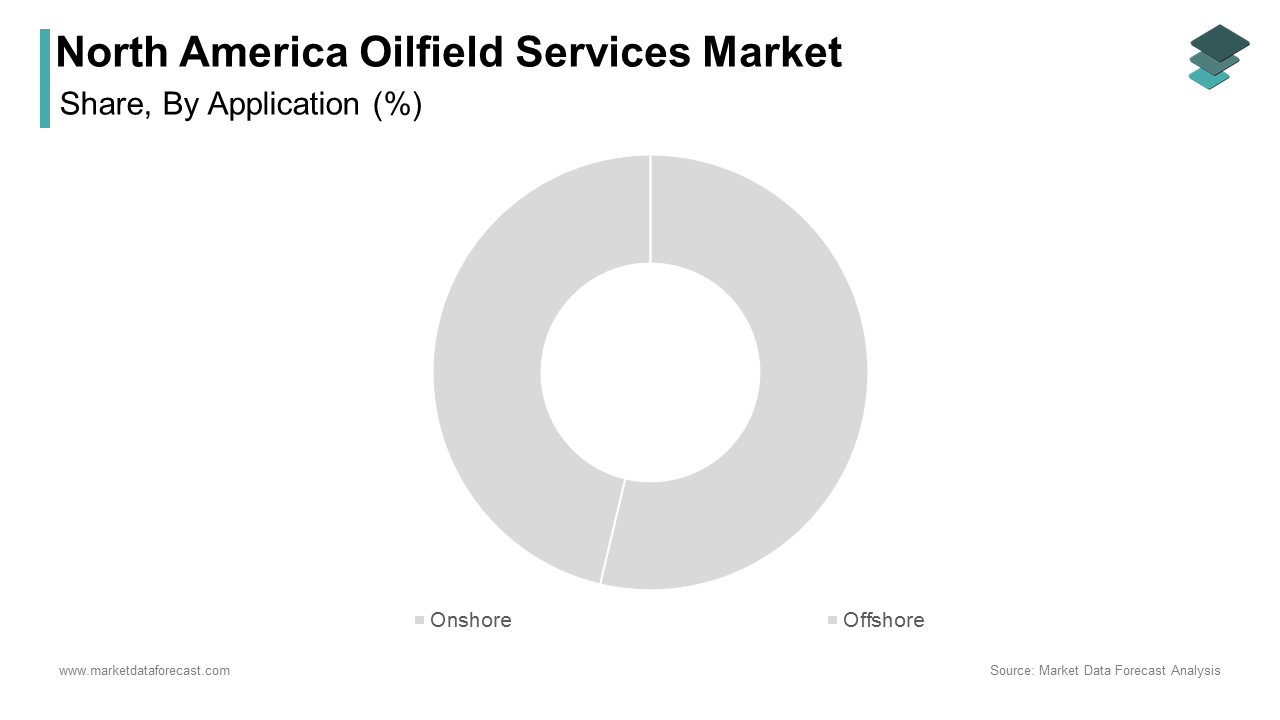
The onshore segment dominated the North America oilfield services market share in 2025 with the vast onshore shale reserves in the United States, particularly in the Permian, Eagle Ford, Bakken, and Marcellus basins. According to the U.S. Energy Information Administration, U.S. onshore oil production averaged 10.8 million barrels per day in 2023, accounting for over 90% of total domestic crude output. The continued growth in shale drilling and hydraulic fracturing activities is fuelling the growth of the North America oilfield services market. The Railroad Commission of Texas reported that in 2023, over 12,000 new wells were drilled in the Permian Basin alone, requiring extensive workover, completion, and production services. Additionally, the Canadian Association of Petroleum Producers noted that unconventional oil production in Canada, primarily from the Montney and Duvernay formations, increased by 6% in 2023.
The offshore segment is projected to register a CAGR of 5.9% from 2026 to 2034 with the renewed investment in deepwater exploration and production projects in the Gulf of Mexico and offshore Eastern Canada. According to the U.S. Bureau of Ocean Energy Management, offshore crude oil production averaged 1.7 million barrels per day in 2023, with major developments such as Chevron’s Ballymore and BP’s Kaskida Phase 2 entering active drilling and completion phases. Additionally, the Bureau of Safety and Environmental Enforcement reported that over 30 new offshore drilling permits were issued in 2023, signaling increased activity in deepwater basins.
By Service Insights
The completion services was accounted in holding 34.2% of the North America oilfield services market share in 2025. This segment’s dominance is primarily driven by the high volume of new well completions, particularly in shale-rich basins such as the Permian, Eagle Ford, and Bakken. According to the U.S. Energy Information Administration, over 9,000 horizontal wells were completed in the U.S. in 2023, requiring extensive hydraulic fracturing, casing, and perforation services. The Society of Petroleum Engineers reported that in 2023, over 70% of newly drilled wells in the U.S. utilized advanced fracturing methods, significantly increasing the need for mobile fracturing fleets and proppant logistics. Additionally, in Canada, the Alberta Energy Regulator noted that unconventional oil completions increased by 8% in 2023, particularly in the Montney and Duvernay formations.
The workover services segment is likely to grow with a projected CAGR of 6.3% during the forecast period. The National Petroleum Council reported in 2023 that workover activity in the Permian Basin increased by 14% compared to the previous year, as operators sought to enhance recovery from mature wells. The growing deployment of coiled tubing, downhole tools, and real-time diagnostics is further boosting demand for workover services.
By Type Insights
The equipment rental segment was the largest contributor of the North America oilfield services market with 58.3% of share in 2025 owing to the growing preference among oil and gas operators to lease specialized equipment rather than invest in capital-intensive purchases. According to the American Petroleum Institute, over 65% of independent oil producers in the U.S. rely on rental services for fracturing fleets, drilling rigs, and production equipment. The U.S. Bureau of Economic Analysis reported that capital expenditures by upstream operators declined by 5% in 2023, prompting increased reliance on rental solutions.
The field operation services segment is projected to grow with a CAGR of 6.1% from 2026 to 2034. This growth is primarily driven by the increasing complexity of oilfield operations and the need for continuous on-site technical support. According to the Society of Petroleum Engineers, over 40% of surveyed operators in North America reported a rise in demand for real-time monitoring and field supervision services in 2023. In Canada, Natural Resources Canada reported that field operation services are becoming more integral in oil sands and deepwater projects, where real-time decision-making and safety compliance are additionally, workforce shortages in remote locations are prompting operators to outsource field management to specialized service providers.
REGIONAL ANALYSIS
United States Oilfield Services Market Insights
The United States outperformed in the North American oilfield services market with 83.2% of total share in 2023 with the resurgence of shale drilling, with the Railroad Commission of Texas reporting over 12,000 new wells drilled in the Permian Basin alone in 2023. Additionally, the Gulf of Mexico remains a key offshore hub, with the Bureau of Ocean Energy Management indicating that offshore production contributed 1.7 million barrels per day. The expansion of enhanced oil recovery (EOR) projects and digital oilfield initiatives is further boosting demand for specialized services.
Canada Oilfield Services Market Insights
Canada oilfield services market held 17.3% of the share in 2025 with its vast oil sands reserves and unconventional shale plays in Western Canada. According to the Canadian Association of Petroleum Producers, oil sands production alone contributed over 3.5 million barrels per day in 2023, making it one of the largest contributors to the global oil supply. Additionally, offshore activity in Eastern Canada, particularly in the Newfoundland and Labrador region, is gaining momentum, with the Canada-Newfoundland and Labrador Offshore Petroleum Board noting that new exploration campaigns are underway in the Orphan Basin.
LEADING PLAYERS IN THE NORTH AMERICA OILFIELD SERVICES MARKET
Schlumberger Limited
Schlumberger is a global leader in oilfield services and holds a dominant position in the North America market. The company provides a comprehensive portfolio of technologies and services, including drilling, well construction, production, and reservoir characterization. Schlumberger plays a pivotal role in advancing digital transformation in upstream operations through its integrated software and automation solutions. Its commitment to innovation, sustainability, and operational efficiency has made it a preferred partner for major and independent oil operators across the region.
Halliburton Company
Halliburton is one of the largest oilfield service providers in North America, known for its expertise in drilling, formation evaluation, and hydraulic fracturing services. The company has a strong presence in key shale basins and offers tailored solutions that enhance well productivity and reduce operational downtime. Halliburton’s focus on research and development has led to breakthroughs in fracturing efficiency and subsurface analytics, which is positioning it as a key player in both conventional and unconventional oil and gas operations.
Baker Hughes, a GE Company (BHGE)
Baker Hughes is a major contributor to the North America oilfield services market, offering a broad range of equipment and services across the upstream value chain. The company has expanded its portfolio to include advanced drilling systems, turbomachinery, and automation technologies with a strong emphasis on digital integration and energy transition solutions. Its strategic partnerships and localized service networks have strengthened its market presence in unconventional plays and offshore developments.
TOP STRATEGIES USED BY KEY MARKET PARTICIPANTS
One of the primary strategies employed by leading oilfield service providers in North America is technology innovation and digital transformation . Companies are investing heavily in automation, artificial intelligence, and real-time data analytics to enhance operational efficiency, reduce downtime, and improve well productivity. These advancements allow for predictive maintenance, remote monitoring, and optimized resource allocation.
Another key strategy is strategic mergers, acquisitions, and partnerships. Major players are acquiring smaller, niche service providers or forming alliances with technology firms to expand their service offerings and geographic reach. These moves help in integrating complementary capabilities and strengthening customer relationships across different oil basins.
The sustainability and energy transition initiatives are shaping strategic decisions. Companies are developing low-carbon service offerings, investing in carbon capture technologies, and supporting electrification in field operations to align with global environmental goals and evolving regulatory landscapes in North America.
KEY MARKET PLAYERS AND COMPETITIVE OVERVIEW
Major Players of the North America Oilfield Services Market include Schlumberger Limited, Halliburton Company, Baker Hughes Company, Weatherford International plc, NOV Inc., TechnipFMC plc, Nabors Industries Ltd., Patterson-UTI Energy Inc., Precision Drilling Corporation, Basic Energy Services Inc., Superior Energy Services Inc., Key Energy Services Inc., Calfrac Well Services Ltd., Trican Well Service Ltd., RPC Inc
The North American oilfield services market is characterized by intense competition among a mix of global giants, regional players, and niche service providers. Established multinational firms such as Schlumberger, Halliburton, and Baker Hughes maintain a strong foothold due to their extensive technological capabilities, well-developed supply chains, and long-standing relationships with major oil producers. However, regional and independent service providers are increasingly gaining traction by offering cost-effective, localized solutions tailored to specific basin requirements. The market is witnessing a shift toward digital integration, automation, and sustainable practices by
prompting companies to differentiate themselves through innovation and service customization. Competition is also intensifying as firms seek to capture market share in high-growth segments such as workover services, offshore drilling support, and enhanced oil recovery. Additionally, the growing emphasis on environmental compliance and carbon reduction is reshaping service offerings, compelling companies to invest in cleaner technologies and operational efficiency.
RECENT HAPPENINGS IN THE MARKET
- In January 2025, Schlumberger launched a new digital well construction platform designed to improve drilling efficiency and reduce non-productive time, which is enhancing its competitive edge in North America’s shale basins.
- In March 2025, Halliburton introduced a next-generation fracturing fluid system that significantly lowers water usage and chemical dependency that aligns with growing environmental concerns and regulatory requirements.
- In May 2025, Baker Hughes partnered with a leading renewable energy firm to develop electrified wellsite solutions that aims to reduce carbon emissions in field operations and support the energy transition in North America.
- In August 2025, a major independent oilfield service provider acquired a regional well intervention company to expand its service footprint in the Permian Basin and strengthen its presence in the workover and completion segment.
- In October 2025, Halliburton announced a strategic collaboration with a U.S.-based AI analytics firm to integrate machine learning into reservoir modeling and production forecasting to improve decision-making for operators in unconventional plays.
MARKET SEGMENTATION
This research report on the North America oilfield services market has been segmented and sub-segmented based on application, service, type and region.
By Application
- Onshore
- Offshore
By Service
- Workover
- Completion Services
By Type
- Equipment Rental
- Field Operation
By Region
- US
- Canada
- Rest of North America