- Product Description Description
- Table of Contents TOC
- List of Table & Figure LOT
- Get Free Sample PDF Sample PDF
North America Paints and Coatings Market Size
The North America paints and coatings market size was valued at USD 43.15 billion in 2024, and the market size is expected to reach USD 60.26 billion by 2033 from USD 44.78 billion in 2025. The market's promising CAGR for the predicted period is 3.78%.
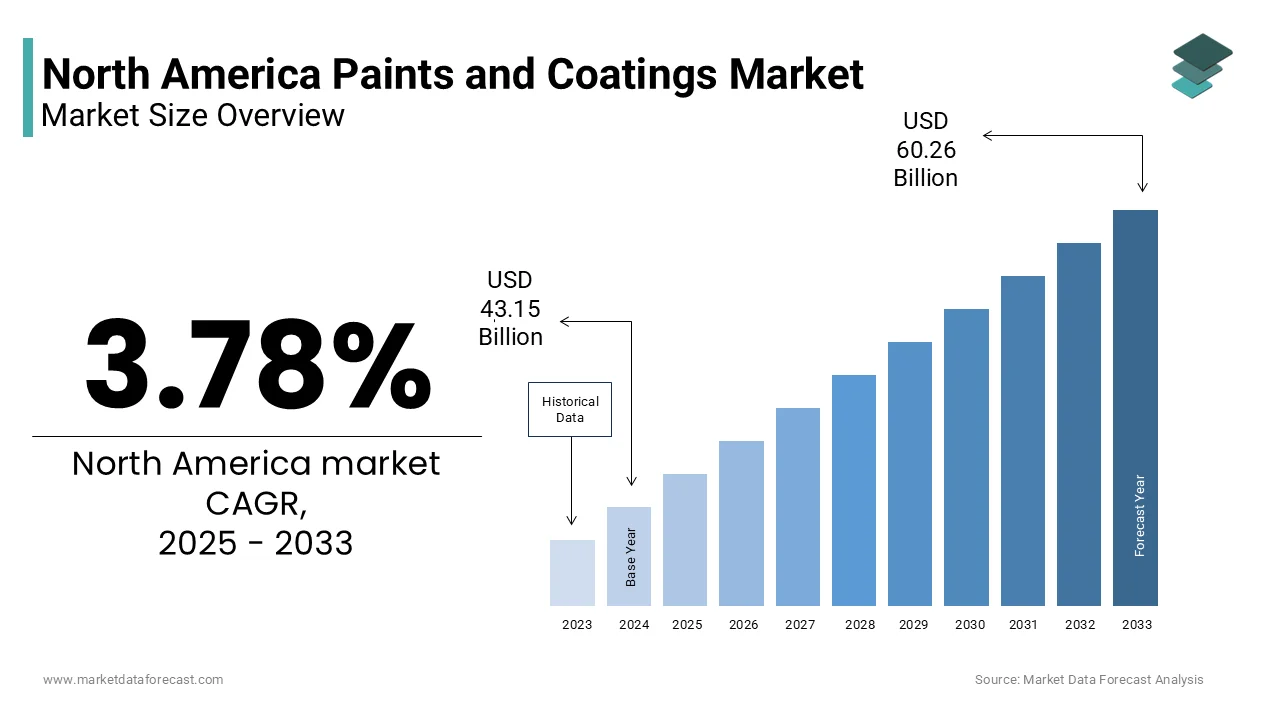
Paints and coatings are protective, decorative, and functional surface treatment solutions across diverse end-use sectors. This market encompasses formulations designed for architectural applications, industrial equipment, automotive components, marine structures, and specialty applications requiring specific performance characteristics such as corrosion resistance, UV protection, and antimicrobial properties. The industry's evolution reflects technological advancement toward sustainable formulations, regulatory compliance with environmental standards, and adaptation to emerging application requirements. According to the American Coatings Association, North American coating manufacturers operate within a regulatory framework that mandates volatile organic compound limitations while promoting innovation in water-based and powder coating technologies. The market's complexity stems from its integration with construction cycles, automotive production schedules, and industrial maintenance requirements that create fluctuating demand patterns throughout economic cycles.
MARKET DRIVERS
Infrastructure Development and Maintenance Requirements
Infrastructure renewal initiatives across North America constitute a fundamental demand catalyst for the paints and coatings market, driven by aging facility conditions and regulatory mandates for protective surface treatments. The American Society of Civil Engineers assigns North American infrastructure a cumulative grade of C-minus, indicating substantial deterioration requiring immediate attention across transportation networks, water systems, and public facilities. State-level initiatives amplify this demand. Municipal water treatment facilities alone require specialized epoxy and polyurethane coatings for a large number of storage tanks and pipeline systems, generating consistent demand for high-performance protective coatings that ensure regulatory compliance and operational safety standards.
Sustainable Coating Technology Adoption
Environmental regulatory evolution and consumer preference shifts toward sustainable products accelerate demand for advanced coating formulations that minimize environmental impact while maintaining performance standards. The United States Environmental Protection Agency's Architectural Coatings Rule establishes stringent volatile organic compound limitations across states, compelling manufacturers to develop water-based and high-solids formulations that reduce atmospheric emissions compared to traditional solvent-based systems. Consumer awareness regarding indoor air quality impacts drives residential coating demand toward zero-VOC formulations. Industrial facility managers increasingly specify powder coatings for equipment protection due to their 100% solids composition and zero emission characteristics. These sustainability imperatives create premium pricing opportunities for environmentally compliant coating manufacturers while establishing long-term market differentiation strategies.
MARKET RESTRAINTS
Raw Material Price Volatility
Commodity price fluctuations for petroleum-derived resins, titanium dioxide pigments, and specialty additives create significant margin compression challenges that constrain market growth potential across North American coating manufacturers. Titanium dioxide pigment shortages during 2022-2023 resulted in price increases, forcing coating manufacturers to implement double-digit price increases that reduced market demand volumes across architectural and industrial segments. Specialty additive suppliers, including rheology modifiers and UV stabilizers, face supply chain disruptions from geopolitical tensions that increase procurement costs while extending lead times beyond normal procurement cycles. Currency exchange rate fluctuations between Canadian dollar, Mexican peso, and US dollar create additional procurement complexity for North American coating manufacturers sourcing materials from international suppliers, with exchange rate variations impacting material costs annually. These cost pressures force manufacturers to maintain higher inventory levels to ensure supply continuity, increasing working capital requirements while reducing operational flexibility during market downturns.
Stringent Regulatory Compliance Requirements
Comprehensive environmental and safety regulations across North American jurisdictions impose substantial compliance costs and operational restrictions that limit market expansion opportunities for coating manufacturers and applicators. The Toxic Substances Control Act requires coating manufacturers to submit pre-manufacturing notifications for new chemical substances. California's Proposition 65 mandates warning labels for coating products containing reproductive toxins, requiring manufacturers to reformulate products or implement costly labeling systems that reduce market competitiveness in premium segments. The Occupational Safety and Health Administration's respirable crystalline silica standard requires coating applicators to implement engineering controls and respiratory protection when sandblasting surfaces, increasing project costs and extending project timelines according to the National Institute for Occupational Safety and Health. Cross-border regulatory harmonization challenges emerge as Canadian provinces implement distinct VOC limitations that differ from US state requirements, forcing manufacturers to maintain separate product inventories and labeling systems for regional compliance. The Department of Transportation's hazardous material transportation regulations classify many coating formulations as dangerous goods, requiring specialized shipping containers and documentation that increase distribution costs for coating distributors serving remote construction sites.
MARKET OPPORTUNITIES
Smart Coating Technology Integration
Advanced functional coating technologies incorporating sensing capabilities, self-healing properties, and adaptive performance characteristics create premium market opportunities for North American coating manufacturers targeting high-value applications. Self-healing polymer coatings that automatically repair micro-cracks extend protective performance life compared to conventional coatings, reducing maintenance costs and creating compelling value propositions for infrastructure owners managing a large number of bridge structures across North America. Antimicrobial coating formulations incorporating copper and silver nanoparticles address healthcare facility requirements for infection control. Military and aerospace applications require electromagnetic interference shielding coatings that incorporate conductive polymers and metal particles, representing specialized market segments with premium pricing structures per gallon for high-performance formulations. These advanced coating technologies command high price premiums compared to conventional products while establishing sustainable competitive advantages for early market entrants.
Digital Application and Color Matching Technologies
Digital transformation in coating application processes and color management systems creates operational efficiency opportunities that reduce waste, improve quality consistency, and enhance customer satisfaction across North American coating markets. Automated color matching systems utilizing spectrophotometric analysis reduce color formulation time while achieving high accuracy, enabling coating retailers to offer same-day custom color services that increase customer retention rates. Cloud-based project management platforms enable coating contractors to track material usage, application progress, and quality metrics across multiple job sites, improving operational visibility and reducing project completion times. Mobile application integration allows residential customers to visualize color options using augmented reality technology, increasing paint purchase conversion rates. Predictive maintenance algorithms analyze coating performance data to recommend optimal recoating schedules, reducing maintenance costs while extending asset life according to facility management consulting firm studies. These digital innovations create new revenue streams for coating manufacturers while establishing competitive differentiation through enhanced customer experience and operational efficiency improvements.
MARKET CHALLENGES
Skilled Labor Shortage and Training Requirements
Critical shortage of qualified coating applicators and technical specialists constrains market capacity expansion while increasing project costs and quality control risks across North American coating application sectors. Geographic distribution challenges emerge as coating application demand concentrates in metropolitan areas while training facilities remain dispersed across regions, increasing travel costs and program completion times. Language and cultural barriers affect training program effectiveness for immigrant workers comprising a portion of construction industry workforce, requiring specialized instruction methods that extend training duration while increasing program costs according to Department of Labor workforce statistics. These human capital constraints limit market capacity expansion while creating wage inflation pressures that increase coating application costs annually.
Supply Chain Disruption and Inventory Management Complexity
Global supply chain vulnerabilities and inventory optimization requirements create operational uncertainty that affects coating availability, pricing stability, and customer service levels across North American coating distribution networks. Port congestion at major North American entry points including Los Angeles and Vancouver creates variability in coating material arrival schedules, requiring distributors to implement dynamic inventory allocation strategies that increase working capital requirements. Natural disaster impacts including Hurricane Ian and Alberta wildfires disrupted coating supply chains, highlighting vulnerability of concentrated manufacturing facilities and distribution centers. Currency exchange rate volatility between US dollar and Chinese yuan affects coating additive procurement costs annually, creating pricing uncertainty that complicates customer contract negotiations and margin management according to the Federal Reserve's foreign exchange rate analysis. Cyber security threats targeting coating manufacturer and distributor information systems increased, creating additional investment requirements for supply chain protection systems and backup inventory locations. These supply chain complexities require coating companies to invest $2-5 million annually in supply chain management systems while accepting reduced operational efficiency compared to pre-pandemic performance levels.
REPORT COVERAGE
| REPORT METRIC | DETAILS |
| Market Size Available | 2024 to 2033 |
| Base Year | 2024 |
| Forecast Period | 2025 to 2033 |
| CAGR | 3.78% |
| Segments Covered | By Resin Type, Technology, End-User, and Region |
|
Various Analyses Covered | Regional & Country Level Analysis, Segment-Level Analysis, DROC, PESTLE Analysis, Porter’s Five Forces Analysis, Competitive Landscape, Analyst Overview on Investment Opportunities |
| Regions Covered | The United States, Canada, Mexico, and Rest of North America |
| Market Leaders Profiled | The Sherwin-Williams Company, PPG Industries, Inc., RPM International Inc., Masco Corporation, and others |
SEGMENTAL ANALYSIS
By Resin Type Insights
The Acrylic resins segment dominated North America's paints and coatings market by commanding a 35.4% of the total share valued in 2024. This leadership position is due to acrylics' exceptional versatility across diverse applications and superior performance characteristics that meet evolving customer requirements. The fundamental driver behind acrylic resin market dominance is their overwhelming preference in residential and commercial architectural coating applications. Acrylic latex paints provide superior color retention, alkali resistance, and moisture vapor permeability essential for interior and exterior wall coating applications. Commercial building maintenance programs increasingly utilize acrylic elastomeric coatings for roof waterproofing applications. These applications benefit from acrylic resins' exceptional UV stability that maintains color retention after 10 years of exterior exposure according to ASTM D418 testing protocols.
Acrylic resins' adaptability across diverse industrial applications creates additional market opportunities that expand beyond architectural segments, contributing significantly to overall market dominance. Industrial maintenance coating specifications increasingly favor acrylic formulations for equipment protection applications due to their excellent adhesion to multiple substrate types including steel, concrete, and plastic materials. Automotive refinish coating applications utilize acrylic urethane formulations for their exceptional gloss retention and chemical resistance properties. Marine coating applications benefit from acrylic resin formulations modified with fluoropolymer additives that provide 15-year service life in harsh saltwater environments according to International Maritime Organization performance standards. This industrial versatility enables acrylic resin manufacturers to achieve economies of scale that reduce production costs compared to specialized resin systems, creating competitive pricing advantages that further reinforce market leadership positions.
The polyurethane resins segment emerge as the fastest-growing segment in North America's paints and coatings market and is projected to achieve a CAGR of 6.2% through 2033. The accelerated expansion of this segment reflects increasing demand for high-performance coating systems that provide exceptional durability and specialized functional properties. The main catalyst driving polyurethane resin growth is the automotive and aerospace industries' intensified demand for protective coating systems that withstand extreme operating conditions while maintaining aesthetic appearance. Original equipment manufacturers specify polyurethane clear coat systems for automotive exterior applications due to their exceptional scratch resistance and gloss retention properties after years of service. Industrial equipment manufacturers increasingly specify polyurethane elastomer coatings for pump housings and pipeline systems due to their superior abrasion resistance that extends service life compared to conventional epoxy systems. Marine vessel manufacturers favor polyurethane deck coatings for their slip-resistant properties and chemical resistance to fuel and lubricant exposure. These demanding performance requirements command premium pricing structures, with polyurethane coating systems priced higher than conventional alternatives while generating superior profit margins for coating manufacturers.
Polyurethane resins' molecular versatility enables formulation of coating systems with precisely tailored performance characteristics that address specific application requirements across diverse end-use markets. Chemical modification techniques allow polyurethane manufacturers to produce formulations ranging from rigid protective films to flexible elastomeric coatings suitable for expansion joint applications. Medical device manufacturers specify biocompatible polyurethane coatings for implantable device applications. Flooring system applications utilize polyurethane formulations modified with antimicrobial additives for healthcare facility installations. This formulation flexibility enables coating manufacturers to develop proprietary product lines that differentiate market positioning while commanding premium pricing premiums that support continued research and development investment in advanced polyurethane technologies.
By Technology Insights
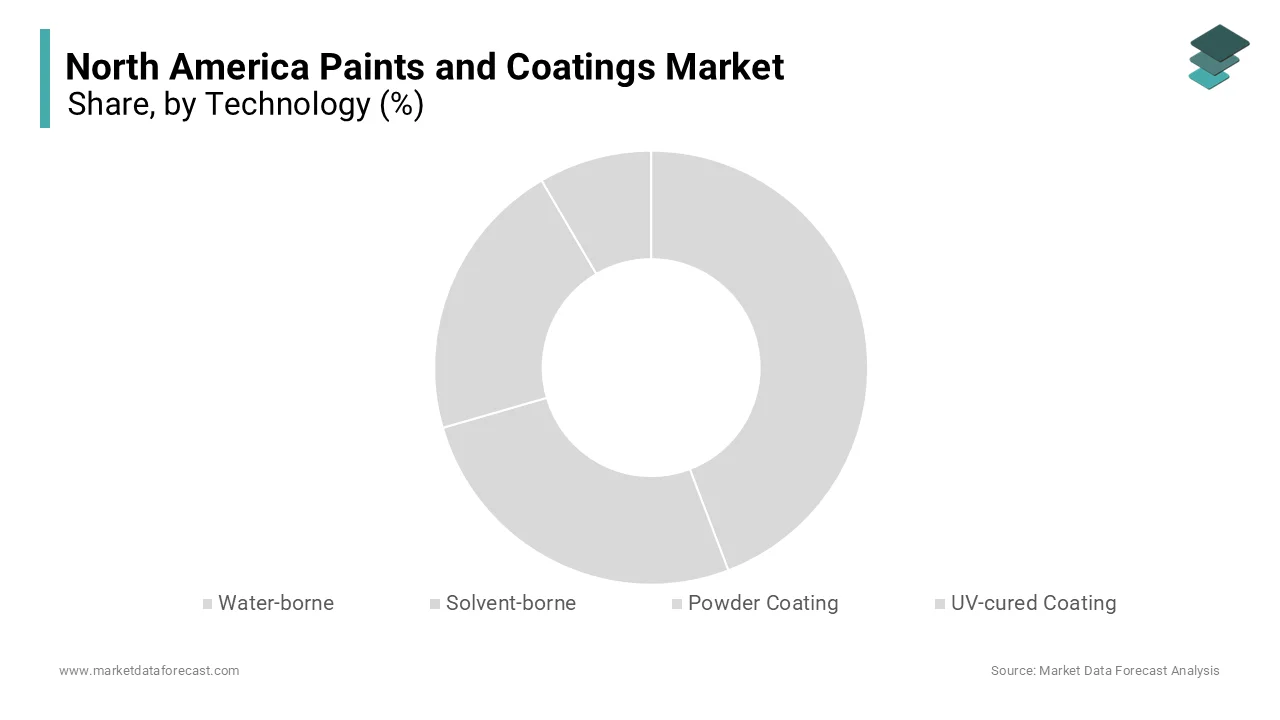
The water-borne coating technology segment maintained led position in North America's paints and coatings market by representing a 56.4% of total volume in 2024. This overwhelming market share reflects regulatory compliance advantages and performance improvements that establish water-borne systems as preferred choices across diverse application sectors. The fundamental driver behind water-borne coating technology dominance is comprehensive regulatory acceptance across North American jurisdictions that mandate volatile organic compound limitations for environmental protection initiatives. The regulatory advantages enable water-borne coating manufacturers to access market segments closed to solvent-borne competitors while maintaining competitive pricing structures that support continued market expansion.
Continuous technological advancement in water-borne coating formulations addresses historical performance limitations while expanding application opportunities across demanding end-use markets. Modern water-borne acrylic formulations achieve gloss retention after years of exterior exposure, matching solvent-borne performance. Automotive original equipment manufacturers increasingly specify water-borne basecoat systems for vehicle finishing operations due to improved color development and reduced environmental impact. Industrial coating applications benefit from water-borne polyurethane formulations that cure at ambient temperatures while providing chemical resistance properties exceeding conventional systems. These performance improvements eliminate traditional barriers to water-borne coating adoption while supporting premium pricing structures that generate superior profit margins compared to commodity coating products.
The powder coating technology segment emerges as the fastest-growing coating application method in North America and is projected to achieve a CAGR of 7.1% through 2033. This accelerated expansion reflects increasing recognition of powder coating advantages including zero volatile organic compound emissions and exceptional durability characteristics. The primary catalyst propelling powder coating growth is the automotive and appliance manufacturing industries' intensified focus on environmental sustainability and regulatory compliance initiatives. Automotive wheel manufacturers achieve reduction in coating waste through powder recovery systems. These environmental advantages enable powder coating applicators to access premium market segments while commanding pricing premiums that exceed liquid coating alternatives.
Powder coating systems provide exceptional mechanical and chemical resistance properties that exceed conventional liquid coating performance in demanding applications across industrial and consumer markets. Powder coatings achieve greater impact resistance compared to liquid coatings, making them ideal for automotive wheel and construction equipment applications requiring superior chip resistance. Metal furniture manufacturers specify powder coating for outdoor applications due to superior UV stability and color retention properties. These performance advantages enable powder coating applicators to command premium pricing while reducing warranty claims and maintenance costs for end-users, creating sustainable competitive advantages that support continued market expansion.
By End-User Insights
The architectural coatings segment represented the dominant end-use segment in North America's paints and coatings market by commanding a 45.4in 2024. This leadership position reflects the essential nature of architectural coatings in residential construction, commercial building maintenance, and infrastructure preservation activities. The fundamental driver behind architectural coating dominance is the consistent demand generated by North America's residential construction market, which requires coating applications for new building completion and existing structure maintenance activities. Multi-family housing development projects specify premium architectural coatings for common areas and exterior surfaces. Regional climate variations influence coating selection patterns, with northern states favoring premium acrylic formulations for freeze-thaw resistance while southern states specify elastomeric coatings for crack bridging applications. These consistent demand patterns enable architectural coating manufacturers to maintain stable production schedules while investing in research and development initiatives that support product innovation and market expansion.
Commercial facility management programs create substantial coating demand through systematic maintenance and refurbishment activities that preserve building asset values while maintaining occupant satisfaction standards. Office building management companies specify premium architectural coatings for interior spaces due to low odor characteristics and rapid drying properties that minimize tenant disruption during renovation activities. Educational institution maintenance programs require specialized coating formulations for gymnasiums and cafeterias that provide enhanced durability and easy cleaning characteristics. Healthcare facility coating specifications mandate antimicrobial and easy-to-clean formulations for patient care areas. These institutional purchasing patterns create stable demand opportunities that enable coating manufacturers to develop specialized product lines while maintaining consistent market share positions across economic cycles.
The protective coatings segment emerge as the fastest-growing end-use in North America's paints and coatings market and is projected to achieve a CAGR of 6.8% through 2033. This accelerated expansion reflects increasing infrastructure preservation requirements and industrial facility modernization initiatives that demand high-performance coating systems. The primary catalyst driving protective coating growth is comprehensive infrastructure renewal programs across North American municipalities and transportation authorities that require specialized coating systems for bridge, tunnel, and highway preservation activities. Municipal water treatment facilities require specialized coating systems for 15,000 storage tanks and pipeline systems, with the American Water Works Association documenting $8 billion annual investment in water infrastructure preservation that includes significant protective coating specification requirements. These infrastructure investments create stable demand opportunities that enable protective coating manufacturers to develop specialized product lines while maintaining consistent market expansion rates.
Industrial manufacturing facilities increasingly specify high-performance protective coatings for equipment protection and facility maintenance applications due to enhanced durability and reduced maintenance requirements that support operational efficiency objectives. Chemical processing facilities require specialized coating systems resistant to aggressive chemical exposure. Power generation facilities utilize specialized coating systems for cooling tower and boiler applications. These industrial applications command premium pricing structures while generating superior profit margins that support continued research and development investment in advanced protective coating technologies.
REGIONAL ANALYSIS
United States
The United States maintained absolute dominance in North America's paints and coatings market by commanding a substantial portion in 2024. This overwhelming market position reflects the country's status as North America's primary manufacturing hub and its extensive integrated supply chain infrastructure. The United States paints and coatings market dominance originates from the country's unparalleled concentration of coating manufacturing facilities and raw material suppliers that create comprehensive supply chain ecosystems supporting diverse end-use applications. Ohio, Pennsylvania, and Illinois form the core of America's coating manufacturing heartland, hosting major facilities including PPG Industries' Cleveland operations, Sherwin-Williams' Cleveland facility, and RPM International's Medina headquarters. These infrastructure advantages enable U.S. coating manufacturers to achieve economies of scale that reduce production costs compared to Canadian counterparts while maintaining superior product quality standards that support premium pricing structures.
American position in the paints and coatings market extends beyond production volume to encompass regulatory framework development and compliance infrastructure that establishes industry standards for North American markets. The United States Environmental Protection Agency's Architectural Coatings Rule establishes volatile organic compound limitations that influence coating formulation development across North America, with California's South Coast Air Quality Management District implementing the nation's most restrictive coating regulations that affect product development strategies for major coating manufacturers. The Consumer Product Safety Commission establishes lead content limitations for residential coating applications, requiring manufacturers to implement comprehensive quality control systems that ensure regulatory compliance while maintaining product performance standards. These regulatory leadership positions enable U.S. coating manufacturers to develop compliant product lines that access premium market segments while maintaining competitive pricing advantages that support continued market expansion.
Canada
Canada maintains a significant secondary position in North America's paints and coatings market. This market share reflects Canada's strategic role as a specialized supplier of environmentally compliant coating formulations and its integration within North America's broader manufacturing ecosystem. Canada's paints and coatings market strength lies in its specialization in environmentally compliant coating formulations that align with global sustainability trends and regulatory requirements across North American jurisdictions. Ontario's coating manufacturing cluster, centered in Mississauga and Brampton, focuses heavily on water-borne and powder coating technologies that meet stringent volatile organic compound limitations established by Environment and Climate Change Canada regulations. Quebec's manufacturing facilities specialize in low temperature curing coating formulations that reduce energy consumption during application processes. These environmental specialization advantages enable Canadian coating manufacturers to access premium market segments while maintaining competitive positioning against larger U.S. competitors through technological differentiation and regulatory compliance expertise.
Canada's paints and coatings market success depends heavily on seamless integration with U.S. coating supply chains and strong export orientation that leverages North American trade relationships and international market access opportunities. Canadian coating manufacturers supply specialized formulations to major U.S. coating distributors including Sherwin-Williams and Home Depot, often operating as strategic suppliers within integrated manufacturing networks that require specialized product capabilities and quality assurance systems. This trade integration extends beyond North America through Canada's participation in the Comprehensive and Progressive Agreement for Trans-Pacific Partnership, which facilitates coating exports to Japan, Australia, and Vietnam with reduced tariff structures that enhance international competitiveness. These export advantages enable Canadian coating manufacturers to achieve economies of scale that reduce production costs while maintaining premium pricing structures that support continued research and development investment in advanced coating technologies.
KEY MARKET PLAYERS AND COMPETITIVE LANDSCAPE
The Sherwin-Williams Company, PPG Industries, Inc., RPM International Inc., Masco Corporation are playing dominating role in the North American paints and coatings market.
The North American paints and coatings market exhibits intense competitive dynamics characterized by established market leaders maintaining dominant positions through comprehensive product portfolios and extensive distribution networks. Competition intensifies across premium segments where technological innovation and sustainable formulation capabilities create differentiation opportunities. Regional coating manufacturers compete effectively in local markets through customer relationships and specialized application expertise that challenge national players' market share positions. Price competition remains significant in commodity coating segments where product differentiation opportunities are limited and customer purchasing decisions primarily focus on cost considerations. Strategic consolidation activities continue as larger manufacturers acquire specialized coating companies to expand capabilities and eliminate competitive threats while achieving operational synergies. Market participants increasingly focus on value-added services and technical support capabilities to differentiate offerings and strengthen customer relationships. Digital transformation initiatives create new competitive dimensions where technology adoption rates influence market positioning and customer engagement effectiveness. Sustainability compliance requirements favor established manufacturers with comprehensive regulatory expertise and formulation capabilities that can efficiently navigate complex compliance requirements.
TOP PLAYERS IN THE MARKET
PPG Industries Inc.
PPG Industries stands as North America's leading coatings manufacturer with extensive global operations spanning automotive, architectural, industrial, and specialty coatings segments. The company's technological innovation in protective coatings and advanced color technologies has established market leadership across multiple end-use applications. PPG's commitment to sustainable coating solutions and digital color matching systems positions it at the forefront of industry advancement. The company's global presence enables it to leverage North American manufacturing excellence while serving international markets with locally adapted formulations. Strategic acquisitions and research partnerships have strengthened PPG's position in emerging coating technologies including smart coatings and self-healing formulations. The organization's focus on customer-centric solutions and technical support services creates sustainable competitive advantages in premium market segments.
Sherwin-Williams Company
The Sherwin-Williams Company maintains dominant market position through comprehensive retail network operations and specialized industrial coating solutions that serve diverse customer requirements across North America. The company's integrated business model combines manufacturing excellence with extensive distribution capabilities through company-owned stores and distributor partnerships. Sherwin-Williams' expertise in architectural coatings and protective systems for infrastructure applications establishes strong market presence in both residential and commercial sectors. The organization's commitment to product innovation and customer service excellence has enabled consistent market share growth across multiple coating categories. Strategic expansion into international markets and specialized industrial applications has diversified revenue streams while reducing dependence on cyclical construction markets. The company's focus on sustainable coating technologies and regulatory compliance positions it favorably for future market opportunities.
AkzoNobel N.V.
AkzoNobel represents significant presence in North America's coatings market through specialized industrial and marine coating applications that require advanced technical expertise and performance characteristics. The company's global research capabilities and sustainable chemistry focus differentiate its product offerings in premium market segments requiring specialized performance properties. AkzoNobel's expertise in protective coatings for harsh environments and marine applications creates strong market position in infrastructure and maritime sectors. The organization's commitment to circular economy principles and bio-based coating formulations aligns with evolving customer sustainability requirements. Strategic partnerships with major industrial customers and infrastructure developers have established long-term contractual relationships that provide stable revenue streams. The company's focus on digital solutions and predictive maintenance technologies enhances customer value while strengthening market relationships.
TOP STRATEGIES USED BY KEY PLAYERS
Strategic Acquisitions and Partnerships Leading coating manufacturers actively pursue acquisition strategies to expand product portfolios, enhance technological capabilities, and strengthen market presence across specialized application segments. These strategic initiatives enable companies to access new customer bases, acquire proprietary technologies, and eliminate competitive threats while achieving operational synergies. Partnership arrangements with raw material suppliers and technology developers provide access to innovative formulations and sustainable chemistry solutions that differentiate market positioning. Joint venture structures facilitate entry into emerging market segments and geographic regions while sharing investment risks and development costs. These collaborative approaches enable coating manufacturers to accelerate innovation cycles while maintaining competitive cost structures and expanding market reach through complementary business relationships.
Sustainable Product Innovation Coating manufacturers prioritize development of environmentally compliant formulations that meet evolving regulatory requirements while maintaining superior performance characteristics across diverse application requirements. Investment in water-borne, powder coating, and bio-based formulations addresses customer sustainability objectives while ensuring regulatory compliance across multiple jurisdictions. Research initiatives focus on reducing volatile organic compound content, eliminating hazardous materials, and developing recyclable coating systems that support circular economy principles. Life cycle assessment methodologies guide product development decisions to minimize environmental impact throughout coating application and service life cycles. These sustainability initiatives create premium pricing opportunities while establishing long-term competitive advantages through regulatory compliance and customer preference alignment.
Digital Transformation and Customer Experience Enhancement Leading coating manufacturers implement comprehensive digital solutions to enhance customer engagement, optimize supply chain operations, and improve application efficiency across diverse market segments. Online color selection tools, mobile application integration, and augmented reality visualization systems improve customer purchasing decisions while reducing return rates and increasing satisfaction levels. Predictive maintenance algorithms and performance monitoring systems provide value-added services that strengthen customer relationships while creating recurring revenue opportunities. Supply chain digitization enables real-time inventory management, automated reordering systems, and optimized delivery scheduling that reduce operational costs while improving service levels. These digital initiatives create sustainable competitive advantages through enhanced customer experience and operational efficiency improvements.
RECENT HAPPENINGS IN THE MARKET
- In March 2024, PPG Industries acquired Versatile Solutions LLC, a specialty coatings manufacturer focusing on industrial maintenance applications. This acquisition is anticipated to strengthen PPG's position in the protective coatings segment and expand its industrial customer base.
- In January 2024, The Sherwin-Williams Company completed the acquisition of Consulco Holdings, a European decorative paints distributor with significant North American operations. This acquisition is expected to enhance Sherwin-Williams' international supply chain capabilities and expand its premium decorative coatings market reach.
- In November 2023, AkzoNobel N.V. partnered with Microsoft Corporation to implement advanced digital solutions for predictive maintenance and customer relationship management. This partnership is anticipated to improve operational efficiency and enhance customer service delivery across North American coating operations.
- In August 2023, PPG Industries launched its new Digital Color Center platform, integrating artificial intelligence and machine learning technologies for advanced color matching and formulation optimization. This initiative is expected to strengthen PPG's competitive position in the architectural coatings market through enhanced customer experience.
- In June 2023, The Sherwin-Williams Company announced strategic partnership with Home Depot Inc. to expand exclusive product offerings and co-develop sustainable coating formulations for residential applications. This partnership is anticipated to strengthen both companies' market positions in the premium residential coatings segment.
MARKET SEGMENTATION
This research report on the North America paints and coatings market has been segmented and sub-segmented based on the following categories.
By Resin Type
- Acrylics
- Alkyd
- Epoxy
- Polyester
- Polyurethane
- Other Resin Types
By Technology
- Water-borne
- Solvent-borne
- Powder Coating
- UV-cured Coating
By End-user
- Architectural
- Automotive
- Wood
- Protective Coatings
- General Industrial
- Transportation
- Packaging
By Country
- The United States
- Canada
- Rest of North America