North America Paperboard Packaging Market Size, Share, Trends & Growth Forecast Report By Grade (Carton board, Container board, Other Grades), Product Type, End Use And Country (US, Canada, And Rest Of North America), Industry Analysis From 2025 To 2033
North America Paperboard Packaging Market Size
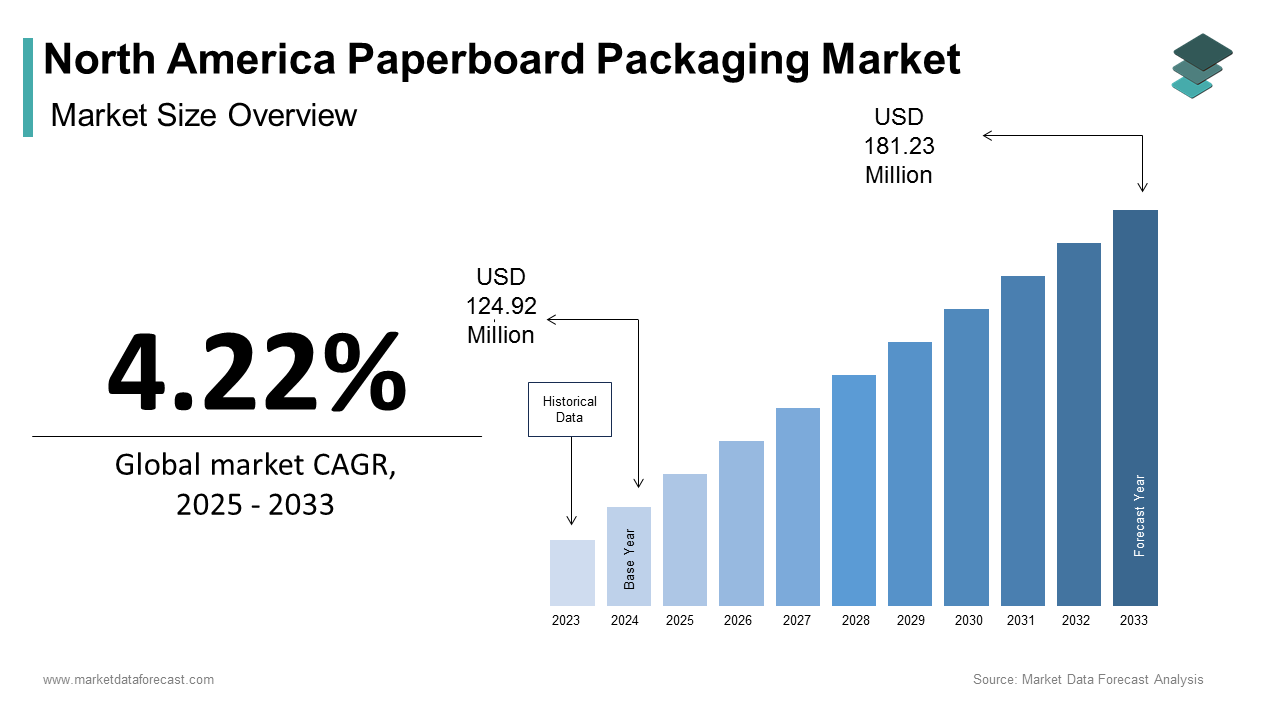
The North America Paperboard Packaging Market Size was calculated to be USD 124.92 million in 2024 and is anticipated to be worth USD 181.23 million by 2033, from USD 130.19 million in 2025, growing at a CAGR of 4.22% during the forecast period.
The paperboard packaging is a sophisticated sector within the broader packaging industry, encompassing the production and utilization of paper-based materials for various protective, promotional, and logistical applications. Paperboard is defined as a thick paper-based material with basis weight exceeding 120 grams per square meter, serves as a fundamental packaging substrate for consumer goods, food and beverage products, pharmaceuticals, and industrial applications across the United States, Canada, and Mexico. As per the Environmental Protection Agency, paperboard constitutes approximately 31% of municipal solid waste generation in the United States, highlighting its ubiquitous presence in daily consumer activities. The market encompasses various paperboard grades including corrugated board, folding cartons, and specialty papers, each serving distinct functional requirements. Manufacturing facilities across the region operate under stringent environmental regulations and sustainability standards that influence production processes and material sourcing decisions.
MARKET DRIVERS
E-commerce Packaging Demand Surge
The expansion of e-commerce activities has fundamentally transformed the packaging requirements across North America by creating substantial demand for paperboard-based protective packaging solutions. As per the U.S. Census Bureau, e-commerce sales reached $279.7 billion in the fourth quarter of 2023, representing a sustained shift in consumer purchasing behavior that requires extensive packaging materials for product protection and shipping. Each e-commerce transaction typically requires 2-3 times more packaging material than traditional retail purchases due to individual item protection and shipping container requirements. According to the National Retail Federation, online retail sales are projected to maintain growth rates exceeding 8% annually through 2025, ensuring continued expansion of paperboard packaging demand.
Sustainable Packaging Consumer Preferences
The growing environmental consciousness has created significant demand for sustainable paperboard packaging solutions that align with corporate sustainability objectives and regulatory requirements. As per the Shelton Group, 73% of North American consumers are willing to pay premium prices for products packaged in environmentally responsible materials, directly influencing brand owner packaging decisions. The Environmental Protection Agency reports that paperboard recycling rates exceed 89% in the United States, making it one of the most recycled packaging materials and supporting circular economy principles. According to the Paper and Packaging Board, 80% of consumers view paper-based packaging as more environmentally friendly than plastic alternatives, creating market preference for paperboard solutions. The Consumer Brands Association indicates that over 75% of Fortune 500 companies have established packaging sustainability commitments that prioritize renewable, recyclable, and compostable materials including paperboard. As per the Ellen MacArthur Foundation, the global shift toward circular economy principles has accelerated corporate investment in sustainable packaging materials by 35% annually.
MARKET RESTRAINTS
Raw Material Cost Volatility and Supply Chain Disruptions
The fluctuating raw material costs and supply chain disruptions is restricting the growth of the Latin America Sports Sunglasses Market. As per the Forest Products Association of Canada, energy costs constitute approximately 15-20% of total paperboard production expenses, with natural gas and electricity price fluctuations directly impacting manufacturing margins. According to the American Trucking Associations, driver shortages and fuel price volatility have resulted in delivery delays of 7-14 days for critical raw materials including pulp, chemicals, and additives. The Bureau of Labor Statistics indicates that labor costs in paperboard manufacturing have increased by 12% annually over the past three years, compounding operational expense pressures.
Regulatory Compliance and Environmental Standards
The stringent environmental regulations and compliance requirements have created operational complexities and increased costs for paperboard packaging manufacturers is also to restrict the growth of the Latin America Sports Sunglasses Market. As per the Occupational Safety and Health Administration, workplace safety regulations have become increasingly complex, requiring manufacturers to invest in employee training programs and safety equipment that increase operational expenses. The Securities and Exchange Commission's climate disclosure requirements have increased reporting burdens for publicly traded packaging companies, necessitating additional administrative resources and third-party verification services.
MARKET OPPORTUNITIES
Smart Packaging Technology Integration
The integration of smart packaging technologies with traditional paperboard substrates is creating opportunities for the growth of the North American paperboard packaging market. According to the Association for Packaging and Processing Technologies, over 60% of major brand owners plan to implement smart packaging solutions by 2026 to enhance consumer engagement and product security. As per the Flexible Packaging Association, smart packaging technologies can reduce product waste by 15-20% through improved inventory management and expiration date monitoring capabilities.
Circular Economy and Recyclable Packaging Solutions
The transition toward circular economy principles and recyclable packaging solutions is anticipated to fuel the growth of the North American paperboard packaging market. As per the Ellen MacArthur Foundation, the global shift toward circular economy models is expected to create $4.5 trillion in economic opportunities by 2030, with paperboard packaging positioned to capture significant value through recyclability and renewable sourcing. According to the How2Recycle program, 89% of North American consumers actively seek recyclable packaging options by creating market demand for clearly labeled and easily processed paperboard solutions. The development of mono-material paperboard structures that eliminate mixed-material laminated enables improved recycling efficiency and supports municipal recycling program objectives.
MARKET CHALLENGES
Competition from Alternative Packaging Materials
Intense competition from alternative packaging materials including plastics, metals, and composite materials is limiting the growth of the North American paperboard packaging market's growth potential and pricing power. The American Chemistry Council reports that flexible plastic packaging maintains a 45% market share in North American packaging applications, with lightweight properties and barrier performance characteristics that compete directly with paperboard solutions. Metal packaging manufacturers have introduced lightweight aluminum containers that offer superior barrier protection and recyclability compared to traditional paperboard alternatives. The rise of biodegradable plastic materials has created confusion among consumers and brand owners regarding optimal sustainable packaging choices. According to the Flexible Packaging Association, flexible packaging solutions offer cost advantages of 20-30% compared to equivalent paperboard structures in certain applications. The development of plant-based plastic alternatives has accelerated, with companies like NatureWorks and Braskem introducing bio-based materials that compete with renewable paperboard substrates.
Energy Transition and Carbon Neutrality Requirements
The transition toward carbon-neutral manufacturing operations and renewable energy sources is impeding the growth of the North American paperboard packaging manufacturers. As per the Science Based Targets initiative, over 200 major packaging companies have committed to achieving net-zero emissions by 2040, which is requiring substantial investments in renewable energy infrastructure and process modifications. The transition from natural gas to renewable energy sources increases manufacturing costs by 25-40% according to the Renewable Energy Buyers Alliance, creating competitive disadvantages for early adopters. According to the Carbon Trust, paperboard manufacturers must reduce Scope 1 and Scope 2 emissions by 90% to achieve carbon neutrality, necessitating fundamental changes to production processes and facility operations. The lack of standardized carbon accounting methodologies creates confusion among manufacturers regarding compliance requirements and reporting obligations.
REPORT COVERAGE
| REPORT METRIC | DETAILS |
| Market Size Available | 2024 to 2033 |
| Base Year | 2024 |
| Forecast Period | 2025 to 2033 |
| CAGR | 4.22% |
| Segments Covered | By Grade, Product Type, End Use, And Region |
| Various Analyses Covered | Global, Regional & Country Level Analysis; Segment-Level Analysis; DROC, PESTLE Analysis; Porter’s Five Forces Analysis; Competitive Landscape; Analyst Overview of Investment Opportunities |
| Regions Covered | Us, Canada, and the Rest of North America |
| Market Leaders Profiled | International Paper Company, WestRock Company, Packaging Corporation of America, Smurfit Westrock (Smurfit Kappa + WestRock), Graphic Packaging International, DS Smith Plc, Mondi plc, Georgia‑Pacific LLC, Sonoco Products Company, Cascades Inc. |
SEGMENTAL ANALYSIS
By Grade Insights
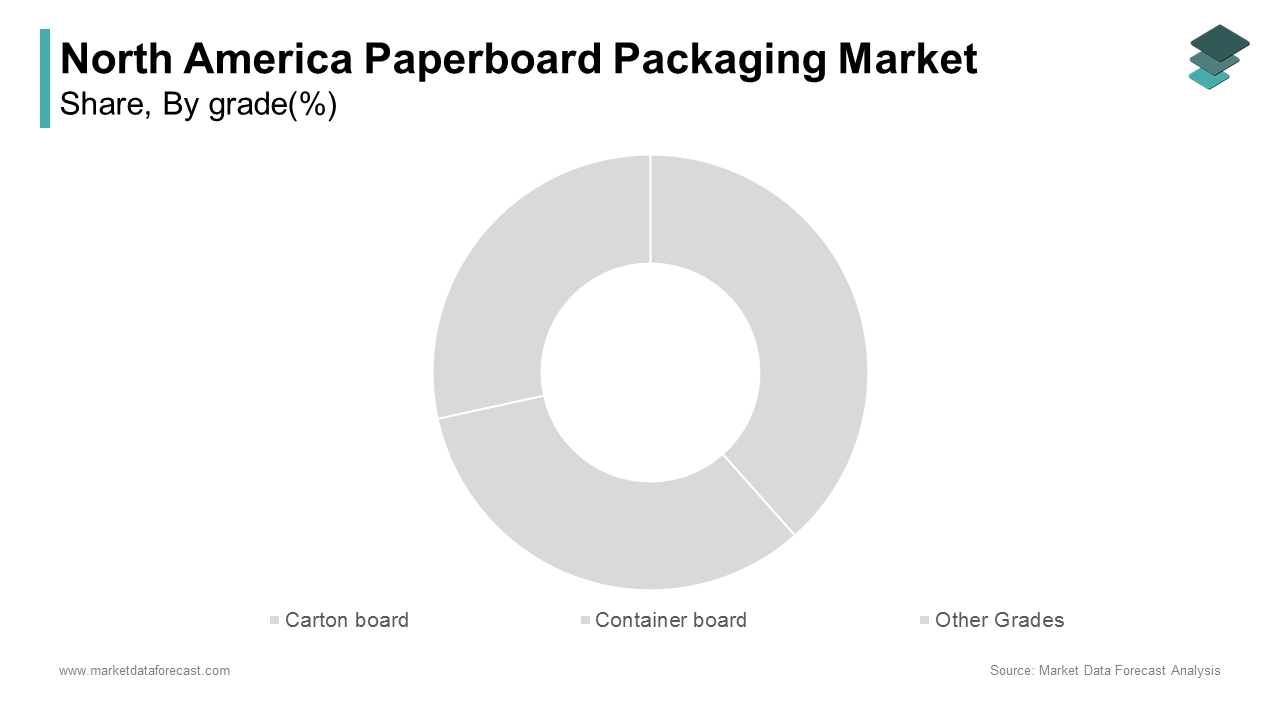
The containerboard segment held a dominant share of the North America paperboard packaging market in 2024. The explosive expansion of e-commerce has created unprecedented demand for containerboard packaging, establishing this grade as the market leader throughout North America. The shift toward direct-to-consumer delivery models has created new requirements for corrugated boxes that can withstand multiple handling cycles and provide product protection during transit.
The cartonboard segment is likely to grow with an expected to grow with a CAGR of 4.8% from 2025 to 2033 with the rapid expansion of cartonboard applications throughout North America. Modern consumers increasingly value packaging aesthetics and functionality as key purchase decision factors, creating demand for high-quality cartonboard solutions that enhance product appeal and communicate brand values. A 2023 consumer behavior study by Mintel revealed that premium packaging increases perceived product value by an average of 31%, driving brand investment in high-quality cartonboard solutions. The integration of sustainable packaging messaging and eco-friendly materials has enhanced the appeal of cartonboard among environmentally conscious consumers. The American Marketing Association reports that 68% of premium brand launches in 2023 featured innovative cartonboard packaging as a key differentiator. The development of smart packaging technologies, including QR codes and NFC tags integrated into cartonboard structures, has enhanced consumer engagement and brand interaction. Luxury retail chains and specialty stores have increasingly specified cartonboard packaging to maintain brand consistency and premium positioning.
By Product Type Insights
The corrugated boxes segment was accounted in holding 58.3% of the North America paperboard packaging market share in 2024 with the supply chain protection and damage prevention has solidified corrugated boxes as the dominant product type in the North America paperboard packaging market. The superior protective characteristics of corrugated packaging, including impact absorption, compression resistance, and vibration damping, make it the preferred choice for manufacturers seeking to minimize product damage during transportation and handling. According to the National Institute for Occupational Safety and Health, corrugated packaging reduces product damage rates by 42% compared to alternative packaging solutions, translating to significant cost savings for manufacturers and retailers. The versatility of corrugated box design allows for custom engineering solutions that address specific product protection requirements, from fragile electronics to heavy industrial components. The integration of automated packaging lines and robotic handling systems has intensified requirements for standardized corrugated box specifications that can interface with modern manufacturing processes. The development of water-resistant and moisture-barrier corrugated materials has expanded application possibilities in challenging environments and extended product shelf life.
The folding cartons segment is anticipated to register a CAGR of 5.2% from 2025 to 2033 with the growing emphasis on consumer brand experience and retail appeal has become the primary catalyst driving the rapid expansion of folding cartons throughout North America. Modern consumers increasingly view packaging as an extension of brand identity and product quality, creating demand for sophisticated folding carton solutions that enhance shelf presence and communicate brand values. The development of smart packaging technologies, including QR codes and NFC tags integrated into folding carton structures, has enhanced consumer engagement and brand interaction. Luxury retail chains and specialty stores have increasingly specified folding carton packaging to maintain brand consistency and premium positioning.
By End-User Industry Insights
The food industry segment was the largest and held 38.4% of the North America paperboard packaging market share in 2024. The fundamental requirements for food safety and preservation have solidified the food industry as the largest end-user segment in the North America paperboard packaging market. The superior barrier properties and contamination prevention capabilities of modern paperboard packaging make it the preferred choice for food manufacturers seeking to maintain product quality and comply with stringent food safety regulations. According to the Food and Drug Administration, paperboard packaging reduces foodborne illness incidents by 28% compared to alternative packaging materials, primarily due to superior barrier properties and reduced contamination risks. The development of advanced moisture-barrier coatings and oxygen-scavenging technologies has enabled paperboard packaging to extend shelf life and maintain food quality for extended periods.
The healthcare industry is projected to expand with a CAGR of 6.8% from 2025 to 2033. The increasing complexity of pharmaceutical products and stringent regulatory requirements for drug packaging have intensified demand for specialized paperboard solutions that ensure product integrity and regulatory compliance. The development of biologic drugs and personalized medicine has created new requirements for packaging that maintains cold chain integrity and provides enhanced barrier protection against moisture and light exposure. A 2023 pharmaceutical packaging study by Pharmaceutical Technology magazine revealed that paperboard packaging achieves 52% better moisture barrier properties and 41% improved light protection compared to traditional pharmaceutical packaging materials. The integration of serialization and track-and-trace technologies has intensified requirements for paperboard packaging that can accommodate RFID tags, 2D barcodes, and other authentication features. The Food and Drug Administration's Drug Supply Chain Security Act has mandated enhanced packaging security features that paperboard solutions can effectively incorporate through advanced printing and encoding technologies.
REGIONAL ANALYSIS
United States Paperboard Packaging Market Insights
The United States was the largest contributor by holding 82.3% of the North America paperboard packaging market share in 2024. The United States maintains its unrivaled market dominance through a sophisticated network of over 500 major paperboard packaging manufacturers and converters, according to the American Forest & Paper Association, supporting the nation's extensive packaging requirements across diverse industries. The country's market strength is further reinforced by favorable regulatory frameworks that facilitate rapid technology adoption and innovation in packaging applications. Economic factors significantly contribute to market strength, with the U.S. Department of Commerce reporting that packaging represents 3.2% of total manufacturing output, creating sustained demand for paperboard solutions. The cultural normalization of premium packaging as a value-added product feature, particularly in major metropolitan areas, has created sustained demand for advanced paperboard packaging technologies. Geographic market distribution shows highest concentration in manufacturing and retail hubs, with California, Texas, and New York collectively accounting for 35% of national paperboard packaging consumption.
Canada Paperboard Packaging Market Insights
Canada paperboard packaging market held 17.7% of share in 2024. According to Natural Resources Canada, the country's forest products industry generated $78 billion in economic activity in 2023, with paperboard packaging representing the fastest-growing segment within this expansion. The country's resource-based economy creates unique market dynamics where paperboard packaging is essential for forestry products, mining, and energy sector operations, fostering a competitive environment that drives service quality and innovation. Industry preferences demonstrate strong emphasis on sustainability and renewable materials, with the Canadian Council of Forest Ministers reporting that 76% of Canadian packaging companies prioritize environmental performance in material selection decisions.
KEY MARKET PLAYERS
Major Players of the Paperboard Packaging Market include International Paper Company, WestRock Company, Packaging Corporation of America, Smurfit Westrock (Smurfit Kappa + WestRock), Graphic Packaging International, DS Smith Plc, Mondi plc, Georgia‑Pacific LLC, Sonoco Products Company, Cascades Inc.
MARKET SEGMENTATION
This research report on the North American paperboard packaging market has been segmented and sub-segmented based on grade, product type, end use, and region.
By Grade
- Carton board
- Container board
- Other Grades
By Product Type
- Folding Cartons
- Corrugated Boxes
- Other Types
By End Use
- Food
- Beverage
- Healthcare
- Personal Care
- Household Care
- Electrical Products
- Other End-User Industries
By Region
- US
- Canada
- Rest of North America
Frequently Asked Questions
1. What are the major types of paperboard packaging?
The major types of paperboard packaging include Folding Cartons, Corrugated Boxes, Rigid Boxes, and Honeycomb Paperboard
2. What are the key drivers of the North American paperboard packaging market?
The Key Drivers of the North America Paperboard Packaging Market include Sustainability Trends, E-commerce Growth, Cost Efficiency, and Regulations
3. What are the major end-use industries for paperboard packaging in North America?
The Major End Use Industries for Paperboard Packaging in North America are Food and Beverage, Personal Care and Cosmetics, Pharmaceuticals, E-commerce, Electronics, and Consumer Goods
4. How does sustainability affect the paperboard packaging market?
Sustainability plays a significant role in the North American market, with both consumers and companies focusing on environmentally friendly packaging options. Paperboard is seen as a sustainable alternative to plastic because it is recyclable, biodegradable, and often made from renewable resources.
5. What are the key challenges facing the paperboard packaging market?
Raw Material Costs: Fluctuating prices for paper pulp and other raw materials can affect overall production costs, Environmental Concerns: While paperboard is more sustainable than plastic, improper disposal can still pose environmental6 challenges. and Competition from Alternatives:** The rise of alternative materials, such as bioplastics, could hinder market growth.
6. What are the trends in the North American paperboard packaging market?
Digital printing on paperboard is gaining popularity due to its flexibility and cost-efficiency for small runs and customized packaging, Manufacturers are focusing on reducing the weight of paperboard packaging without compromising its strength, and making it more eco-friendly and Integration of technology such as QR codes, NFC, and RFID for enhancing consumer engagement.
7. How does the paperboard packaging market affect the recycling industry?
Paperboard packaging has a significant impact on the recycling industry as it is highly recyclable. Many companies have implemented closed-loop recycling systems, where used paperboard packaging is collected, processed, and repurposed into new packaging products.
8. What is the role of technology in the paperboard packaging market?
Technology plays a vital role in improving efficiency in production, enhancing the design process, and reducing environmental impact. Innovations such as automation, smart packaging, and the use of sustainable materials are helping shape the future of paperboard packaging.
9. What is the environmental impact of paperboard packaging?
Paperboard packaging is considered more environmentally friendly than plastic because it is made from renewable resources, is biodegradable, and is recyclable. However, the environmental impact depends on factors such as raw material sourcing, production processes, and disposal practices.
10. What is the expected growth rate of the North American paperboard packaging market?
The North American paperboard packaging market is expected to grow at a CAGR of around 4-6% from 2023 to 2030, driven by increasing demand for sustainable and cost-effective packaging solutions.
Related Reports
Access the study in MULTIPLE FORMATS
Purchase options starting from
$ 2000
Didn’t find what you’re looking for?
TALK TO OUR ANALYST TEAM
Need something within your budget?
NO WORRIES! WE GOT YOU COVERED!
Call us on: +1 888 702 9696 (U.S Toll Free)
Write to us: sales@marketdataforecast.com