- Product Description Description
- Table of Contents TOC
- List of Table & Figure LOT
- Get Free Sample PDF Sample PDF
Market Size, 2025
$11.81 BnMarket Estimate, 2026
$27.08 BnMarket Forecast, 2034
$12.95 BnCAGR, 2026–2034
9.66%Executive Summary: North America POC Diagnostics/Testing Market
- Market Scope: Comprehensive analysis of the North American point-of-care (POC) diagnostics/testing market segmented by product types, end-user settings, and regional/country-level dynamics.
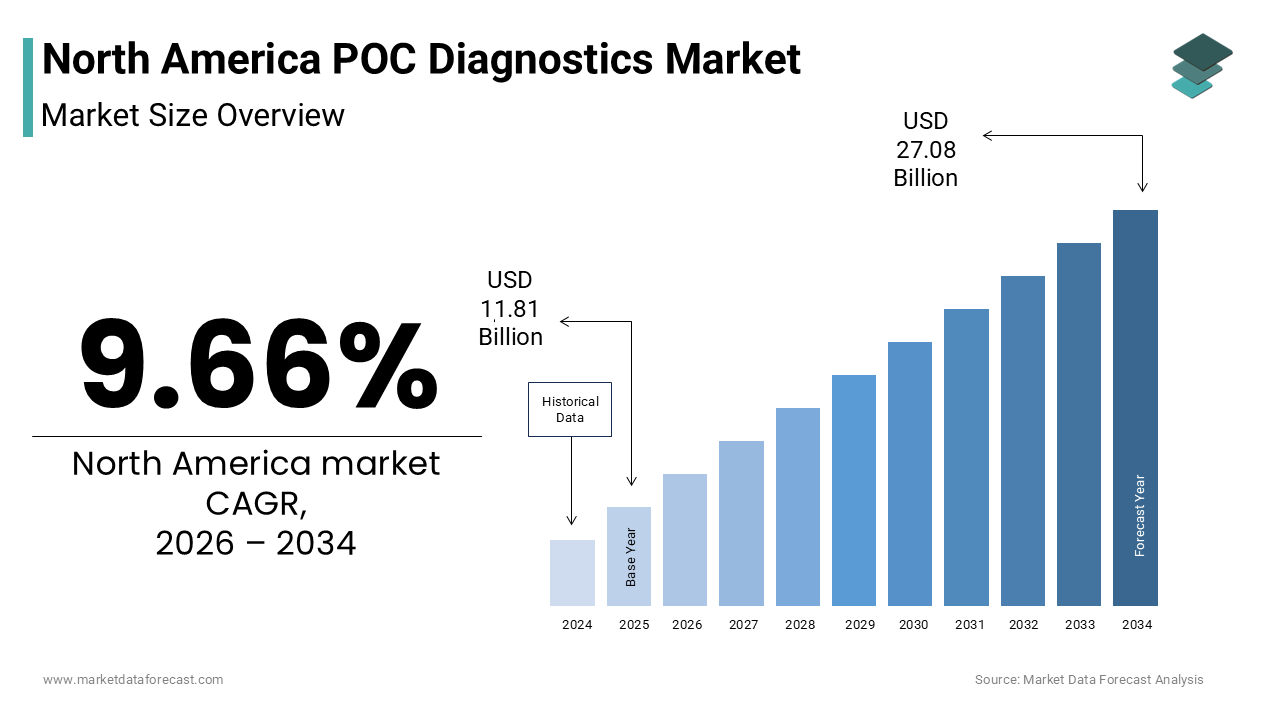
- Market Valuation: Valued at USD 11.81 billion in 2025, estimated at USD 12.95 billion in 2026, and projected to reach USD 27.08 billion by 2034, expanding at a compound annual growth rate (CAGR) of 9.66% from 2026 to 2034.
- Primary Growth Drivers: High prevalence of chronic and infectious diseases, clinical laboratory staff shortages, shift toward decentralized diagnostics, rising adoption of home healthcare/self-testing, and technological advancements allowing remote access and network integration.
Key Market Segment Metrics (2026–2034)
| Category | Leading Segment Focus | High-Impact Focus |
|---|---|---|
| By Product | Infectious Diseases & Glucose Monitoring | OTC Diagnostic Tests, Cardiac Markers, Coagulation, & Blood Gas Testing |
| By End-User | Hospitals & Clinics | Home Healthcare, Ambulatory Care Settings, & Laboratories |
| By Country Focus | The United States (Dominant Market Share) | Canada & Rest of North America |
Regional Insights & Market Dynamics
North America Leadership: Commands the overall global market position due to premium healthcare infrastructure, established reimbursement frameworks, high healthcare affordability, and strong patient awareness.
Market Challenges & Restraints: High device and testing costs for high-volume healthcare facilities, strict regulatory compliance and FDA approval requirements (including extra onsite performance data for point-of-laboratory testing).
Key Market Leaders Profiled: Abbott Laboratories, Inc., Danaher Corporation, Roche Diagnostics Limited, bioMérieux, Siemens Healthcare, Beckman Coulter, Inc., Becton, Dickinson and Company, Johnson & Johnson, Alere Inc., and PTS Diagnostics.
 Download Free Sample Report
North America Point of Care (POC) Diagnostics/Testing Market Size
The North America point-of-care (POC) diagnostics/testing market size was valued at USD 11.81 billion in 2025 and is estimated to reach USD 27.08 billion by 2034 from USD 12.95 billion in 2026, registering a CAGR of 9.66% from 2026 to 2034.
The Point of Care (POC) Diagnostics/Testing is medical testing performed at or near the site of patient care rather than in a centralized laboratory. This sector includes devices for blood glucose monitoring, cardiac marker analysis, infectious disease detection, and coagulation testing used in hospitals, clinics, and home settings. According to the Centers for Disease Control and Prevention, chronic diseases such as diabetes affect 37 million Americans which drives the consistent demand for immediate diagnostic feedback to manage these conditions effectively. As healthcare shifts toward value based models, the emphasis on preventive care and remote patient monitoring amplifies the adoption of portable diagnostic tools. Technological advancements in miniaturization and connectivity enable seamless data integration with electronic health records.
MARKET DRIVERS
Rising Prevalence of Chronic Diseases and Aging Population
The escalating prevalence of chronic diseases coupled with a rapidly aging demographic for continuous monitoring solutions is accelerating the growth of the North America Point of Care (POC) Diagnostics/Testing market. Older adults are more susceptible to conditions such as diabetes cardiovascular disease and respiratory disorders, which require frequent and immediate diagnostic assessment to prevent complications. According to the National Institute on Aging, the population aged 65 and older in the United States is projected to reach 95 million by 2060, creating a substantial base for long term disease management tools. This demographic shift ensures a sustained increase in the utilization of home based and clinic based POC devices for routine health checks. Early detection and regular monitoring help reduce hospital readmissions and lower overall healthcare costs. Healthcare providers increasingly prescribe POC tests to empower patients to manage their conditions autonomously. The integration of these devices into chronic care protocols enhances patient adherence and improves quality of life.
Shift Toward Decentralized Healthcare and Home Care Models
The strategic shift toward decentralized healthcare and home care models by moving diagnostic services from central laboratories to patient homes and outpatient clinics, which is fuelling the growth of the North America Point of Care (POC) Diagnostics/Testing market. Patients and payers increasingly prefer convenient and cost-effective care delivery methods that minimize hospital visits and waiting times. This transition drives demand for user friendly and portable testing devices that can be operated by patients or caregivers with minimal training. The Centers for Medicare and Medicaid Services have expanded reimbursement codes for remote patient monitoring technologies encouraging the adoption of connected POC devices. Hospitals are establishing satellite clinics equipped with POC instruments to serve local communities more efficiently. The convenience of obtaining immediate results at home reduces anxiety and enables quicker therapeutic adjustments. Retail health clinics and pharmacy-based testing centers further expand access to POC services.
MARKET RESTRAINTS
Stringent Regulatory Requirements and Reimbursement Complexities
The stringent regulatory requirements and complex reimbursement policies unfavorably by increasing development costs and delaying product launches, which is limiting the growth of the North America Point of Care (POC) Diagnostics/Testing market. Manufacturers must navigate rigorous approval processes from the Food and Drug Administration which demand extensive clinical validation and quality control measures for diagnostic devices. According to the study, the average time for clearance of moderate risk diagnostic devices can exceed 12 months creating significant barriers for smaller innovators. Additionally, reimbursement rates for POC tests vary widely across private insurers and government programs leading to uncertainty for healthcare providers. The American Medical Association notes that inconsistent coding and payment structures for novel POC assays discourage hospitals from adopting advanced testing platforms. Providers may hesitate to invest in expensive equipment if they cannot guarantee adequate compensation for each test performed. The administrative burden of managing multiple payer contracts further strains resources. These financial and regulatory hurdles limit the speed of innovation and restrict market access for potentially beneficial technologies. Small companies often struggle to compete with larger entities that have dedicated regulatory affairs teams.
Accuracy Concerns and Quality Control Challenges
Concerns regarding the accuracy of point of care tests and challenges in maintaining quality control unfavorably by affecting clinical confidence is additionally degrading the growth of the North America Point of Care (POC) Diagnostics/Testing market. Unlike central laboratories which operate under strict standardized conditions POC testing is often performed by non-laboratory personnel in varied environments, which can introduce errors. According to the College of American Pathologists studies indicate that operator error and environmental factors can lead to significant variability in POC test results compared to reference methods. Such discrepancies can result in misdiagnosis or inappropriate treatment decisions undermining trust in these devices. Healthcare facilities must implement rigorous quality assurance programs including regular calibration and proficiency testing which add to operational costs. The Clinical and Laboratory Standards Institute emphasizes the need for comprehensive training and competency assessment for staff performing POC tests. Lack of standardization across different device manufacturers complicates the interpretation of results when patients switch providers. Regulatory bodies closely monitor adverse events related to inaccurate readings requiring manufacturers to issue recalls or updates.
MARKET OPPORTUNITIES
Integration of Artificial Intelligence and Connectivity
The integration of artificial intelligence and wireless connectivity by enhancing data utility and clinical decision support is attributed to create new opportunities for the growth of the North America Point of Care (POC) Diagnostics/Testing market. Smart POC devices can transmit results directly to electronic health records and alert physicians to abnormal values in real time enabling proactive intervention. AI algorithms can analyze trends in patient data to predict health deteriorations before they become critical improving outcomes. The Food and Drug Administration has approved several AI enabled diagnostic tools that assist in interpreting complex POC results with higher accuracy. This technological advancement transforms simple testing devices into comprehensive health management platforms. Patients benefit from personalized insights and reminders via mobile applications linked to their POC devices. Healthcare providers gain valuable population health data that supports resource allocation and preventive strategies. Manufacturers can offer subscription based services for data analytics creating new revenue streams.
Expansion into Retail and Pharmacy Based Testing
The expansion of diagnostic services into retail pharmacies and community health centers by increasing accessibility and convenience for consumers is also elevate the growth of the North America Point of Care (POC) Diagnostics/Testing market. Pharmacies are increasingly offering screening services for conditions such as influenza strep throat and cholesterol using POC devices to attract foot traffic and provide additional value. This trend creates a vast new distribution channel for POC manufacturers targeting non-traditional healthcare settings. Consumers appreciate the ability to receive immediate results without scheduling doctor appointments reducing barriers to care. Retailers partner with diagnostic companies to offer bundled health packages that include testing and consultation. The convenience of location and extended hours makes these sites ideal for urgent but non-emergency diagnostics.
MARKET CHALLENGES
Shortage of Skilled Personnel for Device Operation
The shortage of skilled personnel trained to operate and maintain point of care devices by limiting operational efficiency and accuracy is a major challenge for the growth of the North America Point of Care (POC) Diagnostics/Testing market. While POC tests are designed for ease of use proper sample collection and device handling still require specific training to ensure reliable results. This workforce gap forces hospitals to rely on nurses and other clinical staff who may lack specialized training in diagnostic instrumentation. High turnover rates among healthcare workers further exacerbate the problem requiring continuous investment in training programs. Inadequate training can lead to procedural errors device misuse and inconsistent quality control practices. Manufacturers must develop intuitive interfaces and comprehensive educational materials to mitigate these risks. The burden of training falls on healthcare facilities already strained by staffing shortages. This human resource constraint hinders the widespread deployment of advanced POC technologies that require more complex operation. Ensuring competency across a diverse and transient workforce remains a persistent operational hurdle.
Data Security and Privacy Risks
The data security and privacy risks associated with internet connected devices that expose sensitive patient information to cyber threats is also to decline the growth of the North America Point of Care Diagnostics/Testing Market. According to the Department of Health and Human Services, healthcare data breaches affected over 40 million individuals in the United States in recent years highlighting the vulnerability of digital health infrastructure. Connected POC devices often lack robust cybersecurity features due to their focus on functionality and cost efficiency. Regulatory requirements under the Health Insurance Portability and Accountability Act mandate strict protection of patient data imposing heavy penalties for non-compliance. Healthcare providers face significant liability and reputational damage if a breach occurs through a diagnostic device. Manufacturers must invest heavily in encryption and secure software updates to protect their products. The complexity of securing a diverse ecosystem of legacy and new devices complicates risk management.
REPORT COVERAGE
| REPORT METRIC | DETAILS |
| Market Size Available | 2025 to 2034 |
| Base Year | 2025 |
| Forecast Period | 2026 to 2034 |
| CAGR | 9.66% |
| Segments Covered | By Product, End-User and Region. |
| Various Analyses Covered | Global, Regional & Country Level Analysis, Segment-Level Analysis, DROC, PESTLE Analysis, Porter’s Five Forces Analysis, Competitive Landscape, Analyst Overview of Investment Opportunities |
| Regions Covered | North America, Europe, APAC, Latin America, Middle East & Africa |
| Market Leaders Profiled | Abbott Laboratories, Inc., Danaher Corporation, Roche Diagnostics Limited, bioMérieux, Siemens Healthcare, Beckman Coulter, Inc., Becton, Dickinson and Company, Johnson & Johnson, Alere Inc., and PTS Diagnostics. |
SEGMENTAL ANALYSIS
By Product Insights
The glucose monitoring segment was accounted in holding 34.6% of the North America Point of Care Diagnostics/Testing Market share in 2025 due to the widespread prevalence of diabetes and the critical need for daily self-management among patients. The condition requires frequent blood sugar checks to prevent acute complications such as hypoglycemia and long-term issues like neuropathy. According to the Centers for Disease Control and Prevention, approximately 37 million Americans have diabetes, which represents over 11% of the total population creating a massive base for consumable test strips and devices. This high disease burden ensures consistent and recurring demand for glucose monitoring solutions across home and clinical settings. The people with diabetes must check their blood glucose levels multiple times a day to adjust insulin doses and dietary intake effectively. This routine necessity drives substantial volume sales for manufacturers of both traditional finger stick meters and continuous glucose monitors. Healthcare providers emphasize tight glycemic control to reduce hospital admissions related to diabetic emergencies. Insurance coverage for glucose testing supplies is widespread recognizing its role in preventing costly complications.
The infectious disease testing segment is likely to grow at a fastest CAGR of 8.5% from 2026 to 2034 with the heightened focus on rapid detection and public health surveillance following recent global pandemic experiences. The need to quickly identify pathogens such as influenza respiratory syncytial virus and SARS CoV 2 has accelerated the adoption of molecular and antigen-based point of care tests. According to the Centers for Disease Control and Prevention, respiratory illnesses cause millions of outpatient visits annually in the United States necessitating fast diagnostic tools to guide isolation and treatment decisions. This urgency drives hospitals and clinics to stockpile rapid test kits to manage seasonal surges effectively. The World Health Organization emphasizes the importance of decentralized testing to control outbreaks and prevent healthcare system overload. Point of care infectious disease tests provide results in minutes allowing for immediate clinical action and reducing transmission risks. Government funding for public health infrastructure has increased supporting the procurement of advanced diagnostic platforms. Employers and schools also utilize these tests for screening purposes during peak seasons. The development of multiplex panels that detect multiple pathogens simultaneously adds value for clinicians.
By End User Insights
The hospitals segment was the largest by holding 39.1% of the North America Point of Care Diagnostics/Testing Market share in 2025 due to the high volume of acute care and emergency procedures requiring immediate diagnostic results. Emergency departments and intensive care units rely on POC testing for decisions regarding trauma cardiac events and sepsis where every minute counts. According to the American Hospital Association, over 130 million emergency department visits occur annually in the United States many of which involve rapid diagnostic testing for troponin lactate or blood gases. This intense operational tempo creates substantial demand for robust and fast POC instruments. The Society of Critical Care Medicine guidelines recommend immediate lactate and blood gas analysis for septic shock patients driving standardized use in ICUs. Hospitals maintain extensive inventories of POC devices to ensure 24/7 availability for urgent cases. The concentration of complex cases in hospital settings necessitates a wide range of testing modalities from coagulation to toxicology. Accreditation standards require rigorous quality control which hospitals are equipped to manage. Centralized procurement within hospital networks allows for bulk purchasing and negotiated pricing.
The home healthcare segment is likely to grow at a fastest CAGR of 9.2% from 2026 to 2034 with the aging population and the strong preference for aging in place rather than institutional care. Older adults with chronic conditions require regular monitoring which is increasingly managed at home using user friendly point of care devices. According to the National Council on Aging, over 75% of adults aged 65 and older prefer to remain in their homes as they age creating demand for remote monitoring solutions. This demographic trend shifts diagnostic activities from clinics to living rooms driving sales of glucose meters coagulation testers and heart failure monitors. The Centers for Medicare and Medicaid Services have expanded coverage for remote patient monitoring services encouraging providers to supply home based testing kits. Family caregivers are trained to perform simple tests reducing the need for frequent nurse visits. Manufacturers design devices with large displays and simple interfaces to accommodate elderly users. Telehealth platforms integrate with home POC devices allowing physicians to review data virtually.
COUNTRY ANALYSIS
The United States Point of Care Diagnostics/Testing Market Analysis
The United States was the top performer of the North America Point of Care Diagnostics/Testing Market by occupying 88.2% of the share in 2025 due to its advanced healthcare infrastructure and high prevalence of chronic diseases. The country is characterized by significant investment in medical technology and a strong culture of preventive care. According to the Centers for Disease Control and Prevention, chronic diseases account for 90% of the nation’s 4.1 trillion dollars in annual healthcare expenditures driving demand for efficient monitoring tools. The presence of major diagnostic manufacturers and innovative startups fosters a competitive and dynamic market environment. Regulatory pathways through the Food and Drug Administration are well established facilitating the launch of new technologies. High disposable income supports the adoption of premium home testing devices. The fragmented healthcare system encourages competition among providers to offer superior diagnostic services. Reimbursement policies from private insurers and Medicare significantly influence product adoption rates.
Canada Point of Care Diagnostics/Testing Market Analysis
Canada Point of Care Diagnostics/Testing Market was ranked second by holding 10.2% of the share in 2025 with the funded healthcare system that prioritizes equitable access and cost effectiveness. The market is driven by government initiatives to improve rural healthcare delivery through decentralized testing solutions. According to Statistics Canada, the aging population is growing rapidly with seniors expected to make up 25% of the population by 2030, increasing demand for chronic disease management tools. Provincial health authorities manage procurement leading to standardized adoption of specific POC platforms across regions. The Canadian Agency for Drugs and Technologies in Health evaluates new diagnostics for clinical and economic value guiding reimbursement decisions. Rural and remote communities benefit greatly from portable POC devices that reduce the need for travel to central laboratories. Strong emphasis on primary care integration supports the use of POC testing in family practice clinics. Regulatory approval by Health Canada ensures high safety standards. The market values durability and ease of maintenance due to diverse geographic conditions.
COMPETITIVE LANDSCAPE
The competitive landscape of the North America Point of Care Diagnostics Testing Market features a mix of established multinational corporations and innovative startups vying for dominance through technological superiority and service excellence. Large global entities leverage extensive distribution networks broad product portfolios and strong brand recognition to serve diverse healthcare settings across the continent. Emerging companies compete by focusing on niche applications novel technologies or superior user experience where they can differentiate from incumbents. Intense rivalry drives continuous improvement in device performance speed accuracy and connectivity to meet demanding clinical requirements. Regulatory compliance with Food and Drug Administration standards acts as a significant barrier to entry ensuring only validated high quality products reach the market. Price competition is moderated by the critical nature of diagnostic accuracy which prioritizes clinical efficacy over cost alone. Collaborations between manufacturers healthcare providers and technology partners foster innovation and streamline clinical workflows.
KEY MARKET PLAYERS
A few notable companies dominating the North American POC testing market include
- Abbott Laboratories, Inc.
- Danaher Corporation
- Roche Diagnostics Limited
- bioMérieux
- Siemens Healthcare
- Beckman Coulter, Inc.
- Becton, Dickinson and Company
- Johnson & Johnson
- Alere Inc.
- PTS Diagnostics
Top Players in the Market
Abbott Laboratories
Abbott Laboratories maintains a prominent position in the North America Point of Care Diagnostics Testing Market through its extensive portfolio of rapid diagnostic devices and consumables. The company specializes in cardiac markers infectious disease testing and blood gas analysis systems used across hospitals and clinics. Recent strategic initiatives include the expansion of its connected health ecosystem to integrate POC results directly with electronic medical records for improved workflow efficiency. Abbott has also invested heavily in research to develop next generation biosensors that offer higher sensitivity and faster turnaround times. Their focus on user friendly design enhances adoption among non-laboratory personnel in decentralized settings.
Siemens Healthineers
Siemens Healthineers contributes significantly to the North America Point of Care Diagnostics Testing Market by offering advanced molecular and immunoassay platforms tailored for near patient testing. The company leverages its expertise in laboratory medicine to bring high precision diagnostics to emergency departments and intensive care units. Recent actions to strengthen market position involve launching compact analyzers capable of running multiple test parameters simultaneously reducing device footprint and operational complexity. Siemens has expanded its digital services portfolio to provide remote monitoring and predictive maintenance for POC instruments ensuring minimal downtime. Strategic partnerships with hospital networks facilitate seamless integration into existing clinical workflows. The company emphasizes sustainability by designing energy efficient devices and reducing packaging waste.
Roche Diagnostics
Roche Diagnostics plays a pivotal role in the North America Point of Care Diagnostics Testing Market through its comprehensive range of glucose monitoring coagulation and infectious disease testing solutions. The company combines deep clinical knowledge with technological innovation to deliver reliable results at the point of need. Recent strategies include enhancing connectivity features in its POC devices to enable real time data transmission and cloud-based analytics for better decision making. Roche has strengthened its supply chain resilience by expanding local manufacturing capabilities to ensure uninterrupted availability of critical reagents and test strips. Collaborations with telehealth providers extend the reach of POC testing into home care and remote settings. The company invests continuously in training programs to ensure proper device usage and quality control.
Top Strategies Used by Key Market Participants
Key players in the North America Point of Care Diagnostics Testing Market employ several strategic approaches to maintain competitive advantage and drive growth. Product innovation remains central as companies develop faster more accurate and easier to use devices tailored for non-laboratory settings. Strategic partnerships with healthcare systems and technology firms enhance integration with electronic health records and telehealth platforms. Expansion of manufacturing and distribution networks within North America reduces supply chain risks and ensures timely product availability. Investment in digital health solutions enables remote monitoring data analytics and predictive maintenance improving operational efficiency. Companies also focus on regulatory compliance and quality assurance to build trust and meet stringent standards. Mergers and acquisitions help broaden product portfolios and access new technologies or customer segments. Training and education programs ensure proper device usage and adherence to quality protocols. Sustainability initiatives address environmental concerns and align with healthcare system goals.
MARKET SEGMENTATION
This market research report on the North America POC Diagnostics Market has been segmented and sub-segmented into the following categories.
By Product
- Infectious Diseases
- Cardiac Markers
- Oncology Markers
- OTC Diagnostic Tests
- Drugs Of Abuse
- Blood Gas Testing
- Fertility Testing
- Urinalysis
- Coagulation
- Hematology
- Glucose Monitoring
- Ambulatory Chemistry
- Decentralized Clinical Chemistry
By End-User
- Clinics
- Hospitals
- Home Healthcare
- Ambulatory Care Settings
- Laboratories
By Country
- The United States
- Canada
- Rest of North America