- Product Description Description
- Table of Contents TOC
- List of Table & Figure LOT
- Get Free Sample PDF Sample PDF
Market Size, 2025
$41.54 BnMarket Estimate, 2026
$44.63 BnMarket Forecast, 2034
$79.18 BnCAGR, 2026–2034
7.43%North America POS Terminals Market Size
The size of the North America POS terminals market was worth USD 41.54 billion in 2025. The regional market is anticipated to grow at a CAGR of 7.43% from 2026 to 2034 and be worth USD 79.18 billion by 2034 from USD 44.63 billion in 2026.
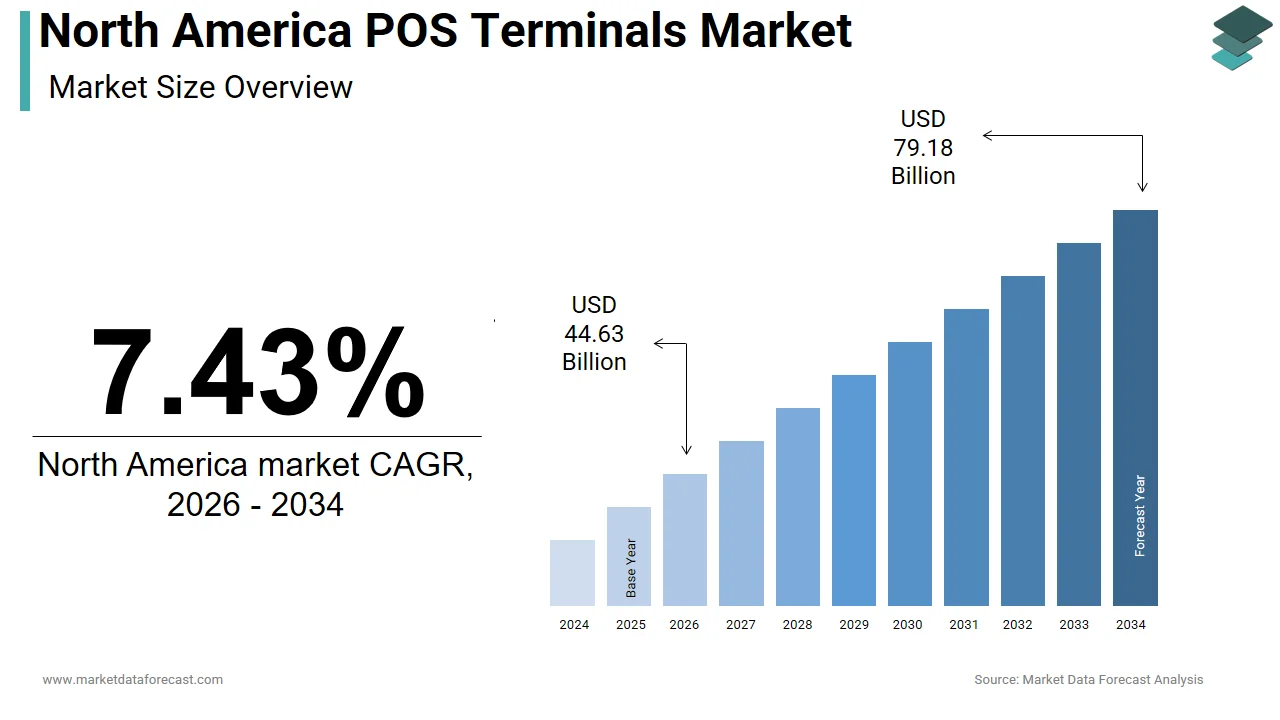
The POS (Point of Sale) terminals is a wide range of electronic devices used for processing payments, managing inventory, and streamlining customer transactions across retail, hospitality, healthcare, and financial services sectors. These terminals have evolved from basic cash registers into sophisticated systems that support contactless payments, mobile integration, cloud-based data management, and real-time analytics. A May 2024 survey from the Federal Reserve found that consumer use of digital wallets increased to 33% in 2023. In recent years, the adoption of EMV-compliant and NFC-enabled terminals has surged due to increasing card fraud concerns and the growing popularity of mobile wallets such as Apple Pay and Google Pay. The rising technological advancements in AI-driven analytics, biometric authentication, and IoT-connected devices is increasing adoption of POS.
MARKET DRIVERS
Rising Adoption of Contactless and Digital Payment Methods
The rapid adoption of contactless and digital payment methods across the region is significantly boosting the North America POS Terminals Market growth. Consumers increasingly prefer fast, secure, and seamless transaction experiences, prompting retailers and service providers to upgrade their POS systems accordingly. This shift is being fueled by heightened awareness of hygiene post-pandemic, greater smartphone penetration, and the widespread rollout of NFC-enabled payment cards. Major banks and fintech companies such as Chase, Square, and PayPal have been actively promoting tap-to-pay technologies is encouraging merchants to invest in compatible POS terminals. In Canada, Interac reports that contactless payments have become the preferred method for transactions under CAD 100 is leading to increased terminal replacements and upgrades. Moreover, the rise of embedded finance and loyalty program integrations within POS systems is further accelerating adoption. Businesses are leveraging these capabilities to offer personalized promotions and streamline checkout processes.
Growth of Small and Medium-Sized Enterprises (SMEs)
The expansion of small and medium-sized enterprises (SMEs), which are increasingly adopting digital payment solutions to enhance operational efficiency and customer experience, is prominently driving the growth of the North America POS Terminals Market. According to the U.S. Small Business Administration, there are over 33 million small businesses in the United States, with more than 70% reporting investments in digital tools to improve transaction processing and business insights in recent years. These SMEs, ranging from independent retailers and foodservice providers to professional service firms, are turning to integrated POS systems that combine payment processing, inventory tracking, employee management, and customer relationship tools. Cloud-based POS platforms, which are offered by companies like Shopify and Toast, have gained traction among smaller businesses due to their affordability, ease of deployment, and scalability, leading to market growth. The surge in demand for cost-effective, feature-rich POS terminals tailored to the needs of micro-businesses and startups is enhancing the market revenue.
MARKET RESTRAINTS
High Cost of Advanced POS Terminal Deployment
The high cost associated with deploying advanced POS systems, particularly for small businesses and independent retailers is primarily restraining the North America POS Terminals Market growth. While modern POS terminals offer enhanced functionalities such as cloud connectivity, AI-driven analytics, and biometric authentication, their acquisition and integration costs can be prohibitive for budget-conscious merchants. According to the U.S. Chamber of Commerce, fewer than half of small businesses cite upfront technology expenses as a barrier to adopting new payment systems is slowing down the replacement cycle for outdated terminals. Beyond hardware costs, businesses also face additional expenditures related to software licensing, system customization, employee training, and ongoing maintenance. As reported by the Canadian Federation of Independent Business (CFIB), many SMEs opt to extend the life of existing POS infrastructure rather than invest in newer models unless mandated by regulatory changes such as EMV compliance updates. Furthermore, the complexity of integrating new POS systems with existing accounting or CRM software often necessitates technical support, which adds to overall implementation costs.
Security Concerns and Data Breach Risks
The Security concerns and the risk of data breaches pose a significant challenge to the growth of the North America POS Terminals Market. POS systems have become prime targets for hackers seeking to exploit vulnerabilities in payment gateways and merchant networks. According to the sources, POS-related data breaches accounted for over 25% of all reported incidents in the U.S. in 2023, exposing millions of consumer records and resulting in substantial financial losses for businesses. Despite advancements in encryption and tokenization technologies, many small and mid-sized businesses lack robust cybersecurity measures, making them susceptible to ransomware attacks and unauthorized access. As per the National Cybersecurity Alliance, only 14% of SMEs have a formal cybersecurity plan, leaving them vulnerable to exploitation through compromised POS devices. The regulatory compliance with standards such as PCI DSS adds another layer of complexity, requiring merchants to implement secure payment processing protocols and undergo periodic audits, which limits the market growth. Many businesses struggle with the technical and financial burden of maintaining compliance, delaying POS system upgrades.
MARKET OPPORTUNITIES
Integration of Artificial Intelligence and Predictive Analytics
The integration of artificial intelligence (AI) and predictive analytics into point-of-sale systems is an emerging opportunity for the growth of the North America POS Terminals Market. Retailers and service providers are increasingly leveraging data-driven insights to optimize pricing strategies, manage inventory, personalize marketing efforts, and enhance customer engagement. Some studies indicate conversion rate increases ranging from 10% to 30%, depending on the specific AI application and business context. Leading POS vendors such as Lightspeed and Shopify are embedding machine learning algorithms into their platforms to analyze purchasing patterns and recommend relevant products during checkout. These intelligent systems also assist in dynamic pricing adjustments based on demand fluctuations, supply chain disruptions, and competitor activity. In Canada, the Information and Communications Technology Council indicates that AI-integrated POS solutions are gaining traction among independent retailers looking to compete with larger e-commerce players. The AI-powered fraud detection modules are being incorporated into POS terminals to identify suspicious transactions and prevent financial losses.
Expansion of Cloud-Based POS Systems
The growing adoption of cloud-based POS systems represents a significant growth opportunity for the North America POS Terminals Market. Unlike traditional on-premise systems, cloud-based solutions offer remote accessibility, real-time data synchronization, automatic software updates, and lower upfront costs is making them particularly attractive to small and medium-sized businesses. Another report from July 2025 indicated that over 72% of retailers now use cloud-based POS systems. This shift is being driven by the need for centralized management across multiple store locations, especially among franchise-based businesses and omnichannel retailers. Cloud-connected POS terminals enable business owners to monitor sales performance, track inventory levels, and manage staff schedules from any internet-enabled device. Companies like Toast and Clover have expanded their offerings to include cloud-integrated payment terminals tailored for restaurants, cafes, and pop-up stores. Moreover, cloud-based POS systems facilitate seamless integration with third-party applications such as accounting software, customer loyalty programs, and e-commerce platforms. As per Payments Canada, this interoperability enhances business efficiency and supports faster digital transformation.
MARKET CHALLENGES
Rapid Technological Obsolescence
The rapid pace of technological obsolescence, which complicates long-term investment decisions for merchants, is creating a major challenge in the expansion of the North America POS Terminals Market. As innovations in payment processing, connectivity, and data analytics continue to emerge, POS hardware and software can quickly become outdated, forcing businesses to frequently upgrade their systems to remain competitive. According to the U.S. Chamber of Commerce, half of small businesses report replacing their POS systems every three to five years is significantly shorter than the typical depreciation cycle for other commercial equipment. This accelerated turnover is driven by advancements such as contactless payments, biometric authentication, AI-driven analytics, and blockchain-based transaction verification, which is escalating the market growth. Merchants who invested in EMV chip-enabled terminals only a few years ago are now faced with the need to adopt NFC-compatible devices to accommodate mobile wallet users. Similarly, the increasing reliance on cloud-based infrastructure has made older, standalone POS systems less viable for modern retail operations.
Regulatory Complexity and Compliance Requirements
Regulatory complexity and evolving compliance requirements present another significant challenge for the growth of the North America POS Terminals Market. Businesses must navigate a landscape of data protection laws, financial regulations, and industry-specific mandates that dictate how transactions are processed, stored, and secured. In Canada, the Office of the Privacy Commissioner emphasizes that businesses handling personal financial information must implement stringent safeguards to prevent unauthorized access and data breaches. Non-compliance can result in hefty fines, and reputational damage is compelling merchants to invest in certified POS systems that meet current regulatory benchmarks. However, the frequent revisions to compliance frameworks create uncertainty, making it difficult for businesses to choose durable and future-proof POS solutions. The varying state and provincial regulations across North America complicate the standardization of payment processing systems is especially for multi-location retailers. The presence of clearer policy harmonization and streamlined certification processes, where the regulatory challenges will continue to influence purchasing decisions and slow down POS terminal deployments in the region.
REPORT COVERAGE
| REPORT METRIC | DETAILS |
| Market Size Available | 2025 to 2034 |
| Base Year | 2025 |
| Forecast Period | 2026 to 2034 |
| Segments Covered | By Type, End-User Industry and Region. |
| Various Analyses Covered | Global, Regional and Country-Level Analysis, Segment-Level Analysis, Drivers, Restraints, Opportunities, Challenges; PESTLE Analysis; Porter’s Five Forces Analysis, Competitive Landscape, Analyst Overview of Investment Opportunities |
| Countries Covered | United States, Canada, Mexico, Rest of North America |
| Market Leaders Profiled | VeriFone System Inc. (Francisco Partners), Ingenico (Worldline), First Data Merchant Services LLC (Fiserv, Inc), BBPOS Limited (Stripe, Inc), Castles technology (RISC OS Developments Ltd), and others. |
SEGMENTAL ANALYSIS
By Type Insights
The fixed point-of-sale systems segment led the North America POS Terminals Market with a significant share in 2025. These systems are widely deployed in traditional retail stores, supermarkets, restaurants, and healthcare facilities where centralized transaction processing is essential. The continued dominance of fixed POS systems is driven by their reliability and integration capabilities with enterprise resource planning (ERP), inventory management, and customer relationship management (CRM) tools, which is driving the segment growth. The large-scale retailers and chain restaurants invest heavily in high-performance fixed terminals that support EMV compliance, NFC payments, and biometric authentication. Major vendors like NCR Corporation and Verifone have seen increased demand for integrated countertop terminals equipped with AI-driven analytics and real-time reporting features.
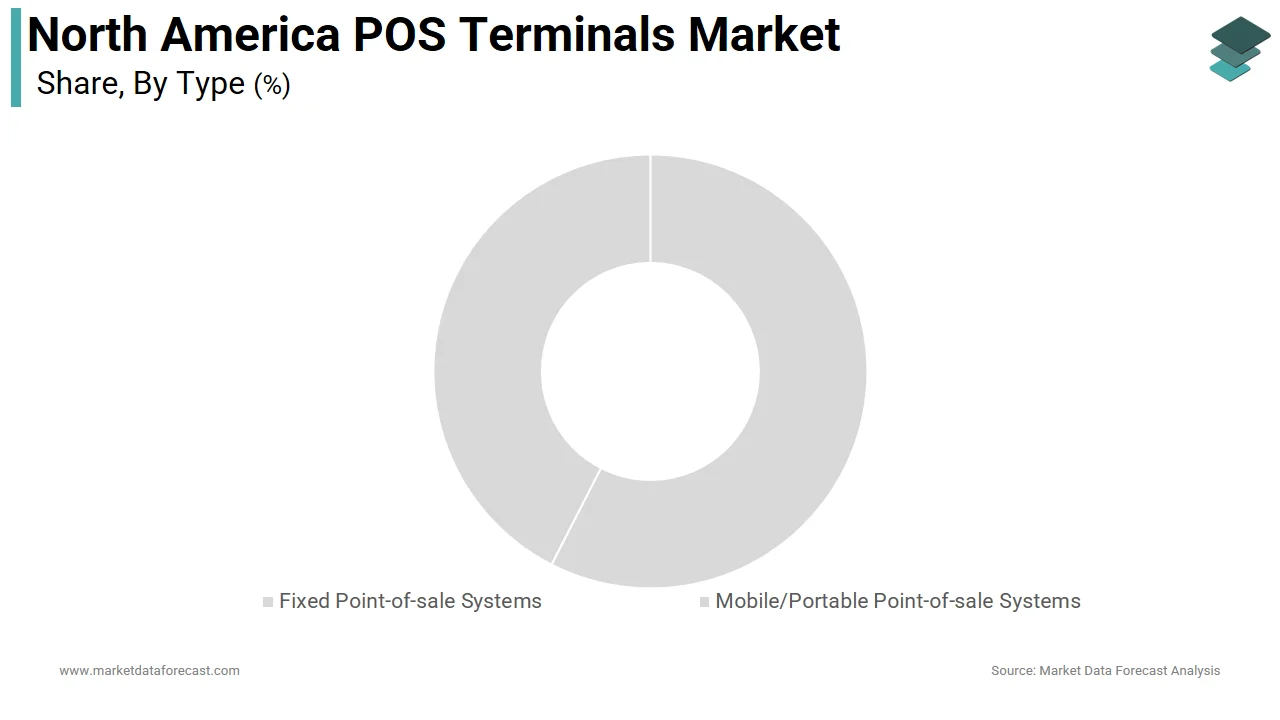
The mobile or portable POS systems segment is estimated to expand at a CAGR of 12.6% throughout the forecast period, with the increasing adoption of flexible payment solutions by small businesses, pop-up shops, food trucks, and service providers seeking mobility and ease of use. The rise of micro-merchants and gig economy enterprises that operate outside traditional storefronts is escalating the segment growth. Furthermore, the restaurant industry has embraced portable POS devices for tableside ordering and payment processing by enhancing customer experience while reducing checkout wait times. According to the NRA's "2024 State of the Restaurant Industry Report," technology adoption is increasing, with 73% of restaurant operators planning to increase their technology investments. In Canada, Payments Canada reports that mobile POS adoption has surged among independent retailers and event vendors, particularly in urban centers like Toronto and Vancouver. With continuous improvements in wireless connectivity, battery life, and cloud integration, mobile POS systems are poised to reshape the future of commerce in North America.
By End-User Industry Insights
The retail sector segment dominated the North America POS Terminals Market by accounting for 55.3% of the market share in 2024. The industry’s extensive reliance on digital payment processing, inventory tracking, and customer engagement tools embedded within modern POS systems. The segment's growth is the ongoing transformation of traditional retail into omnichannel commerce. The integration between online and in-store transactions is contributing to the segment growth. Retailers increasingly deploy hybrid POS systems that synchronize data across physical locations and digital platforms by enhancing inventory visibility and personalized marketing efforts. Moreover, the proliferation of pop-up stores, boutique shops, and direct-to-consumer brands has fueled demand for scalable POS solutions. A July 2025 report indicated that over 72% of retailers were using cloud-based POS systems in 2025 by allowing them to manage sales, staff, and customer interactions efficiently without significant upfront investment.
The healthcare sector is projected to expand at a CAGR of 14.8% during the forecast period, with the increasing need for secure, efficient, and compliant payment processing in hospitals, clinics, telehealth services, and medical billing centers. The expansion of patient-centric financial models, where individuals are responsible for higher out-of-pocket expenses due to rising insurance deductibles, is augmenting the segment growth. Hospitals and private practices are adopting integrated POS systems that support encrypted credit card transactions, digital invoicing, and insurance claim verification, which propels the segment expansion. For Instance, an AMA survey revealed that two-thirds of physicians were using AI tools in 2024, often for tasks that support billing and documentation. The rise of telemedicine platforms has created a demand for virtual POS solutions that allow patients to make co-payments during online consultations.
COUNTRY-LEVEL ANALYSIS
United States POS Terminals Market Insights
The United States dominated the North American POS Terminals Market with 81.2% of the market share in 2024. As one of the world’s most developed economies, the U.S. leads in digital commerce, retail innovation, and fintech advancements, all of which drive strong demand for next-generation POS solutions. The widespread adoption of contactless payments is supported by EMV chip migration and the proliferation of NFC-enabled smartphones. A Visa report from 2023 indicated that more than 50% of in-store transactions in the U.S. were contactless, which aligns with the trend. The rise of e-commerce-integrated brick-and-mortar strategies has led to increased investments in omnichannel POS systems. Companies like Shopify, Lightspeed, and Toast have expanded their presence in the U.S., offering cloud-based terminals tailored for small businesses, restaurants, and specialty retailers.
Canada POS Terminals Market Insights
Canada holds a significant position in the North America POS Terminals Market by contributing 18.7% of the market share in 2024. The country is experiencing rapid digitization across retail, hospitality, and healthcare sectors is fostering increased demand for secure and efficient payment processing solutions. The government’s push for digital financial inclusion and the expansion of fintech services is escalating the nation’s growth. For Instance, the 2023 Survey of Digital Technology and Internet Use, which provides data on business use of e-commerce, cloud computing, and other technologies, is driven by consumer preference for contactless transactions and government-backed incentives for cashless commerce. Moreover, Canadian banks and payment processors such as Interac and Moneris have accelerated the rollout of NFC-enabled POS terminals by aligning with global trends. Urban centers like Toronto, Montreal, and Vancouver have emerged as hotspots for POS innovation, particularly in the restaurant and retail sectors.
Mexico POS Terminals Market Insights
Mexico holds a smaller but growing share of the North America POS terminals market. While still in the early stages of digital payment adoption compared to the U.S. and Canada, Mexico is witnessing a gradual shift toward formalized, electronic transaction systems driven by economic reforms and technological investments. One of the primary catalysts is the Mexican government’s initiative to promote financial inclusion and reduce cash dependency. Additionally, the expansion of fintech companies and mobile banking platforms such as Konfio, Clip, and C6 Bank has facilitated easier access to affordable POS terminals for small businesses. With rising smartphone penetration and increasing internet accessibility, Mexico is gradually transitioning toward a more digitally integrated payment ecosystem. As cross-border trade and tourism continue to grow, the demand for standardized POS systems is expected to rise, positioning Mexico as a promising market for POS terminal expansion in North America.
COMPETITIVE LANDSCAPE
The competition in the North America POS terminals market is highly dynamic, characterized by the presence of established global players, emerging fintech disruptors, and regional manufacturers vying for market share. Traditional hardware vendors like Verifone and Ingenico continue to maintain strong positions due to their extensive distribution networks and long-standing relationships with financial institutions and large enterprises. However, the rise of agile fintech companies such as Square, Shopify, and Toast has introduced new business models centered on affordability, ease of use, and deep software integration, attracting a rapidly growing base of small and mid-sized merchants.
This evolving landscape has led to intensified innovation, particularly in mobile and cloud-based POS systems, where differentiation is increasingly based on ecosystem capabilities rather than just hardware performance. Companies are competing not only on price and functionality but also on customer support, integration with third-party applications, and the ability to offer bundled financial services. Additionally, the emphasis on cybersecurity, regulatory compliance, and interoperability with emerging payment methods is shaping vendor strategies and influencing purchasing decisions across industries. As the market continues to mature, consolidation and strategic partnerships are expected to play a significant role in determining the future competitive structure of the North America POS terminals market.
KEY MARKET PLAYERS
Some of the companies that are playing a dominating role in the North America POS Terminals market include
- VeriFone System Inc. (Francisco Partners)
- Ingenico (Worldline)
- First Data Merchant Services LLC (Fiserv, Inc.)
- BBPOS Limited (Stripe, Inc.)
- Castles Technology (RISC OS Developments Ltd)
TOP PLAYERS IN THE MARKET
- Verifone is a global leader in payment technology and one of the most influential players in the North America POS terminals market. The company has been instrumental in developing secure, scalable, and integrated payment solutions for retail, hospitality, and financial institutions. With decades of experience, Verifone has played a key role in driving EMV compliance, contactless payments, and cloud-based transaction processing across the region.
- Ingenico, now part of Nexi Group, is a major contributor to the North American POS terminals landscape, offering a wide range of payment hardware and software solutions tailored for merchants of all sizes. The company has significantly influenced the adoption of NFC-enabled and mobile POS systems, particularly among small businesses and service providers seeking flexible and secure payment options.
- Square, a subsidiary of Block, Inc., has revolutionized the way small and mid-sized businesses process payments through its user-friendly POS terminals and ecosystem. Known for its mobile POS solutions, Square has enabled widespread digital payment acceptance among micro-merchants, food trucks, pop-up shops, and independent retailers, reshaping the competitive dynamics of the North American POS industry.
TOP STRATEGIES USED BY KEY PLAYERS IN THE MARKET
Expansion into Cloud-Based and Mobile Payment Solutions Leading companies are prioritizing cloud-based and mobile POS offerings to meet the growing demand for flexible, scalable, and easy-to-deploy payment systems. By integrating cloud connectivity, real-time analytics, and remote management capabilities, vendors are catering to SMEs and micro-businesses that require cost-effective yet feature-rich solutions.
Partnerships with Fintech and E-commerce Platforms to enhance their value proposition, POS terminal providers are forming strategic alliances with fintech firms, banking institutions, and e-commerce platforms. These collaborations allow for seamless integration of payment processing with lending services, inventory management, customer engagement tools, and omnichannel commerce strategies.
Investment in Security and Compliance Technologies With rising concerns over data breaches and fraud, key players are embedding advanced security features such as end-to-end encryption, tokenization, and biometric authentication into their POS terminals. This not only ensures compliance with regulatory standards but also builds trust among merchants and consumers, reinforcing vendor credibility in the competitive North American market.
NORTH AMERICA POS TERMINALS MARKET NEWS
- In February 2024, Verifone announced the launch of a next-generation cloud-connected POS terminal designed for quick-service restaurants and retail chains, featuring built-in AI-driven analytics and multi-payment support to enhance merchant decision-making and customer engagement.
- In May 2024, Ingenico partnered with a leading U.S. bank to deploy thousands of NFC-enabled POS devices across small businesses nationwide, aiming to accelerate the adoption of contactless payments and improve transaction security for local merchants.
- In July 2024, Square introduced an updated version of its mobile POS solution with integrated loyalty program features, enabling micro-businesses to track customer preferences and offer personalized promotions directly at the point of sale.
- In September 2024, NCR Corporation acquired a startup specializing in AI-powered fraud detection for POS transactions, strengthening its portfolio of secure payment solutions and enhancing risk management capabilities for enterprise clients.
- In November 2024, Shopify launched a new line of countertop POS terminals tailored for multi-location retailers, offering seamless synchronization with its e-commerce platform and supporting unified inventory management across online and offline sales channels.
MARKET SEGMENTATION
This North America POS Terminals market research report is segmented and sub-segmented into the following categories.
By Type
- Fixed Point-of-sale Systems
- Mobile/Portable Point-of-sale Systems
By End-User Industry
- Retail
- Hospitality
- Healthcare
- Others
By Country
- United States
- Canada
- Mexico
- Rest of North America