- Product Description Description
- Table of Contents TOC
- List of Table & Figure LOT
- Get Free Sample PDF Sample PDF
Market Size, 2025
$21.26 BnMarket Estimate, 2026
$25.12 BnMarket Forecast, 2034
$95.45 BnCAGR, 2026–2034
18.16%North America Power Inverter Market Size
The North America Power Inverter Market Size was calculated to be USD 21.26 billion in 2025 and is anticipated to be worth USD 95.45 billion by 2034, from USD 25.12 billion in 2026, growing at a CAGR of 18.16% during the forecast period.
The power inverter is a range of electronic devices that convert direct current (DC) into alternating current (AC), enabling the operation of AC-powered equipment from DC sources such as batteries, solar panels, and fuel cells. These inverters are components across residential, commercial, industrial, and utility-scale applications, particularly in renewable energy systems where they facilitate the integration of solar photovoltaic (PV) installations with the electrical grid. Additionally, the proliferation of electric vehicles, home energy storage systems, and uninterruptible power supply (UPS) units across data centers and healthcare facilities is reinforcing the importance of advanced power conversion technologies.
MARKET DRIVERS
Expansion of Renewable Energy Infrastructure
The rapid expansion of renewable energy infrastructure such as solar photovoltaic (PV) installations is ascribed to fuel the growth of the North America power inverter market. Power inverters serve as essential components in these systems, converting the DC electricity generated by solar panels into usable AC power for homes, businesses, and the grid. According to the Solar Energy Industries Association (SEIA), the United States installed over 32 gigawatts (GW) of new solar capacity in 2025 , marking a year-over-year increase of 28%. Moreover, government policies such as the Inflation Reduction Act (IRA) have significantly accelerated investment in clean energy by extending tax credits and subsidies for both residential and utility-scale projects. In Canada, similar trends are evident, with provinces like Ontario and Alberta leading in large-scale solar farm deployments. Natural Resources Canada estimates that the country added over 2.5 GW of solar PV capacity in 2025 , necessitating robust inverter solutions capable of handling bidirectional power flow and grid synchronization.
Growth of Residential and Commercial Solar Installations
The growing adoption of solar energy in residential and commercial sectors is additionally to fuel the growth of the North America power inverter market. Homeowners and businesses are increasingly investing in rooftop solar systems to reduce electricity costs, achieve energy independence, and support sustainability goals. Power inverters are integral to these setups by ensuring seamless conversion of solar-generated DC power into AC electricity compatible with household appliances and grid interconnection standards. This widespread uptake is fueled by declining system costs, financing options such as solar leases and power purchase agreements (PPAs), and net metering policies that allow consumers to sell excess electricity back to the grid. On the commercial front, businesses across retail, hospitality, and logistics are adopting solar to meet corporate ESG targets and hedge against rising utility rates.
MARKET RESTRAINTS
Supply Chain Disruptions and Component Shortages
The persistent supply chain disruptions and semiconductor component shortages is limiting the growth of the North America power inverter market. The global semiconductor industry has faced prolonged bottlenecks since 2020, impacting the availability of components such as insulated-gate bipolar transistors (IGBTs), MOSFETs, and microcontrollers used in inverter designs. These delays have resulted in production slowdowns and increased manufacturing costs for inverter manufacturers. A report by McKinsey & Company indicated that material costs for power inverters rose by approximately 20% in 2023 compared to the prior year, pressuring profit margins and delaying project timelines for downstream customers. Additionally, geopolitical tensions and trade restrictions have further complicated sourcing strategies, particularly for silicon carbide (SiC) and gallium nitride (GaN)-based semiconductors that offer superior efficiency in next-generation inverters.
High Initial Costs and Regulatory Complexity
The high initial cost of advanced inverter systems combined with complex regulatory requirements is limiting the growth of the North America power inverter market. According to the National Renewable Energy Laboratory (NREL), the cost of a residential solar inverter typically ranges between $1,000 and $3,000 , depending on the type and capacity. For commercial and utility-scale projects, inverter expenditures can reach hundreds of thousands of dollars per megawatt. Regulatory complexity further compounds this issue. Compliance with standards such as IEEE 1547-2018 for grid interconnection, UL 1741 certification, and local building codes varies across states and provinces, requiring customized inverter configurations.
MARKET OPPORTUNITIES
Integration with Energy Storage Systems
The growing integration of inverters with energy storage systems is gaining huge traction is prompting the growth of the North America power inverter market. Hybrid inverters, which combine the functions of a traditional solar inverter with a battery inverter, enable seamless energy management by allowing users to store excess solar power for later use. According to Wood Mackenzie Power & Renewables, the U.S. energy storage market installed over 4.2 gigawatt-hours (GWh) of new capacity in 2025 , representing a year-over-year growth of 38%. Moreover, utilities and grid operators are increasingly deploying grid-scale battery systems equipped with advanced inverters to enhance grid stability, frequency regulation, and peak shaving capabilities.
Electrification of Transportation and EV Charging Infrastructure
The rapid electrification of transportation and the expansion of electric vehicle (EV) charging infrastructure is another factor propelling the growth of the North America power inverter market. Inverters play a crucial role in EV systems, converting DC power from the battery into AC to drive the motor, while also facilitating bidirectional energy flow in vehicle-to-grid (V2G) and vehicle-to-home (V2H) applications. According to the International Energy Agency (IEA), the number of EVs on U.S. roads surpassed 8 million in 2025 , with projections indicating continued exponential growth. This surge is supported by federal and state-level incentives, including the Bipartisan Infrastructure Law, which allocated $7.5 billion for nationwide EV charging station development.
MARKET CHALLENGES
Rapid Technological Evolution and Product Obsolescence
The rapid pace of technological evolution, which results in frequent product obsolescence and short innovation cycles is restricting the growth of the North America power inverter market. Inverter manufacturers must continuously upgrade their designs to incorporate wide bandgap semiconductors such as silicon carbide (SiC) and gallium nitride (GaN), which offer higher efficiency, reduced size, and improved thermal performance. However, this constant innovation creates pressure on vendors to maintain backward compatibility while introducing forward-looking features. Additionally, the integration of smart grid functionalities such as real-time diagnostics, predictive maintenance, and cybersecurity protections requires continuous software updates and hardware modifications.
Grid Interconnection Standards and Compatibility Issues
The interoperability and compliance with evolving grid interconnection standards pose a major challenge for the growth of the North America power inverter market. Inverters must adhere to regulations such as IEEE 1547-2018, which defines performance, operation, testing, and safety criteria for distributed energy resource (DER) systems. According to the Federal Energy Regulatory Commission (FERC), compliance with updated grid codes has become more complex, particularly in regions with high DER penetration such as California, Texas, and New York. These areas mandate advanced inverter functions including dynamic volt/var control, frequency-watt response, and reactive power support, necessitating sophisticated control algorithms and hardware enhancements.
Moreover, differences in state and provincial regulations create fragmentation in product design requirements. The Interstate Renewable Energy Council (IREC) notes that over 20 U.S. states have unique interconnection procedures, forcing manufacturers to develop region-specific inverter models. Additionally, the emergence of virtual power plants (VPPs) and peer-to-peer energy trading platforms introduces new interoperability challenges, requiring inverters to communicate seamlessly with cloud-based energy management systems.
REPORT COVERAGE
| REPORT METRIC | DETAILS |
| Market Size Available | 2025 to 2034 |
| Base Year | 2025 |
| Forecast Period | 2026 to 2034 |
| CAGR | 18.16% |
| Segments Covered | By Product, Output Voltage, End User, And Region |
| Various Analyses Covered | Global, Regional & Country Level Analysis; Segment-Level Analysis; DROC, PESTLE Analysis; Porter’s Five Forces Analysis; Competitive Landscape; Analyst Overview of Investment Opportunities |
| Regions Covered | Us, Canada, and the Rest of North America |
| Market Leaders Profiled | Enphase Energy, SolarEdge Technologies, SMA Solar Technology AG, ABB Ltd., Schneider Electric SE, Delta Electronics Inc., Fronius International, Sungrow Power Supply, Huawei Technologies Co. Ltd., Eaton Corporation plc, General Electric (GE Renewable Energy), OutBack Power Technologies, and SunPower Corporation |
SEGMENTAL ANALYSIS
By Product Insights
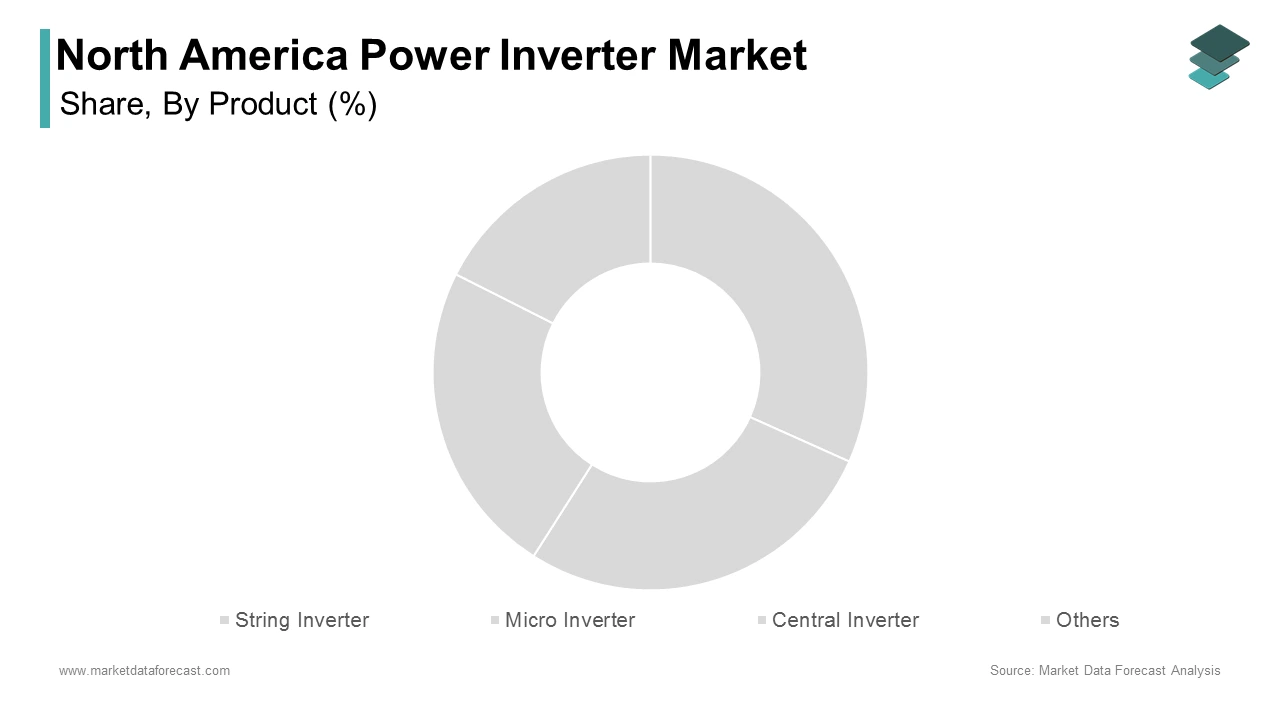
The string inverters segment was the largest by holding 42.3% of the North America power inverter market share in 2025 due to their widespread adoption across residential and small commercial solar installations due to their cost-effectiveness, ease of installation, and compatibility with a broad range of photovoltaic (PV) systems. Additionally, string inverters are widely supported by major manufacturers such as SMA Solar Technology, Fronius, and Enphase (prior to its shift toward microinverters). As per SEIA, over 60% of new residential solar installations in the U.S. during Q1 2025 utilized string inverters, which is indicating strong market resilience despite growing competition from microinverter-based solutions.
The micro inverters segment is swiftly emerging with a CAGR of 17.9% from 2026 to 2034. A primary catalyst for micro inverter adoption is their ability to optimize power output at the individual panel level, thereby improving overall system efficiency, especially in shaded or unevenly oriented installations. According to Wood Mackenzie Power & Renewables, nearly 35% of new residential solar installations in the U.S. incorporated microinverters in 2025, up from less than 10% in 2018. This rise reflects growing consumer preference for enhanced reliability and real-time performance monitoring. Additionally, the expansion of net metering policies and incentives favoring distributed generation has accelerated the uptake of microinverter technology.
By Output Voltage Insights
The low voltage inverters segment in the North America power inverter market, holding approximately 46% of total market share in 2025. The proliferation of rooftop solar installations across homes and small businesses, where typical system voltages remain below 600V AC is fuelling the growth of the segment. Additionally, the growing popularity of battery storage systems integrated with solar arrays has further reinforced demand for low-voltage bidirectional inverters.
Moreover, advancements in compact and modular inverter designs tailored for low-voltage environments have improved efficiency and reduced installation costs. Companies such as Enphase, SolarEdge, and Growatt have introduced highly scalable low-voltage solutions that cater to diverse customer needs by ensuring sustained market dominance.
The high voltage inverters segment is likely to grow with an expected CAGR of 18.3% in the next coming years with the rapid development of utility-scale solar farms, large commercial projects, and grid-connected renewable energy systems that require efficient power conversion at higher voltage levels. Furthermore, the transition to 1,500V DC systems now the industry standard for large-scale solar farms has significantly boosted demand for high voltage inverters. These systems reduce balance-of-system (BOS) costs by minimizing cable losses and enabling longer strings, thereby enhancing project economics.
By End-User Insights
The residential end-user segment was the largest and held 40.2% of the North America power inverter market share in 2025. According to the Solar Energy Industries Association (SEIA), over 4 million U.S. homes had installed solar PV systems by mid-2025 , with an additional 60,000 installations occurring every month. Another key factor fueling residential inverter demand is the availability of federal and state-level financial incentives, including the Inflation Reduction Act (IRA) tax credits and net metering policies. As per the National Renewable Energy Laboratory (NREL), the average payback period for a residential solar system dropped below six years in 2025 , making it an increasingly attractive investment for homeowners. Additionally, the integration of battery storage systems with solar installations has expanded the role of residential inverters beyond simple DC-to-AC conversion to include bidirectional energy flow management.
The utility end-user segment is likely to grow with an expected CAGR of 19.2% from 2026 to 2034. A primary catalyst for this growth is the aggressive buildout of utility-scale solar farms across the United States and Canada. According to the U.S. Energy Information Administration (EIA), over 25 GW of new utility-scale solar capacity came online in 2025, which is representing a 30% increase compared to the previous year. Additionally, grid operators are mandating advanced inverter functions such as dynamic reactive power support, frequency regulation, and fault ride-through capabilities. The Federal Energy Regulatory Commission (FERC) has emphasized compliance with IEEE 1547-2018 standards, which require utility-scale inverters to provide grid-forming and ancillary services.
REGIONAL ANALYSIS
United States Power Inverter Market Insights
The United States was the top performer of the North America power inverter market with 76.3% of share in 2025 with the country's aggressive expansion of solar photovoltaic (PV) installations, both at the residential and utility scale. Additionally, the Inflation Reduction Act (IRA) has played a pivotal role in stimulating investment in renewable energy and grid modernization. The IRA extended the Investment Tax Credit (ITC), providing long-term certainty for developers and investors.
Canada Power Inverter Market Insights
Canada power inverter market held 15.3% of share in 2025 with the expanding renewable energy programs, rural electrification efforts, and supportive provincial policies. The country’s commitment to reducing carbon emissions and transitioning to cleaner energy sources has created a favorable environment for power inverter adoption. In addition, Canada is witnessing a rise in microgrid and off-grid projects, particularly in remote communities that traditionally relied on diesel generators. As part of the federal government’s Clean Growth Program, over 150 northern communities are piloting or implementing solar-diesel hybrid systems, which depend on power inverters for seamless energy conversion and grid synchronization. The Canadian government’s focus on electrification and energy storage is also boosting demand for hybrid inverters capable of managing both solar and battery systems.
LEADING PLAYERS IN THE NORTH AMERICA POWER INVERTER MARKET
One of the leading players in the North America power inverter market is SMA Solar Technology , a global manufacturer known for its high-performance solar inverters. The company has a strong presence across utility, commercial, and residential segments, offering a wide range of string and central inverters tailored for large-scale deployments. SMA’s commitment to innovation and grid-supportive technologies positions it as a key contributor to advancing smart energy systems worldwide.
Another major player is Enphase Energy, which has revolutionized the residential and small commercial markets with its microinverter technology. Enphase's shift from traditional string inverters to module-level power electronics has significantly enhanced system efficiency, safety, and monitoring capabilities. Its integrated software platforms further strengthen its value proposition, making it a preferred choice among homeowners and installers in North America.
SolarEdge Technologies also holds a prominent position in the market by combining power optimizers with inverters to maximize energy harvesting and system flexibility. The company's DC-optimized inverter architecture allows for individual panel performance optimization, improving overall system output even under partial shading conditions.
TOP STRATEGIES USED BY KEY MARKET PARTICIPANTS
A key strategy employed by leading players in the North America power inverter market is continuous innovation through R&D investment. Companies are developing next-generation inverter technologies that support advanced grid functions, higher efficiency, and integration with energy storage and electric vehicle systems. These innovations help maintain competitive differentiation and align with evolving regulatory requirements.
Another approach is expanding product portfolios through strategic partnerships and acquisitions. The inverter vendors can offer comprehensive energy management ecosystems by acquiring specialized firms or forming alliances with software developers and battery manufacturers. This enhances customer retention and enables seamless interoperability across distributed energy resources.
The companies are focusing on strengthening regional presence through localized manufacturing and distribution networks . Establishing regional service centers and collaborating with local distributors ensures faster deployment, better after-sales support, and compliance with regional standards.
KEY MARKET PLAYERS AND COMPETITION OVERVIEW
Major Players of the North America Power Inverter Market include Enphase Energy, SolarEdge Technologies, SMA Solar Technology AG, ABB Ltd., Schneider Electric SE, Delta Electronics Inc., Fronius International, Sungrow Power Supply, Huawei Technologies Co. Ltd., Eaton Corporation plc, General Electric (GE Renewable Energy), OutBack Power Technologies, and SunPower Corporation
The competition in the North America power inverter market is shaped by a dynamic interplay of technological advancement, shifting customer preferences, and evolving policy landscapes. Innovation remains a key battleground, with vendors continuously introducing new features such as smart grid compatibility, real-time diagnostics, and bidirectional power flow capabilities to differentiate their offerings. The rise of microinverters and hybrid inverter systems has intensified rivalry between traditional inverter manufacturers and newer entrants specializing in decentralized energy solutions. Additionally, as the market matures, customer expectations around reliability, ease of integration, and digital monitoring tools have heightened, prompting companies to invest heavily in software-driven platforms and ecosystem-based approaches. Strategic collaborations, product diversification, and localized support structures have become essential for maintaining a competitive edge. While dominant players leverage brand reputation and scale to secure long-term contracts, smaller firms focus on niche segments and rapid adaptability to capture emerging opportunities.
RECENT HAPPENINGS IN THE MAREKT
- In February 2025, Enphase Energy launched a new line of IQ8 microinverters featuring grid-forming capabilities and islanding functionality. This development enables off-grid operation during outages without requiring a dedicated battery by enhancing resilience for residential solar users and strengthening Enphase’s position in the backup power segment.
- In May 2025, SMA Solar Technology announced a collaboration with a major U.S. utility provider to deploy intelligent inverters capable of providing grid services such as voltage regulation and frequency support. This initiative reinforces SMA’s role in utility-scale renewable integration and supports grid modernization efforts across the country.
- In July 2025, SolarEdge introduced an updated version of its StorEdge solution, expanding compatibility with third-party batteries and improving load management features. This move broadens SolarEdge’s appeal in the rapidly growing home energy storage market and strengthens its ecosystem-based approach to energy optimization.
- In October 2025, Fronius USA expanded its production facility in Nashville, Tennessee, to increase domestic manufacturing capacity for its Symo and Primo series inverters. This expansion aims to reduce lead times, enhance supply chain resilience, and meet rising demand from both residential and commercial customers.
- In December 2025, Canadian inverter manufacturer Sineng Electric entered into a distribution agreement with a leading U.S. solar equipment wholesaler. This partnership is intended to boost Sineng’s visibility in the American market and facilitate broader adoption of its high-voltage central inverters in utility-scale projects.
MARKET SEGMENTATION
This research report on the North America power inverter market has been segmented and sub-segmented based on product, output voltage, end user, and region.
By Product
- String Inverter
- Micro Inverter
- Central Inverter
- Others
By Output Voltage
- Low
- Medium
- High
By End User
- Residential
- Commercial
- Utility
- Automotive
- Others
By Region
- US
- Canada
- Rest Of North America