- Product Description Description
- Table of Contents TOC
- List of Table & Figure LOT
- Get Free Sample PDF Sample PDF
Market Size, 2025
$9.12 BnMarket Estimate, 2026
$9.71 BnMarket Forecast, 2034
$16.09 BnCAGR, 2026–2034
6.52%North America Power Transformer Market Size, Growth, Trends & Forecast (2026–2034)
The North America power transformer market size was calculated to be USD 9.12 billion in 2025, is anticipated to be worth USD 9.71 billion in 2026, and is projected to reach USD 16.09 billion by 2034, registering a compound annual growth rate (CAGR) of 6.52% during the forecast period from 2026 to 2034. Driven by extensive grid modernization efforts, aging electrical infrastructure replacement, and increasing renewable energy integration, the regional market continues to expand steadily.
Key Executive Metrics (At-a-Glance)
- 2025 Base Valuation: USD 9.12 Billion
- 2026 Current Valuation: USD 9.71 Billion
- 2034 Forecast Valuation: USD 16.09 Billion
- Compound Annual Growth Rate (CAGR): 6.52% (2026–2034)
- Dominant Core Segment: Closed Core (holding 48.4% of the market share in 2025)
- Fastest-Growing Core Segment: Berry Core (projected at a CAGR of 6.2% from 2026 to 2034)
- Dominant Insulation Segment: Oil-Insulated (dominating with a prominent share in 2025)
- Fastest-Growing Insulation Segment: Gas-Insulated (projected at a CAGR of 6.8% from 2026 to 2034)
- Dominant Phase Segment: Three-Phase (holding a dominant share in 2025)
- Fastest-Growing Phase Segment: Single-Phase (projected at a CAGR of 6.4% during the forecast period)
- Regional Highlights: The United States leads the market with 78.2% of the share in 2025, supported by federal infrastructure investments and grid resilience programs.
Core Market Drivers
- Grid Modernization & Infrastructure Upgrades: Replacement of aging transmission lines and transformers (over 70% being 25+ years old) backed by government funding like the Bipartisan Infrastructure Law.
- Renewable Energy Integration: Widespread connection of wind, solar, and hybrid power systems requiring specialized step-up transformers.
- Electrification Trends: Expanding EV charging infrastructure, industrial automation, and smart grid technology adoption.
Primary Market Restraints & Challenges
- Supply Chain Bottlenecks: Reliance on international raw materials like silicon steel, copper, and specialized insulation materials.
- Regulatory & Compliance Costs: Strict fire safety, environmental mandates, and disposal hurdles.
- Cybersecurity & Workforce Shortages: Protecting digitally integrated smart transformers from cyber threats alongside an aging technical workforce.
North America Power Transformer Market Segmentation Breakdown
| Segment Category | Largest Segment in 2025/2026 | Fastest Growing Segment / Growth Rate |
|---|---|---|
| By Core | Closed Core (48.4% in 2025) | Berry Core (6.2% CAGR) |
| By Insulation | Oil-Insulated | Gas-Insulated (6.8% CAGR) |
| By Phase | Three-Phase | Single-Phase (6.4% CAGR) |
| By Region | United States (78.2% in 2025) | Canada (Driven by hydropower expansion and smart grid programs) |
Major Industry Players Profiled
Key prominent companies operating in the North America power transformer market include Eaton Corporation PLC, GE Vernova (General Electric Company), Schneider Electric SE, Siemens Energy AG, Emerson Electric Co., Hitachi Energy (Hitachi Ltd.), Mitsubishi Electric Corporation, Toshiba Corporation, WEG SA, and Northern Transformer Corporation.
North America Power Transformer Market Size
The North America power transformer market Size was calculated to be USD 9.12 billion in 2025 and is anticipated to be worth USD 16.09 billion by 2034, from USD 9.71 billion in 2026, growing at a CAGR of 6.52% during the forecast period.
The power transformer play a role in voltage conversion by ensuring efficient transmission and distribution of electricity across high-voltage transmission lines, substations, and end-user networks. In North America, the aging infrastructure of electrical grids is prompting extensive modernization efforts, especially in the United States. According to the American Society of Civil Engineers, over 70% of the country’s transmission lines are more than 25 years old, necessitating replacement and upgrades. This has led to increased investments in high-efficiency transformers that support smart grid technologies and renewable energy integration. Additionally, growing electrification trends in transportation, industrial automation, and residential sectors are boosting demand for reliable and advanced power transformation solutions. The push toward decarbonization and clean energy mandates by governments is also influencing the adoption of eco-friendly transformers using biodegradable insulation fluids.
MARKET DRIVERS
Grid Modernization and Infrastructure Upgrades
The ongoing modernization of electrical grid infrastructure is propelling the growth of the North America power transformer market. The U.S. and Canadian power grids were largely built several decades ago and are now undergoing significant upgrades to enhance reliability, efficiency, and resilience. According to the U.S. Department of Energy, nearly 70% of transmission lines and transformers in the U.S. are over 25 years old , making them vulnerable to failures and inefficiencies. Additionally, government initiatives aimed at strengthening grid resilience are accelerating investment in new power transformers. For instance, the Bipartisan Infrastructure Law (BIL) allocates over $65 billion toward modernizing the U.S. power grid, including funding for transmission system upgrades and substation enhancements. These investments directly translate into increased demand for power transformers tailored for smart grid applications. Utilities are prioritizing the deployment of resilient and compact transformers designed for rapid deployment and improved fault tolerance.
Integration of Renewable Energy Sources
The expanding integration of renewable energy sources such as wind, solar, and hydroelectric power into the grid is escalating the growth of the North America power transformer market. Unlike conventional fossil fuel-based generation, renewable energy facilities are often located in remote or decentralized areas, requiring specialized transformers to step up voltage levels for long-distance transmission. Wind and solar farms require transformers at multiple stages of the power chain—from collection systems within the plant to interconnection points with the main grid. The National Renewable Energy Laboratory (NREL) estimates that each utility-scale wind farm typically requires between 30 to 100 transformers, which is depending on its size and configuration. Furthermore, the rise of hybrid renewable energy systems combining solar, wind, and battery storage is increasing demand for bidirectional and high-efficiency transformers.
MARKET RESTRAINTS
Supply Chain Disruptions and Component Shortages
The persistent disruption in global supply chains, particularly concerning components such as copper, silicon steel, and insulating materials is restraining the growth of the North America power transformer market. Transformers rely heavily on these raw materials, many of which are sourced internationally. According to the U.S. Geological Survey, the United States imported over 70% of its silicon steel requirements in 2023 by exposing manufacturers to geopolitical risks and logistical bottlenecks. These disruptions have been exacerbated by trade tensions and export restrictions imposed by key supplier nations. Moreover, the semiconductor shortage though primarily associated with the automotive and electronics industries has indirectly affected the transformer sector due to its reliance on microcontroller-based protection relays and monitoring systems.
Regulatory and Environmental Compliance Costs
The stringent regulatory and environmental compliance standards pose another major challenge for the growth of the North America power transformer market. Governments and regulatory bodies have introduced increasingly rigorous requirements aimed at reducing the environmental impact of electrical equipment, particularly concerning fire safety, recyclability, and the use of hazardous substances. Additionally, fire safety regulations have become more stringent, particularly in urban and environmentally sensitive areas. The National Fire Protection Association (NFPA) has updated its guidelines to mandate non-flammable insulation fluids for transformers installed near waterways, public spaces, and infrastructure. Moreover, the disposal and recycling of decommissioned transformers present logistical and regulatory hurdles.
MARKET OPPORTUNITIES
Expansion of Smart Grid Technologies
The widespread adoption of smart grid technologies presents a substantial opportunity for growth in the North America power transformer market. As utilities seek to enhance grid efficiency, reliability, and responsiveness, there is an increasing emphasis on deploying intelligent transformers equipped with digital monitoring, self-diagnostic capabilities, and remote control features. According to the U.S. Department of Energy, over 70% of U.S. utilities have initiated smart grid modernization programs, many of which involve replacing aging transformers with digitally integrated models.
Smart transformers offer advantages such as real-time load balancing, predictive maintenance alerts, and adaptive voltage regulation, all of which contribute to improved grid performance. The National Institute of Standards and Technology (NIST) emphasizes that smart grid infrastructure requires interoperable and data-enabled devices, which is making intelligent transformers a crucial component of future-ready power systems. Furthermore, the integration of advanced sensors and communication protocols enables utilities to detect anomalies and respond to outages more efficiently.
Electrification of Transportation and Industrial Sectors
The accelerating electrification of transportation and industrial sectors is creating new opportunities for the growth of the North America power transformer market. There is a growing need for high-capacity transformers to support electric vehicle (EV) charging stations, battery manufacturing plants, and electrified industrial processes as governments and businesses shift away from fossil fuels. Electric vehicle fast-charging stations, particularly those operating at ultra-fast levels (150 kW and above), require dedicated transformers to manage high-power demands without straining local distribution networks. The Department of Energy notes that more than 40% of industrial energy consumption in North America is now electrified , driving the need for transformers capable of handling variable loads and integrating with automated control systems. Companies in sectors such as steelmaking, chemical processing, and data centers are investing in high-efficiency transformers to support electrified operations and ensure grid compatibility.
MARKET CHALLENGES
Cybersecurity Risks in Digitally Integrated Transformers
Cybersecurity threats are acting as a huge barrier for the growth of the North America power transformer market. Modern transformers are often equipped with embedded sensors, communication modules, and remote access capabilities, making them susceptible to cyber intrusions that could disrupt grid operations or compromise infrastructure. A breach in a digitally connected transformer could lead to unauthorized control of voltage settings, false alarms, or even deliberate sabotage of grid stability. The North American Electric Reliability Corporation (NERC) has issued advisories warning about vulnerabilities in industrial control systems used in power equipment, which is emphasizing the need for robust security measures. Utilities and manufacturers are responding by incorporating secure communication protocols, encryption mechanisms, and network segmentation strategies into new transformer designs. The National Institute of Standards and Technology (NIST) recommends adopting zero-trust architectures and continuous threat monitoring to safeguard digital assets.
Workforce Shortage and Technical Expertise Gap
The shortage of skilled labor and technical expertise required for the design, installation, and maintenance of advanced transformer systems is also to limit the growth of the North America power transformer market. The aging workforce in the electrical and utility sectors, combined with declining enrollment in technical education programs, has created a skills gap that hampers the timely deployment and servicing of power transformers. According to the U.S. Bureau of Labor Statistics, nearly 40% of electrical power-line workers in North America are aged 55 or older , raising concerns about knowledge retention and workforce continuity. Transformer manufacturing and field servicing require specialized competencies in electrical engineering, insulation technology, and diagnostic testing. However, vocational training programs and apprenticeships in these disciplines have not kept pace with industry demand.
REPORT COVERAGE
| REPORT METRIC | DETAILS |
| Market Size Available | 2025 to 2034 |
| Base Year | 2025 |
| Forecast Period | 2026 to 2034 |
| CAGR | 6.52% |
| Segments Covered | By Core, Insulation, Phase, And Region |
| Various Analyses Covered | Global, Regional & Country Level Analysis; Segment-Level Analysis; DROC, PESTLE Analysis; Porter’s Five Forces Analysis; Competitive Landscape; Analyst Overview of Investment Opportunities |
| Regions Covered | Us, Canada, and the Rest of North America |
| Market Leaders Profiled | Eaton Corporation PLC, GE Vernova (General Electric Company), Schneider Electric SE, Siemens Energy AG, Emerson Electric Co., Hitachi Energy (Hitachi Ltd.), Mitsubishi Electric Corporation, Toshiba Corporation, WEG SA, Northern Transformer Corporation |
SEGMENTAL ANALYSIS
By Core Insights
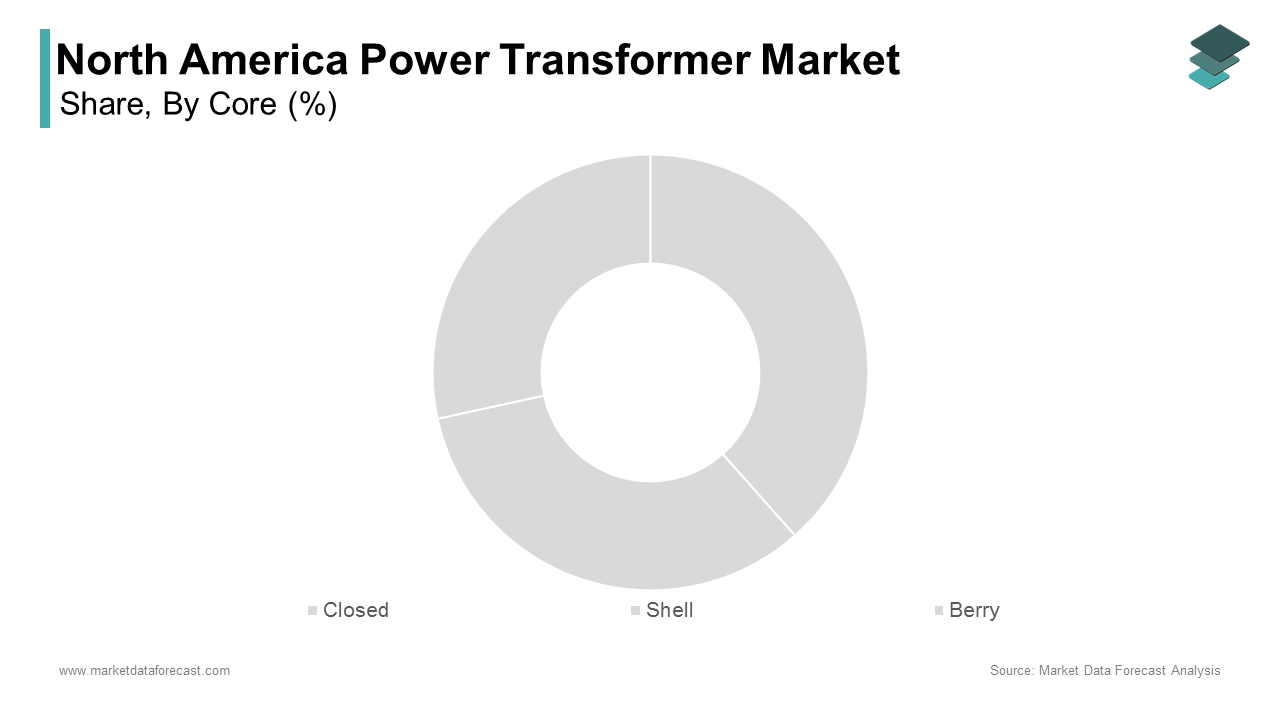
The closed core transformer segment was accounted in holding 48.4% of the North America power transformer market share in 2025 with the superior efficiency and lower magnetic losses associated with closed core designs . According to the U.S. Department of Energy, closed core transformers offer up to 15% higher energy efficiency compared to alternative core types, which is making them ideal for long-distance power transmission where minimizing losses is . Another important factor is the aging infrastructure and ongoing modernization programs . The American Society of Civil Engineers reports that over 70% of U.S. transmission lines are more than 25 years old, which is necessitating upgrades that often involve replacing outdated shell or berry core units with more efficient closed core models. Utility companies like PJM Interconnection and NYISO have prioritized retrofits using closed core transformers to enhance reliability and reduce downtime. Additionally, increased investment in grid resilience and renewable energy integration has further boosted demand. The National Renewable Energy Laboratory (NREL) notes that large-scale wind and solar farms require high-efficiency transformers at transmission-level voltages, reinforcing the preference for closed core configurations.
The berry core transformer segment is projected to register a CAGR of 6.2% from 2026-2034 with the rising deployment of prefabricated and modular substations , particularly in remote and urban areas. The Electric Power Research Institute (EPRI) highlights that over 40% of new substation projects initiated in 2023 included modular components , many of which utilize berry core transformers due to their segmented construction and scalable capacity. The growing need for transformers tailored for industrial process loads in chemical, pharmaceutical, and data center applications is amplifying the growth of the segment. Berry core transformers offer superior thermal performance under fluctuating load conditions, making them well-suited for environments requiring stable voltage regulation.
By Insulation Insights
The oil-insulated transformer segment dominated the North America power transformer market by capturing a prominent share in 2025 with the superior thermal conductivity and dielectric strength of mineral oil , which enhances operational efficiency and equipment longevity. According to the U.S. Environmental Protection Agency (EPA), oil-insulated transformers can operate at higher load capacities without overheating, which is making them preferred choices for large-scale power transmission applications. These transformers are commonly found in major grid nodes managed by entities such as the Tennessee Valley Authority and Hydro-Québec. Another key factor is the long-standing legacy of oil-insulated transformers in existing infrastructure. Moreover, ongoing replacement programs in aging substations support sustained demand. The Edison Electric Institute reports that U.S. electric utilities spent over $30 billion annually on grid modernization efforts , including the retrofitting of older substations with oil-insulated transformers that meet current safety and efficiency standards.
The gas-insulated transformer segment is anticipated to register a CAGR of 6.8% from 2026 to 2034 with the increasing adoption of gas-insulated transformers in underground and indoor substations . As per the International Electrotechnical Commission (IEC), sulfur hexafluoride (SF₆)-insulated transformers are widely used in metropolitan power distribution networks due to their compact size and non-flammable properties. Although SF₆ is a potent greenhouse gas, newer gas mixtures and containment technologies have significantly reduced emissions. The European Environment Agency acknowledges that recent advancements in gas recovery systems have improved leakage rates to below 0.1% annually , enhancing the viability of gas-insulated transformers. Additionally, regulatory mandates promoting safer electrical infrastructure are boosting adoption. The National Fire Protection Association (NFPA) recommends gas-insulated transformers for installations near water bodies, public spaces, and facilities.
By Phase Insights
The three-phase transformer segment was the largest and held a dominant share of the North America power transformer market in 2025 with the superior efficiency and balanced load distribution offered by three-phase systems. The widespread use of three-phase transformers in industrial manufacturing and commercial buildings is ascribed to bolster the growth of the segment. The National Electrical Manufacturers Association (NEMA) states that nearly all heavy-duty motors and machinery operate on three-phase power, which is necessitating dedicated transformers for voltage conversion and distribution. Industries such as steel production, chemical processing, and data centers heavily rely on three-phase units to ensure continuous and stable power supply. Furthermore, the expansion of renewable energy integration into the grid has reinforced demand. Wind and solar farms typically connect to the grid via three-phase transformers that step up generated power for transmission.
The single-phase transformer segment is projected to grow with a CAGR of 6.4% during the forecast period with the rising demand for electricity in residential and small commercial sectors. According to the U.S. Energy Information Administration (EIA), nearly 75% of homes in North America are supplied through single-phase distribution networks, with the use of single-phase transformers at local distribution points. The proliferation of rooftop solar installations and home battery systems, which operate on single-phase power is accelerating the growth of the North America power transformer market. Additionally, the shift toward decentralized energy generation and microgrids is boosting adoption.
REGIONAL ANALYSIS
United States Power Transformer Market Insights
The United States was the top performer of the North America power transformer market with 78.2% of the share in 2025 with the extensive replacement cycle of aging transformers , many of which were installed several decades ago. The U.S. Department of Energy reports that over 70% of transmission lines and transformers are more than 25 years old, which is prompting substantial investments in grid resilience and efficiency. Federal initiatives such as the Bipartisan Infrastructure Law allocate billions toward upgrading the national power infrastructure, directly stimulating demand for new transformers. Additionally, the integration of renewable energy sources is shaping market dynamics. Urbanization and the expansion of EV charging infrastructure are also influencing demand.
Canada Power Transformer Market Insights
Canada power transformer market was ranked second with 13.2% of the share in 2025 with the expansion of hydroelectric and wind power generation , which requires reliable transformer infrastructure for efficient power delivery. Natural Resources Canada states that renewable energy sources contributed nearly 85% of total electricity generation in 2023, with provinces like Quebec and British Columbia leading in hydropower expansion. Additionally, the government’s Smart Grid Program has encouraged the deployment of intelligent transformers equipped with condition-monitoring sensors. Urbanization and electrification of transportation are also shaping demand. Statistics Canada reports that EV sales rose by 18% in 2023.
LEADING PLAYERS IN THE NORTH AMERICA POWER TRANSFORMER MARKET
Siemens Energy
Siemens Energy is a global leader in power transmission and distribution technologies, with a strong footprint in the North American power transformer market. The company offers a comprehensive portfolio of high-voltage transformers tailored for utility-scale applications, renewable integration, and industrial use. Siemens plays a crucial role in advancing grid modernization through its smart transformer solutions that incorporate digital diagnostics and predictive maintenance capabilities, contributing to enhanced grid resilience and efficiency on a global scale.
General Electric (GE) Power
GE Power has been a key player in the power generation and transmission sector for decades, offering advanced power transformer solutions designed for reliability and performance under extreme conditions. The company's focus on innovation has led to the development of compact, high-efficiency transformers suited for urban infrastructure and renewable energy projects. GE’s expertise in grid technologies and long-standing partnerships with utilities position it as a major influencer in shaping the future of power transformation systems worldwide.
Hitachi Energy
Hitachi Energy is a leading provider of power transformers across North America, which is known for its cutting-edge insulation technologies and sustainable product designs. The company delivers custom-engineered transformers for ultra-high voltage transmission, offshore wind interconnection, and smart substation applications. Hitachi Energy contributes significantly to global electrification efforts by integrating digital monitoring systems into its transformers by enabling real-time asset management and improving operational sustainability across international markets.
TOP STRATEGIES USED BY KEY MARKET PARTICIPANTS
A primary strategy employed by key players in the North America power transformer market is product innovation through digital integration, where companies are embedding IoT, artificial intelligence, and predictive analytics into their equipment to enhance performance and user experience. This approach allows real-time monitoring, remote diagnostics, and optimized maintenance scheduling, improving overall operational efficiency.
Another key approach is expanding service portfolios beyond hardware, with firms offering end-to-end solutions that include installation, maintenance, software support, and cloud-based management platforms. This shift from product-centric to solution-oriented offerings strengthens customer retention and enables long-term partnerships across industries.
Strategic acquisitions and partnerships are being leveraged to enhance technological capabilities and geographic reach. Companies are acquiring niche technology firms or forming alliances with software developers to accelerate time-to-market for new innovations and strengthen their foothold in emerging verticals such as micro-fulfillment and cleanroom handling.
KEY MARKET PLAYERS AND COMPETITIVE OVERVIEW
Major Players of the North America Power Transformer Market include Eaton Corporation PLC, GE Vernova (General Electric Company), Schneider Electric SE, Siemens Energy AG, Emerson Electric Co., Hitachi Energy (Hitachi Ltd.), Mitsubishi Electric Corporation, Toshiba Corporation, WEG SA, Northern Transformer Corporation
The competition in the North America power transformer market is intense and marked by the presence of established global manufacturers alongside regional suppliers. Major players leverage their extensive engineering expertise, strong brand reputation, and deep-rooted relationships with utility operators to maintain dominance. However, the growing complexity of grid requirements, coupled with the need for higher efficiency and environmental compliance, is compelling even industry leaders to continuously innovate. Smaller firms are increasingly focusing on specialized transformer types such as gas-insulated and eco-friendly models to carve out distinct market niches. Additionally, the integration of digital technologies like condition monitoring, smart diagnostics, and remote control features is reshaping competitive dynamics, pushing firms to invest heavily in R&D and strategic collaborations. s demand surges for resilient, intelligent, and sustainable power transformation solutions, companies are also expanding their service footprints and exploring new business models such as predictive maintenance contracts and modular transformer deployment.
RECENT HAPPENINGS IN THE MARKET
- In January 2025, Siemens Energy launched a new line of digitally integrated power transformers equipped with AI-driven diagnostics by allowing real-time health monitoring and predictive maintenance to enhance grid reliability and reduce downtime for utility customers.
- In March 2025, General Electric announced a strategic partnership with a U.S.-based materials science firm to develop next-generation insulation fluids that improve thermal performance while reducing environmental impact, which is aligning with evolving regulatory standards for transformer safety and sustainability.
- In June 2025, Hitachi Energy expanded its manufacturing facility in Canada to increase production capacity for ultra-high-voltage transformers, which is supporting cross-border power transmission projects and strengthening its supply chain resilience in North America.
- In August 2025, ABB introduced a modular transformer solution specifically designed for rapid deployment in remote and disaster-prone areas by addressing the rising demand for flexible and mobile power infrastructure amid increasing climate-related disruptions.
- In October 2025, Schneider Electric unveiled a suite of hybrid transformers combining gas and solid insulation technologies that aimed at enhancing fire safety and space efficiency in densely populated urban substations and infrastructure facilities.
MARKET SEGMENTATION
This research report on the North America power transformer market has been segmented and sub-segmented based on core, insulation, phase and region.
By Core
- Closed
- Shell
- Berry
By Insulation
- Gas
- Oil
By Phase
- Single
- Three
By Region
- US
- Canada
- Rest of North America