- Product Description Description
- Table of Contents TOC
- List of Table & Figure LOT
- Get Free Sample PDF Sample PDF
Market Size, 2025
$4.86 BnMarket Estimate, 2026
$4.98 BnMarket Forecast, 2034
$6.09 BnCAGR, 2026–2034
2.54%North America Power Bank Market Summary
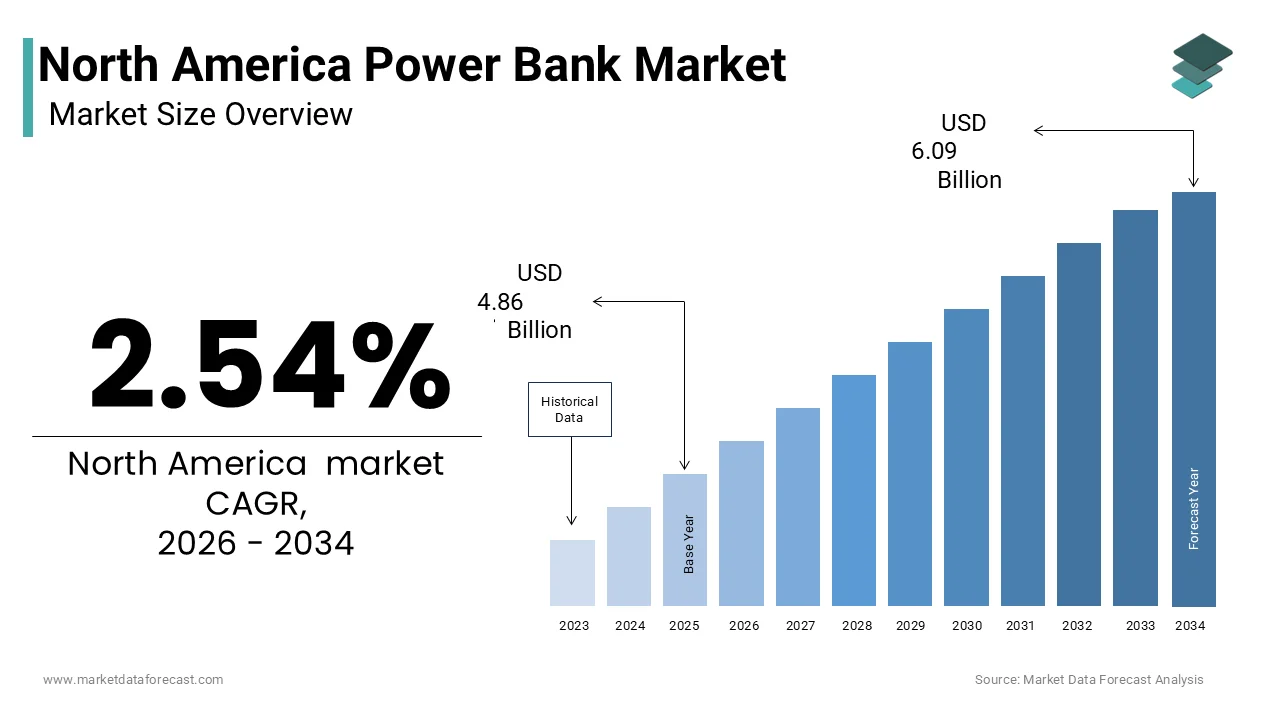
The North America power bank market was valued at USD 4.86 billion in 2025, increased to USD 4.98 billion in 2026, and is projected to grow at a CAGR of 2.54% from 2026 to 2034, reaching USD 6.09 billion by 2034, driven by high smartphone penetration, multi-device usage, and continued reliance on portable power solutions across consumer, enterprise, and emergency-use segments.
Key Market Players
- 2025 Market Size: USD 4.86 billion
- 2026 Estimate: USD 4.98 billion
- 2034 Forecast: USD 6.09 billion
- CAGR (2026–2034): 2.54%
Quick Growth Drivers
- High smartphone and wearable device penetration across the U.S. and Canada
- Rising dependency on mobile devices for work, travel, and outdoor use
- Adoption of fast-charging standards (USB-C PD, Quick Charge)
- Growth in remote work, digital nomadism, and outdoor recreation
- Increasing need for emergency backup power during outages
Principal Restraints
- Safety concerns related to lithium-ion battery overheating and recalls
- Stringent airline, FAA, and transport restrictions on battery capacity
- Proliferation of low-quality and counterfeit products
- Rising compliance costs tied to UL, IEC, and transport regulations
High-Value Opportunities
- Solar-integrated and renewable energy–enabled power banks
- Enterprise and industrial-grade power banks for mobile workforces
- Emergency preparedness and disaster-response charging solutions
- Premium fast-charging, multi-port, and laptop-compatible power banks
Key Market Challenges
- Intense price competition and commoditization of entry-level products
- Market saturation with over 1,000 competing brands
- Supply chain disruptions for lithium cells and semiconductors
- Margin pressure from low-cost imports and private-label brands
Fastest-Growing Segments
- Wearable Device Applications: 15.8% CAGR — health monitoring and smartwatches
- High Charge Power Banks: 18.4% CAGR — laptops, gaming, and professional use
- Digital Display Power Banks: 21.6% CAGR — smart UI and battery transparency
Regional Leadership & Dynamics
- United States (89.3%) — mature market, high device penetration, e-commerce dominance
- Canada (11.2%) — outdoor usage, harsh climate demand, strong travel segment
- Mexico — emerging manufacturing and consumption hub
What Wins Commercially
- Fast-charging, multi-device compatibility (phones, laptops, wearables)
- Strong safety certifications and airline-compliant designs
- Compact, portable form factors with high energy density
- Brand trust, warranty support, and omnichannel availability
Top Strategic Ask for Executives
- Differentiate beyond price through safety, speed, and smart features
- Invest in renewable-powered and emergency-use product lines
- Strengthen supply chain resilience for batteries and chips
- Expand enterprise and B2B-focused power bank solutions
Leading Players
Some of the companies that are playing a dominating role in the North America power bank market include:
- Anker Technology
- Sony Corporation
- Panasonic Corporation
- Lenovo Group
- AsusTeK Computer
- Beijing Xiaomi Technology
- Microsoft Corporation
North America Power Bank Market Size
The north america power bank market was valued at USD 4.86 billion in 2025 and grew to USD 4.98 billion in 2026. The market is projected to reach USD 6.09 billion by 2034, registering a CAGR of 2.54% from 2026 to 2034.
The power bank is a broader consumer electronics ecosystem. A power bank, defined as a portable charging device equipped with built-in batteries and output ports, serves as a secondary power source for mobile devices such as smartphones, tablets, and laptops. The proliferation of high-performance smartphones with energy-intensive features, such as 5G connectivity, high-resolution displays, and advanced processors, has necessitated the adoption of reliable external battery solutions. As per the U.S. Energy Information Administration, over 290 million smartphones were in use across the United States in 2023, underscoring a substantial user base reliant on mobile charging solutions. Simultaneously, the region’s increasing dependency on mobile devices for professional, educational, and recreational purposes has amplified the demand for uninterrupted power access. The rise in remote work and digital nomadism, accelerated by post-pandemic shifts, has further entrenched the relevance of portable charging solutions. Additionally, frequent travelers and commuters in metropolitan areas like New York, Los Angeles, and Toronto have embraced power banks as essential accessories. According to a 2023 survey by Statista, approximately 48% of American adults reported owning at least one portable charger.
MARKET DRIVERS
Surge in Mobile Device Usage and Dependency
The exponential rise in mobile device usage is propelling the power bank market. Smartphones, tablets, and wearable devices have become indispensable tools for communication, productivity, and entertainment. As per the Pew Research Center, 85% of Americans owned a smartphone in 2023, with a growing segment utilizing multiple devices simultaneously. This multi-device ecosystem intensifies the need for portable charging solutions in environments where access to fixed power sources is limited. The integration of power-intensive technologies, such as 5G networks and high-refresh-rate displays,s has further accelerated battery drain, compelling users to seek external power options. According to a 2022 report by Deloitte, over 60% of smartphone users in North America recharge their devices at least twice daily, with a significant portion citing battery life as a primary concern. Furthermore, the shift toward remote work and hybrid learning models has extended device usage beyond traditional settings, increasing reliance on portable power solutions. Urban commuters, frequent travelers, and outdoor enthusiasts represent key consumer segments driving consistent demand. The Federal Communications Commission reported that over 75% of North American households had at least three connected devices in 2023, reinforcing the relevance of power banks as essential accessories.
Technological Advancements in Battery and Charging Solutions
Technological innovation has significantly enhanced product appeal and functionality, which is accelerating the growth of the North America power bank market. Manufacturers are increasingly integrating advanced lithium-polymer and solid-state battery technologies, which offer higher energy density, faster charging speeds, and compact designs. The emergence of USB-C Power Delivery (PD) and Qualcomm Quick Charge protocols has enabled power banks to deliver up to 100W of power, sufficient for charging laptops and high-capacity tablets. Additionally, the incorporation of smart circuitry and multiple output ports allows users to charge several devices simultaneously, aligning with modern usage patterns. The miniaturization of components has also led to ultra-portable models weighing under 200 grams, appealing to travelers and mobile professionals. According to the Consumer Technology Association, over 67% of North American consumers prioritize compactness and portability when purchasing power banks. Furthermore, sustainability-focused innovations, such as solar-integrated and recyclable battery modules, are gaining traction among environmentally conscious users. These advancements not only enhance user experience but also differentiate premium offerings in a competitive market landscape.
MARKET RESTRAINTS
Safety and Regulatory Concerns Surrounding Lithium-Based Batteries
Safety concerns associated with lithium-ion and lithium-polymer batteries are restricting the growth ofthe North American power bank market. Incidents of overheating, swelling, and even combustion have raised consumer awareness and prompted stringent regulatory oversight. The U.S. Consumer Product Safety Commission recorded over 300 reported cases of power bank-related incidents in 2022, including fires and explosions linked to substandard or counterfeit products. These safety risks stem from poor-quality battery cells, inadequate circuit protection, and non-compliance with international safety standards such as UL 2054 and IEC 62133. As per the International Air Transport Association, over 40 airlines operating in North America have imposed restrictions on power banks exceeding 100Wh in carry-on luggage, limiting consumer choice and market penetration. Additionally, regulatory bodies like Health Canada and the Federal Aviation Administration have enforced stricter import and labeling requirements, increasing compliance costs for manufacturers. Counterfeit products, which often bypass these standards, further exacerbate safety risks and erode consumer confidence. According to a 2023 study by the National Institute of Standards and Technology, nearly 22% of power banks sold online in North America failed to meet basic safety certifications. The prevalence of unsafe products has led to increased scrutiny from retailers and e-commerce platforms, resulting in product recalls and reduced shelf availability.
Environmental Impact and E-Waste Management Challenges
The environmental implications of power bank production and disposal are also degrading the growth of the North American power bank market. Power banks, predominantly reliant on lithium-ion batteries, contribute to electronic waste (e-waste) streams that pose significant ecological challenges. The United Nations University reported that North America generated over 15 million tons of e-waste in 2023, with portable charging devices accounting for approximately 3% of this volume. The non-biodegradable nature of lithium-based components and the lack of widespread recycling infrastructure exacerbate environmental degradation. As per the Environmental Protection Agency, less than 25% of lithium-ion batteries in North America are recycled, primarily due to limited consumer awareness and inefficient collection systems. The production process of power banks also involves energy-intensive manufacturing and the extraction of rare earth metals, contributing to carbon emissions and resource depletion. Regulatory bodies in Canada and the U.S. have introduced extended producer responsibility (EPR) frameworks, mandating manufacturers to manage end-of-life disposal. However, compliance with these regulations increases production costs and reduces profit margins, particularly for smaller brands. A 2023 survey by the North American Recycling Association revealed that 58% of consumers are hesitant to purchase power banks due to environmental concerns. The growing emphasis on sustainability and corporate responsibility further pressures manufacturers to adopt eco-friendly alternatives, which may limit innovation and scalability.
MARKET OPPORTUNITIES
Integration with Renewable Energy and Solar Charging Solutions
The integration of renewable energy technologies, particularly solar charging, is expected to significantly boost new opportunities for the growth of the North American power bank market. As sustainability becomes a central consumer value, manufacturers are increasingly incorporating solar panels into portable charging devices to appeal to eco-conscious demographics. According to the International Renewable Energy Agency, solar energy adoption in North America grew by 18% annually between 2020 and 2023, reflecting a broader shift toward green technologies. Solar-integrated power banks, while still a niche segment, are gaining traction among outdoor enthusiasts, emergency responders, and off-grid users. A 2023 report by BloombergNEF indicated that the North American market for solar-powered portable chargers expanded by 27% year-over-year, driven by advancements in photovoltaic cell efficiency and declining manufacturing costs. Companies like Goal Zero and Anker have introduced hybrid models that combine solar panels with high-capacity lithium batteries, enabling off-grid charging in remote locations. The U.S. Department of Energy has also incentivized renewable energy integration through tax credits and grants, encouraging innovation in portable solar solutions. Furthermore, the increasing frequency of natural disasters and power outages in regions like California and Texas has heightened demand for emergency power solutions. As per the Federal Emergency Management Agency, over 12 million Americans experienced power outages lasting more than 24 hours in 2023.
Expansion into Enterprise and Industrial Applications
The enterprise and industrial sectors are also expected to escalate the growth of the North America power bank market. The growing consumer applications with a shift toward business-oriented solutions driven by the rise of mobile workforce ecosystems and field service operations are expected to leverage the growth of the market. According to a 2023 Gartner survey, over 65% of North American enterprises have adopted mobile-first strategies, deploying smartphones, tablets, and handheld devices across logistics, healthcare, retail, and construction industries. These sectors require reliable, high-capacity power banks to ensure uninterrupted device functionality in field environments. For instance, healthcare professionals rely on mobile diagnostic tools and communication devices, necessitating portable charging solutions that meet stringent safety and hygiene standards. Similarly, logistics companies utilize handheld scanners and GPS devices that demand consistent power during extended shifts. As per the U.S. Bureau of Labor Statistics, employment in mobile-intensive sectors such as transportation and warehousing grew by 4.2% in 2023, increasing the demand for ruggedized and high-performance power banks. Industrial-grade models, featuring enhanced durability, multiple port configurations, and long-lasting battery life, are gaining prominence. Additionally, partnerships between power bank manufacturers and enterprise solution providers are fostering customized offerings tailored to specific industry needs.
MARKET CHALLENGES
Intense Price Competition and Market Saturation
Intense price competition is likely to impede the growth of the North America power banks market with a high concentration of both established brands and low-cost manufacturers, particularly those sourcing from Asian suppliers. As per a 2023 Euromonitor report, over 1,200 brands offer power banks in North America, with price points ranging from $10 to $200, creating a fragmented and highly competitive landscape. This oversupply has led to aggressive pricing strategies, eroding profit margins for premium manufacturers. Discount retailers and e-commerce platforms often prioritize low-cost models, which, while accessible to budget-conscious consumers, undermine the value proposition of technologically advanced products. Furthermore, the commoditization of basic power banks has reduced differentiation, forcing manufacturers to compete primarily on cost rather than innovation. The saturation of entry-level segments has also limited opportunities for market expansion, as consumer demand becomes increasingly concentrated on affordable, standardized products. As per a 2023 McKinsey analysis, nearly 40% of North American power bank manufacturers reported declining profit margins due to price wars and stagnant demand growth. The prevalence of counterfeit products further exacerbates this challenge, diluting brand value and consumer trust.
Supply Chain Disruptions and Component Shortages
Supply chain disruptions and component shortages have emerged as a challenge for the growth of the North America power bank market. The global semiconductor shortage, exacerbated by geopolitical tensions and pandemic-related disruptions, has significantly impacted the availability of essential components such as lithium-ion cells, integrated circuits, and charging controllers. As per the Semiconductor Industry Association, North America experienced a 22% decline in semiconductor supply in 2022, directly affecting electronics manufacturing timelines and costs. Lithium, a core component in power bank batteries, has also faced supply constraints due to mining bottlenecks and environmental regulations. The U.S. Geological Survey reported a 15% increase in lithium prices in 2023, driven by supply-demand imbalances and geopolitical risks in key producing regions. These cost escalations have pressured manufacturers to either absorb losses or pass them onto consumers, affecting market competitiveness. The reliance on Asian suppliers for key components has also increased vulnerability to regional disruptions, as seen during China’s lockdowns in early 2023. As per a 2023 Deloitte study, 55% of North American electronics manufacturers reported supply chain delays exceeding 30 days. These persistent disruptions not only hinder market responsiveness but also increase operational uncertainty, compelling manufacturers to reassess sourcing strategies and invest in supply chain resilience. The complexity of global dependencies and component scarcity presents a formidable barrier to consistent market growth and innovation.
REPORT COVERAGE
| REPORT METRIC | DETAILS |
| Market Size Available | 2025 to 2034 |
| Base Year | 2025 |
| Forecast Period | 2026 to 2034 |
| Segments Covered | By Application, Capacity, Indicator, Type, and Region. |
| Various Analyses Covered | Global, Regional, and Country-Level Analysis, Segment-Level Analysis, Drivers, Restraints, Opportunities, Challenges; PESTLE Analysis; Porter’s Five Forces Analysis, Competitive Landscape, Analyst Overview of Investment Opportunities |
| Countries Covered | United States |
| Market Leaders Profiled | Beijing Xiaomi Technology Co., Ltd., Lenovo Group Ltd., Microsoft Corporation, Panasonic Corporation, Sony Corporation, AsusTeK Computer Inc., Anker Technology Co., Intex Technologies, Ambrane India Private Limited |
SEGMENTAL ANALYSIS
By Application Insights
The smartphone segment accounted for a dominant share of the North American power bank market in 2024. The extensive penetration of smartphones across North American demographics serves as the primary factor for the growth of the segment. This widespread adoption is complemented by the growing trend of multi-device ownership, where individuals utilize multiple smartphones for personal and professional purposes. Furthermore, the increasing reliance on smartphones for work-related tasks has blurred the lines between personal and professional device usage, necessitating continuous power availability. As per a 2023 Gartner survey, 73% of remote workers in North America depend on their smartphones as primary communication tools throughout their workday. The integration of power-intensive features such as 5G connectivity, high-resolution displays, and augmented reality applications has accelerated battery drain rates, compelling users to seek external charging solutions. The Federal Communications Commission documented that average daily smartphone usage in North America increased to 4.2 hours in 2023, representing a 12% year-over-year growth, directly correlating with increased power bank utilization. Despite advancements in smartphone technology, battery performance continues to lag behind the exponential growth in device capabilities, creating sustained demand for power bank solutions. Modern smartphones are equipped with energy-intensive processors, high-definition displays, and advanced camera systems that significantly impact battery life. According to the International Energy Agency, the power consumption of flagship smartphones increased by 18% between 2020 and 2023, primarily due to enhanced processing capabilities and 5G integration. Battery technology, however, has experienced only marginal improvements, with lithium-ion energy density increasing by approximately 3% annually over the same period. As per a 2023 Consumer Reports survey, 64% of smartphone users in North America cited battery life as their primary concern, with 42% reporting daily charging requirements beyond their device's native capacity. The introduction of fast-charging technologies, while beneficial, has paradoxically increased power consumption as users engage more intensively with their devices. Battery University data indicates that smartphones with fast-charging capabilities are used 23% more intensively than conventional devices, creating a cyclical demand for portable charging solutions.
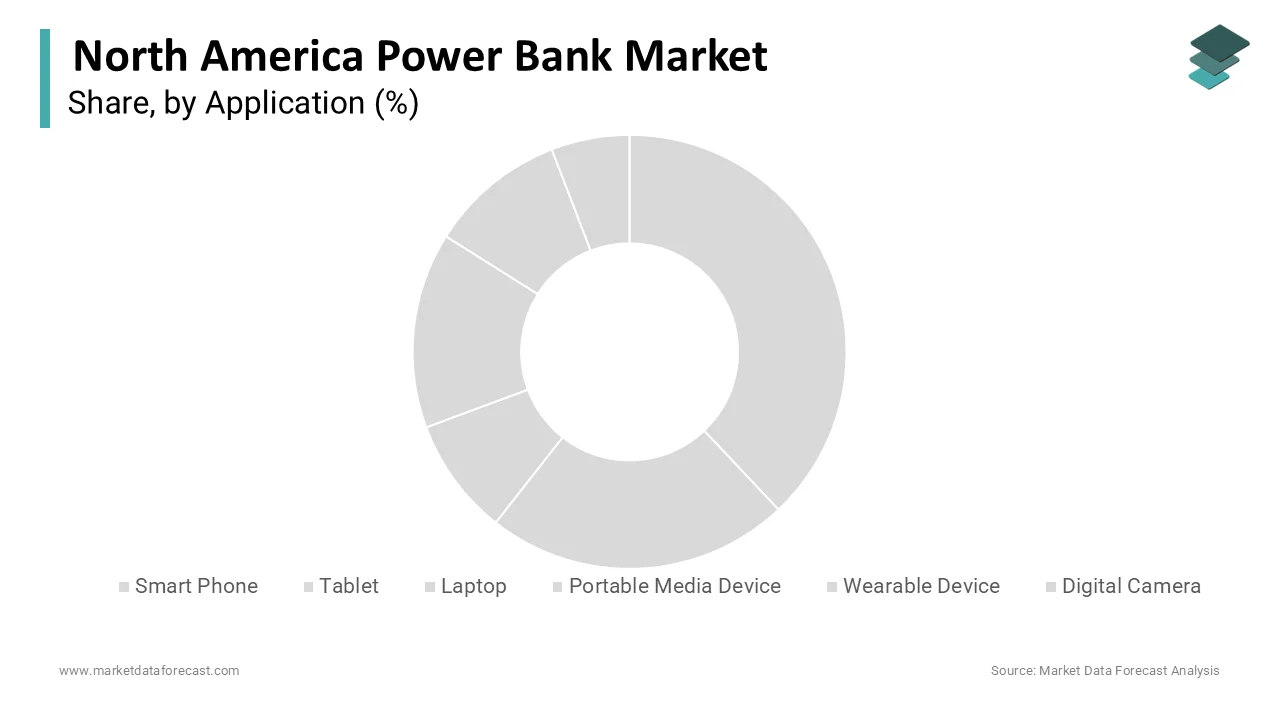
The wearable device segment is expected to witness the fastest CAGR of 15.8% from 2025 to 2033. According to the International Data Corporation, wearable device shipments in North America reached 48.2 million units in 2023, representing a 22% increase from the previous year. Smartwatches have experienced meteoric growth, with the Consumer Technology Association reporting that 35% of American households now own at least one smartwatch, compared to just 12% in 2019. The healthcare and fitness monitoring capabilities of these devices have resonated strongly with North American consumers in the post-pandemic era, where health consciousness has reached unprecedented levels. As per the American Heart Association, 52% of wearable device users in North America utilize their devices for continuous health monitoring, creating a persistent need for charging solutions. The integration of advanced sensors, GPS tracking, and cellular connectivity in modern wearables has significantly increased power consumption, necessitating frequent charging. The unique power requirements and compact form factors of wearable devices have created a specialized market niche that drives the segment's rapid expansion. Unlike traditional mobile devices, wearables demand power banks with specific voltage outputs, compact designs, and wireless charging capabilities. As per the IEEE Standards Association, 78% of wearable devices launched in 2023 featured wireless charging capabilities, requiring compatible power banks with Qi-enabled charging pads. This technological specificity has created premium pricing opportunities, with specialized wearable power banks commanding price premiums of 35-40% over conventional models. The miniaturization trend in wearable technology has also necessitated the development of ultra-portable charging solutions that maintain high energy density. According to the Materials Research Society, wearable device batteries have decreased in size by 28% while maintaining equivalent capacity through advanced lithium-polymer technology implementation. This evolution has spurred innovation in power bank design, with manufacturers developing magnetic charging systems, modular battery configurations, and wearable-integrated charging accessories. The convergence of specialized technical requirements, premium pricing potential, and sustained innovation creates a virtuous growth cycle that propels the wearable device segment to the forefront of market expansion.
By Capacity Insights
The portable mobile power bank segment held 52.3% of the North America power bank market share in 202,4 with its ability to provide an ideal compromise between portability and charging capacity, meeting the diverse needs of North American consumers across various usage scenarios. According to the Consumer Technology Association, 74% of North American power bank users prioritize portability as a key purchasing factor, while simultaneously requiring sufficient capacity to charge their primary devices at least twice. The segment's sweet spot capacity range of 10,000mAh to 15,000mAh effectively addresses this dual requirement, enabling users to maintain device functionality without compromising mobility. As per a 2023 Nielsen survey, 68% of North American travelers carry power banks with capacities within this range, citing the optimal balance between weight and performance. The segment's popularity is further reinforced by its compatibility with airline regulations, as most portable power banks in this capacity range meet the 100Wh limit imposed by the Federal Aviation Administration for carry-on luggage. Additionally, the segment's versatility appeals to diverse user demographics, from college students requiring daily charging solutions to business professionals needing reliable backup power during meetings. The economic accessibility and value proposition of portable mobile power banks have established them as the preferred choice for mainstream North American consumers. This price point represents a sweet spot that balances quality components with mass-market affordability, enabling widespread adoption across income demographics. The cost-effectiveness of portable power banks is further enhanced by their longevity and reliability, with industry data from the Battery University indicating that properly maintained units in this segment typically provide 300-500 charge cycles over 3-4 years of usage. Retail distribution channels have also optimized for this segment, with major retailers like Best Buy and Walmart allocating 65% of their power bank shelf space to portable models according to the National Retail Federation's 2023 electronics retail survey.
The high charge power bank segment is projected to achieve a CAGR of 18.4% from 2025 to 2033. The rapid proliferation of high-power consumption devices and the increasing professional reliance on multiple electronic tools have led to e the exceptional growth trajectory of the high-capacity power bank segment. The rise of content creation professionals, including streamers, videographers, and digital artists, has created a specialized demand for high-capacity power banks capable of sustaining power-hungry equipment during field work. The gaming industry's expansion has also contributed significantly, with the Entertainment Software Association reporting that 67% of North American gamers utilize portable gaming devices that require high-capacity charging solutions. Enterprise adoption of mobile workstations and field service equipment has further accelerated demand, with the increase in mobile professional equipment deployments in 2023. The advancement of fast-charging technologies and the development of comprehensive charging ecosystems have positioned high-capacity power banks as essential components of modern digital lifestyles in North America. This technological evolution has transformed high-capacity power banks from simple battery packs into sophisticated power management systems capable of handling diverse device requirements simultaneously. The Consumer Technology Association reported that 56% of North American consumers who purchased power banks in 2023 specifically sought models with multiple fast-charging ports, reflecting the growing demand for comprehensive charging solutions. The integration of smart charging algorithms and device-specific power optimization has further enhanced user experience, with companies like Anker and Belkin reporting 67% year-over-year sales growth in their high-capacity fast-charging product lines. These technological advancements have not only improved product performance but also justified premium pricing, creating a sustainable growth ecosystem for the segment.
By Indicator Insights
The LED lighting segment was the largest by holding 63.2% of the North American power bank market share in 2024. The role of LED-equipped power banks in emergency preparedness and disaster response scenarios has established them as essential household items across North America, driving their market dominance. According to the Federal Emergency Management Agency, over 12 million Americans experienced power outages exceeding 24 hours in 2023, creating sustained demand for reliable backup power and lighting solutions. Natural disasters, including wildfires in California, hurricanes along the Gulf Coast, and severe winter storms in the Northeast, have heightened awareness of emergency preparedness among North American consumers. The American Red Cross reported that 73% of surveyed households in disaster-prone regions now maintain LED-equipped power banks as part of their emergency preparedness kits. Insurance companies have also begun recommending these devices, with State Farm and Allstate incorporating LED power banks into their disaster preparedness guidelines for policyholders. Government initiatives have further supported market growth, with the Department of Homeland Security allocating $45 million in 2023 for community emergency preparedness programs that includethe distribution of LED-equipped power banks. The integration of LED lighting in power banks has revolutionized outdoor recreation experiences and enhanced lifestyle convenience for North American consumers, establishing this segment as the market leader. Camping, hiking, and adventure tourism have particularly driven demand for multifunctional power banks that provide both charging capabilities and illumination. As per a 2023 Gallup survey, 18% of employed Americans worked remotely at least part-time, with 67% of remote workers reporting regular outdoor work sessions that require portable lighting and charging solutions.
The digital display segment is likely to grow at the fastest CAGR of 21.6% from 2025 to 2033, owing to the increasing demand for sophisticated user interfaces and real-time device information, which has catalyzed the rapid expansion of the digital display power bank segment. According to the Consumer Technology Association, 84% of North American consumers consider user interface quality as a critical factor when purchasing electronic accessories, with digital displays providing immediate visual feedback on charging status and remaining capacity. The integration of smart technology into everyday devices has elevated consumer expectations for transparency and control, with digital displays enabling users to monitor multiple charging parameters simultaneously. Professional users, including content creators and streamers, have also embraced digital display power banks for their ability to provide precise battery management information. The seamless integration of digital display power banks with broader smart device ecosystems and the Internet of Things (IoT) framework has positioned this segment at the forefront of market innovation and growth. As per the Institute of Electrical and Electronics Engineers, the number of IoT-connected devices per North American household increased to 12.8 in 2023, creating demand for charging solutions that can communicate with and provide data to smart home systems. Digital display power banks equipped with Bluetooth connectivity and companion mobile applications have emerged as essential components of comprehensive device management ecosystems.
COUNTRY LEVEL ANALYSIS
United States Power Bank Market Analysis
The United States was the top performer in the North America power bank market by holding 89.3% of the share in 2024. The United States market status demonstrates maturity with consistent growth driven by technological innovation and consumer demand for advanced charging solutions. According to the U.S. Census Bureau, the country's population of 334 million in 2023 provides an extensive consumer base with high smartphone penetration rates exceeding 85%, as documented by the Pew Research Center. The emergence of remote work trends, digital nomadism, and outdoor recreation culture has created sustained demand for portable charging solutions. E-commerce dominance has further accelerated market penetration, with Amazon and other online platforms accounting for 67% of power bank sales according to the National Retail Federation's 2023 electronics retail survey. The country's regulatory environment has also supported market growth, with the Federal Communications Commission establishing clear safety standards that promote consumer confidence and encourage premium product adoption. Innovation hubs in California's Silicon Valley and Texas's technology corridor have fostered continuous product development, with major manufacturers like Anker and RavPower headquartered in these regions.
Canada Power Bank Market Analysis
Canada was ranked second, holding 11.2% of the North American power bank market share in 2024. Canada's developed economy, high technology adoption rates, and geographic characteristics necessitate reliable portable power solutions. According to Statistics Canada, the country's smartphone penetration rate reached 82% in 2023, slightly below that of the United States but representing a substantial consumer base of 31 million users. The harsh winter conditions and vast geographic expanse of Canada create unique demand patterns for power banks, those with enhanced durability and temperature resistance capabilities. The Canadian outdoor recreation industry has also driven market expansion, with Destination Canada documenting 28 million domestic and international visitors in 2023, who increasingly rely on portable charging solutions for navigation and communication. The country's bilingual market characteristics have also influenced product development, with manufacturers incorporating French language interfaces and regional regulatory compliance features.
COMPETITIVE LANDSCAPE
The North American power bank market exhibits intense competitive dynamics characterized by the coexistence of established global brands and emerging regional players vying for market dominance. The competitive landscape is shaped by continuous technological innovation, aggressive pricing strategies, and strategic market positioning efforts that distinguish premium brands from commodity manufacturers. Market leaders leverage their extensive research and development capabilities to introduce breakthrough products that set industry standards and create competitive barriers. The presence of numerous small and medium-sized enterprises adds complexity to the competitive environment, particularly in the budget segment, where price sensitivity drives purchasing decisions. Brand loyalty remains relatively low among mainstream consumers, creating opportunities for new entrants to capture market share through differentiated value propositions and innovative marketing approaches. Distribution channel competition has intensified as manufacturers seek to optimize their retail presence across both traditional brick-and-mortar stores and expanding e-commerce platforms. The market's maturity has led to increased consolidation efforts, with larger players acquiring smaller competitors to expand their product portfolios and geographic reach. Competitive pressures are further amplified by the constant threat of product substitution and the evolving regulatory landscape that impacts manufacturing costs and market access requirements.
KEY MARKET PLAYERS
The major key players of the North America Power Bank Market include
- Beijing Xiaomi Technology Co., Ltd.
- Lenovo Group Ltd.
- Microsoft Corporation
- Panasonic Corporation
- Sony Corporation
- AsusTek Computer Inc.
- Anker Technology Co.
- Intex Technologies
- Ambrane India Private Limited
TOP LEADING PLAYERS IN THE MARKET
- Anker Innovations stands as the undisputed market leader in thNorth Americanna power bank sector, renowned for its cutting-edge charging technologies and premium product portfolio. The company has revolutionized the industry through its PowerCore series, which introduced advanced lithium-polymer battery technology and fast-charging protocols to mainstream consumers. Anker's commitment to safety standards and quality certification has established it as a trusted brand among North American consumers seeking reliable portable charging solutions. Their extensive distribution network spans both online and offline retail channels, ensuring widespread market penetration. The company's continuous investment in research and development has yielded breakthrough innovations,s including gallium nitride technology integration and wireless charging capabilities. Anker's strategic partnerships with major technology companies have further solidified its position as an industry pioneer, consistently setting benchmarks for performance, durability, and user experience in the competitive North American power bank landscape.
- RAVPower has established itself as a formidable competitor in theNorth Americana power bank market through its focus on high-capacity solutions and innovative charging technologies. The company distinguishes itself by offering power banks with exceptional energy density and multi-device charging capabilities that cater to both consumer and professional markets. Their commitment to incorporating the latest USB-C Power Delivery and Qualcomm Quick Charge protocols has positioned them as a preferred choice for tech-savvy consumers. RAVPower's product development strategy emphasizes durability and safety, with rigorous testing procedures ensuring compliance with international standards. The brand has successfully penetrated the outdoor and travel segments through specialized products designed for extreme conditions and extended use. Their competitive pricing strategy,y combined with premium features, has enabled market expansion across diverse consumer demographics. RAVPower's strong online presence and direct-to-consumer sales model have facilitated rapid market response and customer engagement by making it a significant player in the North American power bank ecosystem. Zendure has emerged as a premium player in the North American power bank market by focusing on enterprise-grade solutions and innovative design aesthetics. The company targets discerning consumers who prioritize both functionality and visual appeal in their portable charging devices. Their product lineup features sleek, minimalist designs combined with advanced power management systems that appeal to professionals and lifestyle-conscious consumers. Zendure's expertise in developing solar-integrated power banks has positioned them at the forefront of the sustainable charging solutions movement. The company's commitment to using high-quality materials and implementing robust safety mechanisms has earned recognition from industry experts and consumers alike. Their strategic focus on the luxury segment has enabled premium pricing while maintaining strong customer loyalty. Zendure's collaborative approach with designers and technology partners has resulted in award-winning products that combine cutting-edge functionality with sophisticated aesthetics, establishing a unique market position in the competitive North American landscape.
TOP STRATEGIES USED BY KEY MARKET PARTICIPANTS
- Product Innovation and Technology Integration Leading manufacturers in the North American power bank market consistently prioritize product innovation as their primary strategic focus. This approach involves continuous research and development investments to incorporate cutting-edge battery technologies, advanced charging protocols, and smart connectivity features. Companies are increasingly integrating artificial intelligence and machine learning capabilities to optimize charging efficiency and device compatibility. The emphasis on developing proprietary charging algorithms and safety mechanisms has become a key differentiator. Additionally, manufacturers are exploring sustainable materials and eco-friendly production processes to align with growing environmental consciousness among North American consumers. This innovation-driven strategy enables companies to command premium pricing while establishing technological leadership positions that deter competition from generic manufacturers.
- Strategic Partnerships and Distribution Channel Expansion.n Key players actively pursue strategic partnerships with technology companies, retailers, and e-commerce platforms to strengthen their market presence and distribution capabilities. These collaborations enable manufacturers to leverage established brand recognition and customer bases while expanding their reach across diverse market segments. Partnerships with smartphone manufacturers for co-branded solutions have proven particularly effective in capturing specific consumer demographics. Additionally, companies are investing heavily in omnichannel distribution strategies that seamlessly integrate online and offline retail experiences. Strategic alliances with travel and outdoor equipment retailers have opened new market segments, while collaborations with enterprise technology providers have expanded business-to-business opportunities. These partnership-driven approaches facilitate rapid market penetration and enable companies to adapt quickly to changing consumer preferences and distribution trends.
- Brand Positioning and Customer Experience Enhancement Market leaders focus intensively on brand positioning and customer experience optimization to differentiate themselves in the highly competitive North America power bank market. This strategy involves developing distinctive brand identities that resonate with target consumer segments through targeted marketing campaigns and lifestyle-oriented messaging. Companies invest significantly in customer service infrastructure, including comprehensive warranty programs, responsive technical support, and user-friendly mobile applications for device management. Social media engagement and influencer partnerships play crucial roles in building brand awareness and fostering customer loyalty. Additionally, manufacturers emphasize product design aesthetics and user interface optimization to create emotional connections with consumers. The focus on creating memorable unboxing experiences and providing detailed user education materials further enhances customer satisfaction and brand advocacy, ultimately driving repeat purchases and market share growth.
MARKET SEGMENTATION
This research report on thNorth Americaca power bank market is segmented and sub-segmented into the following categories.
By Application
- Smart Phone
- Tablet
- Laptop
- Portable Media Device
- Wearable Device
- Digital Camera
- Others
By Capacity
- Portable Mobile Power Bank
- Ultra-Portable Mobile Power Bank
- Big Charge Power Bank
- High Charge Power Bank
By Indicator
- LED Lighting
- Digital Display
By Type
- Lithium-Ion (Li-Ion) Battery
- Lithium Polymer (Li-Polymer) Battery
By Country
- United States
- Canada
- Mexico