- Product Description Description
- Table of Contents TOC
- List of Table & Figure LOT
- Get Free Sample PDF Sample PDF
Market Size, 2025
$2.70 BnMarket Estimate, 2026
$3.03 BnMarket Forecast, 2034
$7.55 BnCAGR, 2026–2034
12.1%Executive Summary: North America Precision Farming Market
- Market Scope: Comprehensive regional analysis of the North American precision farming market covering offerings, technologies, application areas, and country-level breakdowns across the U.S., Canada, Mexico, Brazil, and the Rest of North America.
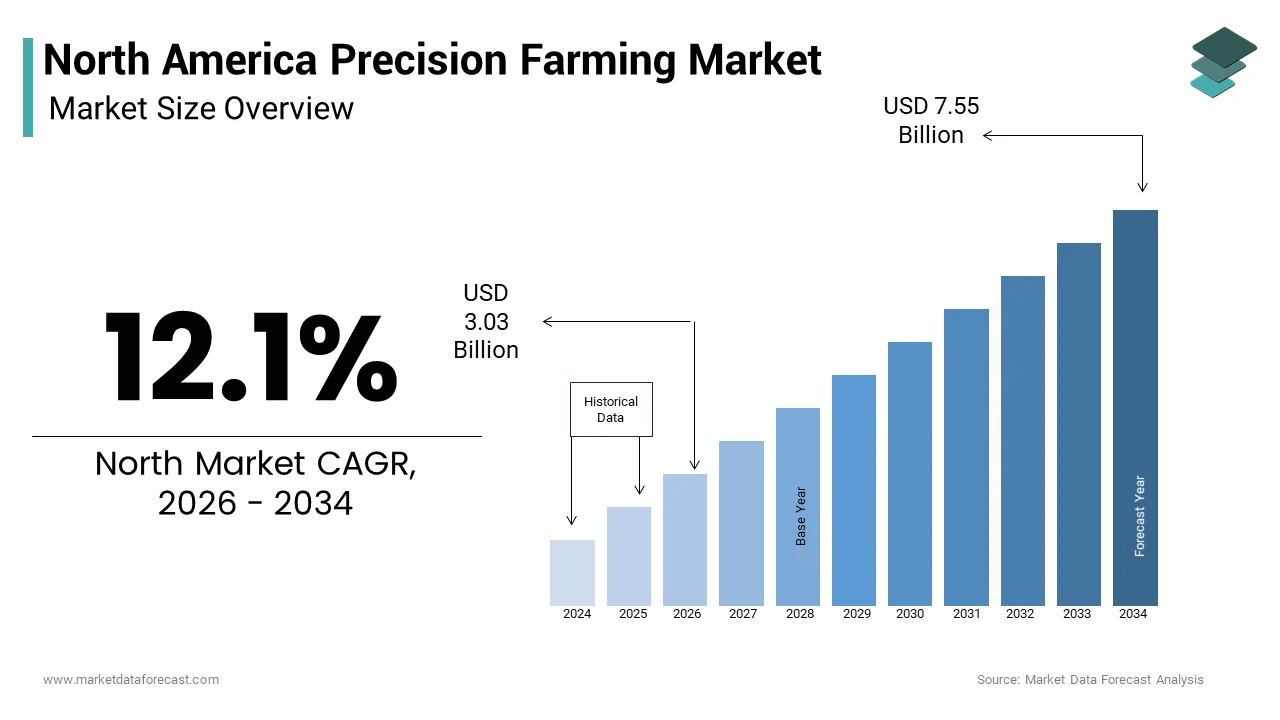
- Market Valuation: Valued at USD 2.70 billion (2025), estimated at USD 3.03 billion (2026), and projected to reach USD 7.55 billion by 2034, registering a strong CAGR of 12.10% (2026–2034).
- Primary Growth Drivers: Widespread adoption of IoT and data analytics to optimize resource utilization, increasing focus on sustainable agricultural practices to reduce greenhouse gas emissions, and the pressing need to enhance crop yields amid climate change challenges.
Key Market Segment Metrics (2026–2034)
| Category | Leading Segment / Position | Fastest-Growing Segment / Scope |
|---|---|---|
| By Offering | Hardware (accounted for 50.4% of the share in 2025, driven by GPS-enabled tractors, drones, and IoT sensors) | Software (projected to grow at a CAGR of 12.8%, propelled by AI and machine learning advancements) |
| By Technology | Guidance Systems (held 40.3% market share in 2025, valued for minimizing overlaps and reducing fuel/input waste) | Remote Sensing (forecasted to grow at a 14.5% CAGR, fueled by satellite imagery and early crop health detection) |
| By Application | Yield Monitoring (dominated with 35.4% share in 2025, enabling data-driven insights for soil fertility and moisture tracking) | Weather Tracking & Forecasting (projected to grow at a 13.2% CAGR due to rising risks from extreme weather events) |
| By Country | The United States (led the market with a 65.3% share in 2025, anchored by vast agricultural infrastructure and advanced state adoption) | Canada (expanding rapidly through initiatives like the Smart Farm Initiative and sustainable farming funds) |
Major Market Players & Competitive Landscape
Market Structure: A competitive marketplace characterized by intense rivalry among established machinery giants and technology providers focusing on strategic tech partnerships, R&D investments, and expansion into smart agriculture verticals.
Key Companies: Raven Industries, Deere & Company, AGCO Corporation, Trimble Navigation Ltd, Monsanto Company, Dupont, Agjunction, Inc., Precision Planting, Inc., SST Development Group, and Dickey-John Corporation.
North America Precision Farming Market Size
The North American precision farming market size was valued at USD 2.70 billion in 2025 and is anticipated to reach USD 3.03 billion in 2026 to reach from USD 7.55 billion by 2034, growing at a CAGR of 12.1% during the forecast period from 2026 to 2034.
Current Scenario of the North America Precision Farming Market
Precision farming is also known as precision agriculture, represents a transformative approach to modern farming practices in North America is leveraging advanced technologies such as GPS, IoT sensors, drones, and data analytics to optimize resource utilization and enhance crop yields. This market is driven by the growing need for sustainable agricultural practices amid increasing food demand and environmental challenges. According to the Food and Agriculture Organization (FAO), global food production must increase by 70% by 2050 to meet the needs of a rapidly growing population, which is placing immense pressure on farmers to adopt innovative solutions.
In North America, where large-scale farming dominates the agricultural landscape, precision farming has emerged as a critical tool for addressing inefficiencies. As per the United States Department of Agriculture (USDA), over 90 million acres of farmland in the U.S. are managed using precision farming techniques, enabling farmers to reduce input costs while improving productivity. Additionally, the increasing prevalence of climate change-induced challenges, such as unpredictable weather patterns and water scarcity, has further prompted the importance of precision farming. For instance, California’s Department of Water Resources reports that precision irrigation systems have reduced water usage by up to 30% in drought-prone regions.
MARKET DRIVERS
Rising Adoption of IoT and Data Analytics
The widespread adoption of IoT and data analytics is a significant driver propelling the North American precision farming market forward. As per the International Data Corporation (IDC), over 70% of large-scale farms in the U.S. now utilize IoT-enabled devices to monitor soil conditions, weather patterns, and crop health in real-time. These technologies enable farmers to make data-driven decisions, optimizing resource allocation and reducing waste.
For example, IoT sensors embedded in fields can provide precise information about soil moisture levels, allowing farmers to implement targeted irrigation strategies. According to a study conducted by Iowa State University, farms using IoT-based precision farming techniques have reported a 25% reduction in water usage and a 15% increase in crop yields. Furthermore, advancements in cloud computing and AI have enhanced the scalability of these systems, which is making them accessible to both small-scale and commercial farmers. The integration of predictive analytics further amplifies their benefits, enabling proactive measures to mitigate risks such as pest infestations or adverse weather conditions. This convergence of technology and agriculture ensures sustained demand for precision farming solutions across North America.
Increasing Focus on Sustainable Agriculture
The growing emphasis on sustainable agriculture is another major driver fueling the expansion of the North American precision farming market. According to the Environmental Protection Agency (EPA), agriculture accounts for approximately 10% of total greenhouse gas emissions in the U.S., prompting governments and organizations to promote eco-friendly farming practices. Precision farming plays a pivotal role in this transition by minimizing the overuse of fertilizers, pesticides, and water resources.
For instance, variable rate technology (VRT), a key component of precision farming, allows farmers to apply inputs such as fertilizers and herbicides at varying rates across a field based on specific needs. As per a report by the University of Nebraska-Lincoln, VRT has reduced fertilizer application by up to 20%, significantly lowering environmental impact. Additionally, government incentives such as subsidies for adopting sustainable technologies under programs like EQIP encourage farmers to invest in precision farming equipment. The alignment of sustainability goals with technological innovation reinforces the dominance of precision farming in the region’s agricultural landscape.
MARKET RESTRAINTS
High Initial Costs of Implementation
A significant restraint hindering the widespread adoption of precision farming in North America is the high initial cost associated with implementing advanced technologies. According to the American Society of Agricultural and Biological Engineers, the upfront investment for precision farming equipment, including GPS systems, drones, and IoT sensors, can range from 5,000 to 50,000 per farm, depending on the scale and complexity of operations. This financial barrier often deters small-scale farmers and agricultural producers in rural areas where financial resources may be limited. Moreover, ongoing maintenance costs add to the financial burden. For instance, as per a study by Purdue University, regular calibration of sensors, software updates, and technical support are essential to ensure optimal performance, requiring additional expenditures. While some federal programs offer grants or low-interest loans to offset these costs, such initiatives are not universally accessible.
Limited Technical Expertise and Awareness
Another significant restraint is the limited technical expertise and awareness surrounding precision farming technologies. Many farmers remain unfamiliar with how these systems function or their ability to enhance productivity. According to a survey conducted by the National Farmers Union, over 60% of small-scale farmers in the U.S. lack adequate knowledge about precision farming tools, by creates skepticism and hesitation among potential users.
Additionally, the complexity of installing and operating these systems requires a certain level of technical knowledge, which many users lack. As per research by Kansas State University, improper implementation of precision farming technologies can lead to inefficiencies, negating the intended benefits. Educational gaps and insufficient outreach programs further exacerbate this issue, particularly among rural communities.
MARKET OPPORTUNITIES
Integration with Smart City Initiatives
The integration of precision farming systems into broader smart city initiatives presents a transformative opportunity for the North American precision farming market. As per the Smart Cities Council, over 300 smart city projects are currently underway across North America, focusing on sustainable urban development and resource management. Precision farming technologies, with their ability to optimize resource usage and reduce environmental impact, align perfectly with these objectives.
For example, cities like Los Angeles and Toronto are investing heavily in urban agriculture projects, such as rooftop gardens and vertical farms, to combat food insecurity and reduce urban heat islands. According to the Urban Land Institute, incorporating precision farming technologies into these projects can improve crop yields by up to 40% while reducing water and energy consumption. Additionally, partnerships with local governments and private stakeholders can facilitate large-scale adoption, unlocking new revenue streams for manufacturers.
Expansion into Emerging Markets
The growing export potential of precision farming technologies to emerging markets offers another significant opportunity for the North American precision farming market. As per the USDA Foreign Agricultural Service, countries in Asia and Africa are increasingly adopting modern agricultural practices to address food security challenges, which is creating a robust demand for advanced farming solutions. North American companies, with their expertise in precision farming, are well-positioned to capitalize on this trend.
For instance, India’s Ministry of Agriculture has launched initiatives to promote the use of precision farming technologies, offering subsidies to farmers who adopt these systems. Similarly, African nations like Kenya and Nigeria are investing in smart agriculture projects to boost productivity. According to the World Bank, precision farming could increase crop yields by up to 50% in developing regions, making it an attractive solution for governments and international organizations.
MARKET CHALLENGES
Dependence on Reliable Internet Connectivity
A significant challenge facing the North American precision farming market is the dependence on reliable internet connectivity for optimal system performance. As per the Federal Communications Commission (FCC), approximately 19 million Americans, primarily in rural areas, lack access to high-speed internet, which is essential for the seamless operation of IoT-enabled farming systems. This digital divide creates a barrier to adoption for farmers in remote locations.
For example, precision farming tools such as GPS-guided tractors and drone-based crop monitoring rely on real-time data transmission to function effectively. According to a study by Texas A&M University, intermittent connectivity issues can disrupt these processes, leading to inefficiencies and increased operational costs. While advancements in satellite-based internet services, such as Starlink, aim to bridge this gap, their availability and affordability remain inconsistent. Addressing this challenge requires significant investment in infrastructure and alternative connectivity solutions, posing a persistent obstacle to market growth.
Competition from Traditional Farming Methods
Competition from traditional farming methods represents another major challenge for the precision farming market in North America. Conventional techniques, such as manual labor and non-automated machinery, dominate the market due to their lower upfront costs and ease of implementation. As per the USDA, traditional farming practices account for over 70% of all agricultural operations, making them a formidable competitor for precision farming technologies.
Additionally, misconceptions about the complexity of precision farming systems deter adoption. According to a survey by the National Association of Conservation Districts, nearly 50% of farmers perceive precision farming as difficult to integrate into existing workflows, despite its long-term benefits. This perception gap, combined with the entrenched market presence of conventional methods, creates a challenging environment for precision farming providers. Bridging this gap requires targeted education campaigns and demonstrations of precision farming’s cumulative advantages, which remain an uphill battle in the current competitive landscape.
REPORT COVERAGE
| REPORT METRIC | DETAILS |
| Market Size Available | 2025 to 2034 |
| Base Year | 2025 |
| Forecast Period | 2026 to 2034 |
| CAGR | 12.1% |
| Segments Covered | By Offering, Technology, Application, and Country. |
| Various Analyses Covered | Global, Regional & Country Level Analysis, Segment-Level Analysis, DROC, PESTLE Analysis, Porter’s Five Forces Analysis, Competitive Landscape, Analyst Overview on Investment Opportunities |
| Regions Covered | The U.S, Mexico, Brazil, Rest of North America |
| Market Leaders Profiled | Raven Industries, Deere & Company, AGCO Corporation, Trimble Navigation Ltd, Monsanto Company, Dupont, Agjunction, Inc, Precision Planting, Inc, SST Development Group, Dickey-John Corporation. |
SEGMENTAL ANALYSIS
By Offering Insights
The hardware dominated the North American precision farming market by accounting for 50.4% of the share in 2025, with widespread adoption of advanced equipment such as GPS-enabled tractors, drones, and IoT sensors, which form the backbone of precision farming operations. For instance, according to the American Society of Agricultural and Biological Engineers, over 70% of large-scale farms in the U.S. now utilize hardware-based precision farming tools to enhance productivity.
A key driving factor is the growing emphasis on mechanization and automation in agriculture. As per Purdue University, the use of GPS-guided machinery has reduced fuel consumption by up to 15% while improving operational efficiency. Additionally, advancements in sensor technology have made hardware systems more affordable and accessible, even for small-scale farmers. Programs like EQIP provide subsidies for purchasing precision farming equipment, further accelerating adoption. These factors collectively reinforce the dominance of hardware in the precision farming market.
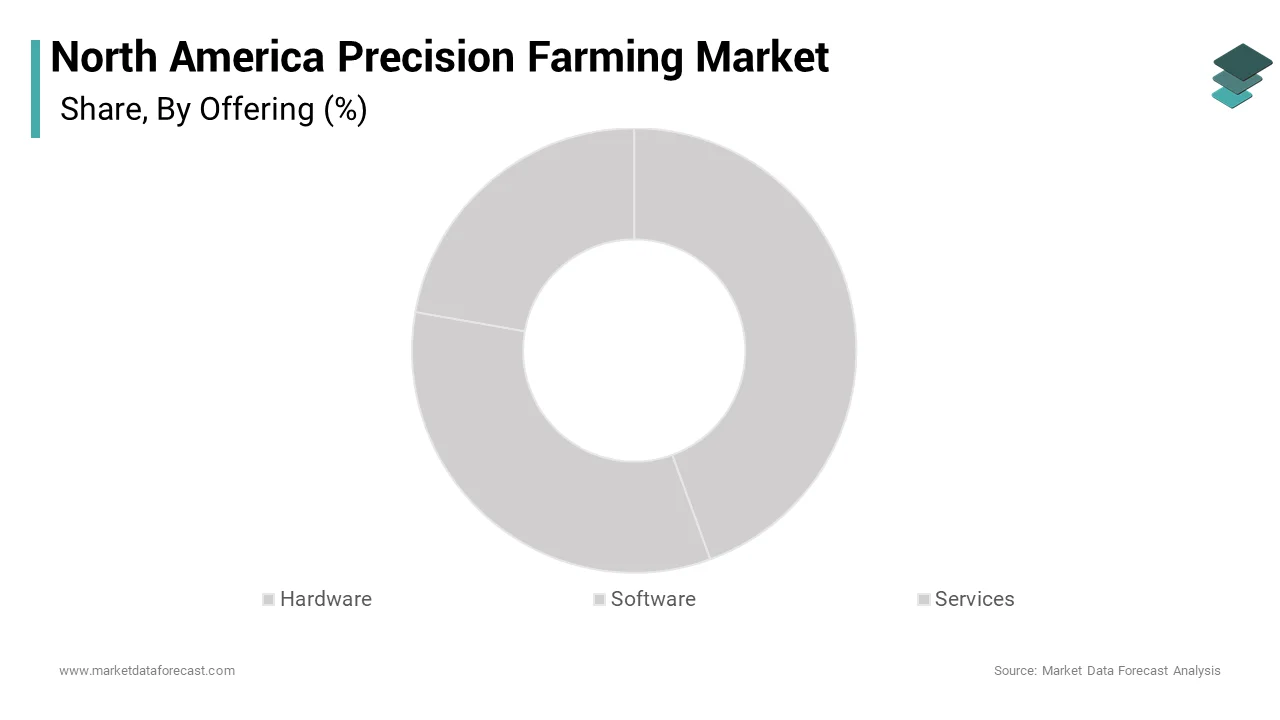
The software is lucratively growing with a projected CAGR of 12.8% throughout the forecast period. A significant driver is the rising adoption of AI and machine learning technologies. According to Iowa State University, AI-powered software can analyze vast datasets from IoT sensors and satellite imagery to provide actionable insights, enabling farmers to make real-time adjustments to their operations. Additionally, government initiatives promoting digital agriculture, such as Canada’s Smart Farm Program, encourage the integration of software solutions into farming practices. The convergence of technological innovation and policy support positions software as a critical growth driver in the precision farming market.
By Technology Insights
The guidance systems segment was the largest and held 40.3% of the North America precision farming market share in 2025. These systems are widely adopted due to their ability to enhance operational efficiency by reducing overlaps and minimizing input wastage during field operations. For example, as per Kansas State University, guidance systems can reduce fuel usage by up to 20%, making them indispensable for modern farming. A primary driving factor is the increasing focus on sustainability and cost-effectiveness. According to the Environmental Protection Agency (EPA), precision farming technologies like guidance systems have significantly reduced the environmental impact of agriculture by optimizing resource usage. Additionally, advancements in GPS and RTK (Real-Time Kinematic) technology have improved the accuracy of these systems, enabling precise navigation even in challenging terrains. Federal programs offering subsidies for adopting sustainable technologies further bolster the adoption of guidance systems. Remote sensing is likely to grow with a CAGR of 14.5% in the coming years. This growth is propelled by its ability to provide comprehensive field-level insights through satellite imagery and aerial drones, enabling farmers to monitor crop health and detect issues early. A key driver is the increasing prevalence of climate-related challenges. According to NASA, remote sensing technologies can identify water stress and pest infestations weeks before visible symptoms appear, allowing farmers to take proactive measures. Additionally, partnerships between governments and private companies, such as Canada’s collaboration with satellite imaging firms, have expanded access to high-resolution data. The emphasis on early detection and mitigation of risks further amplifies the adoption of remote sensing across the region.
By Application Insights
The yield monitoring dominated the North American precision farming market with 35.4% of the share in 2025. For instance, according to the University of Nebraska-Lincoln, yield monitoring systems have helped farmers achieve up to a 10% increase in crop yields by identifying underperforming areas. A major driving factor is the growing need for data-driven insights in agriculture. As per Texas A&M University, yield monitoring allows farmers to track variations in soil fertility and moisture levels is facilitating targeted interventions. The alignment of yield monitoring with sustainability goals reinforces its dominance in the precision farming market.
The weather tracking and forecasting segment is likely to grow with a CAGR of 13.2% in the coming years. This growth is driven by the increasing frequency of extreme weather events, which necessitate accurate and timely forecasts to mitigate risks. A significant driver is the rising prevalence of droughts and floods. According to NOAA, unpredictable weather patterns have caused over $100 billion in agricultural losses in recent years, with the importance of weather tracking technologies. For example, studies conducted by Purdue University reveal that integrating weather forecasting systems with precision farming tools can reduce crop damage by up to 25%. Additionally, federal initiatives promoting climate-resilient agriculture further accelerate adoption. The convergence of risk management and technological innovation positions weather tracking as a critical growth driver in the market.
COUNTRY ANALYSIS
Top Leading Countries in the Market
The U.S. was the top performer in the North American precision farming market with a 65.3% share in 2025 due to its vast agricultural infrastructure and robust adoption of advanced technologies. For instance, states like California and Iowa are pioneers in implementing precision farming tools such as GPS-guided tractors and drone-based crop monitoring.
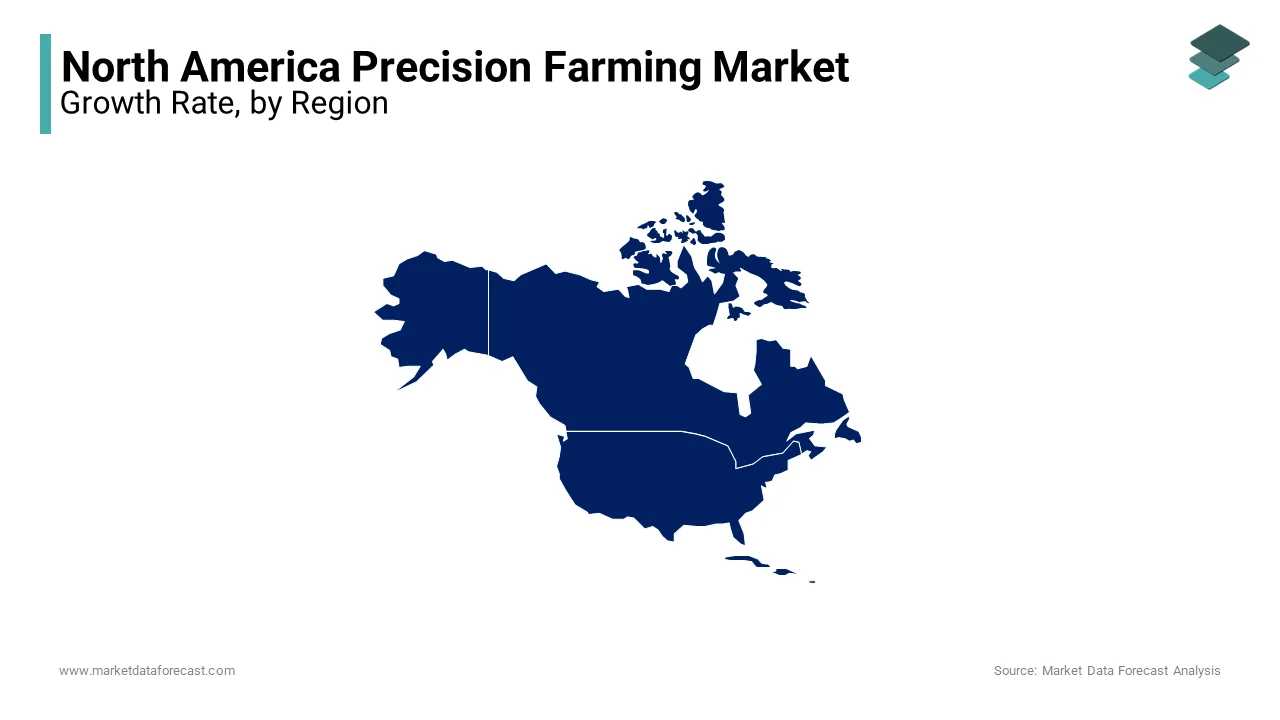
Canada's precision farming market accounted for 15.4% of the share in 2024, with its focus on sustainable farming practices, particularly in regions like Saskatchewan and Alberta. Programs like the Smart Farm Initiative provide funding for precision farming technologies, enhancing the competitiveness of Canadian farmers in both domestic and international markets.
KEY MARKET PLAYERS
Some of the major players in the Precision Farming market are
- Raven Industries
- Deere & Company
- AGCO Corporation
- Trimble Navigation Ltd
- Monsanto Company
- Dupont
- Agjunction, Inc
- Precision Planting, Inc
- SST Development Group
- Dickey-John Corporation.
Top Players In the Market
- John Deere is a global leader in precision farming, renowned for its advanced agricultural machinery and technology solutions. The company’s contribution to the global market lies in its ability to integrate cutting-edge technologies like GPS, IoT, and AI into farming equipment, enabling farmers to optimize resource usage and improve productivity. John Deere’s focus on sustainability aligns with global efforts to reduce agriculture’s environmental impact, making it a trusted partner for modern farmers. Its innovations, such as autonomous tractors and data-driven analytics platforms, have set industry benchmarks, with its dominance in both regional and international markets.
- Trimble Inc. plays a pivotal role in the precision farming market through its comprehensive suite of hardware, software, and services tailored to agricultural needs. The company specializes in guidance systems, yield monitoring, and remote sensing technologies, offering end-to-end solutions for optimizing farm operations. Trimble’s emphasis on interoperability ensures seamless integration with existing farming practices, enhancing user adoption.
- AGCO Corporation is a prominent player in the precision farming market, offering advanced machinery and digital solutions designed to enhance farm efficiency. The company’s Fendt and Massey Ferguson brands are widely recognized for their precision farming capabilities, including variable rate technology and automated steering systems. AGCO’s commitment to innovation is evident in its development of cloud-based platforms that enable real-time data analysis and decision-making.
Top Strategies Used By Key Market Participants
Strategic Partnerships with Technology Providers
Key players in the North American precision farming market frequently collaborate with tech companies to integrate advanced innovations into their offerings. These partnerships enable firms to enhance the functionality of their products, such as combining AI algorithms with IoT sensors, ensuring they remain competitive in an evolving market. For instance, joint ventures with cloud computing providers allow companies to offer scalable solutions for data storage and analytics, appealing to large-scale agricultural operations.
Investment in R&D for Technological Advancements
Innovation remains a cornerstone for maintaining competitiveness in the precision farming market. Leading companies invest heavily in research and development to improve system efficiency and user experience. These firms can differentiate themselves while addressing emerging trends like climate resilience and resource optimization by focusing on advancements such as AI-driven predictive analytics and autonomous machinery.
Expansion into Emerging Applications
To diversify their revenue streams, key players are exploring new applications for precision farming technologies beyond traditional crop management. For example, precision farming tools are increasingly being used in urban agriculture, vertical farming, and livestock management. By targeting these emerging markets, companies can tap into untapped opportunities and reduce reliance on conventional sectors.
COMPETITIVE LANDSCAPE
The North American precision farming market is characterized by intense competition, driven by the presence of established players and emerging startups striving to capture market share. Leading companies leverage their expertise in technology and innovation to offer superior products that comply with stringent environmental standards. The competitive landscape is further shaped by the increasing demand for sustainable solutions, prompting firms to adopt strategies such as mergers, acquisitions, and partnerships. Smaller players, on the other hand, focus on niche markets, targeting specific applications like urban farming or livestock management.
RECENT MARKET NEWS
- In April 2024, John Deere launched a partnership with a leading AI company to enhance its autonomous tractor capabilities. This collaboration aims to provide farmers with advanced automation tools, which are strengthening the company’s prominence in smart farming solutions.
- In June 2023, Trimble Inc. introduced a new cloud-based platform tailored for small-scale farmers. This move aligns with the growing demand for affordable and accessible precision farming tools, broadening the company’s customer base.
- In February 2024, AGCO Corporation acquired a drone technology startup to expand its remote sensing product portfolio. This investment enables the company to cater to emerging trends like crop health monitoring and pest detection.
- In September 2023, a U.S.-based cooperative signed a memorandum of understanding with the government to promote precision irrigation systems. This collaboration aims to address water scarcity challenges while boosting the company’s regional market presence.
- In November 2023, a Canadian firm launched a carbon sequestration initiative, allowing farmers using precision farming tools to earn carbon credits. This program positions the firm as a leader in sustainable agriculture while attracting environmentally conscious buyers.
MARKET SEGMENTATION
This research report on the North American precision farming market is segmented and sub-segmented into the following categories.
By Offering Insights
- Hardware
- Automation and control systems
- and Sensing and Monitoring Devices
- Software
- Web-based
- cloud-based software
- Services
By Technology Insights
- Guidance systems
- Variable rate technology
- remote sensing
By Application Insights
- Yield Monitoring
- Field Mapping
- Crop Scouting
- Weather Tracking & Forecasting
- Irrigation Management
- Inventory Management
- Farm Labor Management
- Financial Management
By Country
- The USA
- Canada
- Mexico