- Product Description Description
- Table of Contents TOC
- List of Table & Figure LOT
- Get Free Sample PDF Sample PDF
Market Size, 2025
$2.54 BnMarket Estimate, 2026
$2.75 BnMarket Forecast, 2034
$5.18 BnCAGR, 2026–2034
8.23%North America Residential Boiler Market Size
The North America residential boiler market size was valued at USD 2.54 billion in 2025 and is anticipated to reach USD 219.59 billion in 2026 from USD 5.18 billion by 2034, growing at a CAGR of 8.23% during the forecast period from 2026 to 2034.
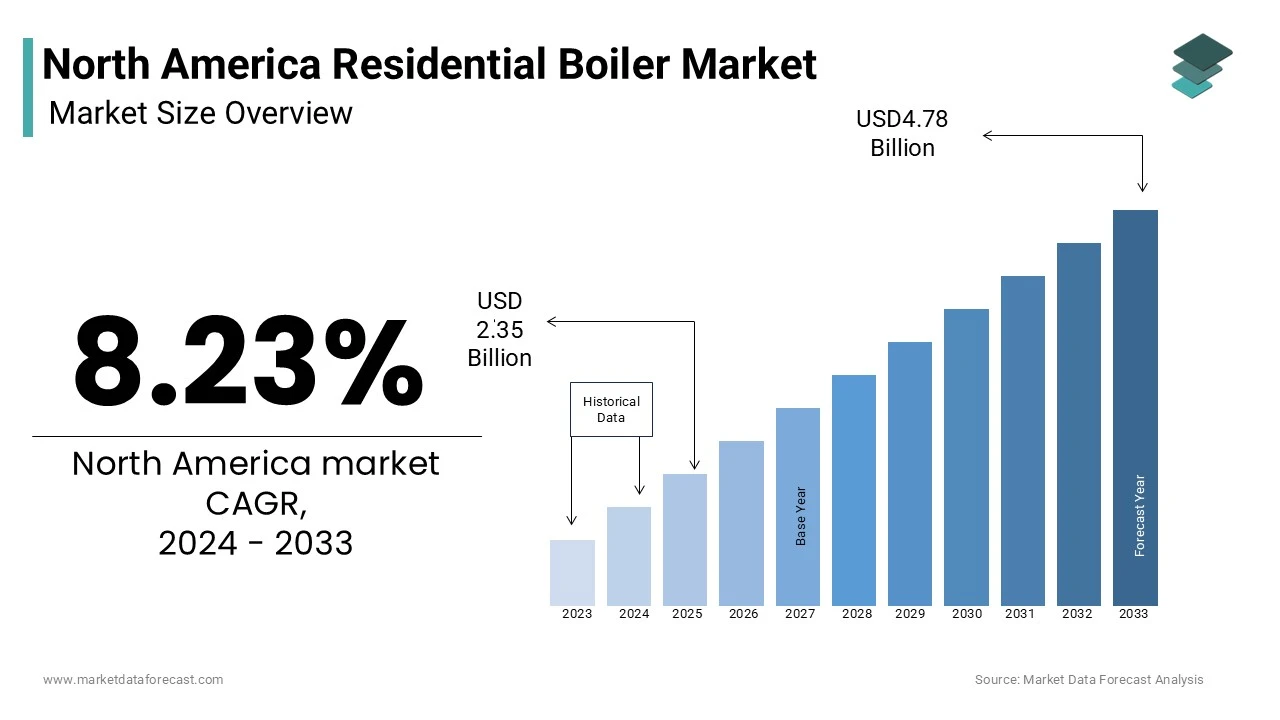
The residential boilers operate on various fuel sources such as natural gas, oil, propane, and electricity, with a growing shift toward high-efficiency condensing models. According to the U.S. Census Bureau, approximately 13.8 million existing homes were sold in the United States in 2023. This rise in home turnover often triggers system upgrades, including heating equipment replacements. Furthermore, the National Association of Home Builders reported that nearly 62% of new single-family homes constructed in 2023 included central heating systems, many of which incorporated modern boiler technology. The integration of renewable energy sources like solar thermal into boiler systems further indicates a shift toward sustainability in residential heating solutions across North America.
MARKET DRIVERS
Increasing Adoption of High-Efficiency Boilers Due to Rising Energy Costs
The growing preference for high-efficiency boilers driven by rising energy costs and consumer awareness regarding long-term savings is driving the growth of the North America residential boiler market. According to the U.S. Energy Information Administration (EIA), average residential natural gas prices increased by 17% between 2022 and 2023. High-efficiency condensing boilers, which can achieve Annual Fuel Utilization Efficiency (AFUE) ratings above 90% that have become increasingly popular as they significantly reduce annual heating bills. Additionally, ENERGY STAR-certified boilers accounted for over 65% of total boiler sales in 2023, demonstrating a strong market movement toward energy-efficient products. Consumers are increasingly prioritizing lifecycle costs over upfront investment, especially given the potential for long-term utility savings. Moreover, manufacturers are responding to this trend by expanding product lines with smart-enabled, modulating boilers that adjust heat output based on demand, further improving efficiency.
Aging Housing Stock Requiring System Replacement and Upgrades
The aging housing infrastructure in the United States and Canada, which necessitates widespread replacement and modernization of outdated heating systems. According to the U.S. Department of Housing and Urban Development, the median age of owner-occupied homes in the U.S. was 42 years as of 2023, with nearly 40% of homes built before 1970. Many of these older homes still operate with legacy boiler systems that are inefficient, costly to maintain, and prone to failure. The National Association of Home Builders (NAHB) estimates that the average lifespan of a residential boiler is between 15 to 20 years, meaning a large portion of installed units are nearing or exceeding their operational limits. This has led to a surge in replacement cycles, especially in regions with harsh winters such as the Northeast and Midwest.
MARKET RESTRAINTS
High Initial Investment and Installation Costs
The relatively high initial investment required for purchasing and installing modern, high-efficiency boiler systems is restricting the growth of the North America residential boiler market. According to data from the U.S. Department of Energy, the average cost of a residential boiler installation ranges between $3,500 and $8,000, depending on system type, size, and complexity. Additionally, the installation process often involves extensive modifications to existing plumbing and electrical systems, further increasing the overall cost. Furthermore, while long-term savings on energy bills can offset the initial outlay, many consumers remain hesitant due to limited access to financing or lack of awareness about available incentive programs.
Stringent Emissions Regulations Limiting Conventional Boiler Models
The stringent emissions regulations imposed by both federal and state governments are increasingly limiting the availability and adoption of conventional non-condensing boiler models is also hampering the growth of the North America residential boiler market. These regulatory shifts, while environmentally beneficial, pose a challenge to market growth by reducing consumer choice and raising product prices. Manufacturers must invest heavily in research and development to comply with these norms, which in turn affects end-user affordability. Moreover, some smaller HVAC contractors struggle to keep pace with rapidly changing technical requirements, leading to supply chain bottlenecks and delayed installations. Consumer confusion around compliance labels and efficiency ratings also contributes to slower decision-making.
MARKET OPPORTUNITIES
Integration of Smart Technology and IoT in Residential Boilers
The integration of smart technology and Internet of Things (IoT) capabilities into heating systems is greatly influencing the growth of the North America residential boiler market. According to a report by Parks Associates, over 58% of U.S. broadband households owned at least one smart home device in 2023, signaling a growing appetite for connected living solutions. This trend extends to HVAC equipment, where smart boilers equipped with remote monitoring, adaptive learning, and real-time diagnostics are gaining traction. Manufacturers such as Viessmann, Baxi, and Navien are incorporating Wi-Fi-enabled thermostats and mobile apps that allow homeowners to control boiler settings from their smartphones. According to the U.S. Department of Energy, smart boiler systems can reduce annual heating costs by up to 15% through optimized temperature scheduling and predictive maintenance alerts.
Expansion of Renewable Energy Incentives Supporting Hybrid Boiler Systems
The expansion of renewable energy incentives supporting hybrid boiler systems that integrate traditional fossil fuels with solar thermal or biomass energy sources is prompting the growth of the North America residential boiler market. In Canada, Natural Resources Canada's Greener Homes Grant offers subsidies of up to CAD $5,000 for homeowners who install renewable energy-based heating systems, including solar-assisted boilers. These incentives have spurred interest in hybrid models that combine the reliability of gas boilers with the sustainability of solar thermal collectors. Moreover, manufacturers such as Bosch and Vaillant are developing modular boiler systems designed to easily integrate with solar thermal panels, enabling seamless transition between energy sources.
MARKET CHALLENGES
Skilled Labor Shortage Hindering Installation and Maintenance Services
The shortage of skilled labor required for proper installation, servicing, and repair of modern boiler systems is anticipated to inhibit the growth of the North America residential boiler market. The Associated Builders and Contractors organization reported in 2023 that 83% of construction firms struggled to find qualified HVAC technicians, which is exacerbating delays in system installations and service calls. The complexity of modern high-efficiency and smart boiler systems requires specialized training, which many existing technicians lack. Additionally, the aging workforce poses a long-term concern. The PHCC notes that the average age of HVAC technicians in the U.S. is 55, with fewer young workers entering the trade
Supply Chain Disruptions Impacting Component Availability and Lead Times
The ongoing supply chain disruptions affecting the availability of key components and extending lead times for new installations is additionally to restrict the growth of the North America residential boiler market. According to the Institute for Supply Management, semiconductor shortages and global logistics bottlenecks persisted into early 2024, affecting production schedules for HVAC equipment manufacturers. Moreover, steel and copper price volatility has added pressure on manufacturing costs. Data from Metal Prices.com indicates that copper prices rose by 18% in 2023 compared to the previous year, directly influencing the cost of heat exchangers, a core component in boiler systems.
SEGMENTAL ANALYSIS
By Product Type Insights
The condensing boiler segment dominated the North America residential boiler market share in 2024 due to its superior energy efficiency, regulatory backing, and increasing consumer preference for long-term cost savings. According to data from the Air-Conditioning, Heating, and Refrigeration Institute (AHRI), shipments of condensing boilers in the U.S. alone grew by 13.5% year-over-year in 2023. The rising emphasis on energy conservation and emissions reduction is leveraging the growth of the North America residential boiler market. Additionally, government incentives and utility rebates have played a pivotal role in accelerating adoption. For instance, NYSERDA reported that over 75,000 condensing boiler installations were supported through its rebate program in 2023 alone. In Canada, Natural Resources Canada’s updated efficiency standards now mandate minimum AFUE levels that effectively phase out non-condensing boilers in most provinces.
The electric boilers segment is projected to grow with a CAGR of 7.4% from 2026 to 2034 with the increasing adoption of net-zero and all-electric building codes, particularly in progressive states like California and New York. According to the U.S. Green Building Council, over 32,000 residential buildings achieved LEED certification in 2023, many of which opted for electric heating systems to eliminate on-site fossil fuel use. Another contributing factor is the declining cost of renewable electricity and the expansion of green power programs. As per the U.S. Energy Information Administration, the average cost of wind and solar-generated electricity fell by 14% in 2023, making electric heating more economically viable. Additionally, manufacturers like Navien and Vaillant have introduced high-efficiency modulating electric boilers that offer zero-emission operation, appealing to environmentally conscious consumers.
REGIONAL ANALYSIS
United States Residential Boiler Market Insights
The United States was the largest contributor by accounting for 78.3% of the North America residential boiler market in 2025 with the aging residential infrastructure, with the U.S. Census Bureau reporting that over 40% of existing homes were built before 1970, necessitating system replacements. Additionally, federal tax credits and utility rebates play a significant role in boosting adoption rates. Moreover, the Northeast and Midwest regions remain hotspots for boiler adoption due to cold climate conditions and higher reliance on hydronic heating systems.
Canada Residential Boiler Market Insights
Canada residential boiler market held 16.3% of share in 2025. The country's cold climate conditions and older housing stock contribute significantly to the demand for replacement units. The expansion of federal and provincial incentive programs, such as the Greener Homes Grant, which provides subsidies of up to CAD $5,000 for energy-efficient heating upgrades. As per the Canada Mortgage and Housing Corporation (CMHC), over 115,000 homeowners applied for these grants in 2023, with a notable percentage opting for high-efficiency condensing boilers.
Top Players in the North America Residential Boiler Market
The Viessmann Manufacturing Company is one of the top key players in the North America residential boiler market. Viessmann offers a wide range of high-efficiency condensing boilers tailored to meet diverse heating needs, which is known for its innovation and long-standing reputation. The company's commitment to sustainability, product reliability, and advanced engineering has made it a preferred choice among homeowners and contractors alike. Its strong distribution network and customer support services further enhance its market presence.
Another major player is BDR Thermea Group, operating under brands like Baxi and Peerless in North America. The company brings extensive European expertise in boiler technology and has successfully adapted its product lineup to suit regional preferences. BDR Thermea emphasizes energy efficiency and smart integration by ensuring that its boilers align with modern residential demands while maintaining performance and durability across varying climates.
A.O. Smith Corporation is also a dominant force in the market recognized for its hybrid and electric boiler solutions. The company leverages its deep-rooted experience in water heating technologies to deliver efficient and eco-friendly residential heating systems. A.O. Smith focuses on innovation, especially in integrating renewable energy sources with traditional boiler systems with its position and contributing significantly to shaping the future of the residential boiler landscape in North America.
Top Strategies Used by Key Market Participants
One major strategy employed by key players in the North America residential boiler market is product innovation and technological advancement. Companies are continuously developing high-efficiency, smart-enabled boilers that offer better performance, reduced emissions, and enhanced user control through mobile connectivity and automation features.
Another approach is expanding distribution networks and strengthening after-sales service. Leading manufacturers are investing in localized dealer partnerships, training programs, and service infrastructure to ensure seamless installation, maintenance, and customer satisfaction across diverse geographic regions.
The firms are actively engaging in strategic collaborations, acquisitions, and partnerships to broaden their product portfolios and enhance technical capabilities. These alliances help companies integrate complementary technologies, enter new market segments, and reinforce their competitive positioning in an evolving industry landscape.
COMPETITIVE LANDSCAPE
The competition in the North America residential boiler market is marked by a blend of established global leaders and emerging regional players striving to capture market share through differentiation and innovation. The market remains highly fragmented, with several manufacturers competing based on efficiency, design, brand reputation, and customer support. While large firms benefit from strong R&D capabilities and broad distribution networks, smaller players are gaining traction by offering niche products and localized customization. Additionally, regulatory pressures and shifting consumer preferences toward sustainable and smart heating systems are reshaping competitive dynamics, prompting continuous adaptation and strategic evolution among market participants.
KEY MARKET PLAYERS
Key players in the North America Residential Boiler Market include
- Bosch Thermotechnology
- Viessmann Manufacturing Company Inc.
- Lennox International Inc.
- Burnham Holdings, Inc.
- Weil-McLain
- Navien Inc.
- Rinnai Corporation
- A. O. Smith Corporation
- Bradford White Corporation
- NTI Boilers
RECENT MARKET DEVELOPMENTS
- In February 2024, Viessmann launched a new line of ultra-compact condensing boilers designed specifically for urban residential settings by improving space utilization while maintaining high efficiency and performance standards.
- In May 2024, BDR Thermea introduced an integrated smart thermostat solution compatible with its entire range of residential boilers by enhancing system control and enabling real-time energy monitoring for homeowners.
- In July 2024, A.O. Smith expanded its manufacturing facility in Milwaukee to increase production capacity for electric and hybrid boilers, which is supporting growing demand driven by clean energy trends and regulatory shifts.
- In September 2024, Weil-McLain announced a partnership with a leading home automation provider to embed boiler diagnostics and remote maintenance alerts directly into smart home platforms by improving customer engagement and service efficiency.
- In November 2024, Burnham Holdings rolled out a comprehensive technician certification program aimed at improving installation quality, which is reducing service callbacks, and strengthening brand loyalty among HVAC professionals and end users.
MARKET SEGMENTATION
This research report on the North America Residential Boiler Market is segmented and sub-segmented based on categories.
By Product
- Condensing
- Natural gas
- Oil
- Electric
- Others
- Non-condensing
- Natural gas
- Oil
- Electric
- Others
By Fuel
- Natural gas
- Oil
- Electric
- Others
By Country
- U.S.
- Canada
- Rest of North America