- Product Description Description
- Table of Contents TOC
- List of Table & Figure LOT
- Get Free Sample PDF Sample PDF
Market Size, 2025
$24.76 BnMarket Estimate, 2026
$30.19 BnMarket Forecast, 2034
$147.70 BnCAGR, 2026–2034
21.95%North America Solar Tracker Market Size
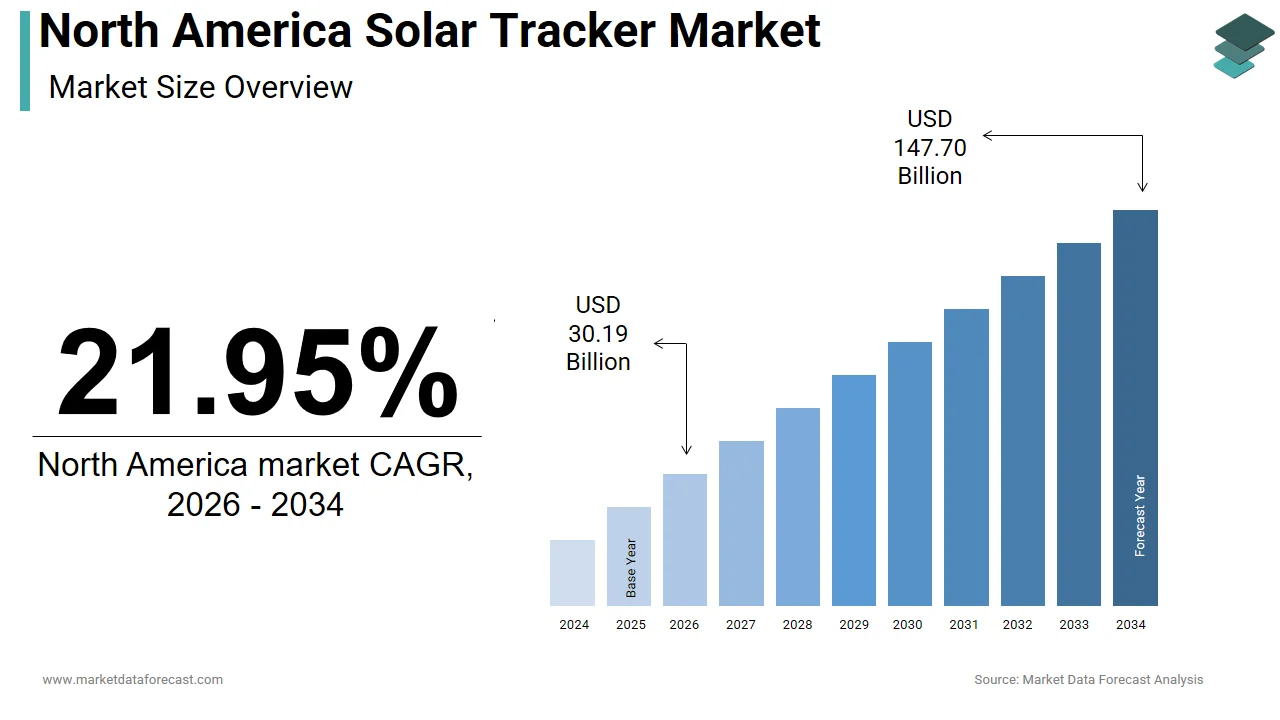
The North America solar tracker market was valued at USD 24.76 billion in 2025, is estimated to reach USD 30.19 billion in 2026, and is projected to reach USD 147.70 billion by 2034, growing at a CAGR of 21.95% from 2026 to 2034.
The solar tracking systems significantly enhance the efficiency of solar installations by following the sun's path across the sky throughout the day, thereby increasing energy output compared to fixed-tilt systems. The market encompasses a wide range of products, including single-axis and dual-axis trackers, and serves utility-scale solar farms, commercial and industrial (C&I) facilities, and residential applications. In recent years, the region has seen a surge in renewable energy adoption, driven by federal incentives, state-level mandates, and growing corporate sustainability goals. According to the Solar Energy Industries Association (SEIA), as of 2023, solar accounted for over 30% of new electric generating capacity additions in the United States. Canada and Mexico have also ramped up investments in solar infrastructure, with Canada’s Natural Resources department reporting that solar capacity surpassed 4 GW in 2023. This rising demand for clean electricity is directly fueling the expansion of advanced solar technologies such as tracking systems, which are now being integrated into more than 60% of large-scale U.S. solar projects, as per Wood Mackenzie Power & Renewables.
MARKET DRIVERS
Increasing Renewable Portfolio Standards (RPS) Across North American States
The proliferation of Renewable Portfolio Standards (RPS) across various U.S. states and Canadian provinces is propelling the growth of the North America solar tracker market. These policies mandate that a certain percentage of electricity generation must come from renewable sources by specific target years. As of early 2024, 31 U.S. states had enforceable RPS policies, with ambitious targets such as California’s goal of achieving 100% clean electricity by 2045 and New York’s mandate of 70% renewable energy by 2030. These aggressive policy frameworks have led to a surge in utility-scale solar installations, where solar trackers are increasingly preferred due to their ability to boost system efficiency by up to 25%, according to Greentech Media. In Texas alone, the Electric Reliability Council of Texas (ERCOT) reported over 18 GW of solar capacity installed by mid-2024, a significant portion of which uses tracking systems. Similarly, in Canada, provinces such as Ontario and Alberta are revising their energy strategies to include more renewables, further stimulating demand for high-efficiency solar solutions.
Declining Costs of Solar Tracking Systems Coupled with Technological Advancements
The declining cost of solar tracking systems, combined with continuous technological improvements that enhance performance and reliabilit,y is accelerating the growth of the North America solar tracker market. Over the past five years, the average price of solar trackers has fallen significantly, with NREL (National Renewable Energy Laboratory) reporting a reduction of nearly 40% between 2018 and 2023. Technological innovations such as smart tracking algorithms, improved actuator mechanisms, and integration with AI-based predictive analytics have enhanced the operational efficiency of solar tracking systems. For instance, companies like NEXTracker and Array Technologies have introduced self-powered trackers that reduce dependency on external power sources, lowering both installation and maintenance costs. These developments are making solar trackers more attractive to project developers aiming to maximize return on investment while meeting stringent energy production targets.
MARKET RESTRAINTS
High Initial Capital Investment and Complex Installation Requirements
The high initial capital investment required for procurement and installation is limiting the growth of the North America solar tracker market. Compared to fixed-tilt mounting systems, solar trackers involve additional components such as actuators, control systems, and structural reinforcements, all of which increase upfront costs. This cost differential can be a deterrent for smaller developers or projects with tight financial margins. Moreover, the installation process for solar trackers is more complex and labor-intensive. It requires precise site leveling, advanced engineering planning, and specialized equipment, particularly in rugged or uneven terrains. In areas such as the Appalachian region or parts of Canada with rocky landscapes, the deployment of tracking systems becomes logistically challenging and costly. Furthermore, the operation and maintenance of trackers demand skilled personnel and periodic calibration, adding to long-term expenses. As per the U.S. Department of Energy, maintenance costs for tracking systems are estimated to be about 20% higher than those for fixed systems over a 25-year lifespan.
Regulatory and Permitting Delays in Key Solar Markets
The prolonged regulatory and permitting processes in major solar-producing states is also hindering the growth of the North America solar tracker market. The project development timelines have been extended due to bureaucratic hurdles, zoning restrictions, and environmental impact assessments. For example, in California, a leading solar marke,t developers often face multi-year delays in securing permits, particularly for large-scale solar farms in ecologically sensitive zones. The California Energy Commission reported that in 2023, the average time to obtain full permitting for utility-scale solar projects exceeded 18 months. In the northeastern U.S., states like Massachusetts and New York have encountered grid interconnection bottlenecks, delaying the commissioning of new solar assets. The Federal Energy Regulatory Commission (FERC) noted that as of late 2023, there were over 1,200 pending interconnection requests across the U.S., many of which involved tracker-equipped solar projects. These delays disrupt project financing and scheduling, which is causing developers to reconsider tracker integration due to uncertainty in timelines and ROI calculations. In Canada, provincial governments have also imposed stringent land-use regulations, particularly in Ontario and Quebec, where agricultural and conservation lands are protected under strict legislation.
MARKET OPPORTUNITIES
Expansion of Utility-Scale Solar Projects in Sunbelt States
The continued expansion of utility-scale solar projects in the Sunbelt states, particularly Texas, Arizona, Nevada, and Florid,a is likely to set new growth opportunities for the growth of North America solar tracker market. These regions offer abundant sunlight, vast tracts of available land, and favorable regulatory climates, making them ideal locations for large-scale solar farms. According to the U.S. Energy Information Administration (EIA), the Sun Belt accounted for over 60% of all new solar capacity additions in the U.S. in 2023, with Texas alone contributing more than 7 GW of new capacity. Solar trackers are especially well-suited for these environments due to their ability to optimize energy capture in high-irradiance conditions. Developers are increasingly favoring tracking systems to meet aggressive power purchase agreement (PPA) targets and maximize return on investment. Additionally, the Infrastructure Investment and Jobs Act (IIJA) and the Inflation Reduction Act (IRA) have injected billions in federal funding and tax credits for renewable energy development, further incentivizing tracker adoption.
Integration of Solar Trackers with Energy Storage and Smart Grid Technologies
The integration of tracking systems with energy storage and smart grid technologies is escalating the growth of the North America solar tracker market. Combining solar trackers with battery storage systems allows for optimized energy harvesting during peak sunlight hours and dispatching stored energy when needed by enhancing overall system efficiency and reliability. According to the National Renewable Energy Laboratory (NREL), hybrid solar-plus-storage projects grew by over 80% in 2023 compared to the previous year, with many incorporating tracking systems to maximize energy intake. Solar trackers play a role in these configurations by ensuring maximum daily energy production, which improves the economics of storage integration. Furthermore, the rise of digitalization in the energy sector is enabling real-time monitoring and optimization of tracking systems through smart grid connectivity. Companies like First Solar and NEXTracker are developing intelligent tracking platforms that communicate with grid operators to adjust tilt angles dynamically based on load demand and weather forecasts.
MARKET CHALLENGES
Supply Chain Disruptions and Component Shortages
The ongoing volatility in global supply chains and shortages of components is substantially restricting the growth of the North America solar tracker market. The manufacturing of solar trackers relies heavily on steel, aluminum, semiconductors, and precision motors—materials that have experienced significant disruptions in recent years due to geopolitical tensions, trade restrictions, and logistical bottlenecks. Steel prices, in particular, have fluctuated dramatically, with the U.S. Bureau of Labor Statistics noting a 35% increase in steel mill product prices between 2021 and 2023. These cost escalations have forced tracker manufacturers to either absorb the losses or pass them on to developers, increasing the overall project cost and reducing the economic attractiveness of tracking systems. In response, several manufacturers have begun localizing production facilities. For example, Array Technologies announced in 2023 that it would expand its U.S.-based manufacturing footprint to mitigate reliance on overseas suppliers.
Land Use Conflicts and Environmental Concerns
The land use conflicts and environmental concerns present another substantial challenge to the expansion of the North America solar tracker market. Large-scale solar projects that deploy tracking systems typically require extensive, flat, and unshaded land, often competing with agricultural, ecological, and recreational uses. According to the U.S. Department of Agriculture (USDA), over 5 million acres of farmland were converted for solar development between 2010 and 2023, raising concerns among policymakers and rural communities. Environmental advocacy groups have also raised alarms regarding habitat disruption and biodiversity loss associated with ground-mounted solar farms equipped with trackers. In California’s Central Valley, for instance, several solar projects faced legal challenges from conservation organizations citing threats to endangered species such as the San Joaquin kit fox and the blunt-nosed leopard lizard. Additionally, some states have implemented stricter land-use regulations to preserve green spaces. In Minnesota, for example, the state legislature passed laws requiring solar developers to incorporate pollinator-friendly vegetation around tracker installations, increasing both compliance costs and complexity.
REPORT COVERAGE
| REPORT METRIC | DETAILS |
| Market Size Available | 2025 to 2034 |
| Base Year | 2025 |
| Forecast Period | 2026 to 2034 |
| Segments Covered | By Axis Type, and Region. |
| Various Analyses Covered | Global, Regional and Country-Level Analysis, Segment-Level Analysis, Drivers, Restraints, Opportunities, Challenges; PESTLE Analysis; Porter’s Five Forces Analysis, Competitive Landscape, Analyst Overview of Investment Opportunities |
| Countries Covered | United States, Canada, Mexico, Rest of North America |
| Market Leaders Profiled | NextTracker Inc., Valmont Industries Inc., Deger Canada Inc., Nexans SA, PV Hardware Solutions, and Others. |
SEGMENTAL ANALYSIS
By Axis Type Insights
The single-axis solar tracker segment dominated the North America solar tracker market share in 2025. Single-axis trackers rotate on one axis, typically aligned north-south to follow the sun’s east-west movement throughout the day. They offer a 15–25% increase in energy output compared to fixed-tilt systems, making them highly attractive for utility-scale projects where maximizing land efficiency is crucial. As per the National Renewable Energy Laboratory (NREL), over 65% of new U.S. utility solar projects deployed in 2023 utilized single-axis tracking technology. Additionally, their mechanical simplicity allows for easier deployment across diverse terrains, particularly in large, flat regions like Texas, Nevada, and California, where most of the continent’s solar capacity expansion is concentrated.
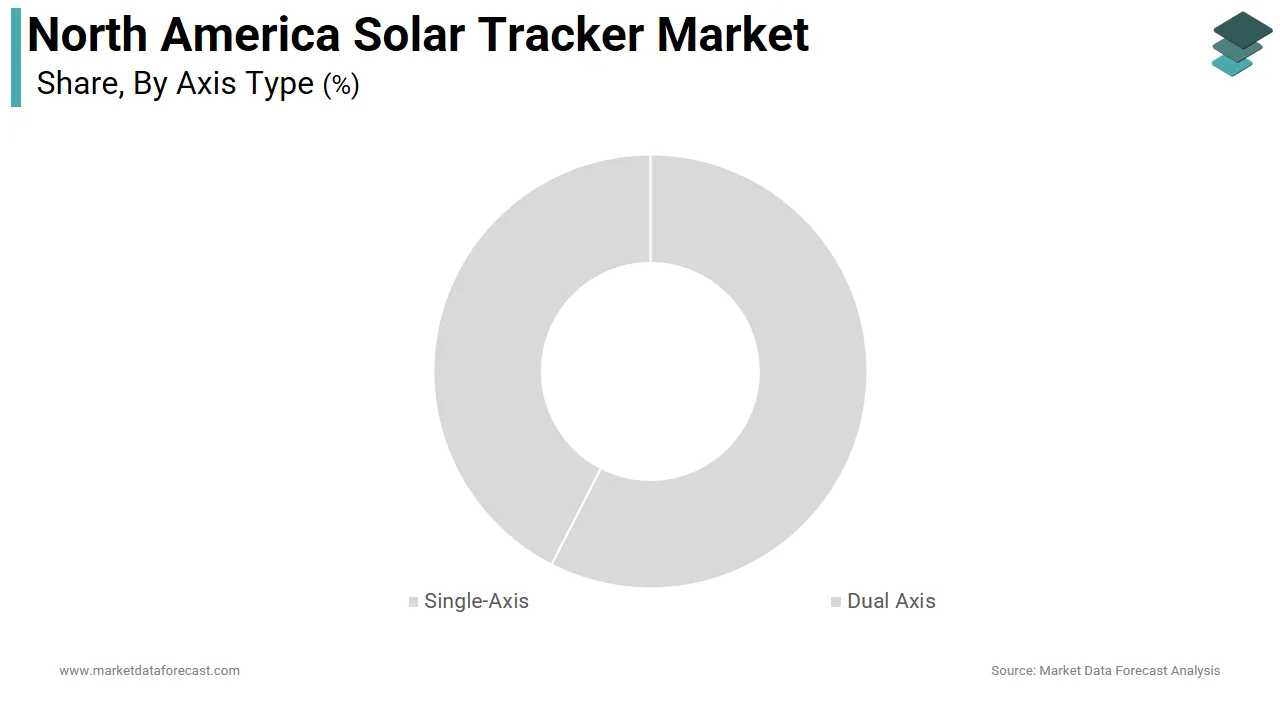
The dual-axis solar tracker segment is lucratively to grow with a CAGR of 9.2% from 2026 to 2034. Unlike single-axis systems, dual-axis trackers adjust both horizontally and vertically, allowing panels to precisely follow the sun’s path across both azimuth and altitude angles. The rapid growth of the segment is the increasing integration of advanced photovoltaic technologies such as bifacial modules and high-efficiency PERC cells. These technologies benefit maximally from the enhanced irradiance capture enabled by dual-axis tracking. Additionally, the growing adoption of smart grid infrastructure and real-time weather forecasting tools has made dual-axis systems more viable for dynamic performance optimization. Companies like NEXTracker and Soltec are deploying AI-integrated dual-axis solutions that adjust tilt angles based on cloud cover and ambient temperature data.
COUNTRY-LEVEL ANALYSIS
United States Solar Tracker Market Insights
The United States was the largest contributor in the North America solar tracker market with 85.3% of the share in 2024, with the tracker adoption in the U.S. is the Inflation Reduction Act (IRA), which extended and expanded tax credits for renewable energy projects. Moreover, states like Texas, California, and Florida have emerged as hotspots for tracker-based solar installations due to favorable land availability and high solar irradiance. The Electric Reliability Council of Texas (ERCOT) reported that over 70% of new solar projects in the state in 2023 included tracking systems.
Canada Solar Tracker Market Insights
Canada was accounted in holding 12.3% of the North America solar tracker market share in 2024 with Ontario’s Green Energy Act, which encourages large-scale solar development through feed-in tariff programs and net-metering incentives. According to the Canadian Solar Industries Association (CanSIA), Ontario alone contributed nearly 50% of the country’s new solar capacity in 2023, much of it using tracking systems to enhance energy output. The integration of trackers in hybrid solar-wind farms in Alberta and Saskatchewan, where developers aim to optimize land use and improve return on investment. The Alberta Electric System Operator (AESO) recorded over 2 GW of solar capacity in interconnection queues as of late 2023, with a growing number of projects opting for tracking technology. The solar tracker market is expected to see increased traction across multiple provinces as Canada advances toward its 2030 emissions reduction targets.
COMPETITIVE LANDSCAPE
The competitive landscape of the North America solar tracker market is marked by a mix of established industry leaders and emerging players striving for technological differentiation and operational efficiency. While dominant companies like NEXTracker, Array Technologies, and Soltec Renewables maintain significant market influence through innovation and scale, newer entrants are leveraging niche technologies and localized strategies to carve out space. This competition fosters continuous advancements in tracker design, materials, and integration with digital platforms. Manufacturers are increasingly focusing on reducing complexity in installation and maintenance, addressing cost sensitivity without compromising performance. Additionally, vertical integration and localized production have become essential differentiators amid supply chain uncertainties.
KEY MARKET PLAYERS
Noteworthy Companies dominating the North America solar tracker market profiled in the report are
- NextTracker Inc.
- Valmont Industries Inc.
- Deger Canada Inc.
- Nexans SA
- PV Hardware Solutions
TOP LEADING PLAYERS IN THE MARKET
- NEXTracker is a leading global provider of solar tracking solutions and holds a strong presence in North America. The company is known for its innovative, high-performance tracker designs that enhance energy yield while reducing operational costs. Its flagship product, the NX Horizon single-axis tracker, is widely deployed across utility-scale projects in the U.S. and Canada. NEXTracker’s focus on smart technology integration, such as AI-driven performance optimization and predictive maintenance, has made it a preferred partner for large renewable developers. Its contributions to advanced engineering and rapid deployment have significantly influenced the evolution of modern solar tracking systems globally.
- Array Technologies is one of the largest manufacturers of solar tracking systems in North America, with a long-standing reputation for durability and efficiency. The company's flagship product, the DuraTrack® system, is designed for ease of installation and minimal maintenance over the project lifecycle. Array Technologies emphasizes scalable solutions tailored for diverse terrains and climatic conditions, making their products suitable for both large-scale and distributed solar farms. Their commitment to innovation and sustainability has helped drive down balance-of-system costs, contributing to broader adoption of tracking technology. Their influence extends beyond North America, shaping global standards for tracker design and performance.
- Soltec Renewables is a fast-growing player in the North American solar tracker market, recognized for its self-powered SF7 single-axis tracker. The company brings a European engineering perspective combined with localized manufacturing capabilities in the U.S., allowing for quicker response times and better supply chain resilience. Soltec’s trackers are designed for easy commissioning and low maintenance, which enhances long-term reliability and investor confidence. The company also invests heavily in digital monitoring tools that improve asset management and performance analytics.
TOP STRATEGIES USED BY KEY MARKET PARTICIPANTS
One major strategy employed by leading players in the North America solar tracker market is continuous product innovation aimed at enhancing performance and reducing lifetime costs. Companies are developing smarter, more durable tracking systems equipped with real-time monitoring and adaptive control features that optimize energy capture under varying weather conditions.
Another key approach is expanding local manufacturing and supply chain capabilities to mitigate logistical risks and reduce delivery lead times. Several firms have established or expanded production facilities within the U.S. and Canada to ensure faster deployment and better alignment with regional demand patterns.
The strategic partnerships and joint ventures with engineering, procurement, and construction (EPC) firms and energy developers are being leveraged to secure long-term project pipelines. These collaborations help manufacturers integrate their tracking solutions seamlessly into large-scale solar developments, which reinforces their market position and customer retention.
RECENT MARKET DEVELOPMENTS
- In January 2024, NEXTracker announced the launch of its next-generation AI-powered monitoring platform, designed to enhance real-time performance optimization of solar tracker installations. This development allows operators to dynamically adjust tilt angles based on environmental conditions, improving overall system efficiency and longevity.
- In March 2024, Array Technologies expanded its manufacturing facility in New Mexico to increase domestic production capacity and reduce dependency on global supply chains. This move was part of a broader strategy to meet rising demand from utility-scale solar developers across the U.S.
- In June 2024, Soltec Renewables entered into a strategic collaboration with a leading EPC firm to integrate its SF7 tracker into multiple upcoming solar projects in Texas and California. This partnership ensured seamless deployment and reinforced Soltec’s growing presence in key solar markets.
- In September 2024, a major U.S.-based solar developer selected NEXTracker for a 500 MW utility-scale solar project in Nevada, citing the company’s proven reliability and advanced digital controls as key selection criteria.
- In November 2024, Array Technologies introduced an enhanced version of its DuraTrack system featuring modular components and reduced maintenance requirements. This update was well received in the market, particularly among investors seeking lower long-term operating costs.
MARKET SEGMENTATION
This North America solar tracker market research report is segmented and sub-segmented into the following categories.
By Axis Type
- Single-Axis
- Dual Axis
By Country
- United States
- Canada
- Mexico
- Rest of North America