- Product Description Description
- Table of Contents TOC
- List of Table & Figure LOT
- Get Free Sample PDF Sample PDF
Market Size, 2025
$19.24 BnMarket Estimate, 2026
$21.97 BnMarket Forecast, 2034
$63.60 BnCAGR, 2026–2034
14.21%Executive Summary: North America Stationary Battery Storage Market
- Market Scope: Comprehensive North America stationary battery storage market analysis covering technology segments, application sectors, regional leadership metrics, key industry participants, and emerging renewable energy and grid stability trends.
- Market Valuation: Valued at USD 19.24 billion (2025), estimated at USD 21.97 billion (2026), and projected to reach USD 63.60 billion by 2034, registering a robust CAGR of 14.21% (2026–2034).
- Primary Growth Drivers: Rapid expansion of renewable energy integration (solar and wind) requiring storage to manage supply fluctuations, government incentives (U.S. Inflation Reduction Act providing tax credits), and rising demand for grid services like frequency regulation and load balancing.
Key Market Segment Metrics (2026–2034)
| Category | Leading Segment (Historical / 2024 Position) | Fastest-Growing Segment |
|---|---|---|
| By Technology Type | Lithium-ion batteries (held a dominant share in 2024 due to energy density and declining costs) | Alternative technology types (expected to grow at an estimated CAGR of 18.5% for long-duration storage) |
| By Application | Utility segment (accounted for 58.3% of the market share in 2024) | Commercial & Industrial (C&I) sector (projected to register a CAGR of 19.2%) |
| By Region / Country | United States (led the market with an 84.3% share in 2024), followed by Canada (12.3%) | North American regional grid-scale storage corridors and commercial microgrid deployments |
Major Market Players & Market Structure
Market Structure: Highly competitive North American energy storage and battery manufacturing landscape featuring major technology enterprises competing on multi-year supply agreements, domestic manufacturing facility investments, and strategic developer acquisitions.
Key Companies: Tesla, LG Energy Solution, Panasonic Corporation, Fluence Energy, BYD Company, Siemens AG, General Electric, ABB Ltd., Eaton Corporation, Enphase Energy, NextEra Energy, SunPower Corporation, KORE Power, Powin Energy, and EnerSys.
North America Stationary Battery Storage Market Size
The North America stationary battery storage market size was valued at USD 19.24 billion in 2025 and is anticipated to reach USD 21.97 billion in 2026 from USD 63.60 billion by 2034, growing at a CAGR of 14.21% during the forecast period from 2026 to 2034.
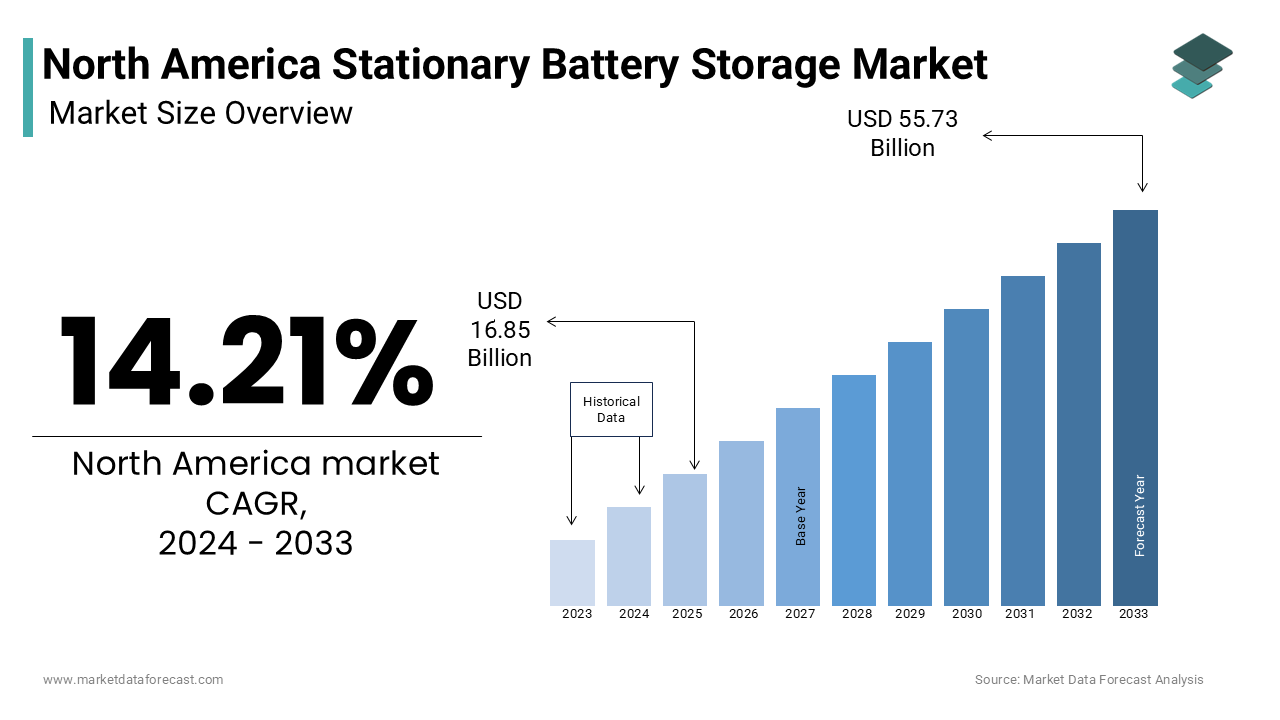
The stationary battery storage is the deployment of energy storage systems that are fixed in location and used for storing electricity generated from renewable or conventional sources. These systems play a crucial role in stabilizing power grids, managing peak loads, integrating renewable energy, and enhancing energy reliability for utilities, commercial enterprises, and residential users. In addition to utility applications, the rise of distributed energy resources such as behind-the-meter battery installations in homes and businesses has further fueled market expansion. Technological advancements in lithium-ion, flow batteries, and emerging solid-state systems are also contributing to greater efficiency and cost reductions.
MARKET DRIVERS
Expansion of Renewable Energy Integration
The increasing integration of intermittent renewable energy sources such as solar and wind into the power grid is propelling the growth of the North America stationary battery storage market. According to the U.S. Energy Information Administration (EIA), renewable energy accounted for nearly 23% of total electricity generation in the U.S. in 2024, with wind and solar leading the growth. However, the variable nature of these energy sources necessitates reliable storage solutions to manage supply fluctuations and maintain grid stability. Stationary battery systems allow excess energy to be stored during periods of high production and discharged when generation is low, ensuring a consistent power supply. Furthermore, many states have set aggressive renewable portfolio standards (RPS) mandating higher shares of clean energy in the coming decades.
Government Incentives and Regulatory Support
Government incentives and regulatory policies have played a pivotal role in accelerating the adoption of stationary battery storage across North America. At the federal level, the U.S. Inflation Reduction Act (IRA) introduced substantial tax credits for energy storage systems under the Investment Tax Credit (ITC), enabling developers and consumers to offset capital expenditures. According to the National Renewable Energy Laboratory (NREL), these incentives have made it economically viable for utilities and private entities to invest in large-scale storage projects in states like Texas, New York, and Arizona where grid congestion and peak demand issues are prevalent. These coordinated efforts from policymakers are creating a favorable environment for the expansion of stationary battery storage with its role in the broader clean energy transition across North America.
MARKET RESTRAINTS
High Capital Expenditure and Cost Barriers
One of the most significant constraints remains the high initial capital expenditure required for system deployment is restraining the growth of the North America stationary battery storage market. According to the U.S. Department of Energy (DOE), even though battery costs have declined over the past decade, the average installed cost for utility-scale lithium-ion battery systems still ranges between $250 and $350 per kilowatt-hour, depending on project size and complexity. For commercial and residential users, the upfront investment needed for behind-the-meter storage can be prohibitive, especially without access to government incentives or financing options. Moreover, the economic viability of storage projects often depends on factors such as local electricity rates, time-of-use tariffs, and potential revenue from ancillary services variables that may not always justify the return on investment within an acceptable timeframe.
Supply Chain Constraints and Material Shortages
The vulnerability of global supply chains and shortages of key raw materials used in battery manufacturing are hindering the growth of the North America stationary battery storage market. Lithium, cobalt, nickel, and graphite are essential components of lithium-ion batteries, which dominate the current market landscape. According to the U.S. Geological Survey (USGS), geopolitical tensions, mining bottlenecks, and environmental concerns have led to disruptions in the supply of these minerals by causing price volatility and delays in production schedules. Additionally, the reliance on foreign imports for processed battery materials poses a risk to domestic energy security. The U.S. government has initiated domestic sourcing strategies, including investments in recycling technologies and alternative material research. However, until a more robust and localized supply chain is established, the availability and affordability of stationary battery storage systems will remain constrained, which is limiting market expansion.
MARKET OPPORTUNITIES
Growth of Microgrids and Decentralized Energy Systems
The expanding deployment of microgrids and decentralized energy systems is expected to boost the growth of the North America stationary battery storage market. These localized energy networks operate independently or in conjunction with the main grid, offering enhanced reliability, resilience, and sustainability in remote and disaster-prone areas. According to the U.S. Department of Energy (DOE), over 400 microgrid projects were operational across the United States in 2024, with battery storage playing a central role in ensuring continuous power supply during outages or emergencies. In Canada, provinces like Alberta and Ontario have incentivized microgrid development through funding programs and regulatory reforms aimed at promoting cleaner, self-sufficient energy solutions. Natural Resources Canada reports that indigenous communities and rural settlements are also leveraging microgrids with battery storage to replace costly diesel generators with renewable alternatives.
Increasing Demand for Grid Services and Ancillary Applications
The rising demand for grid services such as frequency regulation, load balancing, and voltage support is driving the growth of the North America stationary battery storage market. According to the Federal Energy Regulatory Commission (FERC), battery storage systems are uniquely suited for providing ancillary services due to their ability to rapidly charge and discharge, which is responding within milliseconds to fluctuations in grid demand and supply. Independent System Operators (ISOs) and Regional Transmission Organizations (RTOs) across the U.S., including PJM Interconnection and CAISO, have implemented market structures that allow battery operators to monetize these services, enhancing the economic feasibility of storage projects.
MARKET CHALLENGES
Technological Limitations and Performance Degradation
The issue of performance degradation over time is impeding the growth of the North America stationary battery storage market. Unlike traditional energy generation assets, battery systems experience capacity loss and efficiency decline after repeated charging and discharging cycles, which impacts long-term reliability and economic viability. This degradation affects the return on investment for large-scale storage projects, particularly those participating in competitive energy markets where predictable performance is essential. Additionally, extreme temperatures and improper usage patterns can accelerate deterioration, posing technical and financial risks for operators.
Regulatory and Market Access Complexity
The navigating the complex and fragmented regulatory landscape is a significant challenge for the growth of North America stationary battery storage market. According to the Federal Energy Regulatory Commission (FERC), inconsistencies in state-level regulations and ISO/RTO market participation rules create uncertainty for developers seeking to deploy storage assets at scale. In some regions, outdated tariff structures fail to adequately value the full range of benefits provided by battery storage, such as peak shaving, demand response, and grid resilience enhancements. This limits the ability of project developers to secure financing and optimize revenue streams. Additionally, the lack of standardized interconnection procedures leads to lengthy approval timelines and increased project costs. While FERC Order 841 mandates open access for storage in wholesale markets, implementation varies across regions, slowing market integration.
REPORT COVERAGE
| REPORT METRIC | DETAILS |
| Market Size Available | 2025 to 2034 |
| Base Year | 2025 |
| Forecast Period | 2026 to 2034 |
| CAGR | 14.21% |
| Segments Analysed | By Technology Type, Application & Region |
| Various Analyses Covered | Global, Regional & Country Level Analysis, Segment-Level Analysis, Drivers, Restraints, Opportunities, Challenges; PESTLE Analysis; Porter's Five Forces Analysis, Competitive Landscape, Analyst Overview of Investment Opportunities |
| Regions Analysed | U.S., Canada, Rest of North America |
| Key Market Players | Tesla, LG Energy Solution, Panasonic Corporation, Fluence Energy, BYD Company, Siemens AG, General Electric, ABB Ltd., Eaton Corporation, Enphase Energy, NextEra Energy, SunPower Corporation, KORE Power, Powin Energy, and EnerSys. |
SEGMENTAL ANALYSIS
By Technology Type Insights
The lithium-ion batteries segment held a dominant share of the North America stationary battery storage market in 2024 due to their superior energy density, longer cycle life, and declining manufacturing costs. According to the U.S. Department of Energy (DOE), lithium-ion batteries have become the preferred choice for utility-scale projects due to their rapid response times and scalability, which is making them ideal for grid balancing and renewable integration. Additionally, the widespread adoption of lithium-ion systems in electric vehicles has driven economies of scale, reducing per-unit costs for stationary applications. Furthermore, major battery manufacturers such as Tesla, LG Energy Solution, and Panasonic have expanded their production facilities across North America, ensuring steady supply and fostering technological advancements.
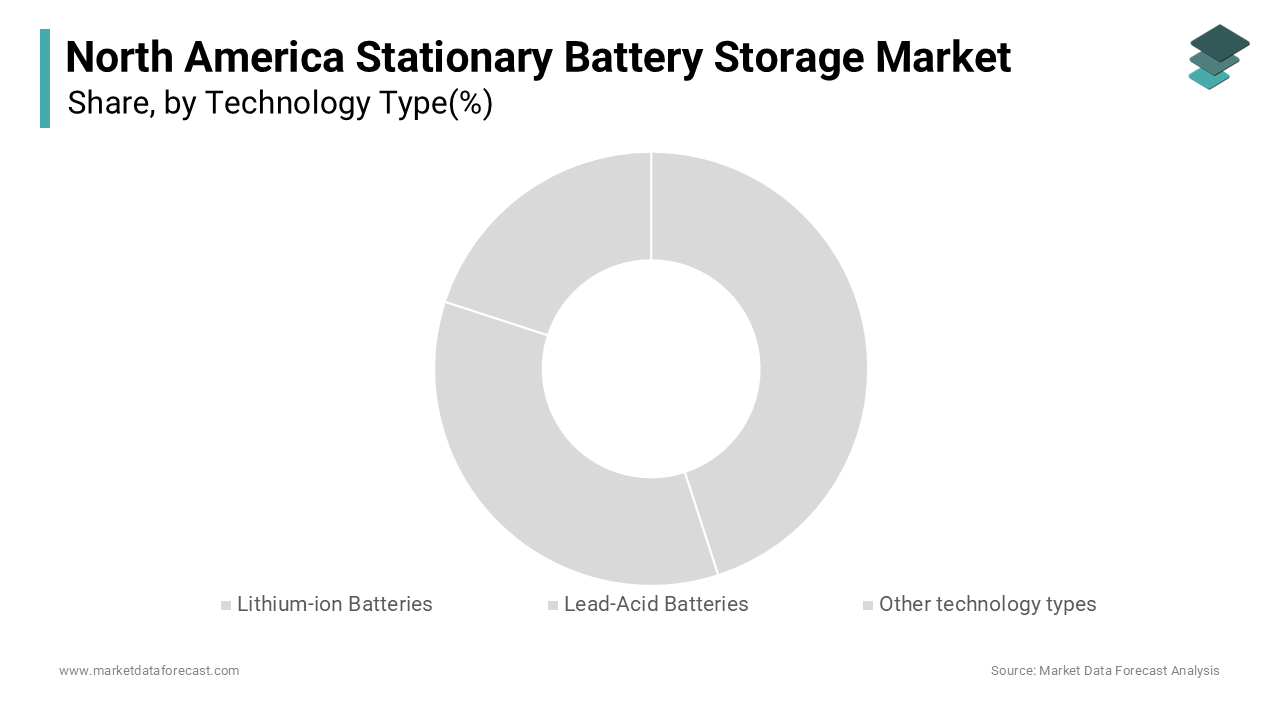
The other technology types segment is expected to grow with an estimated CAGR of 18.5% in the next coming years with the increasing demand for long-duration energy storage (LDES) that can support the grid beyond the four-to-six-hour discharge limit typical of lithium-ion systems. According to the Long Duration Energy Storage Council, LDES capacity in North America is expected to exceed 50 GW by 2040, with flow batteries playing a crucial role in multi-hour storage applications. Moreover, rising concerns about raw material availability for lithium-ion chemistries have prompted interest in alternative chemistries such as sodium-ion, which leverages abundant and locally available materials. In addition, companies like Ambri, Form Energy, and ESS Inc. are piloting innovative iron-air and aqueous hybrid flow batteries designed for extended discharge durations.
By Application Insights
The utility segment was accounted in holding 58.3% of the North America stationary battery storage market share in 2024 with the the increasing integration of intermittent renewable energy sources such as wind and solar into the power grid. Utility operators require large-scale storage systems to manage fluctuations in generation, maintain grid stability, and meet peak demand without relying on fossil fuel-based peaker plants. According to the U.S. Energy Information Administration (EIA), more than 80% of new utility-scale solar installations in the U.S. now include co-located battery storage, reflecting a strategic shift toward hybrid energy systems that optimize efficiency and reliability.
The Commercial & Industrial (C&I) sector is expected to register a CAGR of 19.2% in the next coming years. Businesses are increasingly adopting behind-the-meter battery storage to reduce peak demand charges, participate in demand response programs, and enhance energy resilience. According to the National Renewable Energy Laboratory (NREL), C&I customers account for nearly 60% of non-residential distributed energy storage installations in the U.S., in high-energy-cost states like California, New York, and Massachusetts. Major corporations, including Amazon, Walmart, and Google, have deployed battery storage alongside on-site solar to support net-zero commitments and improve operational efficiency.
REGIONAL ANALYSIS
The United States was the top performer of the North America stationary battery storage market by capturing 84.3% of share in 2024. According to the U.S. Department of Energy (DOE), over 10 gigawatts of new battery storage capacity came online in 2024 alone, with California, Texas, and Arizona leading deployment due to high solar penetration and grid congestion challenges. The Inflation Reduction Act (IRA) has played a pivotal role in accelerating investments by extending tax credits for standalone energy storage systems, enabling developers to offset capital expenditures. Corporate procurement is another key growth driver, with tech giants and retailers investing heavily in behind-the-meter storage to support sustainability goals.
Canada was positioned second by holding 12.3% of the North America stationary battery storage market share in 2024. According to the Canadian Electricity Association, several utility-led pilot projects are underway to evaluate the effectiveness of battery storage in managing peak loads and deferring costly infrastructure upgrades. Moreover, indigenous communities and remote settlements are adopting off-grid battery systems to replace diesel generators with cleaner alternatives. Federal support through the Smart Renewables and Electrification Pathways Program (SREP) has also encouraged private-sector investment in storage solutions tailored for both residential and commercial applications.
COMPETITIVE LANDSCAPE
The competition in the North America stationary battery storage market is marked by rapid technological innovation, strong policy support, and increasing demand from utilities, industrial consumers, and prosumers. A diverse set of players including established battery manufacturers, emerging startups, and integrated energy solution providers are vying for dominance through differentiated offerings and strategic positioning.
Market leaders are leveraging economies of scale and brand recognition to secure large-scale projects, while niche players focus on specialized applications such as microgrids, long-duration storage, and hybrid renewable integration. The regulatory environment further shapes competitive dynamics, influencing how companies engage with wholesale and retail electricity markets.
Beyond product development, competition extends into financing models, digital monitoring platforms, and service-level differentiation aimed at enhancing asset performance and customer retention.
KEY MARKET PLAYERS
Key players in the North America Stationary Battery Storage Market include
- Tesla
- LG Energy Solution
- Panasonic Corporation
- Fluence Energy
- BYD Company
- Siemens AG
- General Electric
- ABB Ltd.
- Eaton Corporation
- Enphase Energy
- NextEra Energy
- SunPower Corporation
- KORE Power
- Powin Energy
- EnerSys
Top Players in the North America Stationary Battery Storage Market
One of the leading players in the North America stationary battery storage market is Tesla, Inc., which is known for its innovative energy products such as the Megapack and Powerwall. Tesla has played a transformative role in bringing lithium-ion-based grid-scale and residential storage solutions to mainstream markets, setting new benchmarks for performance, integration, and scalability.
Another key player is LG Energy Solution, a major manufacturer of high-capacity battery cells used across utility and commercial applications. The company supplies components to multiple system integrators and has expanded its presence through strategic partnerships with U.S.-based energy storage developers, strengthening regional supply chain resilience.
Fluence Energy, Inc., a Siemens and AES joint venture, stands out as a dedicated provider of grid-scale energy storage solutions. Fluence delivers turnkey storage systems tailored for frequency regulation, renewable integration, and peak shaving, playing a crucial role in shaping the modernization of North American power infrastructure.
Top Strategies Used by Key Market Participants
A primary strategy among key players in the North America stationary battery storage market is vertical integration and localized manufacturing expansion. Companies are investing in domestic production facilities to reduce dependency on global supply chains and ensure faster deployment timelines.
The strategic partnerships with utilities and independent power producers. The battery manufacturers and system integrators can tailor solutions that meet specific grid requirements while securing long-term contracts by aligning with energy providers.
A strategy involves technology diversification and R&D investments. Leading firms are exploring next-generation chemistries such as iron-air, sodium-ion, and solid-state batteries to enhance performance, longevity, and sustainability by ensuring they remain at the forefront of an evolving market landscape.
RECENT MARKET DEVELOPMENTS
- In January 2024, Tesla announced a multi-year supply agreement with a major U.S. utility to deploy its Megapack systems for a large-scale solar-plus-storage project in California.
- In March 2024, LG Energy Solution broke ground on a new battery cell manufacturing facility in Tennessee by aiming to increase domestic production capacity and reduce reliance on overseas supply chains for North American deployments.
- In June 2024, Fluence Energy launched a new software platform designed to optimize battery dispatch in real time, which is improving revenue generation through participation in energy and ancillary services markets across PJM and CAISO regions.
- In September 2024, NextEra Energy Storage is a subsidiary of NextEra Energy, acquired a mid-sized battery storage developer to expand its project pipeline and accelerate deployment of co-located renewables and storage assets nationwide.
- In November 2024, Form Energy partnered with a major Midwest utility to pilot its 100-hour iron-air battery system, which is marking a significant step forward in demonstrating long-duration storage capabilities and opening new pathways for decarbonizing the power grid.
MARKET SEGMENTATION
This research report on the North America stationary battery storage Market is segmented and sub-segmented based on categories.
By Technology Type
- Lithium-ion Batteries
- Lead-Acid Batteries
- Other technology types
By Application
- Residential
- Commercial & Industrial
- Utility
By Country
- U.S.
- Canada
- Rest of North America