- Product Description Description
- Table of Contents TOC
- List of Table & Figure LOT
- Get Free Sample PDF Sample PDF
Market Size, 2025
$270 MnMarket Estimate, 2026
$283.77 MnMarket Forecast, 2034
$422 MnCAGR, 2026–2034
5.1%Executive Summary: North America Surface Plasmon Resonance Market
- Market Scope: Comprehensive market assessment of the North American surface plasmon resonance (SPR) sector, covering product categories, analytical applications, country-level breakdowns, and core technological frameworks.
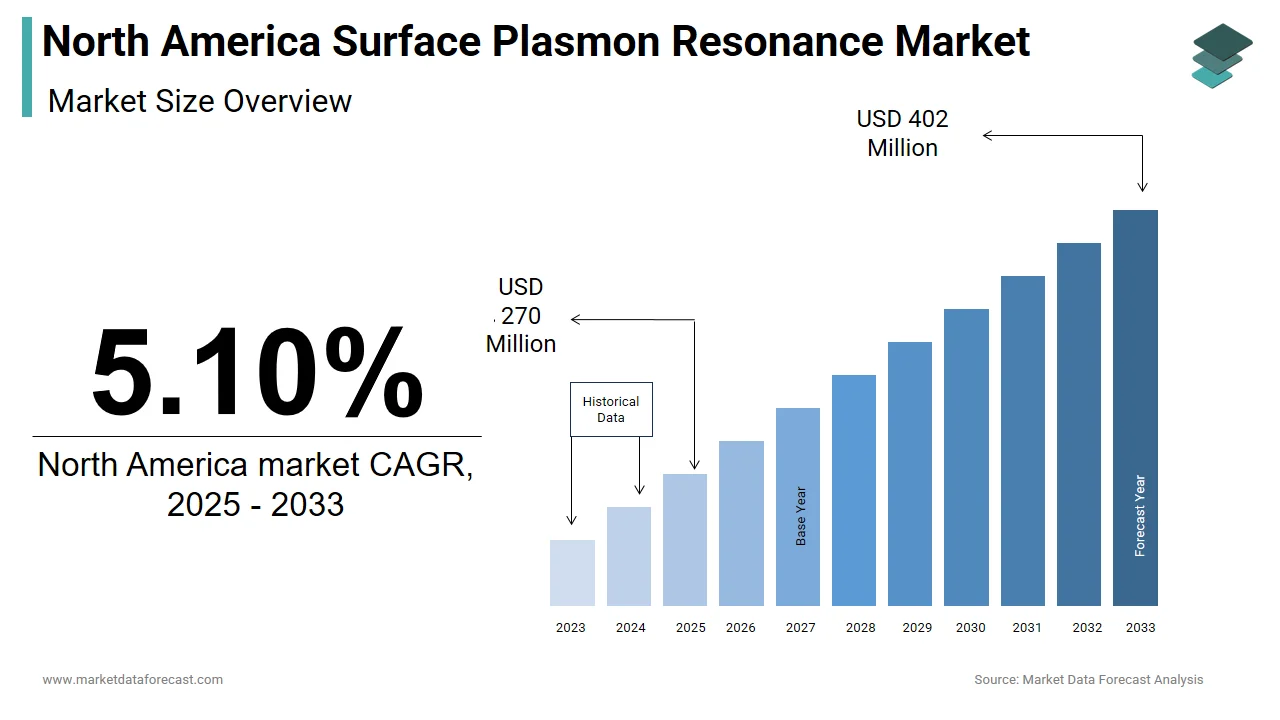
- Market Valuation: Valued at USD 270 million in 2025, estimated at USD 283.77 million in 2026, and projected to reach USD 422 million by 2034, registering a CAGR of 5.10% from 2026 to 2034.
- Primary Growth Drivers: Shift from labeled to cost-effective label-free detection techniques, rising adoption of microfluidic techniques to minimize reagent consumption, integration of AI-driven advanced imaging software, and extensive R&D investments by life science firms.
Key Market Segment Metrics (2026–2034)
| Category | Leading Segment Position | Fastest-Growing / Key Growth Segment |
|---|---|---|
| By Product | Sensor System (largest segment holding a dominant share in 2025 as the core optical detection and recurring chip-revenue component) | Reagents (projected to register the fastest CAGR of 9.2% due to increasing biological assay complexity and custom coupling chemistries) |
| By Application | Drug Discovery (held 55.4% market share in 2025, driven by label-free real-time kinetic analysis for therapeutic candidates and biologics) | Biosensor (expected to expand at the fastest CAGR of 10.5% through portable point-of-care diagnostics and pathogen tracking) |
| By Country | United States (top performer capturing an 85.4% share in 2025, supported by robust pharma infrastructure and new drug approvals) | Canada (held 14.5% share in 2025, driven by biotechnology clusters in Toronto/Vancouver and strong translational vaccine research) |
Major Market Players & Market Structure
Market Structure: Moderately consolidated landscape dominated by global multinational companies competing across AI software integration, high-throughput systems, multi-modal spectroscopy hybrids, and comprehensive customer support.
Key Companies: Bio-Rad Laboratories Inc., Cytiva, AMETEK Inc., Sartorius AG, Biosensing Instrument Inc., General Electric Co., Bruker Corporation, and Horiba Ltd.
North America Surface Plasmon Resonance Market Size
The size of the North America surface plasmon resonance market was worth USD 270 million in 2025. The North America market is anticipated to grow at a CAGR of 5.10% from 2026 to 2034 and be worth USD 422 million by 2034 from USD 283.77 million in 2026.
MARKET SCENARIO
North America is predicted to lead the Global SPR market and is estimated to reach a CAGR of 6.2% during the forecast period. The market in the U.S is required to rule the North America SPR. Label-free detection techniques replace labeled detection techniques because of cost-effectiveness, availability of many types of products in the Surface Plasmon Resonance market for good profits, and including the complementary techniques with Surface Plasmon Resonance to increase the specificity of the test and the main drivers for the increase in the demand for SPR. This also adds to the demand on the global SPR market to a certain extent. SPRs major trends include a rise in the adoption of micro fluids techniques to decrease the consumption of reagents, Introducing advanced imaging software for the detailed report of SPR, and proper investment in R and D by many companies.
However, factors such as inadequate financing in developing countries, high product prices, and unavailability of devices in some regions are expected to hamper the overall market growth. In addition, the lack of trained professionals, especially in emerging economies, to implement the protocol is also expected to hamper the market's growth. The protocol is specific and requires a trained professional to perform the procedure to achieve the desired results with minimal manual error.
REPORT COVERAGE
| REPORT METRIC | DETAILS |
| Market Size Available | 2025 to 2034 |
| Base Year | 2025 |
| Forecast Period | 2026 to 2034 |
| Segments Covered | By Product, Application, and Region. |
| Various Analyses Covered | Global, Regional and Country-Level Analysis, Segment-Level Analysis, Drivers, Restraints, Opportunities, Challenges; PESTLE Analysis; Porter’s Five Forces Analysis, Competitive Landscape, Analyst Overview of Investment Opportunities |
| Countries Covered | United States, Canada, Mexico, Rest of North America |
| Market Leaders Profiled | Bio-Rad Laboratories Inc, Cytiva, AMETEK Inc, Sartorius AG, Biosensing Instrument Inc, General Electric Co, Bruker Corporation, and Horiba Ltd. |
SEGMENTAL ANALYSIS
By Product Insights
The sensor system segment was the largest, holding a dominant share of the North America Surface Plasmon Resonance Market in 2025 with its crucial role as the core detection component in SPR instruments. These systems utilize optical sensors to detect changes in refractive index near a metal surface, enabling real-time monitoring of biomolecular interactions without labels. The recurring revenue model is associated with proprietary sensor chips, which require regular replacement due to single-use or limited reuse capabilities. Advances in sensor technology such as multi-channel arrays and higher density formats have expanded their utility in high-throughput screening applications. Pharmaceutical companies prefer integrated sensor systems that offer automated alignment and calibration, reducing user error and increasing data reliability. The compatibility of these sensors with various immobilization chemistries allows researchers to study diverse molecular targets, including small molecules, proteins, and nucleic acids.
The reagent segment is projected to register the fastest CAGR of 9.2% during the forecast period owing to the increasing complexity of biological assays and the need for specialized coupling chemistries. Reagents include immobilization kits, regeneration solutions, and running buffers that are essential for preparing sensor surfaces and maintaining experimental conditions. Researchers are increasingly focusing on challenging targets such as membrane proteins and intrinsically disordered proteins, which require customized reagent formulations to ensure stable immobilization and accurate kinetics. The shift toward fragment-based drug discovery also drives demand for high-purity reagents that minimize background noise. Manufacturers are introducing ready-to-use reagent packs that simplify workflow and reduce preparation time, appealing to high-throughput environments. The growing awareness of reproducibility issues has led to stricter quality control standards for reagents, further boosting demand for premium products.
By Application Insights
The drug discovery segment held 55.4% of the North America Surface Plasmon Resonance Market share in 2025 due to the extensive use of SPR technology in identifying and characterizing potential therapeutic candidates. SPR provides label-free real-time data on binding affinity and kinetics, which are parameters for evaluating drug efficacy and safety. SPR is particularly valuable in early-stage discovery for screening large libraries of compounds and optimizing lead molecules. The ability to analyze small-molecule protein interactions without labeling artifacts makes SPR indispensable for structure-based drug design. The rise of biologics and biosimilars further reinforces the dominance of this segment as these complex molecules require detailed kinetic profiling. Regulatory agencies expect comprehensive binding data during investigational new drug applications, driving mandatory adoption.
The biosensor segment is expected to grow at the fastest CAGR of 10.5% during the forecast period with the expansion of point-of-care diagnostics and environmental monitoring applications. SPR-based biosensors offer high sensitivity and specificity for detecting pathogens, toxins, and biomarkers in complex matrices. The miniaturization of SPR technology has enabled the development of portable devices suitable for field use and clinical settings. Data from public health agencies indicates that the deployment of SPR biosensors for infectious disease surveillance increased by 20%, following recent global health crises. These sensors provide real-time results without the need for extensive sample preparation, making them ideal for emergency response. The versatility of SPR allows for the detection of diverse analytes ranging from viruses to heavy metals. Government investments in public health infrastructure further support the adoption of advanced biosensing technologies.
COUNTRY LEVEL ANALYSIS
U.S. Surface Plasmon Resonance Market Analysis
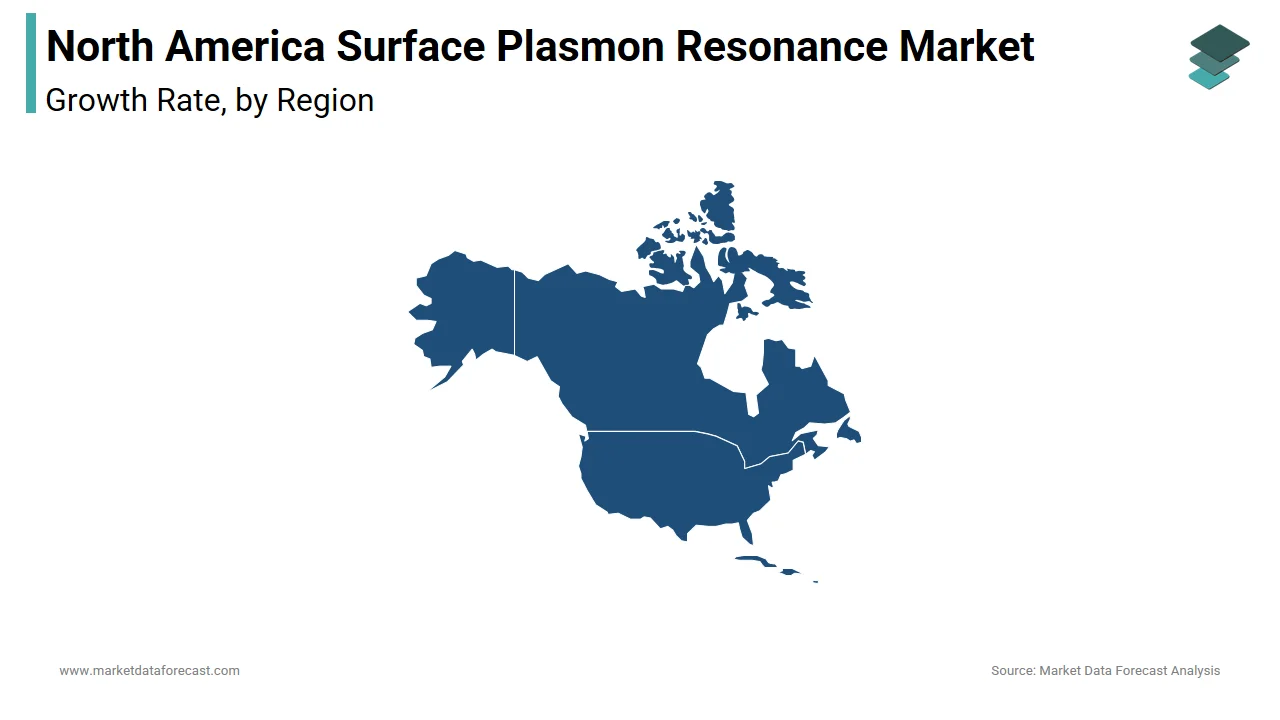
The United States was the top performer in the North America Surface Plasmon Resonance Market by capturing 85.4% of the share in 2025 with its robust pharmaceutical industry and extensive research infrastructure. The country is home to major biopharmaceutical companies and leading academic institutions that heavily invest in advanced analytical technologies. The presence of key market players and a well-established regulatory framework further supports market growth. The United States leads globally in new drug approvals, necessitating rigorous kinetic characterization. The concentration of contract research organizations and core facilities provides widespread access to SPR technology. Government initiatives promoting precision medicine and infectious disease research also drive adoption. The strong intellectual property protection encourages innovation and commercialization of new SPR applications.
Canada Surface Plasmon Resonance Market Analysis
Canada Surface Plasmon Resonance Market was positioned second by holding 14.5% of the share in 2025, with strong government support for life sciences research and a focus on collaborative innovation. The country has a well-developed network of research hospitals and universities that utilize SPR for basic and translational research. Canadian researchers are particularly active in vaccine development and immunology, where SPR plays a crucial role in antibody characterization. The presence of emerging biotechnology clusters in cities like Toronto and Vancouver drives local demand. Collaborative partnerships between academia and industry facilitate technology transfer and commercialization. Regulatory harmonization with the United States through trade agreements simplifies market access for international vendors.
COMPETITIVE LANDSCAPE
The North America Surface Plasmon Resonance Market features a moderately consolidated competitive landscape dominated by established multinational corporations with strong brand recognition and extensive distribution networks. Large players leverage their comprehensive product portfolios and global resources to maintain dominance in high-value segments such as pharmaceutical drug discovery. Niche specialists compete by offering specialized instruments for academic research or specific industrial applications, focusing on cost-effectiveness and ease of use. Competition intensifies around technological advancements such as higher sensitivity, miniaturization, and integration with artificial intelligence. Companies differentiate themselves through superior customer support, comprehensive training programs, and reliable after-sales service. Price competition exists in the academic sector where budget constraints are significant, but value-based differentiation prevails in industrial applications.
KEY MARKET PLAYERS
The leading companies operating in the North America surface plasmon resonance market include:
- Bio-Rad Laboratories Inc.
- Cytiva
- AMETEK Inc.
- Sartorius AG
- Biosensing Instrument Inc.
- General Electric Co.
- Bruker Corporation
- Horiba Ltd.
TOP PLAYERS IN THE MARKET
- Cytiva maintains a leading position in the North America Surface Plasmon Resonance Market through its Biacore instrument portfolio, which is widely recognized as the industry standard for label-free interaction analysis. The company provides comprehensive solutions, including high-throughput systems and specialized sensor chips tailored for drug discovery and biologics characterization. Recent actions include the launch of advanced software updates that integrate artificial intelligence for automated data analysis and improved user experience. Cytiva also expanded its technical support network across major pharmaceutical hubs to ensure rapid response and customer satisfaction. The company actively collaborates with key opinion leaders to publish validation studies demonstrating the reliability of its platforms.
- Sartorius AG contributes significantly to the North America Surface Plasmon Resonance Market by offering robust and user-friendly SPR instruments designed for both academic and industrial applications. The company emphasizes ease of use and reliability, making its technology accessible to researchers with varying levels of expertise. Recent initiatives include the introduction of compact SPR systems suitable for smaller laboratories and core facilities with limited space. Sartorius has also enhanced its consumable portfolio with new sensor chip chemistries that improve immobilization efficiency and reduce non-specific binding. The company invests heavily in training programs and webinars to educate users on best practices and experimental design.
- Bruker Corporation plays a vital role in the North America Surface Plasmon Resonance Market by integrating SPR technology into its broader suite of analytical instruments for life sciences and material science. The company leverages its expertise in spectroscopy and microscopy to offer hybrid solutions that provide complementary data for comprehensive molecular characterization. Recent actions include the development of multimodal platforms that combine SPR with other biophysical techniques such as light scattering and calorimetry. Bruker has also focused on enhancing software capabilities to facilitate seamless data integration and analysis across different methods. The company targets niche applications in material science and nanotechnology, expanding the utility of SPR beyond traditional biological research. Collaborations with academic institutions drive innovation and validate new use cases.
TOP STRATEGIES USED BY KEY MARKET PARTICIPANTS
Key players in the North America Surface Plasmon Resonance Market employ several strategic approaches to maintain competitiveness and drive growth. Product innovation remains central, with companies developing high-throughput systems and AI-driven software to enhance data accuracy and user efficiency. Strategic acquisitions allow firms to expand their technology portfolios and enter new application segments such as materials science and diagnostics. Partnerships with academic institutions and contract research organizations facilitate collaborative research and validate product performance in real-world settings. Investment in customer training and technical support services builds trust and reduces barriers to adoption for complex technologies. Manufacturers also focus on expanding their consumable offerings with specialized sensor chips and reagents to create recurring revenue streams. Marketing efforts emphasize regulatory compliance and data reproducibility to appeal to pharmaceutical clients facing strict approval requirements.
MARKET SEGMENTATION
This research report on the North America surface plasmon resonance market is segmented and sub-segmented into the following categories.
By Product
- Imaging System
- Sensor System
- Reagent
By Application
- Drug Discovery
- Material Science
- Biosensor
By Country
- United States
- Canada
- Mexico
- Rest of North America