- Product Description Description
- Table of Contents TOC
- List of Table & Figure LOT
- Get Free Sample PDF Sample PDF
Market Size, 2025
$84.08 BnMarket Estimate, 2026
$86.51 BnMarket Forecast, 2034
$108.66 BnCAGR, 2026–2034
2.89%Executive Summary: North America TIC Market
- Market Scope: Comprehensive market assessment of the North American Testing, Inspection, and Certification (TIC) sector, covering service types, end-user verticals, country-level frameworks, and the integration of digital twin/predictive analytics technologies.
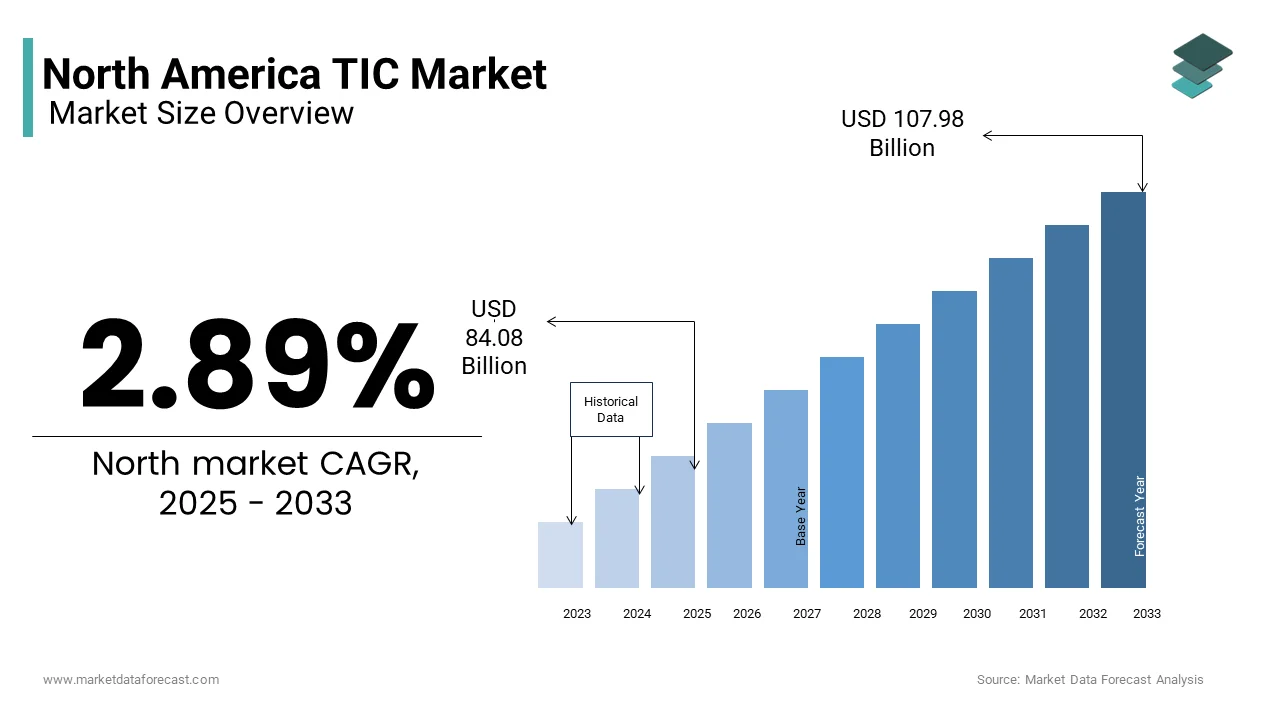
- Market Valuation: Valued at USD 84.08 billion in 2025, estimated at USD 86.51 billion in 2026, and projected to reach USD 108.66 billion by 2034, registering a CAGR of 2.89% from 2026 to 2034.
- Primary Growth Drivers: Expanding infrastructure modernization initiatives (e.g., bridge and grid inspections), rising regulatory oversight in consumer product safety, and the rapid deployment of renewable energy installations (wind, solar, and BESS).
Key Market Segment Metrics (2026–2034)
| Category | Leading Segment Position | Fastest-Growing / Key Growth Segment |
|---|---|---|
| By Type | Outsourced TIC Services (held a dominant market share in 2024 due to lean operational shifts and third-party compliance mandates) | In-house TIC (projected to grow at a CAGR of 9.4% from 2025 to 2033, driven by real-time quality control in semiconductor and EV manufacturing) |
| By End-User Vertical | Manufacturing and Industrial Goods (largest segment, holding 31.2% market share in 2024 backed by heavy industrial output and safety audits) | Environmental Vertical (expected to grow at a CAGR of 10.7% from 2025 to 2033 due to tightening air, water, and soil regulations) |
| By Country | United States (top performer holding a substantial 7.4% share in 2024, anchored by vast manufacturing and federal compliance regimes) | Canada (accounted for 13.2% market share in 2024, supported by strict CSA standards and extensive pipeline/natural resource integrity audits) |
Major Market Players & Market Structure
Market Structure: Highly competitive landscape featuring established global leaders and agile regional specialists competing through digital transformation, AI-driven inspection systems, blockchain verification, and sector-specific accreditations.
Key Companies: SGS SA, Intertek Group Plc, Bureau Veritas, TÜV SÜD, Applus Services, SA, UL Solutions, DNV GL, Mistras Group, Avomeen LLC, Envigo Corporation, AB Sciex LLC, DEKRA SE, and ALS Limited.
North America TIC Market Size
The North America TIC market size was valued at USD 84.08 billion in 2025 and is anticipated to reach USD 86.51 billion in 2026 to reach USD 108.66 billion by 2034, growing at a CAGR of 2.89% during the forecast period from 2026 to 2034.
The Testing, Inspection, and Certification (TIC) is an ecosystem of services designed to ensure compliance, safety, quality, and performance across industries such as manufacturing, construction, energy, aerospace, and consumer goods. These services are instrumental in validating product integrity, regulatory adherence, and operational reliability throughout the lifecycle of goods and infrastructure.
MARKET DRIVERS
Expanding Infrastructure Modernization Initiatives
The large-scale modernization of aging infrastructure is boosting the growth of the North America TIC market. The American Society of Civil Engineers (ASCE) assigned a cumulative grade of C- to U.S. infrastructure in its 2021 Infrastructure Report Card, revealing that 43% of public roadways are in poor or mediocre condition and over 46,000 bridges are structurally deficient. This unprecedented capital infusion necessitates rigorous third-party testing and inspection to ensure construction quality, material compliance, and long-term durability. For instance, the Federal Highway Administration mandates independent verification for all federally funded bridge projects, increasing reliance on accredited TIC providers. Additionally, the U.S. Department of Energy reports that 70% of the nation’s power grid transmission lines are over 25 years old, accelerating inspections under NERC reliability standards.
Rising Regulatory Scrutiny in Consumer Product Safety
The intensifying regulatory oversight on consumer product safety is propelled by increasing public awareness and legislative action, which is escalating the growth of the North American TIC market. The CPSC’s mandate under the Consumer Product Safety Act requires manufacturers to conduct third-party testing for over 15,000 types of children’s products to meet ASTM F963 toy safety standards. Furthermore, California’s Proposition 65, enforced by the Office of Environmental Health Hazard Assessment (OEHHA), compels businesses to test for over 900 listed carcinogens and reproductive toxins, affecting an estimated 1.2 million products sold in the state. The proliferation of e-commerce platforms such as Amazon and Walmart, which now require ISO 17025-accredited test reports for high-risk categories, further amplifies demand for pre-market certification.
MARKET RESTRAINTS
Shortage of Skilled TIC Professionals
The persistent shortage of qualified technicians, inspectors, and certification specialists is limiting the growth of the North American TIC market. The U.S. Bureau of Labor Statistics projects a 4% decline in employment for materials engineers between 2022 and 2032, while demand for certified non-destructive testing (NDT) personnel is expected to grow by 12% annually in the energy and aerospace sectors. This skills gap is exacerbated by the lack of standardized training pathways and low enrollment in technical certification programs. According to the National Center for Construction Education and Research (NCCER), only 18% of community colleges in the U.S. offer accredited TIC-related curricula, limiting workforce pipeline development. The complexity of emerging technologies such as drone-based structural inspections and AI-powered defect recognition further widens the competency gap, as traditional training programs lag behind technological adoption.
Fragmented Regulatory Framework Across Jurisdictions
The substantial operational friction due to the fragmented and non-harmonized regulatory landscape across federal, state, and provincial jurisdictions is also hindering the growth of the North American TIC market. In the United States, 50 states maintain independent building codes, fire safety regulations, and environmental standards, leading to inconsistent compliance requirements for multi-state projects. For instance, while 34 states have adopted the International Building Code (IBC), 16 states modify it with local amendments, necessitating redundant testing and certification processes. The National Fire Protection Association (NFPA) reports that over 300 different fire code variants are enforced across U.S. municipalities, complicating product certification for manufacturers. The U.S. Government Accountability Office found in 2022 that companies operating in more than 10 states spend 27% more on compliance due to regulatory misalignment. Cross-border trade under USMCA lacks mutual recognition of TIC outcomes, requiring dual assessments for products entering both markets.
MARKET OPPORTUNITIES
Integration of Digital Twins and Predictive Analytics in Asset Inspection
The adoption of digital twin technology and predictive analytics for real-time asset monitoring and condition-based inspection is posing new opportunities for the growth of the North America TIC market. Digital twins are virtual replicas of physical assets, which are increasingly deployed in sectors such as oil and gas, power generation, and transportation infrastructure to simulate performance and anticipate failures. General Electric reports that its digital twin models for gas turbines have reduced unplanned downtime by 25% and extended inspection intervals by up to 30%. In the U.S. power sector, utilities leveraging digital twins for transformer monitoring have achieved a 40% improvement in fault prediction accuracy, as per the Electric Power Research Institute (EPRI). The Federal Aviation Administration (FAA) is piloting digital twin frameworks for aircraft structural health monitoring, with Boeing estimating a 20% reduction in inspection labor costs through AI-driven anomaly detection. The integration of IoT sensors with cloud-based analytics enables continuous data streaming from pipelines, bridges, and rail systems by allowing TIC providers to shift from periodic to predictive inspection models.
Expansion of Renewable Energy Infrastructure Requiring Specialized TIC Services
The rapid deployment of renewable energy infrastructure, particularly in wind, solar, and energy storage systems, is also fuelling the growth of the North America TIC market. The U.S. Energy Information Administration (EIA) projects that renewable sources will account for 44% of total U.S. electricity generation by 2050, up from 22% in 2023, driven by federal tax incentives under the Inflation Reduction Act (IRA). This transition demands specialized inspection protocols for solar photovoltaic (PV) farms, wind turbine blades, and battery energy storage systems (BESS). As of 2023, the U.S. has over 139,000 MW of installed solar capacity, with more than 7,000 utility-scale solar facilities requiring regular performance verification and fire safety assessments. The National Renewable Energy Laboratory (NREL) indicates that 18% of solar farms experience degradation rates exceeding 1% per year, necessitating third-party performance testing. Drones equipped with thermal imaging, used by TIC providers like SGS and Bureau Veritas, have reduced wind farm inspection time by 60%, as per the American Wind Energy Association (AWEA).
MARKET CHALLENGES
Cybersecurity Vulnerabilities in Digitized TIC Operations
The escalating cybersecurity threats that jeopardize data integrity and cloud-based certification. The shift toward connected inspection tools—such as IoT-enabled sensors, drones, and AI-powered analytics—has expanded the attack surface for malicious actors. Client trust is restricting the growth of the North America TIC market. According to the U.S. Cybersecurity and Infrastructure Security Agency (CISA), the professional, scientific, and technical services sector, which includes TIC firms, experienced a 68% increase in reported cyber incidents between 2021 and 2023. The Ponemon Institute found that the average cost of a data breach in the professional services industry reached $5.04 million in 2023, the second-highest across all sectors. Furthermore, as TIC firms handle sensitive data related to product design, material composition, and safety compliance, they become attractive targets for industrial espionage. The reliance on third-party software vendors for digital twin platforms and certification management systems introduces supply chain risks; a 2023 report by the Software Engineering Institute at Carnegie Mellon University revealed that 74% of software vulnerabilities in industrial applications originate from third-party components. Regulatory bodies such as ANSI and ISO are now mandating cybersecurity compliance under standards like ISO/IEC 27001 and NIST SP 800-171, increasing operational complexity.
Escalating Client Demand for Faster Turnaround Times
The escalating pressure to deliver faster turnaround times without compromising accuracy was limiting the growth of the North American TIC market. Similarly, in pharmaceutical manufacturing, the U.S. Food and Drug Administration (FDA) mandates that facility validations be completed within 90 days of submission, compressing TIC providers’ timelines for compliance audits. The construction industry faces similar pressures; the Associated General Contractors of America (AGC) found that 68% of contractors expect inspection results within 48 hours to avoid costly site delays, yet the average turnaround time for structural testing remains at 72–96 hours. The rise of agile supply chains and rapid product iteration in electronics and automotive sectors further intensifies demand for expedited testing—some clients now require 24-hour turnaround for material compliance reports.
REPORT COVERAGE
| REPORT METRIC | DETAILS |
| Market Size Available | 2025 to 2034 |
| Base Year | 2025 |
| Forecast Period | 2026 to 2034 |
| CAGR | 2.89% |
| Segments Covered | By Type, End-User, Country |
| Various Analyses Covered | Global, Regional, and Country Level Analysis; Segment-Level Analysis; DROC; PESTLE Analysis; Porter’s Five Forces Analysis; Competitive Landscape; Analyst Overview of Investment Opportunities |
| Regions Covered | The United States, Canada, Mexico, Rest of North America |
| Market Leaders Profiled | SGS SA, Intertek Group Plc, Bureau Veritas, TUV SUD, Applus Services, SA, UL LLC , DNV GL, Mistras Group, Avomeen LLC, Envigo Corporation, AB Sciex LLC, DEKRA SE, ALS Limited. |
SEGMENTAL ANALYSIS
By Type Insights
The outsourced testing, inspection, and certification (TIC) services segment accounted in holding a dominant share of the North America TIC market in 2024, with a strategic shift among industrial and commercial enterprises toward leaner operations and reliance on specialized third-party expertise. For instance, the U.S. Environmental Protection Agency mandates third-party verification for over 70% of emissions reporting under the Greenhouse Gas Reporting Program (GHGRP), affecting more than 8,000 facilities nationwide. As per the Environmental Defense Fund, 92% of these facilities contract accredited TIC providers to ensure data integrity and avoid penalties. Additionally, the outsourcing trend is reinforced by cost-efficiency imperatives. The aerospace sector exemplifies this trend: Boeing sources over 75% of its material certification from external TIC bodies such as SGS and Intertek, as internal capabilities cannot scale to meet global airworthiness standards like EASA Part 21G and FAA AC 00-56B. Furthermore, the rise of digital supply chains and e-commerce platforms like Amazon requires standardized, externally validated test reports, which makes in-house verification insufficient for market access.
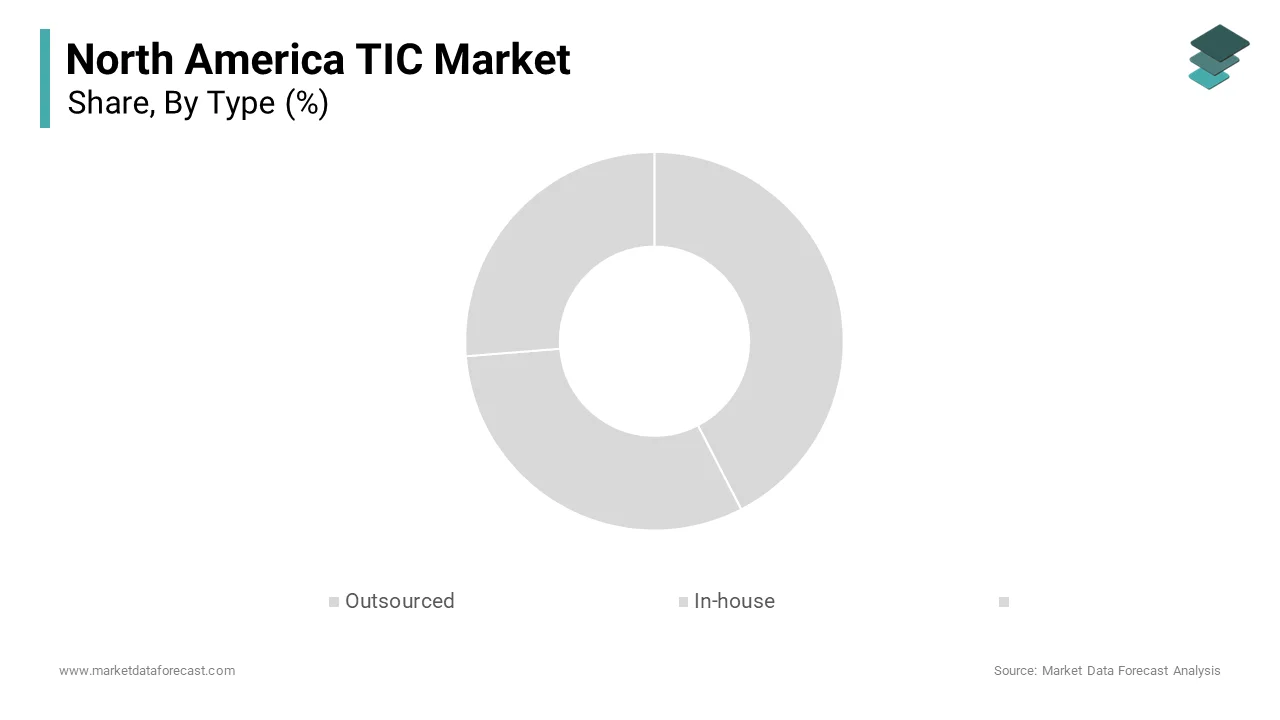
The in-house TIC segment is swiftly emerging with a CAGR of 9.4% from 2025 to 2033, with the need for real-time quality control in high-velocity manufacturing environments, particularly in semiconductor fabrication and electric vehicle (EV) production. Tesla, for example, operates over 14 in-house inspection hubs across its U.S. facilities, conducting more than 12,000 daily quality checks on battery cells and powertrains to maintain production speed without compromising safety. As per the Semiconductor Industry Association (SIA), chipmakers like Intel and TSMC’s Arizona facility perform 95% of wafer-level testing internally to minimize latency and protect proprietary intellectual property. Additionally, Industry 4.0 integration enables seamless embedding of AI-driven inspection systems within production lines. Rockwell Automation notes that manufacturers using in-house AI-powered vision systems reduce defect detection time from hours to milliseconds.
By End-User Vertical Insights
The Manufacturing and Industrial Goods vertical segment was the largest and held 31.2% of the North America TIC market share in 2024, with the sector’s vast scale, regulatory intensity, and reliance on precision conformity assessment. National Association of Manufacturers reports that U.S. industrial output reached $2.7 trillion in 2023, necessitating extensive TIC engagement for machinery safety, material compliance, and process validation. For instance, OSHA’s Process Safety Management (PSM) standard applies to over 25,000 industrial facilities handling hazardous chemicals, mandating third-party audits and mechanical integrity inspections. The American Society of Mechanical Engineers (ASME) confirms that 88% of pressure vessels and boilers in the sector require external certification under the ASME Boiler and Pressure Vessel Code. Furthermore, supply chain traceability requirements under the Uyghur Forced Labor Prevention Act (UFLPA) compel manufacturers to validate raw material origins through independent TIC audits. Customs and Border Protection data shows that 94% of high-risk imports undergo third-party verification, reinforcing the sector’s dependence on robust inspection ecosystems.
The Environmental segment is expected to grow with a CAGR of 10.7% from 2025 to 2033, with the tightening of environmental regulations and the expansion of mandatory monitoring programs across air, water, and soil domains. The EPA’s 2023 National Enforcement Initiative mandates third-party verification for all industrial dischargers under the National Pollutant Discharge Elimination System (NPDES), affecting over 40,000 facilities nationwide. As per the Natural Resources Defense Council, 78% of municipal wastewater plants now require quarterly effluent testing by accredited labs, up from 52% in 2020. Air quality monitoring is also intensifying: the EPA reports that 98 of the 107 largest U.S. cities exceed permissible ozone levels, triggering continuous emissions testing for industrial stacks and mobile sources. California’s Air Resources Board (CARB) enforces real-time emissions reporting for over 1,200 facilities, with 60% relying on external TIC providers for compliance. As per CDP North America, only 32% of corporate emissions data was third-party verified in 2022, indicating a vast untapped market.
COUNTRY ANALYSIS
United States TIC Market Analysis
The United States was the top performer of the American TIC market with the7.4% share in 2024. The nation’s expansive manufacturing base, valued at $2.7 trillion in output that da drives a continuous need for product certification, safety audits, and materials testing. The Occupational Safety and Health Administration (OSHA) conducts over 70,000 workplace inspections annually, with 42% resulting in citations that necessitate corrective actions verified by TIC providers. Additionally, the Federal Aviation Administration (FAA) mandates third-party certification for 100% of aircraft components under Part 21, supporting a robust aerospace TIC ecosystem. The Consumer Product Safety Commission (CPSC) oversees more than 15,000 product categories requiring independent testing, with over 8,000 accredited labs operating nationwide. The Department of Energy reports that over 1,400 new battery and solar manufacturing facilities are under development, each subject to rigorous TIC protocols. Cybersecurity standards under NIST SP 800-171 are also expanding the scope of digital compliance audits.
Canada TIC Market Analysis
Canada held second position with 13.2% of the North American TIC market share in 2024. The Canadian Standards Association (CSA Group) oversees over 3,000 standards, with mandatory certification required for electrical equipment, gas appliances, and construction materials. Technical Safety BC alone conducts over 1.2 million inspections annually on boilers, pressure vessels, and elevators, illustrating the depth of regulatory enforcement. The oil and gas industry, concentrated in Alberta, contributes significantly to TIC demand with the Alberta Energy Regulator mandates third-party integrity assessments for 480,000 km of pipelines, with 90% requiring annual NDT inspections. Environment and Climate Change Canada enforces air and water quality monitoring for over 6,000 industrial facilities under the Canadian Environmental Protection Act (CEPA). Additionally, Canada’s commitment to net-zero emissions by 2050 has spurred growth in renewable energy certification, with Natural Resources Canada projecting a 65% increase in wind and solar capacity by 2030.
COMPETITIVE LANDSCAPE
The competitive landscape of the North America TIC market is characterized by a blend of established global leaders and agile regional specialists vying for dominance across fragmented regulatory and industrial domains. Incumbents leverage their extensive accreditation networks, technical depth, and multi-sector capabilities to maintain strong footholds, while niche players differentiate through speed, innovation, and domain-specific expertise. The market is marked by intense pressure to deliver faster, more reliable, and technologically advanced services, driven by evolving regulatory demands and client expectations for transparency. Strategic differentiation increasingly hinges on digital capabilities, sustainability offerings, and the ability to navigate complex cross-border compliance requirements. Mergers, acquisitions, and technology partnerships are common as firms seek to broaden service portfolios and enhance operational resilience. While the presence of global giants ensures stability, the rise of specialized entrants fosters innovation, creating a dynamic environment where agility and domain mastery often outweigh scale alone. The absence of monopolistic control ensures continuous evolution with competition centered on service quality, innovation, and long-term advisory value rather than price alone.
KEY MARKET PLAYERS
These are the market players that are dominating the North America TIC market.
- SGS SA
- Intertek Group Plc
- Bureau Veritas
- TUV SUD
- Applus Services,
- SA UL LLC
- DNV GL
- Mistras Group
- Avomeen LLC
- Envigo Corporation
- AB Sciex LLC
- DEKRA SE
- ALS Limited
Top Players In The Market
- SGS stands as a cornerstone in the global Testing, Inspection, and Certification landscape, with its North American operations serving as a hub for cross-industry compliance. The company’s strength lies in its end-to-end service model, spanning from product certification to environmental monitoring and supply chain audits. SGS has built deep integration with regulatory frameworks across the U.S. and Canada, enabling seamless conformity assessments for multinational clients. Its reputation for technical rigor and accreditation under ISO/IEC 17020 and 17025 standards has made it a preferred partner in high-stakes sectors such as aerospace, energy, and consumer goods.
- Bureau Veritas has established itself as a pivotal force in North America’s TIC ecosystem by combining technical excellence with strategic sector specialization. The company excels in delivering tailored compliance solutions for complex industries such as maritime, construction, and industrial safety. Its North American presence is marked by strong collaborations with federal and provincial regulatory bodies, ensuring alignment with local and international standards. Bureau Veritas differentiates itself through innovation in digital certification and risk-based inspection models, enabling clients to achieve sustainable compliance.
- Intertek has emerged as a dominant player in the North America TIC market by prioritizing customer-centric innovation and end-to-end assurance solutions. The company’s strength lies in its ability to integrate testing and certification within broader supply chain and market access strategies, particularly for consumer goods, electronics, and pharmaceuticals. Intertek’s North American operations serve as a gateway for global exporters seeking compliance with U.S. and Canadian regulatory requirements. The company has pioneered digital platforms that streamline certification processes, reduce time-to-market, and enhance transparency. Its emphasis on sustainability verification and product integrity has positioned it as a trusted advisor in brand protection and regulatory navigation.
Top Strategies Used By Key Market Participants
- One major strategy employed by leading TIC providers is the integration of digital technologies into core service offerings. Companies are deploying AI-driven analytics, remote inspection tools, and cloud-based certification platforms to enhance accuracy, reduce turnaround times, and improve client engagement. This digital transformation enables real-time monitoring and predictive maintenance by shifting the TIC model from reactive to proactive assurance.
- Another key approach is strategic specialization in high-growth sectors such as renewable energy, electric mobility, and advanced manufacturing. TIC firms position themselves as indispensable partners in complex, regulated environments where technical depth and compliance precision are paramount.
RECENT MARKET NEWS
- In March 2023, SGS launched a digital certification platform across its North American operations, enabling clients in the manufacturing and consumer goods sectors to receive real-time compliance updates and automated audit trails by enhancing transparency and reducing approval cycles.
- In July 2023, Bureau Veritas partnered with a leading North American renewable energy developer to provide integrated inspection and certification services for a series of utility-scale solar and battery storage projects, which is strengthening its footprint in the clean energy transition.
- In November 2023, Intertek expanded its laboratory network in Texas with a new facility dedicated to electric vehicle battery testingalignsaligning with the growing demand for performance and safety validation in the automotive electrification sector.
- In February 2024, UL Solutions introduced a blockchain-based product certification system in the U.S. market by allowing manufacturers to secure immutable verification records and streamline compliance for smart devices and IoT products.
- In May 2024, TÜV SÜD acquired a regional industrial safety consultancy based in Ontario by enhancing its ability to deliver localized compliance solutions for Canadian infrastructure and manufacturing clients under CSA and provincial regulations.
MARKET SEGMENTATION
This research report on the North America TIC market is segmented and sub-segmented into the following categories.
By Type
- Outsourced
- In-house
By End-User Vertical
- Consumer Goods and Retail
- Environmental (Effluent, Water, Soil, Air)
- Food and Agriculture
- Manufacturing and Industrial Goods
- Oil and Gas
- Construction and Engineering
- Other End-user Verticals
By Country
- United States
- Canada
- Mexico