- Product Description Description
- Table of Contents TOC
- List of Table & Figure LOT
- Get Free Sample PDF Sample PDF
Market Size, 2025
$6.31 BnMarket Estimate, 2026
$6.68 BnMarket Forecast, 2034
$10.58 BnCAGR, 2026–2034
5.92%North America Titanium Dioxide Market Size
The Titanium dioxide market size in North America was valued at USD 6.31 billion in 2025 and is predicted to be worth USD 10.58 billion by 2034 from USD 6.68 billion in 2026 and grow at a CAGR of 5.92% from 2026 to 2034.

The Titanium dioxide (TiO₂) is a naturally occurring oxide of titanium, which is widely recognized for its high refractive index, excellent opacity, and strong UV resistance. It serves as a critical pigment in various industries, including paints and coatings, plastics, paper, cosmetics, and food products. In North America, the titanium dioxide market has evolved significantly due to changing industrial dynamics, regulatory pressures, and evolving end-user demands. The U.S. remains the largest consumer of TiO₂ in the region, driven by robust construction activity and ongoing demand from the automotive sector. As per data from the United States Geological Survey (USGS), the U.S. accounted for over 75% of total titanium dioxide consumption in North America in 2023, with domestic production primarily concentrated in Louisiana and Nevada. Imports from countries such as China and India have declined slightly due to trade policy shifts and increased domestic output. According to the American Coatings Association, the coatings industry alone consumed nearly 450,000 metric tons of titanium dioxide in 2022, reflecting sustained demand despite economic fluctuations. Environmental regulations, especially those enforced by the Environmental Protection Agency (EPA), have prompted manufacturers to adopt more sustainable production practices.
MARKET DRIVERS
Growth in Construction and Automotive Industries
The construction and automotive sectors are driving the growth of the North America titanium dioxide market. Titanium dioxide’s role as a white pigment in paints, coatings, and plastics makes it indispensable to these industries. In the U.S., the construction sector experienced significant growth post-pandemic, with residential and non-residential building completions rising sharply. According to the U.S. Census Bureau, total construction spending reached $1.8 trillion in 2023, marking a year-over-year increase of 9.3%. This surge in construction activity has directly boosted the demand for architectural coatings, which account for approximately 60% of TiO₂ consumption in the U.S.
Expansion of the Packaging Industry
The packaging industry is attributed in prompting the growth of the North America titanium dioxide market. Titanium dioxide imparts brightness and opacity to plastic packaging materials, making them visually appealing while ensuring product integrity. The rise of e-commerce and the growing preference for packaged food and beverages have fueled this sector's expansion. Plastic packaging, in particular, has witnessed robust demand, with polyethylene terephthalate (PET) and high-density polyethylene (HDPE) containers increasingly incorporating titanium dioxide for aesthetic and functional benefits. Plastics News reported that in 2023, North American plastic packaging shipments grew by 6.2%, reaching an all-time high of 54 billion pounds. Additionally, the shift toward sustainable packaging solutions has led to innovation in recyclable plastic composites, many of which still rely on TiO₂ for performance attributes.
MARKET RESTRAINTS
Stringent Environmental Regulations
The tightening of environmental regulations surrounding its production and use is hindering the growth of the North America titanium dioxide market. Regulatory agencies, particularly the U.S. Environmental Protection Agency (EPA) and Environment and Climate Change Canada (ECCC), have intensified scrutiny on emissions and waste management practices within the chemical manufacturing sector. In 2022, the EPA classified titanium dioxide as a potential inhalation hazard following assessments by the International Agency for Research on Cancer (IARC), which is prompting stricter handling and exposure guidelines. Companies are now required to implement additional safety measures, conduct frequent air quality monitoring, and invest in cleaner production technologies. According to Chemical Week, compliance costs for TiO₂ producers in the U.S. increased by an estimated 15% between 2021 and 2023. Moreover, some downstream users, particularly in consumer goods and cosmetics, have begun seeking alternatives or reformulating products to avoid potential regulatory backlash.
Volatility in Raw Material Prices
The volatility in raw material prices for feedstock minerals such as ilmenite and rutile is additionally to limit the growth of the North America titanium dioxide market. These natural resources are essential for producing titanium dioxide, and their availability and pricing are influenced by geopolitical tensions, mining disruptions, and transportation bottlenecks. This cost escalation has placed immense pressure on North American TiO₂ manufacturers. Companies operating in the U.S. and Canada are heavily reliant on imported raw materials, with over 60% of titanium-bearing ores sourced externally, as reported by the U.S. Geological Survey (USGS). Higher input costs have forced producers to either absorb losses or pass on price increases to customers, both of which impact profitability and market competitiveness. Additionally, the global push for electrification and green technologies has diverted attention and capital toward alternative resource extraction methods, such as synthetic rutile processing, which remain costly and unproven at scale.
MARKET OPPORTUNITIES
Rise of Sustainable and Green Chemistry Initiatives
The adoption of sustainable and green chemistry initiatives is creating new opportunities for the North America titanium dioxide market. There is a growing emphasis on developing eco-friendly titanium dioxide production processes as industries increasingly prioritize environmental responsibility. According to the American Chemical Society, companies implementing advanced chloride-based TiO₂ production techniques have reduced carbon dioxide emissions by up to 30% compared to conventional sulfate methods. Moreover, the shift toward circular economy models has encouraged the recycling of titanium dioxide from industrial waste streams and end-of-life products. A study conducted by the National Renewable Energy Laboratory (NREL) in 2023 revealed that up to 15% of titanium dioxide used in paint formulations could be recovered and reused without compromising quality. Incentives from governmental bodies such as the EPA’s Safer Choice Program and Canada’s Clean Growth Program are further accelerating the transition toward greener alternatives.
Growing Demand in Specialty Applications
Titanium dioxide is finding increasing utility in specialty sectors such as electronics, pharmaceuticals, and nanotechnology is additionally to present new opportunities for the growth of North America titanium dioxide market. In North America, these niche markets are expanding rapidly, offering fresh avenues for TiO₂ consumption. For instance, in the electronics industry, titanium dioxide is being utilized in capacitors and semiconductor coatings due to its dielectric properties and thermal stability. In the pharmaceutical sector, titanium dioxide is widely used as a safe, inert pigment in drug tablets and medical devices. The U.S. Food and Drug Administration (FDA) continues to approve its use in oral and topical formulations, reinforcing its relevance in healthcare applications. Furthermore, advancements in nanotechnology have opened doors for TiO₂ nanoparticles in sunscreen formulations, self-cleaning surfaces, and photovoltaic cells.
MARKET CHALLENGES
Substitution Threat from Alternative White Pigments
The increasing substitution of TiO₂ with alternative white pigments such as calcium carbonate, kaolin clay, and zinc oxide is challenging factor for the growth of the North America titanium dioxide market. Paint formulators are increasingly blending titanium dioxide with extenders like calcined clay to maintain opacity while cutting costs. The American Coatings Association observed that in 2023, around 20% of water-based paint formulations included higher proportions of alternative pigments, reducing TiO₂ content by up to 15%.
Supply Chain Disruptions and Geopolitical Tensions
The supply chain disruptions and geopolitical tensions impacting the availability of raw materials is likely to impede the growth of the North America titanium dioxide market. Titanium dioxide production relies heavily on imported titanium-bearing ores, particularly from regions prone to political instability or trade restrictions. For example, Russia’s invasion of Ukraine in 2022 disrupted global mineral trade flows, indirectly affecting titanium ore exports from Eastern Europe. According to the U.S. Geological Survey (USGS), in 2023, the U.S. imported nearly 35% of its titanium feedstock from countries experiencing trade uncertainties, including South Africa and Mozambique. Additionally, logistical bottlenecks and freight delays have compounded sourcing difficulties.
REPORT COVERAGE
| REPORT METRIC | DETAILS |
| Market Size Available | 2025 to 2034 |
| Base Year | 2025 |
| Forecast Period | 2026 to 2034 |
| CAGR | 5.92% |
| Segments Covered | By Grade, Application, and Region |
|
Various Analyses Covered | Regional & Country Level Analysis, Segment-Level Analysis, DROC, PESTLE Analysis, Porter’s Five Forces Analysis, Competitive Landscape, Analyst Overview on Investment Opportunities |
| Regions Covered | The United States, Canada, Mexico, and Rest of North America |
| Market Leaders Profiled | Huntsman, Tronox, Kronos, Chemours, and Argex Titanium Inc, and others |
SEGMENTAL ANALYSIS
By Grade Insights
The rutile segment was accounted in holding a dominant share of the North America titanium dioxide market in 2025 with its superior optical properties, including higher refractive index and better UV resistance compared to ilmenite. According to the U.S. Geological Survey (USGS), approximately 480,000 metric tons of rutile-based titanium dioxide were consumed across North America in 2023, with the U.S. representing nearly 90% of this volume. Moreover, regulatory shifts favoring lower environmental impact have accelerated the preference for rutile over other grades. Unlike ilmenite, which often requires additional processing steps that generate more waste, rutile is compatible with cleaner chloride-based manufacturing processes.
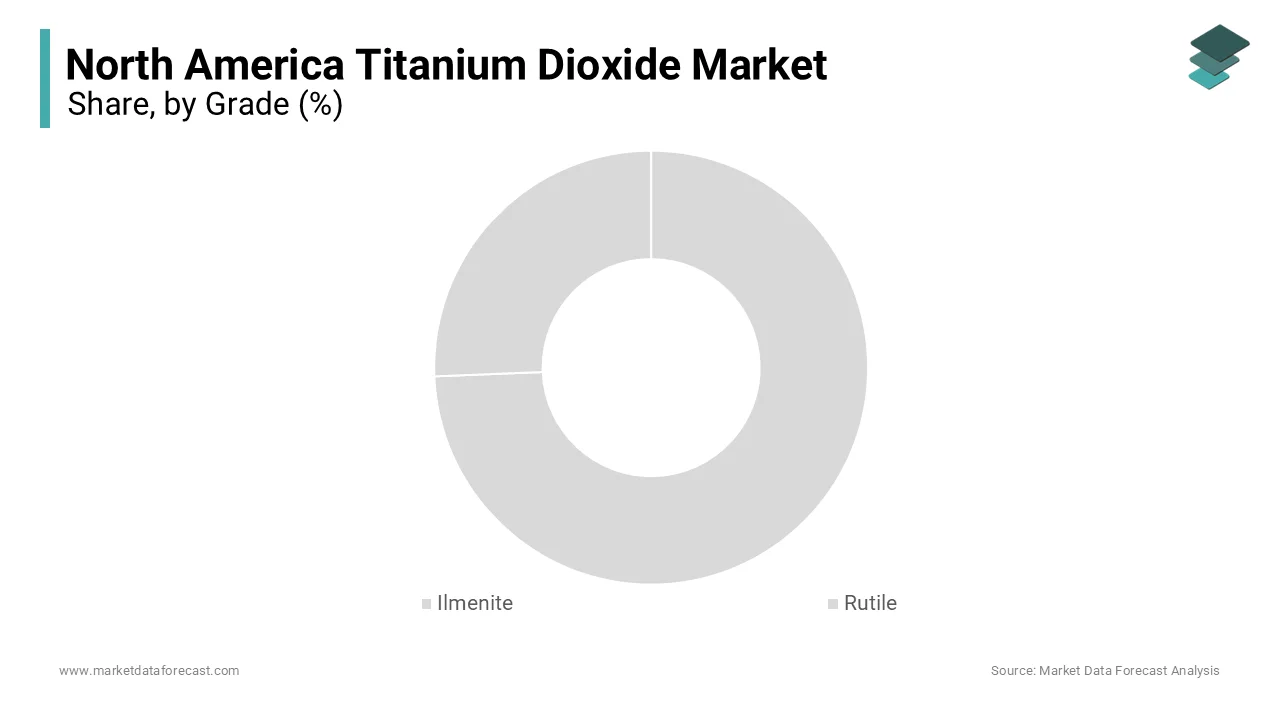
The ilmenite segment is emerging with a CAGR of 5.8% from 2026 to 2034. Ilmenite’s appeal lies in its economic viability. It serves as a raw material input for synthetic rutile production and sulfate-process TiO₂, both of which remain crucial for certain regional manufacturers. In 2023, Canada and Mexico saw a surge in ilmenite-based TiO₂ production, driven by lower processing costs and abundant local reserves. According to Natural Resources Canada, ilmenite mining output rose by 8.2% in 2023, supporting downstream pigment production in Quebec and Ontario. Additionally, the shift toward circular economy initiatives has spurred interest in using ilmenite in recycled pigment blends. A study by the National Research Council of Canada revealed that in 2023, over 10% of recovered TiO₂ from post-consumer paint waste contained ilmenite derivatives, contributing to sustainable supply chains. Furthermore, small and medium-sized coating manufacturers in the U.S. Midwest have increasingly opted for ilmenite-based products due to cost advantages, as reported by Plastics News.
By Application Insights
The paints and varnishes segment held 42.3% of the North America titanium dioxide market share in 2025 with the widespread use of TiO₂ in architectural, industrial, and automotive coatings due to its ability to provide opacity, brightness, and UV protection. According to the American Coatings Association, the U.S. coatings industry alone accounted for over 480,000 metric tons of titanium dioxide usage in 2023, reflecting robust demand from both residential and commercial sectors. Furthermore, sustainability mandates have encouraged formulators to maintain TiO₂ in high-quality formulations despite rising costs.
The New Research Applications segment is lucratively to register a CAGR of 7.2% during the forecast period. The increasing utilization of nanostructured titanium dioxide in self-cleaning surfaces and air purification systems . A 2023 report by the National Renewable Energy Laboratory (NREL) indicated that TiO₂ nanoparticles demonstrated a 25% improvement in photocatalytic efficiency when used in indoor air filtration systems, making them attractive for green building technologies. Moreover, advancements in solar cell technology have led to renewed interest in TiO₂-based dye-sensitized photovoltaics. Additionally, the healthcare sector is adopting TiO₂ for antimicrobial coatings on medical devices.
REGIONAL ANALYSIS
The United States
The United States held 78.3% of the North America titanium dioxide market share in 2025 with the country’s well-established industrial base, particularly in construction, automotive, and packaging sectors all of which are major consumers of TiO₂. Additionally, the U.S. automotive industry has seen a resurgence, with light vehicle production increasing by 12% in 2023 compared to the previous year, as reported by the Alliance for Automotive Innovation. Titanium dioxide plays a critical role in automotive paint formulations, enhancing durability and color retention. Regulatory developments also shape the market landscape. The Environmental Protection Agency (EPA) has imposed stricter guidelines on TiO₂ handling, prompting companies to adopt cleaner production methods.
Canada
Canada titanium dioxide market was positioned second with 14.3% of the share in 2025. The Canadian Plastics Industry Association reported that in 2023, over 40% of rigid plastic containers incorporated titanium dioxide for aesthetic and functional benefits. Additionally, e-commerce expansion has fueled demand for durable and visually appealing packaging solutions, which is further boosting TiO₂ consumption. Environmental regulations have also influenced market dynamics. Environment and Climate Change Canada (ECCC) introduced updated guidelines in 2023 requiring improved emission controls for chemical manufacturers.
KEY MARKET PLAYERS AND COMPETITIVE LANDSCAPE
Huntsman, Tronox, Kronos, Chemours, and Argex Titanium Inc. are some of the notable companies in the North America Titanium Oxide market.
The competition in the North America titanium dioxide market is characterized by a high degree of consolidation among a few major players who dominate production, distribution, and innovation. While entry barriers are high due to capital-intensive operations and stringent environmental regulations, by existing players continuously seek to differentiate themselves through product specialization and sustainability initiatives. Competitive dynamics are further shaped by fluctuating raw material availability, evolving end-user demands, and regulatory pressures that influence production strategies. Companies also emphasize long-term contracts with key customers to secure demand stability and reduce exposure to market volatility. Additionally, advancements in application-specific TiO₂ grades have intensified rivalry, especially in high-performance sectors such as automotive coatings and specialty polymers.
TOP PLAYERS IN THE MARKET
Tronox Holdings plc
Tronox Holdings plc is one of the top most key players in the North America titanium dioxide market. The company operates one of the largest integrated pigment production systems globally and has a strong presence in the region through its manufacturing facilities in Louisiana. Tronox is known for its sustainable production practices and vertical integration, which enables efficient sourcing of raw materials. Its product portfolio caters to various industries including paints, coatings, plastics, and paper, making it a key supplier in North America. Another major player is Venator Materials PLC , which has a significant footprint in the U.S. titanium dioxide market. Venator focuses on innovation and product diversification, offering high-quality TiO₂ solutions tailored for both industrial and consumer applications. The company emphasizes customer-specific formulations and has been actively investing in research and development to meet evolving regulatory and performance standards across different sectors.
Kronos Worldwide, Inc.
Kronos Worldwide, Inc. is also a dominant force in the North America titanium dioxide market. With decades of experience, Kronos provides rutile and anatase-grade titanium dioxide products that are widely used in coatings, plastics, and specialty applications. The company maintains a strong supply chain network and leverages strategic partnerships to ensure consistent product availability and quality. Its commitment to operational excellence and environmental stewardship further strengthens its regional position.
TOP STRATEGIES USED BY KEY PLAYERS
Key players in the North America titanium dioxide market employ several strategic approaches to reinforce their competitive positions. One major strategy is vertical integration , where companies acquire or develop upstream resources such as mineral sands and processing facilities. This approach ensures a stable supply of raw materials, reduces dependency on external suppliers, and enhances cost efficiency.
The product innovation and differentiation, wherein manufacturers focus on developing specialized titanium dioxide grades tailored for niche applications. The companies can meet evolving industry requirements in sustainability and performance by allowing them to capture premium market segments.
The strategic acquisitions and partnerships play a vital role in expanding market reach and enhancing production capabilities. Companies frequently engage in mergers, joint ventures, or collaborations with downstream users to strengthen their distribution networks, improve technological capabilities, and maintain its dominance in a highly consolidated market landscape.
RECENT HAPPENINGS IN THE MARKET
- In February 2025, Tronox announced the launch of a new sustainable titanium dioxide production initiative at its Louisiana facility, which is aiming to reduce carbon emissions and align with global environmental standards.
- In May 2025, Venator entered into a strategic partnership with a leading North American coatings manufacturer to co-develop next-generation titanium dioxide formulations optimized for low-VOC applications.
- In August 2025, Kronos initiated a capacity expansion project at its Ohio-based pigment finishing plant to better serve growing demand from the packaging and plastics industries.
- In November 2025, Tronox completed the acquisition of a mineral sands operation in Florida, strengthening its raw material supply chain and reinforcing its vertical integration strategy.
- In January 2026, Venator launched a digital customer engagement platform to streamline order management, technical support, and product customization services for industrial clients across North America.
MARKET SEGMENTATION
This research report on the North America titanium dioxide market has been segmented and sub-segmented based on the following categories.
By Grade
- Ilmenite
- Rutile
By Application
- Paints and Coatings
- Cosmetic Products
- Paper and Plastics
- Healthcare and Food Industry
- Thin Films
- Construction
By Country
- The United States
- Canada
- Rest of North America