- Product Description Description
- Table of Contents TOC
- List of Table & Figure LOT
- Get Free Sample PDF Sample PDF
North America Ultrasonic Sensor Market Size
In 2024, the North America Ultrasonic Sensor Market was valued at USD 1.52 billion and is forecasted to grow to USD 2.85 billion by 2033, at a CAGR of 7.23%.
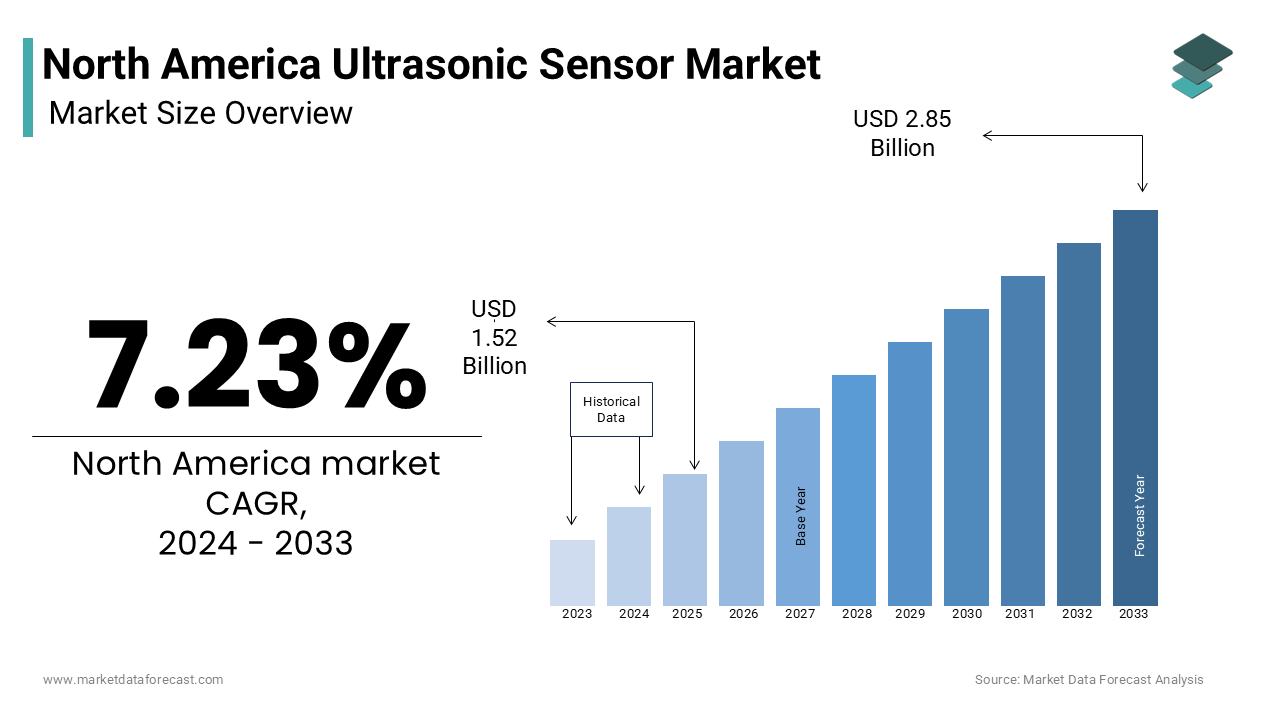
Ultrasonic sensor is a device that utilize high-frequency sound waves for non-contact distance measurement, object detection, and fluid level monitoring across industrial, automotive, healthcare, and consumer electronics applications. Ultrasonic sensors are widely used in automation, robotics, parking assistance systems, medical imaging, and industrial process control due to their reliability, accuracy, and ability to function in diverse environmental conditions. The United States is the dominant contributor to this market, driven by the presence of major technology firms, a strong manufacturing base, and increasing adoption of automation across key industries. Canada also plays a growing role, particularly in automotive and industrial automation sectors.
MARKET DRIVERS
Expansion of Industrial Automation and Smart Manufacturing
The rapid expansion of industrial automation and smart manufacturing technologies is one of the primary drivers of the North America ultrasonic sensor market. The adoption of Industry 4.0 principles, including robotics, IoT-enabled sensors, and real-time data analytics, has significantly increased the demand for ultrasonic sensors in manufacturing environments. There is a broader shift toward automated production lines and that companies are increasingly interested in and adopting robotics. Ultrasonic sensors play a crucial role in these systems by enabling non-contact object detection, proximity sensing, and precise distance measurement, which are essential for robotic arms, conveyor systems, and quality control processes. Apart from these, the push for energy-efficient manufacturing practices has led to the integration of smart sensors that support predictive maintenance and real-time monitoring. Companies such as Siemens, Rockwell Automation, and ABB have expanded their sensor portfolios to include ultrasonic-based solutions tailored for industrial applications.
Growth in Automotive Safety and Driver Assistance Systems
The increasing integration of ultrasonic sensors in automotive safety and driver assistance systems is another major driver of the North America ultrasonic sensor market. With the rising emphasis on vehicle safety and autonomous driving capabilities, automakers are incorporating ultrasonic sensors into parking assistance, blind spot detection, lane departure warning, and collision avoidance systems. According to the National Highway Traffic Safety Administration (NHTSA), over 90% of new vehicles sold in the U.S. in 2023 included some form of advanced driver-assistance system (ADAS), many of which rely on ultrasonic sensors for short-range object detection. These sensors are particularly effective in low-speed environments such as parking and traffic congestion, where they provide real-time feedback to drivers and autonomous systems. Apart from these, the rise of electric vehicles (EVs) and autonomous shuttles has further increased demand for ultrasonic sensors due to their reliability and cost-effectiveness compared to alternative technologies like LiDAR and radar. Major automotive suppliers such as Bosch, Continental, and Denso have expanded their ultrasonic sensor offerings to meet the growing demand from original equipment manufacturers (OEMs).
MARKET RESTRAINTS
Environmental and Operational Limitations in Extreme Conditions
The performance limitations of these sensors in extreme environmental conditions, which can impact their reliability and accuracy, is a significant restraint affecting the North America ultrasonic sensor market. Ultrasonic sensors operate by emitting high-frequency sound waves and measuring the time it takes for them to bounce back from an object. However, factors such as temperature variations, humidity, dust, and background noise can interfere with the sensor’s ability to detect objects accurately. According to the National Institute of Standards and Technology (NIST), fluctuations in air temperature can cause sound waves to refract or travel at different speeds, leading to measurement errors. This is particularly problematic in industrial settings such as foundries, outdoor automation systems, and high-humidity environments where ultrasonic sensors may struggle to maintain consistent performance. Besides, in automotive applications, heavy rain, snow, or dirt accumulation on sensor surfaces can reduce detection accuracy, limiting their effectiveness in all-weather conditions. To mitigate these challenges, manufacturers are investing in protective enclosures and signal-processing algorithms, but these solutions often increase production costs and complexity.
High Cost of Integration and Technical Expertise Requirements
The high cost of integration and the need for specialized technical expertise to implement and maintain these systems effectively is another major restraint on the North America ultrasonic sensor market. While ultrasonic sensors offer reliable performance in many applications, their deployment often requires extensive engineering, calibration, and compatibility testing with existing control systems. Moreover, the requirement for skilled technicians to configure and maintain these systems presents a barrier for small and medium-sized enterprises (SMEs) that may lack the necessary technical resources. In the automotive sector, the complexity of integrating ultrasonic sensors with vehicle control units (VCUs) and ADAS software further increases development timelines and costs. These integration and skill-related barriers hinder widespread adoption, particularly in cost-sensitive applications and smaller-scale operations.
MARKET OPPORTUNITIES
Integration with Smart Cities and IoT Infrastructure
The integration of these sensors into smart cities and Internet of Things (IoT) infrastructure is a significant opportunity emerging in the North America ultrasonic sensor market. As urban centers across the U.S. and Canada invest in smart technologies to improve efficiency, safety, and sustainability, ultrasonic sensors are being deployed in applications such as smart parking, traffic monitoring, waste management, and building automation. Ultrasonic sensors play a crucial role in smart parking systems by detecting vehicle presence in real time and transmitting data to centralized platforms for dynamic space allocation. Further, these sensors are being used in waste management systems to monitor bin fill levels and optimize collection routes, reducing operational costs and environmental impact.
Expansion in Healthcare and Medical Imaging Applications
The expansion of ultrasonic sensors in healthcare and medical imaging applications presents a major growth opportunity for the North America market. These sensors are increasingly being used in patient monitoring, non-invasive diagnostics, and medical robotics, where they provide accurate and real-time data without the need for physical contact. Ultrasonic sensors are integral to applications such as respiratory monitoring, fluid level detection in infusion pumps, and proximity sensing in robotic-assisted surgeries. Also, the aging population in North America is increasing the demand for home healthcare solutions, where ultrasonic sensors are used in fall detection systems, bed occupancy monitoring, and mobility assistance devices.
MARKET CHALLENGES
Competition from Alternative Sensing Technologies
The increasing competition from alternative sensing technologies such as LiDAR, radar, infrared, and vision-based systems is one of the major challenges facing the North America ultrasonic sensor market. These technologies offer different advantages in terms of range, accuracy, and environmental adaptability, making them viable substitutes in applications such as autonomous vehicles, industrial automation, and security systems. Unlike ultrasonic sensors, which are limited in range and can be affected by environmental noise, LiDAR and radar offer higher precision and better performance in adverse weather conditions. Many next-generation autonomous vehicles are shifting toward multi-sensor fusion systems that combine radar, LiDAR, and cameras for enhanced perception capabilities. Apart from these, vision-based sensors are gaining traction in industrial automation due to their ability to provide real-time visual feedback and object recognition.
Standardization and Interoperability Issues Across Applications
The lack of standardization and interoperability across different applications and industries is a significant challenge in the North America ultrasonic sensor market. Ultrasonic sensors are used in a wide range of environments, including automotive, industrial, healthcare, and consumer electronics, each with unique performance requirements and integration protocols. Also, the absence of universal standards for sensor data formats, communication interfaces, and calibration methods has led to compatibility issues between different manufacturers and systems. This lack of standardization complicates the integration of ultrasonic sensors into larger automation and IoT networks, increasing development time and costs for end users. The U.S. National Institute of Standards and Technology (NIST) emphasized that inconsistent sensor performance metrics make it difficult for buyers to compare products and ensure reliability across different applications. Additionally, in the automotive sector, the Society of Automotive Engineers (SAE) pointed out that variations in sensor placement, signal processing algorithms, and software integration have led to inconsistencies in driver assistance systems.
SEGMENTAL ANALYSIS
By Technology Insights
The retro-reflective sensors segment represented the largest category in the North America ultrasonic sensor market by capturing a 42.3% of total revenue in 2024. These sensors are widely adopted in industrial automation and logistics applications due to their ability to detect objects using a single unit that both emits and receives sound waves after they reflect off a target. This configuration eliminates the need for a separate receiver, simplifying installation and reducing costs. Additionally, these sensors are extensively used in automotive manufacturing for part detection and assembly line monitoring. Their reliability in diverse lighting and environmental conditions further enhances their appeal across manufacturing, logistics, and consumer electronics industries.
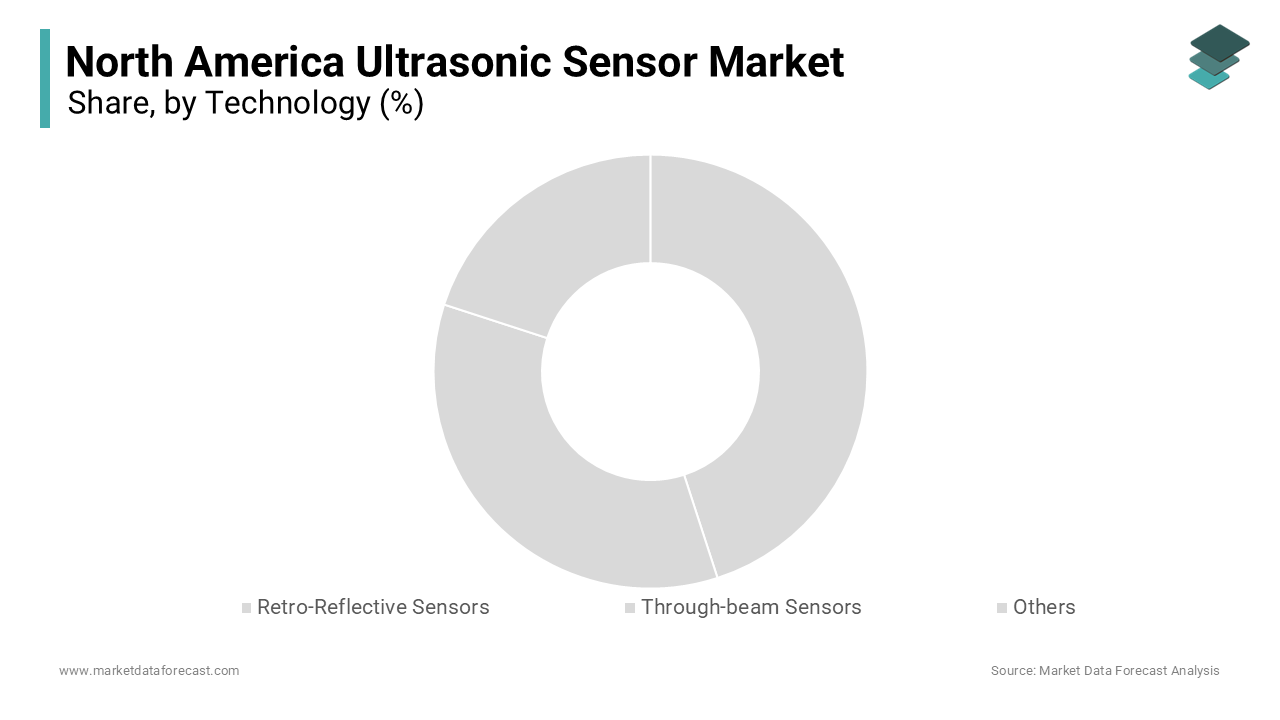
The through-beam sensors segment is the fastest-growing in the North America ultrasonic sensor market and is projected to expand at a CAGR of 9.3% from 2025 to 2033. These sensors are gaining traction due to their superior detection accuracy and ability to operate over longer distances compared to other ultrasonic technologies. Also, these sensors utilize a separate transmitter and receiver positioned opposite each other, allowing for precise object detection when the beam is interrupted. Through-beam sensors are increasingly being deployed in smart parking systems, automated warehouses, and security applications, where high reliability and minimal false triggers are essential. Besides, the rise of autonomous guided vehicles (AGVs) in industrial and logistics settings has further boosted demand for through-beam sensors, which provide real-time obstacle detection in dynamic environments. Moreover, these sensors are being integrated into healthcare equipment such as infusion pumps and patient monitoring systems to ensure accurate and continuous operation.
By Type Insights
The obstacle detection segment led the North America ultrasonic sensor market by accounting for a 37.1% of total revenue in 2024. These sensors are particularly effective in low-speed environments, providing real-time feedback to drivers and autonomous systems. Additionally, the industrial sector is a major consumer of obstacle detection sensors, particularly in robotics and automated guided vehicles (AGVs). Obstacle detection sensors are also widely used in consumer electronics such as robotic vacuum cleaners and smart home security systems.
The distance measurement segment is the fastest-growing in the North America ultrasonic sensor market and is projected to expand at a CAGR of 9.6% from 2025 to 2033. It is used for distance measurement are gaining popularity due to their accuracy, reliability, and cost-effectiveness in industrial, automotive, and medical applications. These sensors emit high-frequency sound waves and calculate the time taken for the waves to return after hitting an object, enabling precise distance calculations. Apart from these, the automotive industry is increasingly integrating distance measurement sensors into adaptive cruise control and lane-keeping assistance systems. In the healthcare sector, these sensors are being used in patient monitoring systems, bed occupancy detection, and mobility assistance devices.
By Application Insights
The automotive sector prevailed in the North America ultrasonic sensor market by capturing a 34.3% of total revenue in 2024. Ultrasonic sensors have become integral to modern vehicles, particularly in advanced driver-assistance systems (ADAS) such as parking assistance, blind spot detection, and collision avoidance. Additionally, the increasing adoption of autonomous and semi-autonomous vehicles has further driven demand for ultrasonic sensors in parking assist, lane departure warning, and pedestrian detection systems. Automotive manufacturers such as Ford, General Motors, and Tesla have been incorporating ultrasonic sensors into their vehicle platforms to enhance safety and convenience. Also, the U.S. remains a leader in automotive technology innovation, with ongoing investments in sensor-driven mobility solutions.
The healthcare sector is the fastest-growing application segment in the North America ultrasonic sensor market, projected to expand at a compound annual growth rate (CAGR) of 9.8% during the forecast period. Ultrasonic sensors play a crucial role in non-invasive diagnostics, patient monitoring, and medical robotics, providing real-time data without the need for physical contact. Apart from these, ultrasonic sensors are being used in infusion pumps, respiratory monitoring systems, and fall detection devices, particularly in home healthcare applications.
REGIONAL ANALYSIS
United States Ultrasonic Sensor Market Insights
The United States secured the dominant position in the North America ultrasonic sensor market by accounting for a 83% of regional revenue in 2023. The electronics and automation sectors in the U.S. expanded, driven by strong growth in industrial robotics, automotive manufacturing, and healthcare technology. The country is home to a vast ecosystem of ultrasonic sensor manufacturers and technology firms, including major players such as Honeywell, Texas Instruments, and Sensata Technologies. The automotive industry remains a key consumer. Apart from these, the industrial automation sector is expanding rapidly. The healthcare industry is also adopting ultrasonic sensors for patient monitoring and diagnostic applications, supported by rising investments in telemedicine and remote healthcare solutions.
Canada Ultrasonic Sensor Market Insights
Canada saw a steady growth in the North America ultrasonic sensor market. The Canadian automotive industry, especially in Ontario, remains a major consumer of ultrasonic sensors, with major original equipment manufacturers (OEMs) such as Ford, General Motors, and Stellantis integrating these sensors into next-generation vehicles. Additionally, the industrial automation sector is expanding, with companies investing in robotics and smart manufacturing solutions to improve efficiency and safety. The healthcare sector is also adopting ultrasonic sensors for patient monitoring and diagnostic applications, particularly in home healthcare and telehealth services. Remote patient monitoring solutions have gained traction, with ultrasonic sensors playing a role in fall detection and mobility assistance devices.
Rest of North America Insights
The Rest of North America, including Mexico and Central American territories, holds a smaller but growing share of the regional ultrasonic sensor market. Mexico’s proximity to the U.S. makes it a strategic manufacturing hub for ultrasonic sensors used in automotive assembly, industrial automation, and consumer electronics. Additionally, the automotive industry in Mexico remains a key consumer, with major OEMs such as Nissan, Toyota, and BMW maintaining production facilities that rely on ultrasonic sensors for parking assistance and proximity detection. In Central America, countries like Costa Rica and El Salvador have developed electronics assembly clusters, attracting foreign investment in sensor manufacturing and packaging. While still a niche market, the Rest of North America presents opportunities for ultrasonic sensor manufacturers seeking cost-effective production and supply chain diversification.
Top Players in the North America Ultrasonic Sensor Market
Honeywell International Inc.
Honeywell is a global leader in sensing technologies and holds a strong position in the North America ultrasonic sensor market. The company offers a wide range of ultrasonic sensors used in automotive, industrial, and consumer electronics applications. Honeywell is known for its innovation in sensor design, integration, and performance reliability. Its contributions to the global market include the development of high-precision sensors for advanced driver-assistance systems and industrial automation. The company's strong R&D focus and strategic partnerships have enabled it to maintain a competitive edge in the evolving sensor landscape.
Texas Instruments Incorporated (TI)
Texas Instruments is a key player in the ultrasonic sensor space, particularly in the automotive and industrial sectors. The company has developed highly integrated ultrasonic sensor solutions that support proximity detection, parking assistance, and object avoidance in vehicles. TI’s focus on semiconductor-based sensor technology has allowed for miniaturization, improved accuracy, and lower system costs. Its contributions to the global market include enabling cost-effective and scalable ultrasonic sensing platforms that are widely adopted by automotive OEMs and Tier-1 suppliers across North America and beyond.
Sensata Technologies
Sensata Technologies is a major manufacturer of sensors and controls, with a strong presence in the North American ultrasonic sensor market. The company serves a broad range of industries, including automotive, industrial, and aerospace. Sensata is recognized for its expertise in developing robust and high-performance ultrasonic sensors tailored for demanding environments. Its contributions to the global market include the integration of sensor technologies into next-generation electric and autonomous vehicles, as well as smart industrial systems, reinforcing its role as a key innovator in the ultrasonic sensing domain.
Top Strategies Used by Key Market Participants
Innovation through R&D and Product Development
Leading ultrasonic sensor manufacturers prioritize continuous innovation to meet evolving application demands. Companies are investing heavily in research and development to enhance sensor accuracy, reduce size, and improve environmental resilience, particularly for automotive and industrial automation applications.
Expansion into High-Growth Sectors
To strengthen their market positions, key players are focusing on expanding into high-growth sectors such as electric vehicles, healthcare, and smart infrastructure. By aligning their product portfolios with emerging trends, companies are able to capture new opportunities and drive sustained growth.
Strategic Collaborations and Technology Partnerships
Manufacturers are increasingly forming strategic alliances with automotive OEMs, industrial automation providers, and medical device companies to integrate ultrasonic sensors into next-generation systems. These partnerships help accelerate product adoption and enhance technical capabilities through shared expertise and co-development initiatives.
KEY MARKET PLAYERS AND COMPETITIVE LANDSCAPE
Key players in the North America Ultrasonic Sensor Market include Keyence Corporation, Pepperl+Fuchs AG, Honeywell International Inc., Rockwell Automation, Inc., Baumer Ltd., Omron Corporation, Murata Manufacturing Co., Ltd., Balluff Inc., SICK AG, Banner Engineering, Migatoron Corporation, MaxBotix Inc., Senix Corporation, and Gems Sensors.
The competition in the North America ultrasonic sensor market is shaped by a mix of global semiconductor companies, sensor specialists, and automotive electronics suppliers, all striving to meet the rising demand across diverse industries. While established players dominate the market due to their strong brand recognition, extensive R&D capabilities, and well-established distribution networks, emerging companies are gaining traction by offering niche, application-specific solutions. The automotive sector remains a key battleground, with manufacturers competing to provide cost-effective and high-performance ultrasonic sensors for parking assistance and advanced driver-assistance systems (ADAS). In the industrial segment, the competition centers around sensor integration with automation and robotics, where precision, reliability, and environmental resilience are critical. Additionally, the healthcare and consumer electronics sectors are emerging as key growth areas, prompting companies to innovate in terms of miniaturization, power efficiency, and ease of integration. As demand for smart, connected, and autonomous systems continues to rise, the market remains highly dynamic, with players differentiating themselves through technological advancements, strategic partnerships, and targeted application development.
RECENT MARKET DEVELOPMENTS
- In January 2023, Honeywell launched a new line of high-precision ultrasonic sensors designed for industrial automation and robotics applications, enhancing its portfolio for smart manufacturing and logistics automation in North America.
- In May 2023, Texas Instruments introduced an advanced ultrasonic sensing platform tailored for automotive applications, featuring integrated signal processing and improved detection accuracy for use in next-generation driver-assistance systems.
- In October 2023, Sensata Technologies expanded its North American production capacity by opening a new sensor manufacturing facility in Michigan, aimed at meeting rising demand from automotive and industrial customers.
- In March 2024, Murata Manufacturing, a global leader in sensor technology, partnered with a major U.S. automotive OEM to co-develop ultrasonic sensors for electric vehicle parking assistance systems, strengthening its foothold in the North American automotive sector.
- In August 2023, STMicroelectronics announced a collaboration with a North American medical device company to integrate ultrasonic sensors into non-invasive patient monitoring systems, expanding its presence in the healthcare segment of the ultrasonic sensor market.
MARKET SEGMENTATION
This research report on the North America ultrasonic sensor market is segmented and sub-segmented based on categories.
By Technology
- Retro-Reflective Sensors
- Through-beam Sensors
- Others
By Type
- Level Measurement
- Distance Measurement
- Obstacle Detection
- Others
By Application
- Consumer Electronics
- Automotive
- Aerospace & Defense
- Healthcare
- Industrial
- Others
By Country
- The United States
- Canada
- Rest of North America