- Product Description Description
- Table of Contents TOC
- List of Table & Figure LOT
- Get Free Sample PDF Sample PDF
Market Size, 2025
$89.56 BnMarket Estimate, 2026
$94.93 BnMarket Forecast, 2034
$151.31 BnCAGR, 2026–2034
6%Executive Summary: Global Office Stationery Supplies Market
- Market Scope: Comprehensive global analysis of workplace and administrative products categorized into consumables, durables, and adhesives, spanning desk accessories, paper products, filing tools, and distribution networks.
- Market Valuation & Forecast: Valued at USD 89.56 billion in 2025, estimated at USD 94.93 billion in 2026, and projected to reach USD 151.31 billion by 2034, registering a steady CAGR of 6.0% (2026–2034).
- Primary Growth Drivers: Proliferation of flexible working and hybrid home office spaces, expansion of small and medium-sized enterprises (SMEs), and surging digital e-commerce adoption by manufacturers to expand market reach. Counterbalancing trends include paperless office initiatives and virtual videoconferencing reducing meeting accessory demands.
Key Global Office Stationery Supplies Market Segment Metrics (2026–2034)
| Category | Leading Segment (2025 Position) | Fastest-Growing Segment |
|---|---|---|
| By Product | Paper Products (largest category spanning printer paper, notebooks, pads, and sticky notes) | Desk Supplies (projected fastest growth driven by ergonomic and premium workspace organization accessories) |
| By Application | Office Buildings (held the leading share owing to continuous administrative and commercial workspace operations) | Schools & Educational Institutions (expanding rapidly due to rising student enrollments and institutional procurement) |
| By Region | Asia-Pacific (dominated global market share supported by industrialization, manufacturing capabilities, and a large student base) | Middle East & Africa (fastest-growing regional market fueled by investments in educational and office infrastructure) |
Major Office Stationery Market Players & Competitive Landscape
Market Structure: Highly competitive global marketplace featuring leading multinational conglomerates, direct-to-consumer digital acquisitions, and retail giants competing intensely on omnichannel expansion, eco-friendly procurement, and automated enterprise distribution.
Key Industry Companies: 3M, BIC, HAMELIN, ICO, LYRECO, WHSmith, Mitsubishi, Aurora, and Newell.
 Download Free Sample Report
Global Office Stationery Supplies Market Size
The Global Office Stationery Supplies Market was valued at USD 89.56 billion in 2025, is estimated to reach USD 94.93 billion in 2026, and is projected to reach USD 151.31 billion by 2034, growing at a CAGR of 6 % from 2026 to 2034.

According to the International Labour Organization, the global service sector, which relies heavily on administrative support, employs over 2 billion people, creating a vast baseline demand for functional office tools. According to data from the United Nations Educational, Scientific and Cultural Organization, approximately 650 million students and educators globally utilize stationery products for academic and administrative purposes, highlighting the dual commercial and educational consumption base. These statistics underscore the indispensable nature of these supplies in maintaining institutional efficiency and personal productivity. The market dynamics are influenced by the persistence of physical documentation despite digital transformation trends and the rising emphasis on ergonomic workspace design. Sustainable manufacturing practices using recycled fibers and biodegradable plastics have become standard protocols among leading manufacturers. Regulatory frameworks governing environmental sustainability and chemical safety strictly evaluate product composition, ensuring consumer protection. This rigorous oversight shapes the competitive landscape while driving innovation in eco-friendly materials and smart organizational solutions tailored to modern hybrid work environments.
MARKET DRIVERS
Persistent Need for Physical Documentation and Legal Compliance
The enduring requirement for physical records in legal, financial, and healthcare sectors is a key factor propelling the office stationery supplies market expansion. Despite digital advancements, many jurisdictions mandate hard-copy signatures, original contracts, and archived physical files for regulatory compliance and audit trails. According to the American Bar Association, over 80% of legal firms still maintain physical file rooms for original deeds, wills, and court submissions due to evidentiary standards that prioritize tangible documents. This regulatory necessity ensures consistent procurement of high-quality paper folders and archival storage solutions. Additionally, the healthcare industry requires physical patient consent forms and prescription pads, which must be stored securely. The Health Insurance Portability and Accountability Act guidelines often necessitate physical backups for critical patient data, creating steady demand for secure filing cabinets and organized stationery. Businesses value the tangibility of physical documents for brainstorming sessions and contract negotiations where digital devices may be distracting or insecure. The tactile nature of paper aids in cognitive processing and retention for many professionals. This reliance on physical media prevents complete obsolescence of stationery products. Manufacturers respond by developing specialized papers with security features and durable filing systems. The segment benefits from the slow but steady digitization of legacy systems that still require physical handling. Thus, the legal and administrative backbone of society sustains the market.
Growth of Small and Medium Enterprises and Home Offices
The proliferation of small and medium enterprises and the structural shift towards remote work fundamentally transform the consumption patterns for office stationery supplies, which further contribute to the global market expansion. As individuals establish home offices, they require personalized and ergonomic stationery solutions that differ from bulk corporate purchases. According to the Small Business Administration, small businesses account for 43.5% of the gross domestic product in the United States, with millions of new entities forming annually, each requiring initial setup supplies. This entrepreneurial surge drives demand for starter kits, including notebooks, pens, planners, and desktop organizers. Remote workers seek aesthetically pleasing and functional items that enhance their home workspace ambiance, leading to higher spending per unit compared to traditional corporate procurement. The rise of the gig economy means more independent contractors who purchase their own supplies rather than relying on employer provisions. E-commerce platforms facilitate easy access to diverse stationery options catering to individual preferences. Social media trends promote productive and organized workspaces, influencing purchasing decisions among younger demographics. Manufacturers introduce premium and designer stationery lines to capture this value-conscious yet style-oriented segment. The decentralization of workspaces expands the customer base beyond large corporations. This demographic shift ensures diversified revenue streams for retailers. The personalization trend supports higher margins for specialized products.
MARKET RESTRAINTS
Rapid Digitalization and Paperless Initiatives
The aggressive adoption of digital technologies and corporate paperless initiatives hinders the office stationery supplies market expansion. Organizations are increasingly replacing physical memos, invoices, and reports with cloud-based collaboration tools and electronic signature platforms. According to the Gartner Group, 70% of large enterprises have implemented comprehensive digital transformation strategies that reduce paper consumption by up to 40% within the first three years. This statistical evidence highlights the direct correlation between digital maturity and declining stationery usage. Cloud storage solutions eliminate the need for physical filing cabinets and folders, reducing demand for organizational supplies. Electronic tablets and styluses are replacing notebooks and pens in meeting rooms and classrooms. The convenience of instant search and retrieval in digital formats outweighs the benefits of physical archiving for many users. Environmental concerns also drive companies to minimize paper waste to meet sustainability goals. Software updates frequently render printed manuals and guides obsolete. The shift towards virtual meetings reduces the need for printed agendas and handouts. While niche markets remain, the overall volume of basic stationery faces structural decline. Manufacturers must pivot towards premium or specialized products to offset volume losses. This technological displacement poses a long-term threat to traditional product lines.
Environmental Regulations and Sustainability Costs
Stringent environmental regulations and the rising cost of sustainable raw materials create substantial hurdles for manufacturers in the office stationery supplies market. Governments are imposing stricter limits on deforestation, plastic use, and chemical emissions in production processes. The European Union Green Deal mandates that all packaging must be reusable or recyclable by 2030, forcing stationery producers to redesign products and supply chains. Compliance with these standards increases production costs significantly as companies source certified recycled paper and biodegradable plastics. According to the Forest Stewardship Council, obtaining certification for sustainable wood pulp can increase material costs by 15% to 20% compared to conventional sources. These additional expenses are often passed on to consumers who may be price-sensitive. Small manufacturers struggle to afford the technology required for eco-friendly production, leading to market consolidation. Consumers are increasingly aware of greenwashing and demand transparent supply chains, which requires costly auditing and verification. The transition away from single-use plastics affects items like pen casings and tape dispensers. Developing alternatives that maintain durability and functionality is technically challenging. Retailers face pressure to stock only certified sustainable brands, limiting shelf space for conventional items. These regulatory and economic pressures squeeze profit margins. Companies must balance ecological responsibility with financial viability.
MARKET OPPORTUNITIES
Expansion of Eco-Friendly and Biodegradable Products
The growing consumer preference for sustainable and environmentally responsible office supplies presents a significant opportunity for market expansion. Buyers are actively seeking products made from recycled materials, bamboo, cornstarch, and other renewable resources that minimize ecological footprints. According to the Global Packaging Institute, 60% of consumers are willing to pay a premium for products with verified sustainable credentials, indicating strong market potential for green stationery. This trend drives innovation in biodegradable pens, compostable notebooks, and plastic-free packaging. Brands that transparently communicate their sustainability efforts build strong loyalty among environmentally conscious customers. Corporate social responsibility policies encourage businesses to procure green supplies to meet their own sustainability targets. Schools and universities are adopting eco-friendly procurement guidelines, influencing bulk purchasing decisions. Manufacturers can leverage certifications such as Cradle to Cradle or Energy Star to validate claims. The development of seed-embedded paper and plantable pencils offers unique marketing angles. Retailers create dedicated green sections, attracting niche demographics. Partnerships with environmental organizations enhance brand credibility. The circular economy model encourages take-back programs for used supplies. This shift towards sustainability transforms a commodity market into a value-driven sector. Innovation in material science opens new product categories. The opportunity lies in making sustainability accessible and affordable.
Integration of Smart and Ergonomic Designs
The integration of smart technology and ergonomic principles into traditional stationery items offers substantial opportunities for product revitalization and premium pricing. Consumers are increasingly concerned about health issues related to prolonged writing and poor posture, driving demand for ergonomically designed grips, stands, and organizers. According to the Occupational Safety and Health Administration, musculoskeletal disorders account for 33% of all workplace injury cases, highlighting the need for ergonomic interventions. Smart notebooks that sync handwritten notes to digital devices bridge the gap between analog and digital workflows, appealing to tech-savvy professionals. Pen scanners and digital styluses enhance productivity by converting text instantly. Ergonomic chairs and desk accessories complement stationery purchases, creating cross-selling opportunities. Manufacturers collaborate with health experts to design products that reduce strain and improve comfort. The aesthetic appeal of modern minimalist designs attracts younger consumers who value both form and function. Customization options allow users to personalize their workspace, enhancing emotional connection to the product. Online platforms enable direct feedback loops for rapid product iteration. The convergence of health tech and stationery creates a new premium segment. This innovation redefines the utility of traditional tools. The opportunity exists in enhancing user experience through thoughtful design.
MARKET CHALLENGES
Volatility in Raw Material Prices
The fluctuation in prices of key raw materials, such as wood pulp, plastic resins, and metals, is a significant challenge to maintaining stable profit margins in the office stationery supplies market. Global supply chain disruptions and geopolitical tensions often lead to sudden spikes in input costs. According to the World Bank Commodity Markets Outlook, wood pulp prices increased by 25% in recent years due to logging restrictions and transportation bottlenecks. This volatility makes it difficult for manufacturers to predict costs and set competitive retail prices. Plastic resin prices are tied to crude oil markets, which are inherently unstable. Small and medium-sized manufacturers lack the hedging capabilities of larger corporations, making them vulnerable to price shocks. Passing these costs to consumers risks losing market share to cheaper alternatives or digital substitutes. Inventory management becomes complex as companies try to balance stock levels against rising costs. Long-term contracts with suppliers may lock in unfavorable rates if prices drop. The uncertainty discourages investment in new product development. Retailers face margin compression if they absorb cost increases. This financial instability threatens the viability of smaller players. The industry must develop more resilient supply chains. Diversifying sourcing regions is a potential but complex solution.
Intense Price Competition and Commoditization
The high degree of product commoditization and intense price competition among numerous global and local players creates a challenging environment for brand differentiation and profitability. Basic stationery items, such as ballpoint pens and standard copy paper, are perceived as interchangeable by many consumers, leading to price wars. According to the National Retail Federation, private label stationery products have captured 30% of the market share in major retail chains due to their lower price points. This trend pressures branded manufacturers to reduce prices, eroding margins. Differentiating based on quality is difficult when functional performance is similar across brands. Marketing expenditures increase as companies fight for visibility in crowded retail spaces. Online marketplaces exacerbate price transparency, allowing consumers to easily find the lowest option. Brand loyalty is low for everyday consumables, making customer retention difficult. Innovation is often quickly copied by competitors, reducing the window of exclusivity. Manufacturers struggle to justify premium pricing without clear value addition. The race to the bottom impacts investment in research and development. Consolidation in the retail sector gives buyers significant negotiating power. This dynamic forces companies to constantly seek cost efficiencies. Sustaining growth requires strategic positioning beyond price.
REPORT COVERAGE
| REPORT METRIC | DETAILS |
| Market Size Available | 2025 to 2034 |
| Base Year | 2025 |
| Forecast Period | 2026 to 2034 |
| Segments Covered | By Product, Application, and Region |
| Various Analyses Covered | Global, Regional & Country Level Analysis, Segment-Level Analysis, DROC, PESTLE Analysis, Porter’s Five Forces Analysis, Competitive Landscape, Analyst Overview on Investment Opportunities |
| Regions Covered | North America, Europe, Asia Pacific, Latin America, Middle East & Africa |
SEGMENTAL ANALYSIS
By Product Insights
The paper products segment dominated the market by holding a commanding share of the global market in 2025. The dominance of the paper products segment in the global market is attributed to their fundamental role in documentation, communication, and administrative processes across all sectors and the enduring legal and regulatory requirement for physical documentation in business and government operations. According to the International Chamber of Commerce, over 70% of international trade transactions still rely on physical bills of lading and certificates of origin due to varying global digital acceptance standards. This statutory necessity ensures a steady baseline demand for high-quality copy paper and specialized forms. Additionally, many government agencies mandate hard-copy submissions for tax filings and licensing applications, creating institutional bulk purchases. The tactile nature of paper facilitates review and approval workflows in hierarchical organizations where digital signatures are not yet fully integrated. Courts and legal firms require original signed documents for evidentiary purposes, sustaining demand for archival-grade paper. Businesses use paper for brainstorming and planning sessions as it allows for flexible, non-linear thinking. The reliability of paper as a permanent record without dependency on software compatibility appeals to risk-averse sectors. Manufacturers respond by producing eco-friendly and durable paper variants to meet sustainability goals. This regulatory and operational reliance prevents rapid obsolescence. The segment benefits from the sheer volume of daily administrative tasks globally. Thus, paper products remain the backbone of office supplies.
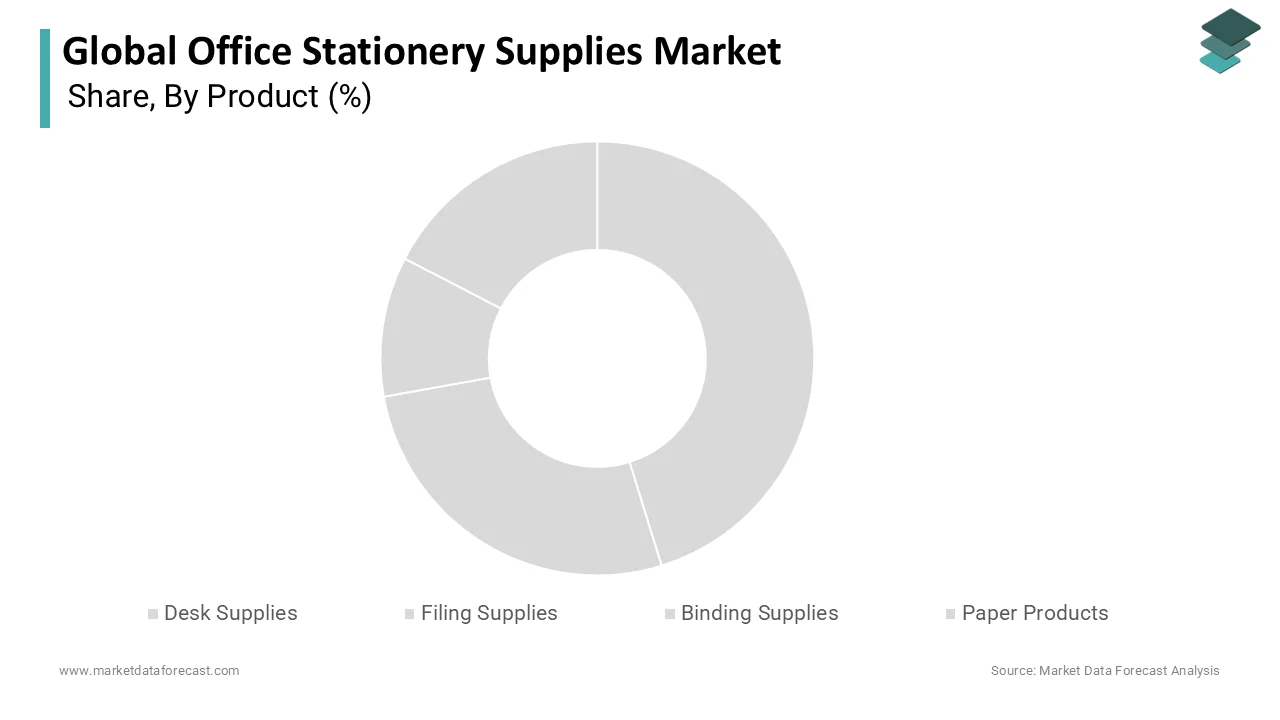
On the other hand, the desk supplies segment is estimated to showcase a prominent CAGR of 6.2% over the forecast period in the global market owing to the structural shift towards remote work, which has prompted individuals to invest in personalized and functional home office setups. According to Global Workplace Analytics, 30% of the global workforce will work at least one day a week remotely by 2025, creating a massive new consumer base for desk accessories. Remote workers seek items such as premium pens, organizers, and desk mats that enhance productivity and reflect personal style. Unlike corporate bulk buying, individual consumers prioritize aesthetics and ergonomics, leading to higher value per unit sales. The trend of showcasing home offices on social media platforms drives demand for visually appealing and unique desk supplies. Consumers are willing to pay a premium for items that improve their daily work experience and comfort. E-commerce platforms facilitate easy access to diverse and niche desk supply brands. Manufacturers introduce innovative designs, such as modular organizers and smart desk accessories, to capture this market. The emotional connection to one's workspace encourages frequent upgrades and additions. This consumer-driven demand outpaces traditional corporate procurement cycles. The segment benefits from the decentralization of work environments. Personalization becomes a key differentiator in a crowded market.
By Application Insights
The office buildings segment had the major share of the global market in 2025. The growth of the office buildings segment in the global market is driven by the high density of administrative activities and continuous operational needs within corporate environments and the relentless operational demands of corporate entities, which require a steady replenishment of stationery supplies. According to the International Labour Organization, the service sector, which includes most office-based industries, employs over 2 billion people globally, creating a vast and consistent user base. Large corporations implement centralized procurement systems that ensure regular bulk orders of paper, pens, and filing supplies to maintain workflow efficiency. The need for professional presentation in client meetings and internal reporting drives demand for high-quality stationery. Administrative staff rely on these tools for scheduling, note-taking, and document management. Corporate branding initiatives often involve customized stationery items, reinforcing company identity. The scale of office operations means that even small per-employee usage amounts aggregate to significant volumes. Contracts with major suppliers provide stability and predictable revenue streams for manufacturers. The transition to hybrid models has not eliminated the need for central office supplies but has altered distribution patterns. Businesses prioritize reliability and quality to support professional standards. This institutional dependency ensures the segment remains the largest consumer. The segment benefits from the sheer number of registered businesses globally.
On the other side, the schools segment is predicted to witness a notable CAGR of 6.5% over the forecast period in the global market owing to the increasing global student enrollment and heightened government investment in educational resources and infrastructure. According to the United Nations Educational, Scientific and Cultural Organization, primary and secondary school enrollment has reached record highs, with over 1.5 billion students worldwide requiring daily access to stationery supplies. Governments in developing regions are expanding access to education, leading to higher consumption of notebooks, pencils, and art supplies. Public funding initiatives often include provisions for free or subsidized school supplies for low-income families, boosting volume sales. The emphasis on early childhood education increases demand for specialized creative stationery, such as crayons and safety scissors. Private schools and international institutions drive demand for premium and branded supplies. Seasonal back-to-school campaigns create significant sales spikes annually. Educational curricula increasingly incorporate hands-on projects requiring diverse material inputs. The universal nature of education ensures a broad and recurring customer base. Manufacturers tailor products to meet safety and durability standards for young users. This demographic momentum supports sustained market expansion. The segment benefits from the societal priority placed on education.
COUNTRY LEVEL ANALYSIS
North America Office Stationery Supplies Market Analysis
North America holds a mature but stable share of the global office stationery supplies market, and the region is likely to expand steadily over the next few years, characterized by high per capita consumption and a strong shift towards premium and eco-friendly products. The region is a leader in adopting sustainable stationery solutions and ergonomic workspace accessories. According to the United States Census Bureau, there are over 30 million small businesses in the United States, each requiring regular stationery supplies for operations. This vast entrepreneurial base drives consistent demand despite corporate downsizing trends. The prevalence of remote work has shifted purchasing from large corporate contracts to individual consumer sales via e-commerce. Consumers in this region prioritize brand reputation and environmental certifications such as FSC-certified paper. Major retailers offer extensive private label options, competing on price and convenience. The education sector remains a significant contributor with steady enrollment numbers. Regulatory pressures for sustainable packaging influence product design and manufacturing. Innovation in smart stationery and digital integration is prominent. The market is highly competitive,e with established players dominating shelf space. Supply chain efficiency is critical for meeting just-in-time demands. North America sets trends in workplace wellness and sustainability that influence global markets. The focus on quality and convenience sustains value growth.
Europe Office Stationery Supplies Market Analysis
Europe occupies a significant share of the office stationery supplies market, et and the region is likely to maintain moderate and stable growth over the next few years, driven by stringent environmental regulations and a strong cultural emphasis on design and sustainability. The region leads in the adoption of recycled and biodegradable stationery products. According to the European Environment Agency, over 70% of paper packaging in Europe is now recycled, reflecting a strong consumer and regulatory push for circular economy practices. This mandate forces manufacturers to innovate in material sourcing and production processes. Governments provide incentives for companies adopting green procurement policies, boosting sales of eco-friendly supplies. The education system in countries like Germany and France emphasizes high-quality writing instruments and notebooks, fostering brand loyalty. Design aesthetics play a crucial role in purchasing decisions, with consumers preferring minimalist and stylish products. The decline in traditional office spaces is offset by growth in home office setups. Cross-border trade within the EU facilitates efficient distribution. Local manufacturers compete with global brands on sustainability credentials. Regulatory compliance adds cost but creates barriers to entry for non-compliant imports. The market values transparency and ethical sourcing. Europe remains a hub for innovation in sustainable stationery.
Asia Pacific Office Stationery Supplies Market Analysis
Asia Pacific represents the fastest-growing region in the office stationery supplies market, and the region is likely to witness exponential expansion over the next few years, driven by rapid urbanization, expanding education sectors, and rising disposable incomes. Countries like China, India, and Japan are key contributors to regional growth. According to the Asian Development Bank, secondary school enrollment in Southeast Asia has increased by 15% over the last decade, driving substantial demand for educational stationery. Rapid industrialization has led to a surge in new office establishments requiring initial setup supplies. The growing middle class prioritizes education and professional appearance, leading to higher spending on premium stationery. E-commerce platforms have revolutionized distribution, reaching rural areas previously underserved. Local manufacturing capabilities have expanded, reducing reliance on imports and lowering costs. Cultural factors such as the importance of gift-giving drive sales of luxury pen and notebook sets. Government initiatives to improve literacy and infrastructure support market expansion. The region offers vast potential for volume growth. Competition is intense,e with many local players offering low-cost alternatives. Innovation focuses on affordability and accessibility. Asia Pacific is becoming a global manufacturing hub for stationery.
Latin America Office Stationery Supplies Market Analysis
Latin America is likely to experience progressive recovery and steady growth over the next few years, characterized by economic volatility but resilient demand in education and public sectors. Brazil and Mexico are the largest markets in the region. According to the Inter-American Development Bank, public spending on education in Latin America averages 4.5% of GDP, supporting steady demand for school supplies despite economic fluctuations. Informal retail channels play a significant role in distribution, reaching diverse consumer segments. Price sensitivity is high, leading to strong competition from low-cost local manufacturers. The rise of small businesses in urban centers drives demand for basic office supplies. Import tariffs and currency instability affect the availability of premium imported brands. Local producers focus on essential items with high turnover rates. Sustainability awareness is growing but remains secondary to affordability. Government procurement programs provide stability for large suppliers. The market is fragmented with many small distributors. Opportunities exist in affordable eco-friendly products. Economic recovery efforts boost corporate spending. Latin America offers long-term growth potential as stability improves.
Middle East and Africa Office Stationery Supplies Market Analysis
The Middle East and Africa are likely to accelerate infrastructure development and adoption rates over the next few years due to government investments in healthcare modernization and educational expansion. Gulf Cooperation Council countries lead in premium consumption, while Africa shows potential in basic supplies. According to the African Union, initiatives to achieve universal primary education have increased school enrollment by 20% in sub-Saharan Africa, creating new demand for basic stationery. Government investments in new administrative capitals and business hubs in the Middle East drive corporate demand. The tourism and hospitality sectors contribute to hotel and office supply needs. Import dependency is high for most countries, leading to vulnerability to global price changes. Local manufacturing is limited but growing in larger economies like South Africa and Egypt. Cultural preferences for high-quality writing instruments influence premium sales. Religious and cultural events drive seasonal spikes in gift stationery. Distribution challenges in remote areas limit market reach. International aid organizations often supply stationery for schools and NGOs. The market is price-sensitive but values durability. Opportunities exist in localized production and distribution networks.
COMPETITIVE LANDSCAPE
The competition in the Office Stationery Supplies Market is characterized by a mix of established multinational corporations and numerous local manufacturers striving for market presence. Leading companies compete primarily on brand reputation, product quality,y and sustainability credentials rather than price alone due to the commoditized nature of many basic items. The market sees intense rivalry in the writing instruments and paper products segments where innovation in eco-friendly materials drives differentiation. Private label brands from major retailers pose significant competition by offering lower-priced alternatives that appeal to cost-conscious consumers. Strategic acquisitions and mergers are common as firms seek to expand their product portfolios and geographic reach. Regulatory pressures regarding environmental sustainability force all players to adapt their manufacturing processes and material sourcing. Customer loyalty is built through consistent quality and innovative design features. The shift towards remote work has intensified competition in the home office segment, with companies focusing on aesthetics and ergonomics. Digital integration offers new avenues for differentiation but requires substantial investment. This dynamic environment fosters continuous improvement in product offerings and sustainability practices, benefiting consumers globally.
KEY MARKET PLAYERS
Some of the companies that are playing a dominant role in the Global Office Stationery Supplies Market include:
- 3M
- BIC
- Hamelin
- ICO
- Lyreco
- WHSmith
- Mitsubishi
- Aurora
- Newell Brands
TOP LEADING PLAYERS IN THE MARKET
- Newell Brands Inc. is a global consumer goods company with a dominant presence in the office stationery sector through its portfolio of iconic brands such as Sharpie,e Paper Mate, te and EXPO. The company focuses on delivering innovative writing instruments and organizational solutions that cater to both professional and educational needs. Recent actions include expanding its sustainable product lines by introducing pens made from recycled materials and biodegradable components. Newell Brands actively invests in digital marketing campaigns to engage younger demographics and promote brand loyalty. The company strengthens its market position by optimizing supply chain efficiency and enhancing e-commerce capabilities. By prioritizing product quality and environmental responsibility, Newell Brands maintains its reputation as a trusted provider of essential office supplies. Its strategic focus on innovation ensures relevance in a changing workplace landscape. This commitment to sustainability and consumer engagement drives continuous growth and brand strength across global markets.
- ACCO Brands Corporation is a leading manufacturer of office products specializing in binding, filing,g, and presentation solutions under brands like Five Star GBC and Kensington. The company plays a crucial role in helping individuals and organizations organize, protect,tect and present their information effectively. Recent initiatives involve launching ergonomic desk accessories and smart storage solutions designed for hybrid work environments. ACCO Brands actively collaborates with retailers to expand distribution channels and improve product visibility. The company strengthens its market position through strategic acquisitions that broaden its product portfolio and geographic reach. By focusing on durability and design, ACCO Brands meets the evolving needs of modern professionals. Its commitment to operational excellence ensures consistent product availability and quality. This strategic approach enables the company to adapt to market trends and maintain a competitive edge in the global office supplies industry.
- BIC SA is a worldwide leader in stationery products renowned for its high-quality and affordable writing instruments, including pens, markers, nd highlighters. The company serves millions of consumers daily through its extensive distribution network and strong brand recognition. Recent actions include introducing eco-friendly product ranges such as the BIC Eco Solutions line, which uses recycled plastic and bio-basedmaterials. BIC actively promotes sustainability through partnerships with environmental organizations and recycling programs. The company strengthens its market position by innovating in product design and enhancing manufacturing efficiency. By focusing on accessibility and reliability, BIC remains a preferred choice for students and professionals alike. Its global presence and local adaptation strategies ensure broad market penetration. This dedication to affordability and sustainability secures its leadership in the competitive stationery market.
TOP STRATEGIES USED BY KEY MARKET PARTICIPANTS
Key players in the Office Stationery Supplies Market employ several strategic approaches to maintain competitiveness and drive growth. Product innovation remains a primary strategy, with companies investing heavily in developing eco-friendly materials and ergonomic designs to meet sustainability goals and consumer preferences. Strategic partnerships with retailers and e-commerce platforms facilitate broader distribution and enhanced visibility. Companies also prioritize brand differentiation through customized and premium product lines that appeal to specific demographic segments. Supply chain optimization is crucial for reducing costs and ensuring timely delivery in a volatile global environment. Digital transformation initiatives include integrating smart technologies into traditional stationery items to enhance functionality. Educational outreach and corporate social responsibility programs build brand loyalty and trust. These combined strategies enable participants to address evolving market demands and strengthen their position in the competitive landscape.
GLOBAL OFFICE STATIONERY SUPPLIES MARKET NEWS
- In January 2025, BIC declared that it had agreed to purchase all of the outstanding shares of Inkbox, a renowned direct-to-consumer provider of semi-permanent tattoos with its corporate headquarters in Toronto, Canada. A 65 million USD (57 million euros) upfront payment plus a deferred contribution based on Inkbox's future sales and profitability development is how the deal is set up.
- In October 2025, with an agreement to purchase Marshall Retail Group, UK retailer WH Smith hopes to more than triple its international travel business and boost its position in the $3 billion US airport market. The UK retailer, a mainstay of the UK high street known for its stationery and book selection, announced that it has agreed to pay $400 million to acquire the Las Vegas-based business to accelerate the growth of its travel division and avoid the worst effects of the UK slowdown in city and town centers.
MARKET SEGMENTATION
This research report on the global office stationery supplies market has been segmented and sub-segmented into the following categories.
By Product
- Desk Supplies
- Filing Supplies
- Binding Supplies
- Paper Products
- Others
By Application
- Office Buildings
- Schools
- Hospitals
By Region
- North America
- Europe
- Asia Pacific
- Latin America
- The Middle East and Africa