- Product Description Description
- Table of Contents TOC
- List of Table & Figure LOT
- Get Free Sample PDF Sample PDF
Market Size, 2025
$279.3 BnMarket Estimate, 2026
$293.7 BnMarket Forecast, 2034
$439.6 BnCAGR, 2026–2034
5.17%Global Olefins Market Report Summary
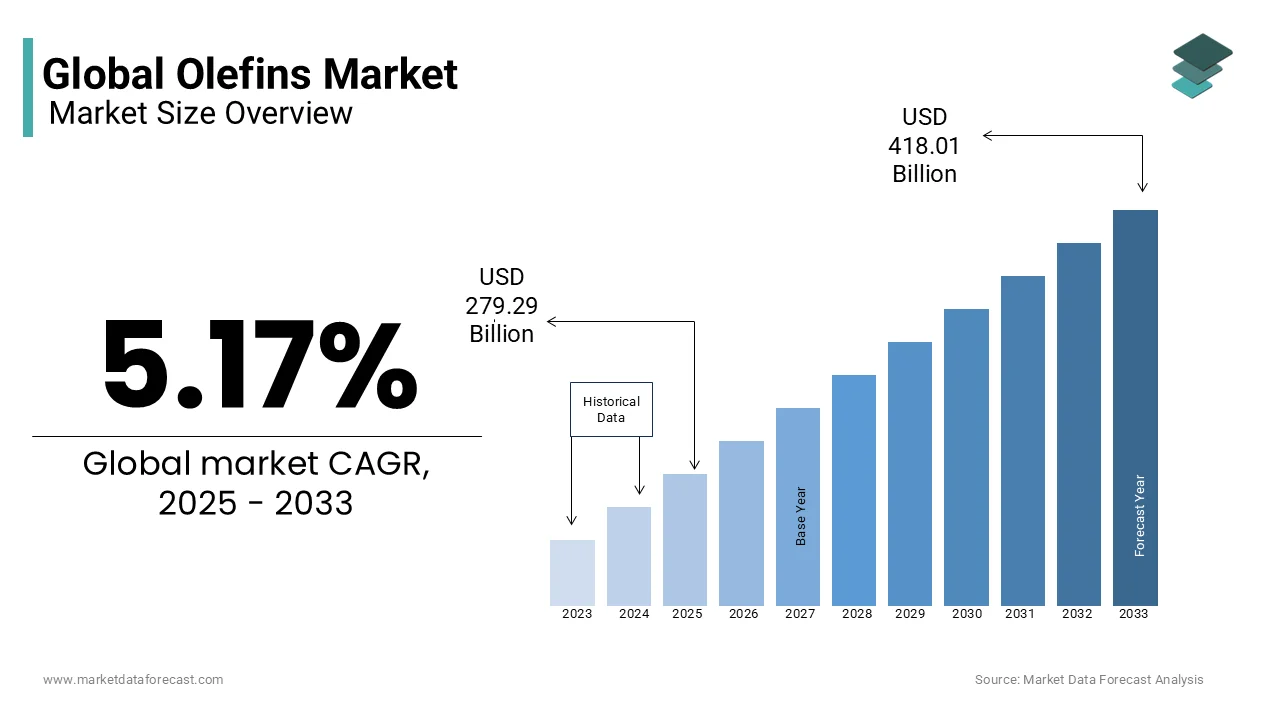
The global olefins market was valued at USD 279.31 billion in 2025, is estimated to reach USD 293.75 billion in 2026, and is projected to reach USD 439.66 billion by 2034, growing at a CAGR of 5.17% during the forecast period. Market growth is driven by increasing demand for petrochemical derivatives, expanding industrial manufacturing activities, and rising applications in plastics, coatings, and packaging. Olefins are essential building blocks in the chemical industry and are widely used in the production of polymers and synthetic materials. Rapid industrialization and infrastructure development are further supporting steady market growth globally.
Key Market Trends
- Rising demand for petrochemical derivatives is driving market growth.
- Increasing use of olefins in plastics and packaging applications is boosting demand.
- Growing industrial manufacturing and infrastructure activities are supporting market expansion.
- Expansion of downstream chemical processing industries is enhancing market development.
- Technological advancements in petrochemical production are improving efficiency.
Segmental Insights
- Based on type, the ethylene segment accounted for 61.1% of the global olefins market share in 2025. This dominance is attributed to its extensive use in polyethylene production and various petrochemical applications.
- Based on application, the paints and coatings segment held a major share of the global olefins market in 2025, driven by increasing construction and industrial coating demand.
Regional Insights
- The global olefins market is experiencing strong growth across regions, supported by industrialization and chemical manufacturing expansion.
- Asia Pacific was the largest contributor, accounting for 43.6% of the global olefins market share in 2025, driven by rapid industrial growth, expanding petrochemical infrastructure, and increasing demand from manufacturing sectors.
Competitive Landscape
The global olefins market is highly competitive, with key players focusing on production expansion, technological advancements, and strategic partnerships to strengthen their market position. Companies are investing in petrochemical integration, sustainability initiatives, and capacity enhancements. Prominent players in the global olefins market include Exxon Mobil Corporation, INEOS AG, Royal Dutch Shell, National Petrochemical Company, China Petroleum & Chemical Corporation, SABIC, DuPont, Total, NOVA Chemicals Corporate, Chevron Phillips Chemical Company LLC, LyondellBasell Industries Holdings B.V., Sasol, Evonik Industries AG, Qatar Chemical Company Ltd, Mitsubishi Electric Corporation, Idemitsu Kosan Co. Ltd., Mitsui Chemicals, Inc., Jam Petrochemical Company, TPC Group, and BASF SE.
Global Olefins Market Size
The global olefins market size was valued at USD 279.31 billion in 2025, and the market size is expected to reach USD 439.66 billion by 2034 from USD 293.75 billion in 2026. The market's promising CAGR for the predicted period is 5.17%.
Olefins (also known as alkenes) are a class of unsaturated hydrocarbons that contain at least one carbon-to-carbon double bond. These compounds are derived mainly from steam cracking of naphtha ethane or other hydrocarbon feedstocks and are essential precursors for manufacturing plastics synthetic rubbers and various chemical intermediates. As per the United States Energy Information Administration the United States alone produced approximately 35 million metric tons of ethylene in recent years highlighting the massive scale of industrial output required to meet downstream demand. The industry operates within a complex ecosystem influenced by crude oil prices natural gas availability and geopolitical stability. Regulatory frameworks regarding carbon emissions and plastic waste management are increasingly shaping operational strategies and investment decisions. The shift towards lighter feedstocks such as ethane in North America has altered global trade dynamics creating regional competitive advantages. Olefins are integral to diverse sectors including packaging automotive construction and healthcare reflecting their ubiquitous presence in modern life. The market is characterized by high capital intensity and cyclical demand patterns tied to global economic growth. Technological advancements in catalytic processes and energy efficiency are critical for maintaining profitability amidst fluctuating raw material costs. The integration of circular economy principles is prompting producers to explore bio based and recycled feedstock options. This transition aims to reduce the environmental footprint while ensuring supply security. The strategic importance of olefins underscores their role as key indicators of industrial health and chemical innovation.
MARKET DRIVERS
Expansion Of Packaging Industry and Urbanization
The rapid expansion of the packaging industry driven by global urbanization and e commerce growth helps drive the olefins market. Ethylene and propylene are the key raw materials for producing polyethylene and polypropylene which are widely used in flexible and rigid packaging solutions. As per the United Nations Department of Economic and Social Affairs approximately 68 percent of the world population is projected to live in urban areas by 2050 increasing the demand for convenient and durable packaging materials. Urban lifestyles necessitate ready to eat foods and single serve products which rely heavily on plastic packaging for preservation and hygiene. The boom in online retailing further accelerates the need for protective packaging materials such as films sacks and containers. Polyethylene films are preferred for their lightweight nature and cost effectiveness in shipping goods globally. The rise of middle class consumers in emerging economies increases purchasing power and consumption of packaged goods. This demographic shift drives sustained demand for olefin derivatives across various consumer segments. Manufacturers are responding by expanding production capacities to meet the growing requirements of the packaging sector. The versatility of olefin based plastics allows for customization in terms of strength transparency and barrier properties. This adaptability makes them indispensable for modern packaging applications. The continuous growth of urban centers ensures a steady increase in packaging consumption. This driver establishes a strong foundation for long term market expansion. The reliance on plastics for convenience and safety reinforces the critical role of olefins.
Growing Demand For Lightweight Automotive Components
The automotive industry's shift towards lightweight vehicles to improve fuel efficiency and reduce emissions significantly fuels the expansion of the olefins market. Propylene and ethylene derivatives are used to manufacture polypropylene and polyethylene components that replace heavier metal parts in vehicles. As per the International Energy Agency the global push for stricter emission standards has compelled automakers to reduce vehicle weight by up to 10 percent using advanced materials. Polypropylene is extensively used in interior trim bumpers and battery casings due to its high strength to weight ratio and resistance to chemicals. The electrification of vehicles further boosts demand for specialized plastics in battery housings and insulation materials. Olefin based polymers offer design flexibility allowing for complex shapes and integrated functions that enhance vehicle performance. The durability and recyclability of these materials align with sustainability goals in the automotive sector. Governments worldwide are implementing regulations that incentivize the use of lightweight materials to lower carbon footprints. This regulatory pressure accelerates the adoption of olefin derived components in both traditional and electric vehicles. The trend towards autonomous driving also requires sophisticated interior systems that utilize high performance plastics. Automakers are collaborating with chemical producers to develop innovative materials that meet safety and performance standards. This synergy drives continuous innovation and demand growth. The focus on efficiency and sustainability ensures that olefins remain central to automotive manufacturing. This driver supports robust market growth in the transportation sector.
MARKET RESTRAINTS
Volatility In Raw Material Prices And Supply Chain Disruptions
The volatility in raw material prices particularly crude oil and natural gas restrains the growth of the olefins market. Since olefins are primarily produced from hydrocarbon feedstocks fluctuations in energy prices directly impact production costs and profit margins. As per the Organization of the Petroleum Exporting Countries oil prices have experienced significant swings due to geopolitical tensions and supply chain disruptions affecting global stability. These price fluctuations create uncertainty for producers who struggle to maintain consistent pricing strategies for downstream customers. Supply chain bottlenecks caused by logistical challenges or political instability can lead to shortages of key feedstocks such as naphtha and ethane. The dependence on specific regions for raw materials exposes the market to regional risks and trade restrictions. Producers face difficulties in planning long term investments when input costs are unpredictable. High energy costs also increase the operational expenses of steam cracking facilities which are energy intensive. This financial pressure can lead to reduced production rates or temporary plant shutdowns. The inability to pass on increased costs to customers due to competitive market conditions further squeezes margins. Small and medium sized producers are particularly vulnerable to these economic shocks. The lack of diversified feedstock sources limits flexibility in managing cost pressures. This restraint hinders market stability and growth potential. The need for hedging strategies adds complexity to business operations.
Stringent Environmental Regulations And Plastic Waste Concerns
Stringent environmental regulations and growing concerns over plastic waste hamper the expansion of the olefins market. Governments worldwide are implementing bans on single use plastics and imposing taxes on virgin plastic production to encourage recycling and sustainability. The European Commission’s SUP Directive aims for a "significant and sustained reduction" in the consumption of specific plastic products, with key implementation milestones and collection targets set for 2025 and 2029, directly curbing demand for virgin olefin resins. These regulations force producers to invest in expensive recycling technologies and alternative materials to comply with legal requirements. Consumer awareness about environmental pollution has led to a shift away from conventional plastics towards bio based or reusable alternatives. The negative perception of plastic waste affects brand reputation and customer loyalty for companies relying on olefin based products. Compliance with carbon emission standards requires significant capital expenditure for upgrading facilities and adopting cleaner technologies. The transition to a circular economy challenges the traditional linear production model of olefins. Producers face pressure to demonstrate sustainability credentials through certified recycled content or bio based feedstocks. The high cost of developing and scaling these alternatives limits their immediate adoption. Regulatory uncertainty in different regions complicates global supply chain management. This restraint necessitates a fundamental shift in business models and product portfolios. The industry must balance profitability with environmental responsibility.
MARKET OPPORTUNITIES
Development Of Bio Based And Circular Olefins
The development of bio-based and circular olefins opens new pathways for the olefins market growth. This is driven by industries seeking sustainable alternatives to fossil fuel-derived products. Bio ethylene and bio propylene produced from renewable resources such as sugarcane or corn offer a lower carbon footprint. As per the American Chemistry Council the chemical industry is investing billions in recycling infrastructure and bio based technologies to meet sustainability goals. Circular olefins derived from chemical recycling of plastic waste provide a viable solution to reduce reliance on virgin feedstocks. Advanced pyrolysis and depolymerization technologies enable the conversion of post consumer plastic waste into high quality olefins. This approach aligns with corporate sustainability targets and regulatory requirements for recycled content. Brands are increasingly demanding certified circular materials to enhance their environmental credentials. The availability of mass balance certification schemes facilitates the integration of circular olefins into existing supply chains. Partnerships between chemical producers and waste management companies accelerate the development of recycling ecosystems. Government incentives and subsidies support the commercialization of bio based and circular technologies. The growing market for green chemicals offers premium pricing opportunities for sustainable olefins. This transition opens new revenue streams and reduces environmental impact. The focus on innovation drives competitiveness and long term viability. This opportunity positions olefin producers as leaders in the green economy.
Expansion In Emerging Markets And Infrastructure Development
The expansion in emerging markets driven by rapid infrastructure development and industrialization offers lucrative opportunities for the olefins market. Countries in Asia Pacific Latin America and Africa are experiencing robust economic growth leading to increased demand for construction materials and consumer goods. As per the World Bank infrastructure investment in developing countries is expected to reach trillions of dollars annually requiring vast amounts of plastics and chemicals. Polyethylene and polypropylene are essential for pipes cables insulation and packaging in construction projects. The rising middle class in these regions boosts consumption of automobiles appliances and packaged foods which rely on olefin derivatives. Local governments are promoting manufacturing hubs to reduce import dependence creating demand for domestic olefin production. Investments in new cracking facilities and downstream units in emerging economies enhance supply security and reduce logistics costs. The availability of low cost labor and favorable regulatory environments attracts foreign direct investment. Trade agreements facilitate the export of olefin based products to global markets. The untapped potential in rural areas provides additional growth avenues for packaging and agricultural films. This expansion diversifies market reliance on mature economies. The focus on industrialization supports sustained demand growth. This opportunity enables producers to capture new customer segments and increase market share.
MARKET CHALLENGES
High Capital Intensity And Long Lead Times For Projects
The high capital intensity and long lead times associated with olefin production projects are a serious challenge for the olefins market participants. Building a steam cracker facility requires billions of dollars in investment and several years of planning and construction. As per the Society of Chemical Industry the average cost of a world scale ethylene cracker exceeds 4 billion dollars with construction timelines ranging from three to five years. This substantial financial commitment exposes companies to market risks such as changes in demand or feedstock prices during the development phase. Delays in permitting regulatory approvals or technical issues can further extend timelines and increase costs. The cyclical nature of the olefins market means that new capacity may come online during periods of oversupply leading to reduced profitability. Securing financing for such large projects is challenging especially in uncertain economic conditions. The need for continuous maintenance and upgrades adds to operational expenditures. Companies must carefully balance capacity expansion with market demand to avoid overcapacity. The complexity of integrating new facilities with existing infrastructure requires specialized expertise. Risk mitigation strategies such as joint ventures or phased investments are often necessary. This challenge limits the agility of producers to respond to market changes. The high barrier to entry restricts competition to large established players.
Competition From Alternative Materials And Substitutes
Competition from alternative materials and substitutes presents a major challenge to the olefins market. This is because industries are seeking more sustainable and high-performance options. Materials such as glass metal paper and bio based polymers are increasingly replacing conventional plastics in various applications. As per the Ellen MacArthur Foundation the global movement towards a circular economy encourages the substitution of virgin plastics with reusable or compostable alternatives. Glass and metal are preferred for food and beverage packaging due to their recyclability and perceived safety. Paper based packaging is gaining traction in e commerce and retail sectors as a biodegradable option. Bio based polymers derived from starch or cellulose offer similar properties to olefin based plastics with lower environmental impact. The development of advanced composites and nanomaterials provides high strength alternatives for automotive and construction applications. These substitutes often benefit from favorable regulatory treatment and consumer preference. Olefin producers face pressure to innovate and improve the sustainability profile of their products to remain competitive. The cost competitiveness of substitutes varies depending on raw material prices and production scales. The shift in consumer preferences towards eco friendly materials affects demand for traditional olefins. This challenge requires continuous research and development to enhance product performance and sustainability. The industry must adapt to changing material trends to maintain market relevance.
REPORT COVERAGE
| REPORT METRIC | DETAILS |
| Market Size Available | 2025 to 2034 |
| Base Year | 2025 |
| Forecast Period | 2026 to 2034 |
| CAGR | 5.17% |
| Segments Covered | By Type, Application, and Region |
| Various Analyses Covered | Global, Regional & Country Level Analysis, Segment-Level Analysis, DROC, PESTLE Analysis, Porter’s Five Forces Analysis, Competitive Landscape, Analyst Overview on Investment Opportunities |
| Regions Covered | North America, Europe, Asia Pacific, Latin America, and Middle East & Africa |
| Market Leaders Profiled | Exxon Mobil Corporation, INEOS AG, Royal Dutch Shell, National Petrochemical Company, China Petroleum & Corporation, SABIC, DuPont, Total, NOVA Chemicals Corporate, Chevron Phillips Chemical Company LLC, and others. |
SEGMENTAL ANALYSIS
By Type Insights
The ethylene segment dominated the global olefins market and accounted for a 61.1% share in 2025. This dominance of the segment is driven by its status as the most produced organic compound and the primary building block for the petrochemical industry. It serves as the precursor for a vast array of downstream products including polyethylene ethylene oxide and ethylene dichloride. Ethylene spearheads the market mainly because it is the essential feedstock for producing polyethylene which is the most widely used plastic globally. Polyethylene accounts for more than 30 percent of total plastic production and is indispensable in packaging films containers and bottles. The relentless growth of the e commerce sector and consumer goods industry drives the need for flexible and rigid packaging solutions made from high density and low density polyethylene. Ethylene's versatility allows it to be polymerized into various grades suitable for diverse applications ranging from grocery bags to industrial liners. The cost effectiveness of ethylene production particularly from shale gas derived ethane in North America enhances its competitive advantage. This economic efficiency supports large scale production volumes that satisfy global consumption needs. The integration of ethylene into supply chains for food preservation and medical supplies further cements its critical role. The inability to substitute polyethylene in many applications due to performance and cost factors ensures sustained demand for ethylene. This structural dependence on ethylene for plastic manufacturing secures its leading position in the olefins market. Ethylene serves as the foundation for a wide range of chemical intermediates that are vital for multiple industrial sectors. Derivatives such as ethylene oxide ethylene glycol and vinyl acetate are produced from ethylene and are used in antifreeze polyester fibers adhesives and solvents. Ethylene glycol is a key component in the production of polyethylene terephthalate PET which is extensively used in beverage bottles and textile fibers. The automotive and construction industries rely heavily on these derivatives for manufacturing components and materials. The diverse application spectrum of ethylene derivatives reduces dependency on any single end use market providing stability to demand. Technological advancements in catalytic processes have improved the yield and efficiency of ethylene conversion into high value chemicals. The global expansion of textile and automotive industries in emerging markets further boosts the consumption of ethylene based intermediates. The strategic importance of ethylene in producing essential chemicals makes it irreplaceable in the industrial ecosystem. This broad utility across sectors ensures that ethylene remains the cornerstone of the olefins market. The continuous innovation in derivative applications expands its market reach.

The propylene segment is predicted to witness the highest CAGR of 5.6% from 2026 to 2034 owing to increasing demand for polypropylene and propylene oxide. It is growing rapidly due to the surging demand for polypropylene which is favored for its lightweight durability and resistance to heat and chemicals. The automotive industry extensively uses polypropylene for interior parts bumpers and battery casings to reduce vehicle weight and improve fuel efficiency. The healthcare sector relies on polypropylene for syringes vials and protective equipment due to its sterilizability and safety. The global focus on hygiene and sanitation following recent health crises has accelerated the consumption of disposable medical products made from polypropylene. The material's recyclability aligns with sustainability goals encouraging its use in durable goods. Automakers are increasingly replacing metal parts with polypropylene composites to meet stringent emission standards. The versatility of polypropylene allows for customization in terms of strength and flexibility meeting diverse engineering requirements. The expansion of healthcare infrastructure in developing nations further drives demand for medical grade polypropylene. This multi sector appeal ensures robust growth for propylene. The shift towards lightweight and sustainable materials supports long term market expansion. Besides these, the expansion of propylene oxide and acrylonitrile applications is a key driver of growth for the propylene segment. Propylene oxide is a crucial intermediate for producing polyols used in polyurethane foams for insulation and furniture. Acrylonitrile derived from propylene is essential for manufacturing acrylic fibers plastics and rubber used in textiles and automotive parts. The construction industry's focus on thermal insulation drives the consumption of polyurethane foams made from propylene oxide. The textile industry's shift towards synthetic fibers boosts demand for acrylonitrile. Propylene's role in producing these high value chemicals diversifies its application base beyond polypropylene. Innovations in catalyst technology have improved the efficiency of propylene conversion into these derivatives. The growing middle class in emerging economies increases demand for consumer goods containing these materials. The integration of propylene derivatives into green building practices supports sustainable growth. This chemical versatility ensures that propylene remains a high growth segment. The focus on energy efficiency and comfort drives continued adoption.
By Application Insights
The paints and coatings segment held the majority share of the olefins market in 2025. This is because olefin derivatives are key ingredients in resins, binders, and solvents used in protective and decorative coatings. Extensive global use of olefin-based resins in construction and infrastructure makes the paints and coatings segment the dominant market leader. Acrylics and vinyl acetates derived from ethylene and propylene are essential for producing durable and weather resistant paints. Olefin based coatings protect structures from corrosion moisture and UV radiation extending their lifespan. The rapid urbanization in Asia Pacific and Latin America fuels the construction of residential and commercial buildings requiring high quality paints. Infrastructure development initiatives such as bridges roads and airports rely on specialized coatings for maintenance and protection. The aesthetic appeal of decorative paints also drives consumer demand in the housing market. Olefin derivatives offer superior adhesion and flexibility making them ideal for various substrates. The regulatory push for low volatile organic compound coatings favors advanced olefin based formulations. The renovation and maintenance of existing infrastructure further sustain demand. This broad application in construction ensures the leading position of this segment. The focus on durability and aesthetics supports consistent growth. Industrial maintenance and protective coatings represent a major driver for the paints and coatings segment in the olefins market. Industries such as oil and gas marine and manufacturing require robust coatings to protect equipment and structures from harsh environments. Olefin based epoxies and polyurethanes provide excellent resistance to chemicals abrasion and extreme temperatures. The expansion of offshore drilling and shipping activities increases the demand for marine coatings. Manufacturing facilities rely on these coatings to maintain operational efficiency and safety. The longevity of olefin based coatings reduces maintenance frequency and costs for industrial operators. Regulatory standards for safety and environmental protection drive the adoption of high performance coatings. The growth of renewable energy infrastructure such as wind turbines also requires specialized protective coatings. This industrial demand ensures a stable and high volume market for olefin derivatives. The focus on asset protection and operational reliability sustains growth. The technical superiority of olefin based coatings supports their dominance.
The surfactants segment is estimated to register the fastest CAGR of 7.1% over the forecast period due to the increasing demand for cleaning agents personal care products and industrial applications. Growing demand for hygiene-focused products and rising personal care consumption are driving rapid growth in the surfactants segment. Olefin derived surfactants such as linear alkylbenzene sulfonates are key ingredients in detergents shampoos and body washes. The personal care industry is expanding in emerging markets where rising disposable incomes enable consumers to purchase premium hygiene products. Olefin based surfactants offer effective cleaning foaming and emulsifying properties that are essential for these formulations. The trend towards natural and mild surfactants drives innovation in olefin derivatives. The proliferation of e commerce facilitates the distribution of personal care products to remote areas. The focus on health and wellness sustains the demand for hygiene products. This consumer behavior shift ensures robust growth for the surfactants segment. The versatility of olefin surfactants supports diverse product formulations. The emphasis on cleanliness drives long term market expansion. Industrial cleaning and agricultural formulations are key drivers of growth for the surfactants segment. Olefin based surfactants are used in industrial cleaners degreasers and agrochemical formulations to enhance efficacy. Industrial facilities rely on powerful cleaning agents to maintain hygiene and operational efficiency. Olefin surfactants provide superior wetting and dispersing properties that are critical for these applications. The expansion of the food and beverage industry increases the demand for industrial sanitizers. The agricultural sector's focus on crop yield optimization drives the adoption of advanced agrochemical formulations. The regulatory push for biodegradable surfactants favors olefin based options that meet environmental standards. The growth of automated cleaning systems in industries requires specialized surfactant formulations. This industrial and agricultural demand ensures sustained growth for the segment. The focus on efficiency and sustainability supports market expansion. The technical advantages of olefin surfactants drive adoption.
REGIONAL ANALYSIS
Asia Pacific Olefins Market Analysis
Asia Pacific led the global olefins market and accounted for a 43.6% share in 2025. This expansion of the APAC market is propelled by rapid industrialization and massive consumption of plastics and chemicals. China India and South Korea are key contributors. Asia Pacific maintains its leading position due to its status as the global manufacturing hub and rapid industrialization. China is the world's largest producer and consumer of olefins driven by its vast petrochemical industry. The region's expanding middle class drives consumption of packaged goods automobiles and electronics which rely on olefin derivatives. Government initiatives in India and Southeast Asia to boost manufacturing capabilities further increase demand. The availability of skilled labor and infrastructure supports large scale production facilities. The integration of regional supply chains enhances efficiency and competitiveness. The focus on self sufficiency in chemical production reduces reliance on imports. This industrial momentum ensures that Asia Pacific remains the dominant market. The continuous investment in new cracking capacities supports growth. The region's economic vitality drives sustained demand for olefins.
North America Olefins Market Analysis
North America was the next prominent region in the global olefins market and captured a 22.1% share in 2025. This position is driven by abundant shale gas resources and advanced production technologies. The United States is the primary contributor. It maintains a strong market position due to the shale gas revolution which provides low cost ethane feedstock for olefin production. The competitive edge attracts significant investment in new cracking facilities and downstream units. The region's advanced technological capabilities enhance production efficiency and environmental compliance. The demand for lightweight automotive materials and packaging supports domestic consumption. Trade agreements facilitate the export of olefin products to global markets. The focus on sustainability drives innovation in recycling and bio based olefins. This resource advantage ensures North America's competitiveness. The strategic location supports efficient logistics. The region's leadership in technology drives innovation.
Europe Olefins Market Analysis
Europe holds a significant share of the global olefins market due to strict environmental regulations and a focus on sustainability. Germany France and Italy are key players. It maintains its market status through a strong focus on sustainability and circular economy principles. The region leads in developing chemical recycling technologies to convert plastic waste back into olefins. Strict regulations on single use plastics influence production strategies and product portfolios. The mature market focuses on high value specialty chemicals and performance materials. The emphasis on carbon neutrality drives investment in green hydrogen and electrification of crackers. This regulatory framework shapes the market dynamics. The focus on innovation supports long term viability. The region's commitment to sustainability sets global standards.
Middle East and Africa Olefins Market Analysis
The Middle East and Africa region holds a notable share of the global olefins market owing to abundant oil and gas reserves. Saudi Arabia and the United Arab Emirates are key producers. The Middle East maintains its position due to abundant hydrocarbon resources which provide low cost feedstock for olefin production. Large scale cracking facilities produce olefins for export to global markets particularly Asia. The strategic location facilitates efficient shipping routes. Government initiatives to diversify economies support the growth of the petrochemical sector. The focus on cost efficiency ensures competitiveness in global trade. The region's role as a key supplier supports global supply security. The investment in infrastructure enhances production capacity. The focus on integration drives economic growth.
Latin America Olefins Market Analysis
Latin America is predicted to expand notably in the global olefins market from 2026 to 2034 due to increasing domestic demand for plastics and chemicals driven by economic development. Brazil and Mexico are key contributors. Brazil and Mexico have established production capacities that serve local markets and reduce import dependence. The growing automotive and packaging sectors drive demand for olefin derivatives. Challenges related to infrastructure and investment persist but opportunities for growth remain. The focus on regional integration enhances market stability. The potential for shale gas development in Argentina offers future prospects. The region's emerging status presents opportunities for expansion. The focus on local value addition supports growth.
COMPETITIVE LANDSCAPE
The competitive landscape of the olefins market is characterized by intense rivalry among large integrated chemical companies and regional producers. Major players compete on cost efficiency scale and sustainability credentials to capture market share. The availability of low cost feedstocks such as shale gas in North America and naphtha in Asia creates regional competitive advantages. European producers face higher energy costs and strict environmental regulations driving them to innovate in green technologies. Competition is also influenced by global trade dynamics and tariff policies. Companies invest heavily in research and development to create differentiated products and improve process efficiency. Consolidation activities allow larger firms to achieve economies of scale and optimize asset portfolios. The shift towards circular economy models introduces new competitors in the recycling sector. Customer relationships and supply chain reliability are key differentiators. Market dynamics require continuous adaptation to fluctuating raw material prices and demand patterns. Innovation in sustainable production methods is becoming a critical competitive factor. This environment fosters strategic alliances and technological advancements. Maintaining relevance requires a balance of cost leadership and sustainability.
KEY MARKET PLAYERS
Some of the notable companies the global olefins market are
- Exxon Mobil Corporation
- INEOS AG
- Royal Dutch Shell
- National Petrochemical Company
- China Petroleum & Chemical Corporation
- SABIC
- DuPont
- Total
- NOVA Chemicals Corporate
- Chevron Phillips Chemical Company LLC
- LyondellBasell Industries Holdings B.V.
- Sasol
- Evonik Industries AG
- Qatar Chemical Company Ltd
- Mitsubishi Electric Corporation
- Idemitsu Kosan Co. Ltd.
- Mitsui Chemicals, Inc.
- Jam Petrochemical Company
- TPC Group
- BASF SE
Top Players in the Market
- BASF SE is a leading chemical producer in Europe with a significant presence in the olefins market through its integrated Verbund sites. The company produces ethylene and propylene as key building blocks for its downstream portfolio. Recent actions include investing in electric steam crackers to reduce carbon emissions and enhance sustainability. BASF collaborates with technology providers to develop energy efficient production methods. The company focuses on circular economy initiatives by incorporating recycled feedstocks into its olefin production. These efforts strengthen its position as a sustainable supplier in the European market. BASF leverages its extensive distribution network to serve diverse industries. The commitment to innovation and environmental responsibility drives long term growth. This strategic approach ensures competitiveness in a regulated environment. The integration of digital solutions optimizes operational efficiency.
- Dow Inc is a major participant in the Europe olefins market known for its advanced manufacturing capabilities and product innovation. The company produces high quality ethylene and propylene derivatives for various applications. Recent strategies involve expanding its portfolio of circular and renewable olefins to meet sustainability goals. Dow has invested in recycling technologies to convert plastic waste into raw materials for olefin production. The company partners with value chain stakeholders to create closed loop systems. These actions enhance its reputation as a leader in sustainable chemistry. Dow focuses on customer collaboration to develop tailored solutions. The emphasis on low carbon products aligns with regulatory requirements. This approach supports market expansion and brand loyalty. The company continues to optimize its asset base for efficiency.
- INEOS AG is a key player in the Europe olefins market with a strong focus on operational excellence and cost leadership. The company operates several cracking facilities across the continent producing essential olefins. Recent actions include acquiring assets to strengthen its supply chain and market presence. INEOS invests in maintenance and upgrades to ensure reliable production and safety. The company explores opportunities in shale gas sourcing to improve competitiveness. These efforts support its position as a reliable supplier in the region. INEOS focuses on flexibility in feedstock usage to adapt to market conditions. The commitment to efficiency drives profitability and growth. The company engages in strategic partnerships to enhance logistics. This operational focus ensures resilience in a volatile market.
Top Strategies Used by Key Market Participants
Key players in the olefins market employ diverse strategies to maintain competitiveness and drive growth. Sustainability initiatives focus on developing circular and bio based olefins to meet environmental regulations. Investment in electric cracking technologies reduces carbon footprints and energy costs. Strategic partnerships with recycling firms secure alternative feedstock sources. Operational excellence programs optimize production efficiency and reduce downtime. Expansion into high value derivatives diversifies revenue streams and reduces commodity exposure. Digital transformation enhances supply chain visibility and predictive maintenance. Companies prioritize customer collaboration to develop customized solutions. These combined approaches help operators navigate market volatility while ensuring long term profitability in a capital intensive industry landscape.
MARKET SEGMENTATION
This research report on the global olefins market has been segmented and sub-segmented based on type, application, and region.
By Type
- Butadiene
- Ethylene
- Propylene
- Others
By Application
- Lubricant Additives
- Surfactants
- Agricultural Chemicals
- Paints and Coatings
- Corrosion Inhibitors
- Other Applications
By Region
- North America
- Europe
- Asia Pacific
- Latin America
- Middle East & Africa