- Product Description Description
- Table of Contents TOC
- List of Table & Figure LOT
- Get Free Sample PDF Sample PDF
Market Size, 2025
$282.3 MnMarket Estimate, 2026
$304.4 MnMarket Forecast, 2034
$555.1 MnCAGR, 2026–2034
7.8%Executive Summary: Global Organ Preservation Market Analysis & Growth Forecast (2026-2034)
- Market Scope: Comprehensive global industry analysis covering preservation solutions, transportation techniques, specific organ types, regional adoption frameworks, and primary global demand drivers.
- Market Valuation: Valued at USD 282.38 million in 2025, estimated at USD 304.41 million in 2026, and projected to reach USD 555.14 million by 2034, registering a robust CAGR of 7.8% from 2026 to 2034.
- Primary Growth Drivers: Rising volume of global organ transplantation surgeries, increasing incidence of multi-organ dysfunction syndrome and chronic failures, aging populations, and technological innovations in long-distance transport and preservation solutions.
Key Global Organ Preservation Market Segment Metrics (2026-2034)
| Category | Leading Segment (2025 Position) | Fastest-Growing Segment |
|---|---|---|
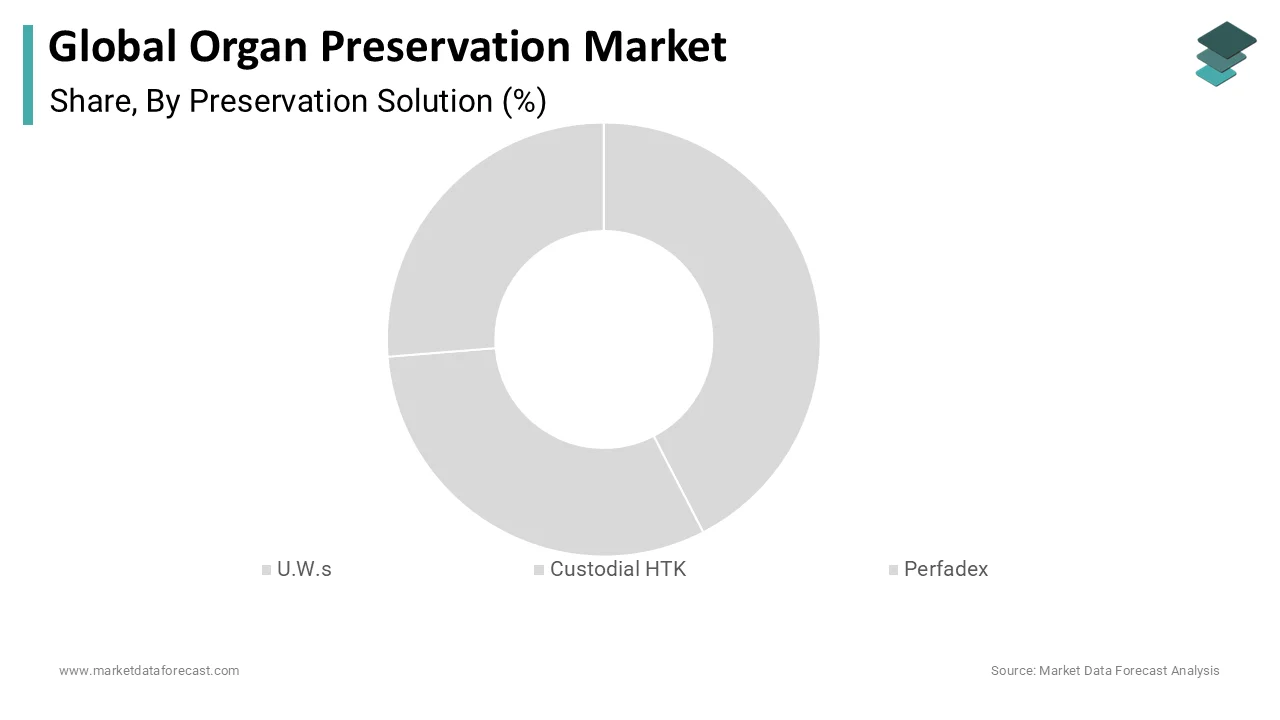
| By Preservation Solution | University of Wisconsin (U.W.) Solution (held significant share due to rising organ transplantation prevalence) | Custodial HTK & Perfadex (growing rapidly through expanding multi-organ clinical applications) |
| By Transportation Technique | Static Cold Storage (accounts for a large share due to widespread clinical familiarity and Ice preservation) | Hypothermic Machine Perfusion (experiencing fast growth through advanced waste-removal capabilities) |
| By Organ Type | Kidney (holds largest share driven by high prevalence of renal failure and exchange programs) | Liver (driving demand via physiological 37°C maintenance solutions reducing post-transplant tissue injury) |
| By Region | North America (predicts significant share due to high healthcare expenditure and advanced transplant infrastructure) | Asia-Pacific (fastest-growing regional market driven by severe renal/liver failure burdens in India and China) |
Major Global Organ Preservation Market Players & Industry Structure
Market Structure: Highly specialized global medical technology landscape characterized by strict regulatory approvals, strategic FDA clearances for transport systems, and a focus on expanding organ viability windows.
Key Companies: Essential Pharmaceuticals (U.S.), Dr. Franz Kohler Chemie GmbH (Germany), Organ Recovery Systems (U.S.), Xvivo Perfusion AB (Sweden), and Waters Medical Systems LLC (U.S.).
Global Organ Preservation Market Size
The global organ preservation market was valued at USD 282.38 million in 2025 and is expected to be worth USD 304.41 million in 2026 and reach USD 555.14 million by 2034, registering a CAGR of 7.8% during the forecast period from 2026 to 2034.
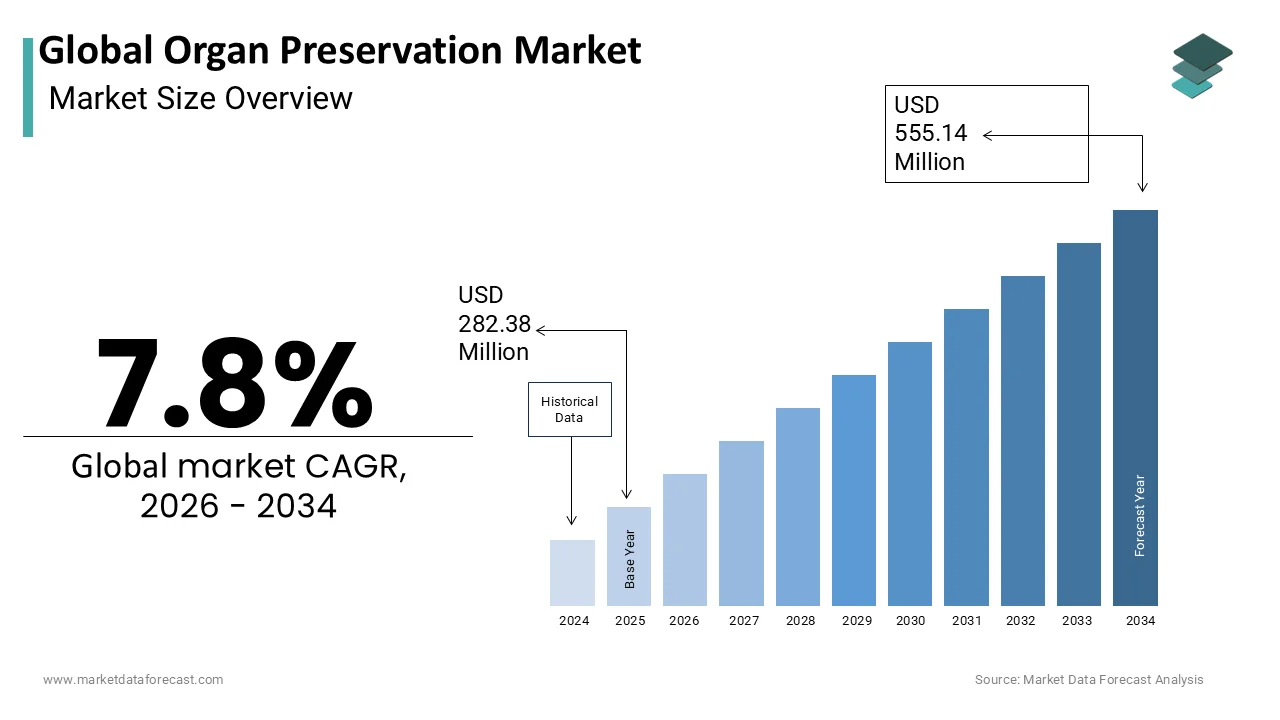
Organ preservation is the supply line for organ transplantation. Organ preservation helps keep up organs' quality before transplantation as these organs are frail in the outside air and broken once taken from the human body. Organ preservation assumes a vital part in endeavors to beat the lack of organ benefactors while tending to change the socioeconomics of the giver pool by making organs feasible for transplantation that were beforehand not used.
MARKET DRIVERS
Y-O-Y growth in the number of transplantation surgeries worldwide is majorly promoting the global organ preservation market growth.
Organ preservation solutions are beneficial to keep the organs safe before transplantation surgery in hospitals. The organs such as the heart, kidney, liver, lungs, and others collected from the donor are preserved in specific organ transplantation surgeries. Focus on improving the quality of services and promoting the success rate of transplantation surgery is enhancing the growth rate of the global organ preservation market. In addition, governments' growing number of initiatives in promoting these solutions is expected to favor the global organ preservation market growth.
The emergence of the latest technology in the medical sector and innovative techniques presents growth opportunities for the global organ preservation market.
Furthermore, creating awareness of different treatment procedures through campaigns and digital advertisements will also help the market players grow tremendously. In addition, the launch of reimbursement schemes by the government in concern towards ordinary people is significantly influencing the demand of the organ preservation market. Furthermore, the prevalence of saving organs and reducing the risk during organ transplantation is likely to outshine the growth rate of the global organ preservation market.
FDA has approved organ preservation devices for conducting animal studies with the rapid advancements in such technologies. This is due to a shortage of organs. Most researchers are finding devices for the long time preservation of an organ to transport over a long distance. These researchers are working primarily on animal organs and testing the organ life by using many solutions not to destroy the organ. Nowadays, some heart transplant operations are successful but focusing more on the preservation technique drives the market forward.
The increasing incidence of multi-organ dysfunction syndrome and the increase in the older population drive the market forward.
Multiple organ dysfunction syndromes are common among ICU patients and lead to death. Most lung disease and kidney disease people are prone to sudden organ failure while taking treatment. These people require organ transplantation for their survival. These people search for vital organs in organ preservation centers based on some rules. Older people were also prone to several diseases related to organ infection. Increasing these types of people also drives the organ preservation market for the donation of the organ or transplantation of the organ.
MARKET RESTRAINTS
Lack of awareness in managing the techniques due to fewer training programs is slowly hampering the growth rate of the global organ preservation market.
Stringent rules and regulations by the government are one reason for the declining market's growth rate. These treatment solutions need a high cost that ordinary people cannot afford is a challenging attribute for the market participants. Rapid changes in economic strategies may also negatively impact the growth rate of the organ preservation market. The shortage of skilled people, especially in undeveloped countries, impedes the market's demand.
REPORT COVERAGE
| REPORT METRIC | DETAILS |
| Market Size Available | 2025 to 2035 |
| Base Year | 2025 |
| Forecast Period | 2026 to 2034 |
| Segments Covered | By Preservation Solution, Transportation Technique, Organ Type, and Region |
| Various Analyses Covered | Global, Regional & Country Level Analysis, Segment-Level Analysis; DROC, PESTLE Analysis; Porter’s Five Forces Analysis, Competitive Landscape, Analyst Overview of Investment Opportunities |
| Regions Covered | North America, Europe, Asia Pacific, Latin America, Middle East & Africa |
| Market Leaders Profiled | Essential Pharmaceuticals (U.S.), Dr. Franz Kohler Chemie GmbH (Germany), Organ Recovery Systems (U.S.), Xvivo Perfusion AB (Sweden), and Waters Medical Systems LLC (U.S.). |
SEGMENTAL ANALYSIS
By Preservation Solution Insights
Based on the preservation solution, the U.W., i.e., the University of Wisconsin, is likely to hold the most significant share value due to the rising prevalence of organ transplantation. In addition, constant economic growth in developed and developing countries boosts the market's demand.
By Transportation Technique Insights
Based on the transportation technique, Static Cold Storage accounts for a significantly large market share due to increasing awareness of the availability of different methods. Static cold storage is one of the forms of organ preservation. Organs are stored in a solution on ice until transplanted. In static cold storage, preservation solutions help preserve the organ without damage and prevent it from swelling the cells. The most used solution for cold storage is histidine-tryptophan-ketoglutarate (HTK) solutions, according to the University of Wisconsin (U.W.).
The Hypothermic Perfusion segment will experience fast growth in the upcoming years. This is another preservation technique that is used next to static cold storage. Hypothermic machine perfusion (HMP) is another technique for preserving the organ by removing waste products. This technique is used for kidney and liver transplantation.
By Organ Type Insights
Based on the Organ Type, the kidney segment holds the largest share due to the growing number of kidney failure incidences. Adopting advanced technology in the medical sector is fueling the market's demand. The results of kidney donor transplants have been increasing in recent years. Over the past few years, there has been an increase in kidney donation and exchange programs. Nowadays, kidney donations are taken from non-heart-beating donors (NHBD). These organs need preservation kits or devices to transfer from one place to another, which drives the market forward.
The liver segment also drives the market forward due to the increased number of patients who need to transplant their liver due to their health conditions. The donor's liver is kept in a physiological state at 37°C. This preservation reduces tissue injury when the liver is transplanted and improves the organ quality to improve liver transplantation outcomes ultimately. In addition, transplanted livers that are under preservation show better functionality.
REGIONAL ANALYSIS
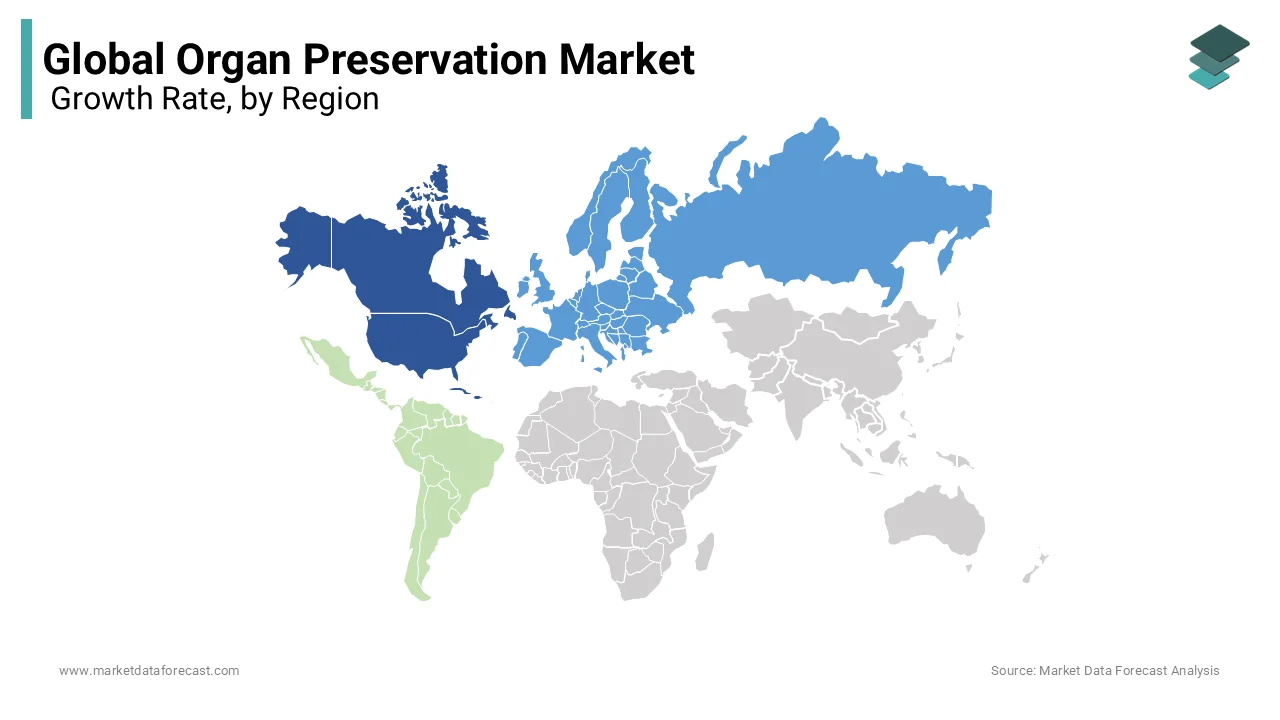
Geographically, the North American organ preservation market is predicted to have a significant share of the global organ preservation market during the forecast period due to the increasing expenditure on healthcare and the rise in the demand to improve healthcare services. In addition, organ preservation has become essential in America due to the increase in transplantation. These preservations help to improve and increase the life of the organ without affecting its function until it has got used. A new organ preservation solution has been started in the U.S., offering widespread organ use and cost-effective procedures. These new preservation solutions are used to increase the period the organ remains viable from the starting point of the time that it is removed from the donor to the time it is transplanted into a recipient. Each organ has a different survival period after the donor body's removal. Some of them are preserved safely for four to six hours, while livers can be preserved for about 12 to 18 hours. Kidneys have a total life of about 24 hours after removing from the donor. Organ donation has been increasing in Canada in recent years. However, many people die yearly due to insufficient organs and waiting for organ transplants.
The European market is the second-largest region in holding the highest market shares due to the increase in support from the government, which has come forward to encourage organ donation. Euro transplant foundation is used for the identification of a suitable recipient. It also helps the area to be created for organ preservation before it is transmitted to the recipient. In Germany, nearly 9,000 people are waiting for a donor organ to save many people's lives using these preservation places. The demand for these organ transplants is more than the supply and distribution. The United Network for Organ Sharing (UNOS) is an organization that gives information about the instruction and guidelines for matching donors with transplant recipients. This organ preservation includes blood type, weight, time the organ will exist, and donor details. Spain has a highly significant organ donation from elderly donors, which has favorable results in organ preservation in this region. In Spain, more than half of donors are over 60 years. Therefore, Spanish organ donations have the highest share in Europe.
Asia-Pacific is likely to take place as the fastest growth in the market. LATAM and MEA, both regions, are to show a definite increase in demand. In India, nearly 1.9 lakh persons suffer from renal failure yearly; these people undergo renal transplants. In India, approximately forty percent of patients die annually of liver failure or liver cancer. All these factors drive the organ preservation market in this region. Organ preservation in China has started for the last ten years. In China, government and international health agencies are facing problems in securing organs for transplantation in China. In China, nearly 7000 transplants are conducted each year which require preservation places for these organs, which drives the market forward.
KEY MARKET PLAYERS
Some of the noteworthy companies dominating the global organ preservation market profiled in this report are
Essential Pharmaceuticals (U.S.)
Franz Kohler Chemie GmbH (Germany)
Organ Recovery Systems (U.S.)
Xvivo Perfusion AB (Sweden)
Waters Medical Systems LLC (U.S.)
RECENT HAPPENINGS IN THE MARKET
-
On February 06, 2020, the first series of pediatric donor hearts were preserved and transported using the Paragonix SherpaPak Cardiac Trasport system at the University of Florida and Le Bonheur Children's hospital.
-
On February 10, 2020, Paragonix Technologies, Inc. announced the clearance by FDA for its Donor Lung Preservation System- LUNGguard.
- On January 13, 2020, Paragonix Technologies Inc. published that it had got approval from the US FDA for the Pancreas Transport System, which is commercially available to Pancreas transplant centers and Organ preservatory organizations.
- In 2021, the French medical technology Industry established a manufacturing facility for organ preservation solutions in Tamil Nadu. This facility will provide improved quality and advanced technology for organ preservation.
- In 2022, TransMedics Group, Inc. received U.S. Food and Drug Administration clearance (PMA) for a Heart System for use with organs from donors.
MARKET SEGMENTATION
This research report on the global organ preservation market has been segmented and sub-segmented based on preservation solutions, transportation technique, organ type, and region.
By Preservation Solution
- U.W.s
- Custodial HTK
- Perfadex
By Transportation Technique
- Static Cold Storage
- Hypothermic Machine Perfusion
- Normothermic Machine Perfusion
By Organ Type
- Kidney
- Liver
- Lung
By Region
- North America
- Europe
- Asia-Pacific
- Latin America
- The Middle East and Africa