- Product Description Description
- Table of Contents TOC
- List of Table & Figure LOT
- Get Free Sample PDF Sample PDF
Market Size, 2025
$716 MnMarket Estimate, 2026
$789 MnMarket Forecast, 2034
$1,708 MnCAGR, 2026–2034
10.13%Global Organic Pasta Market Size
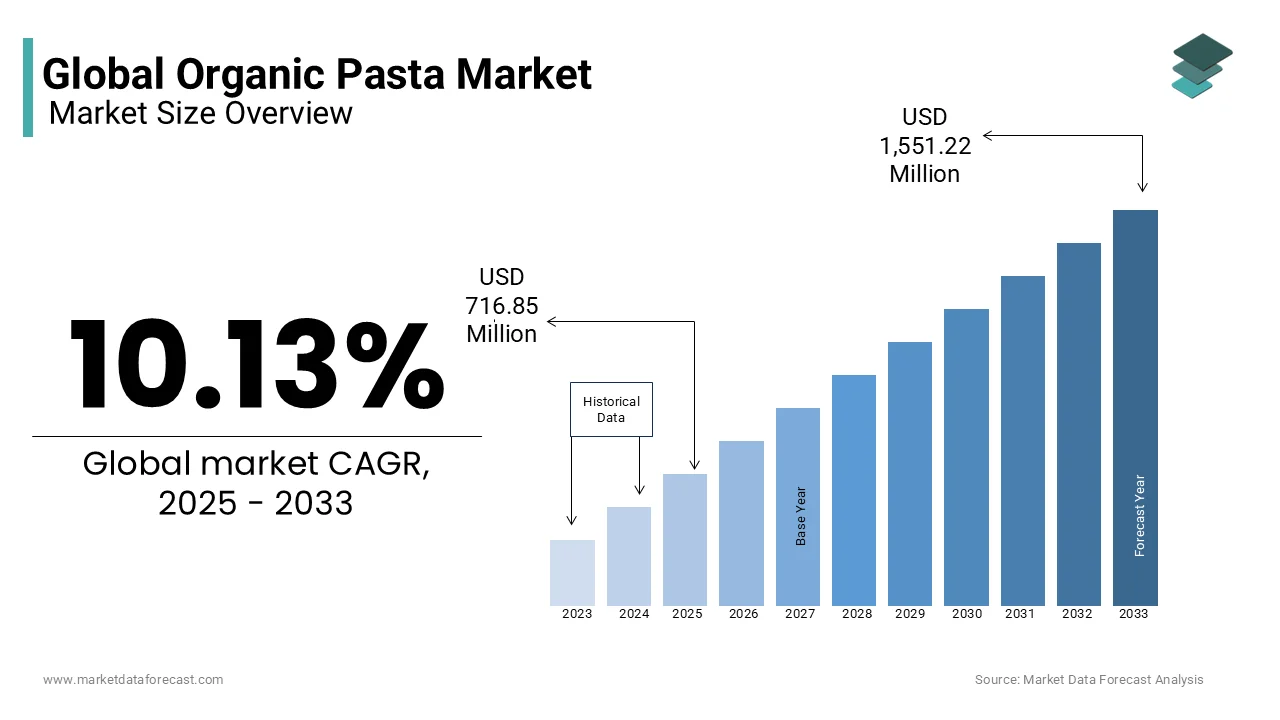
The global organic pasta market size was valued at USD 716.85 million in 2025, and the global market size is expected to reach USD 1,708.37 million by 2034 from USD 789.47 million in 2026. The market's promising CAGR for the predicted period is 10.13%.
One of the most consumed Italian foods in the world, pasta, now enters the organic food market with the rising consumer demand. Organic pasta is created from naturally developed wheat and grains, and substance pesticides and fertilizers are not utilized in planting and development. Wellbeing cognizant guardians screen their kids' dietary patterns. Guardians are hopeful about bringing up youngsters to eat nourishments plentiful in supplements and nutrients for a better physiological and subjective turn of events. The ingredients used in pasta production have become an important factor in consumer choice, which is boosting the demand in the global organic pasta market.
MARKET DRIVERS
Organic trends are one of the most popular trends in the food and beverage industry and are increasingly being embraced by large consumer bases worldwide. Organic foods are considered as fresh, low in pesticides, better for the environment, and add nutritional value to foods. Pasta has gradually become one of the favorite foods of consumers in Europe and North America. Also, the organic movement is attracting attention in these two regions, which will influence the organic pasta market to prosper internationally. Makers are focusing on innovation strategies to further influence consumers. Manufacturers are adopting intensive nutritional strategies, such as adding multifunctional and nutritious ingredients to organic pasta. Therefore, the combination of nutritionally healthy and organic ingredients is a pioneer in innovative innovations, which will create many opportunities for participants in the global organic pasta market. For example, organic pasta makers have used ingredients like whole wheat pasta, olive oil, celery, grass-fed organic dairy cheese, and other healthy and innovative ingredients to meet the needs of consumers.
Increased consumer awareness negatively affects foods that contain chemicals. Today, consumers do not prefer chemicals that are harmful to food. Also, the addition of preservatives and additives during food processing has also affected consumers regarding the chemical properties of food. Therefore, organic foods are giving consumers optimism with their non-chemical properties. Organic pasta is an important part of consuming organic food. This is because pasta is considered a staple food for many consumer bases. There is an increasing need to present a positive image for dry pasta products. This is because it is less popular in light of other alternatives and alternatives, such as fresh pasta, rice pasta, instant soups, cereals, and grains. Consumers have a general perception that pasta is fat, difficult to digest, and complicated to cook, so market participants should design a communication strategy that highlights the health benefits of organic pasta. Therefore, manufacturers are increasing the demand for organic pasta by introducing gluten-free and grain-free ingredients into ready-to-use products.
Millennium generations are well aware of the health benefits of organic pasta. The increasing spending on nutritional foods of the Millennium Generation has a positive impact on the organic pasta market. The organic benefits are flattering to the millennial generation and feel free to pay high prices for organic pasta. In created districts, including North America and Europe, pasta is viewed as customary nourishment for utilization. The region's vibrant millennial generation follows the trend of exploring and trying new foods. In particular, the growing awareness of the health benefits associated with organic pasta among the demographics of the Millennium will play an important role in the future growth of the market. In addition, other post-Millennium trends, such as Non-GMO, Clean Label, and Vegan, are likely to support the consumption of organic pasta. Product marketing plays an important role in raising consumer awareness of the various products available on the market.
It is very important to recognize consumer needs and plan various products to meet them. Therefore, organic pasta manufacturers are changing their product brands and improving their marketing strategies. Additionally, a unique brand image was created for these organic pasta products, allowing consumers to get to know the brand, not the company. The innovation strategy adopted by food and beverage manufacturers will provide a favorable opportunity for stakeholders in the organic pasta market. Additionally, these stakeholders are focusing on developing new products to attract more customers, which is expected to spur growth in the organic pasta market as consumers try different variations. Furthermore, the main objective of the manufacturer is to establish a well-developed R&D facility to develop innovative products with better ingredients. Prices continue to be a major impediment to the growth of the organic pasta market in emerging countries. Higher-priced organic pasta enjoys good sales in North America and Europe. In emerging countries like Mexico, India, Turkey, and China, the demand for organic pasta is relatively low due to low disposable incomes and consumer awareness.
REPORT COVERAGE
| REPORT METRIC | DETAILS |
| Market Size Available | 2025 to 2034 |
| Base Year | 2025 |
| Forecast Period | 2026 to 2034 |
| CAGR | 10.13% |
| Segments Covered | By Source, Product, Packaging, Category, Application, Distribution Channel and Region. |
| Various Analyses Covered | Global, Regional and Country Level Analysis; Segment-Level Analysis; DROC; PESTLE Analysis; Porter’s Five Forces Analysis; Competitive Landscape; Analyst Overview of Investment Opportunities |
| Regions Covered | North America, Europe, APAC, Latin America, Middle East & Africa |
| Market Leaders Profiled | AMI Operating Inc, Quinoa Corporation, H.J. Heinz Company L.P, Barilla G.E R. F. LLI S.P.A, RPs Pasta Company, DR. SCHR AG/SPA, Bionaturae LLC, Jovial Foods Inc, Pastificio Lucio Garofalo S.p.A, Doves Farm Foods Ltd |
REGIONAL ANALYSIS
North America represents the highest proportion of pasta consumption, while Europe occupies the first place in pasta production. The two main regions that dominate the organic pasta market are North America and Europe. The same goes for the organic pasta market. The United States has the highest consumption of organic pasta and will continue to show strong growth during the forecast period. This is due to the high demand for organic products due to the consumer's rapid propensity for health and wellness trends. In Southeast Asia, the consumption of organic pasta is relatively low due to a lack of product knowledge and high prices. However, with strong economic growth in Asian countries, the increase in consumer per capita income is expected to increase demand at high growth rates in the coming years.
KEY MARKET PLAYERS
Major Key Players in the Global Organic Pasta Market are AMI Operating Inc, Quinoa Corporation, H.J. Heinz Company L.P, Barilla G.E R. F. LLI S.P.A, RPs Pasta Company, DR. SCHR AG/SPA, Bionaturae LLC, Jovial Foods Inc, Pastificio Lucio Garofalo S.p.A, Doves Farm Foods Ltd
RECENT HAPPENINGS IN THE MARKET
- In 2019, a group of designers developed an innovative look for organic pasta and filmed it during Milan Design Week. This was a joint effort of two large pasta manufacturers, TrafileTurconi and Baradello.
- The Barilla Group built up a 3D printer with Bühler to make creative types of pasta available to be purchased in the retail showcase.
- In August 2019, Sanrio Co., Ltd. launched organic pasta in the Hello Kitty range for children, along with the organic pasta sauce. The launch started in the United States and the products are available through online retail channels and Hello Kitty Café.
MARKET SEGMENTATION
This research report on the global organic pasta market has been segmented and sub-segmented based on source, product, packaging, category, application, distribution channel, and region.
By Source
- Wheat
- Rice
- Legumes
- Buckwheat
- Oats
- Others
By Product
- Penne
- Spaghetti
- Elbows
- Fettuccine and Linguine
- Filled Pasta
- Others
By Packaging
- Boxes
- Trays
- Packets and Pouches
By Category
-
Fresh
- Dried
By Distribution Channel
- Direct
- Indirect
By Country
- North America
- Europe
- The Asia Pacific
- Latin America
- The Middle East and Africa