- Product Description Description
- Table of Contents TOC
- List of Table & Figure LOT
- Get Free Sample PDF Sample PDF
Market Size, 2025
$90.45 BnMarket Estimate, 2026
$102.45 BnMarket Forecast, 2034
$277.6 BnCAGR, 2026–2034
13.27%Global Quinoa Market Report Summary
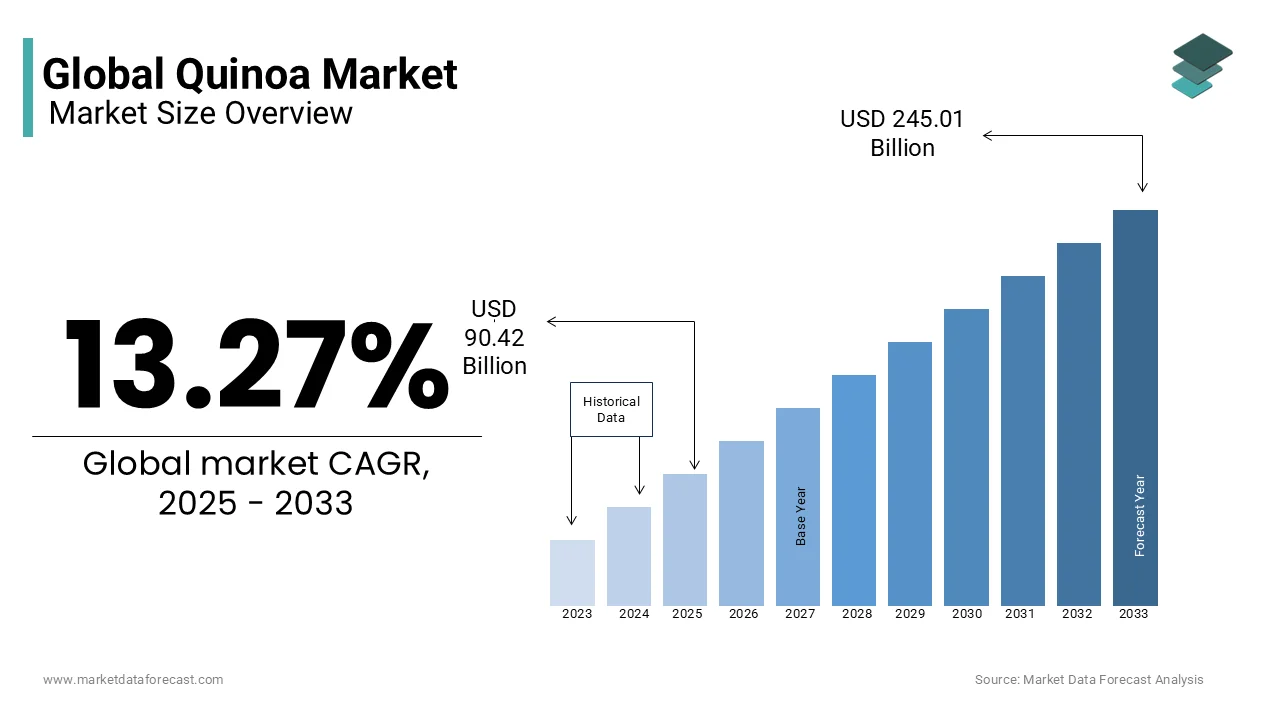
The global quinoa market size was valued at USD 90.45 billion in 2025, is projected to reach USD 102.45 billion in 2026, and is expected to soar to USD 277.61 billion by 2034, growing at a strong CAGR of 13.27% during the forecast period. Market growth is driven by rising global demand for nutrient-rich, gluten-free grains, increasing adoption of quinoa in healthy diets, and expanding use across packaged foods, bakery, snacks, and ready-to-eat meals. Growing consumer interest in plant-based, high-protein foods and strong retail and online availability continue to boost global quinoa consumption.
Key Market Trends
- Rapid growth in the popularity of quinoa as a gluten-free, high-fiber, and protein-rich superfood.
- Increasing use of quinoa in cereals, snacks, bakery items, beverages, and functional food products.
- Rising adoption of plant-based and clean-label diets worldwide.
- Expanding distribution through supermarkets, specialty stores, and e-commerce platforms.
- Product innovation including quinoa-based pasta, flour blends, beverages, and meal kits.
- Strong marketing focus on sustainability, organic farming, and ethical sourcing.
Segmental Insights
- Based on application, the food industry segment held the dominant share of the global quinoa market in 2025, driven by quinoa’s integration into mainstream and specialty foods—from breakfast cereals and bakery items to snacks and ready-to-eat meals.
- Based on type, the inorganic segment held a prominent share of the quinoa market in 2025 due to higher crop yields, lower production costs, and greater commercial availability compared to organic varieties.
- Based on end users, the packed food segment captured a prominent share of the global quinoa market in 2025, supported by rising demand for convenient, ready-to-use quinoa ingredients in retail and foodservice channels.
Regional Insights
- North America was the largest regional contributor, accounting for 68.2% of the global quinoa market share in 2025. Strong demand is fueled by increasing adoption of healthy diets, the popularity of superfoods, and wide product availability across major retail chains in the U.S. and Canada.
Competitive Landscape
The global quinoa market is highly competitive, featuring seed producers, food manufacturers, and companies specializing in quinoa-based consumer products. Key players are focusing on sustainable farming practices, innovative food formulations, and global distribution expansion. Major companies in the global quinoa market include Adaptive Seeds, Territorial Seed Company, Victory Seed Company, Hancock Seed Company, The Real Seed Collection Ltd, Alter Eco, Andean Valley Corp, Quinoa Foods Company, COMRURAL XXI SRL, NorQuin, QUINOABOL, Keen One Quinoa, The British Quinoa Company, Andean Naturals Inc., and Inca Organics
Global Quinoa Market Size
The global quinoa market size was valued at USD 90.45 billion in 2025. The global market size is expected to reach USD 277.61 billion by 2034 from USD 102.45 billion in 2026. The market's promising CAGR for the predicted period is 13.27%.
Quinoa (Chenopodium quinoa Willd.) is a nutrient-dense pseudocereal native to the Andean region of South America, historically cultivated by indigenous communities in Bolivia, Peru, and Ecuador. Unlike true cereals, quinoa is a dicotyledonous plant belonging to the Amaranthaceae family, renowned for its exceptional protein quality, containing all nine essential amino acids, particularly high in lysine and methionine. As per the Food and Agriculture Organization of the United Nations, quinoa has been recognized as a climate-resilient crop, capable of thriving in altitudes exceeding 4,000 meters, saline soils, and arid conditions where traditional grains fail.
MARKET DRIVERS
Rising Global Demand for Plant-Based, High-Protein Diets
The surge in consumer preference for plant-based nutrition has significantly elevated quinoa’s prominence in modern diets among health-conscious and flexitarian populations. According to the Global Nutrition Report 2023, over 40% of adults in North America and Western Europe actively seek protein sources beyond animal products, driven by concerns over cardiovascular health and environmental sustainability.
Expansion of Quinoa Cultivation Beyond the Andean Region
The rising adaptation of the crop to non-traditional geographies by reducing supply dependency on South America and enhancing global availability is escalating the growth of the Quinoa Market. In the Canadian Prairies, researchers at the University of Saskatchewan have developed frost-tolerant varieties that mature in 90–100 days by enabling commercial production in temperate zones. The Indian Council of Agricultural Research reports that quinoa cultivation in Rajasthan and Haryana has expanded to over 15,000 hectares since 2020, supported by government incentives for nutri-cereals.
MARKET RESTRAINTS
High Production Costs and Limited Mechanization in Traditional Growing Regions
The quinoa cultivation remains economically challenging in its native Andean heartland due to labor-intensive practices and underdeveloped agricultural infrastructure, which is hampering the growth of the Quinoa Market. Manual sowing and threshing increase production costs by up to 40% compared to mechanized systems, as reported by the Inter-American Institute for Cooperation on Agriculture. Additionally, the absence of centralized processing facilities leads to significant post-harvest losses estimated at 15–20% by the FAO’s Post-Harvest Management Unit due to inadequate drying and storage.
Saponin Content and Processing Requirements Limiting Consumer Acceptance
The broader quinoa adoption lies in its natural saponin coating, a bitter-tasting compound that must be removed before human consumption. As per research published in the Journal of Cereal Science, saponin levels in raw quinoa can range from 0.5% to 2.5% of seed weight, necessitating thorough washing or mechanical abrasion to ensure palatability. Inadequate processing leads to consumer rejection; a sensory evaluation study by the University of Copenhagen found that 73% of unacquainted tasters rated untreated quinoa as “unpleasant” due to its astringent aftertaste. In regions lacking processing infrastructure, such as parts of East Africa and South Asia, this requirement hinders commercialization.
MARKET OPPORTUNITIES
Integration into Functional and Medicated Food Formulations
Quinoa is increasingly being leveraged as a functional ingredient in medical nutrition, sports supplements, and gluten-free products, which is driven by its balanced macronutrient profile and bioactive compounds. As per the Academy of Nutrition and Dietetics, quinoa contains high levels of polyphenols, flavonoids, and phytosterols, which exhibit anti-inflammatory and glycemic control properties. Clinical trials conducted at the Universidad San Francisco de Quito demonstrated that daily quinoa consumption reduced fasting blood glucose by 12% in prediabetic patients over 12 weeks.
Adoption in Climate-Resilient Agriculture and Food Security Programs
Quinoa’s resilience to extreme environmental conditions positions it as a strategic crop in global food security initiatives amid climate change. As per the United Nations Environment Programme, quinoa can withstand temperatures from -8°C to 38°C and tolerate soil salinity levels up to 40 dS/m—far exceeding the thresholds of wheat or maize. In Egypt, the Ministry of Agriculture has allocated 10,000 hectares for quinoa cultivation in the Nile Delta’s saline zones, where traditional crops are failing due to rising groundwater salinity.
MARKET CHALLENGES
Genetic Erosion and Loss of Traditional Varietal Diversity
The commercialization of quinoa has led to a narrowing of cultivated varieties, which is threatening the genetic diversity that underpins its adaptability. This factor is likely to impede the growth of the Quinoa Market. The National Institute of Agricultural Innovation of Peru reports that 60% of traditional quinoa varieties have seen reduced cultivation since 2000 due to market preference for uniform, high-yielding types. This genetic homogenization increases vulnerability to pests and climate shocks; a 2022 outbreak of downy mildew in Bolivia disproportionately affected monoculture farms, causing up to 40% yield loss, as documented by the Andean Plant Pathology Network.
Price Volatility and Market Access Inequities for Smallholder Farmers
The Andean smallholder farmers often receive a minimal share of the final retail value due to economic instability, which is likely to act as a barrier for the growth of the Quinoa Market. This disparity stems from fragmented supply chains, lack of direct export access, and dominance of intermediaries. Additionally, speculative trading and fluctuating import policies such as sudden tariffs in Iran and Turkey cause price swings of up to 35% annually, as reported by the FAO’s Agricultural Market Information System.
REPORT COVERAGE
| REPORT METRIC | DETAILS |
| Market Size Available | 2025 to 2034 |
| Base Year | 2025 |
| Forecast Period | 2026 to 2034 |
| CAGR | 13.27% |
| Segments Covered | By Application, Type, End Users, and Region |
| Various Analyses Covered | Global, Regional & Country Level Analysis; Segment-Level Analysis, DROC, PESTLE Analysis, Porter’s Five Forces Analysis, Competitive Landscape, Analyst Overview of Investment Opportunities |
| Regions Covered | North America, Europe, APAC, Latin America, Middle East & Africa |
| Market Leaders Profiled | Quinoa Foods Company, Northern Quinoa Production Corporation, Quinoa Corporation, Andean Valley S.A., Keen One Quinoa, The British Quinoa Company, Hain Celestial Group, Andean Naturals Inc., European Quinoa Group and Inca Organics. |
SEGMENTAL ANALYSIS
By Application Insights
The food industry segment was the largest and held a dominant share of the quinoa market in 2025 with quinoa’s integration into mainstream and specialty food products, ranging from breakfast cereals to ready-to-eat meals. The European Food Safety Authority recognizes quinoa as a high-fiber, low-glycemic-index grain by making it ideal for diabetic and weight-management formulations. Additionally, the gluten-free food sector relies heavily on quinoa; the Celiac Disease Foundation states that 65% of certified gluten-free grain products in Europe and North America now include quinoa as a primary ingredient.
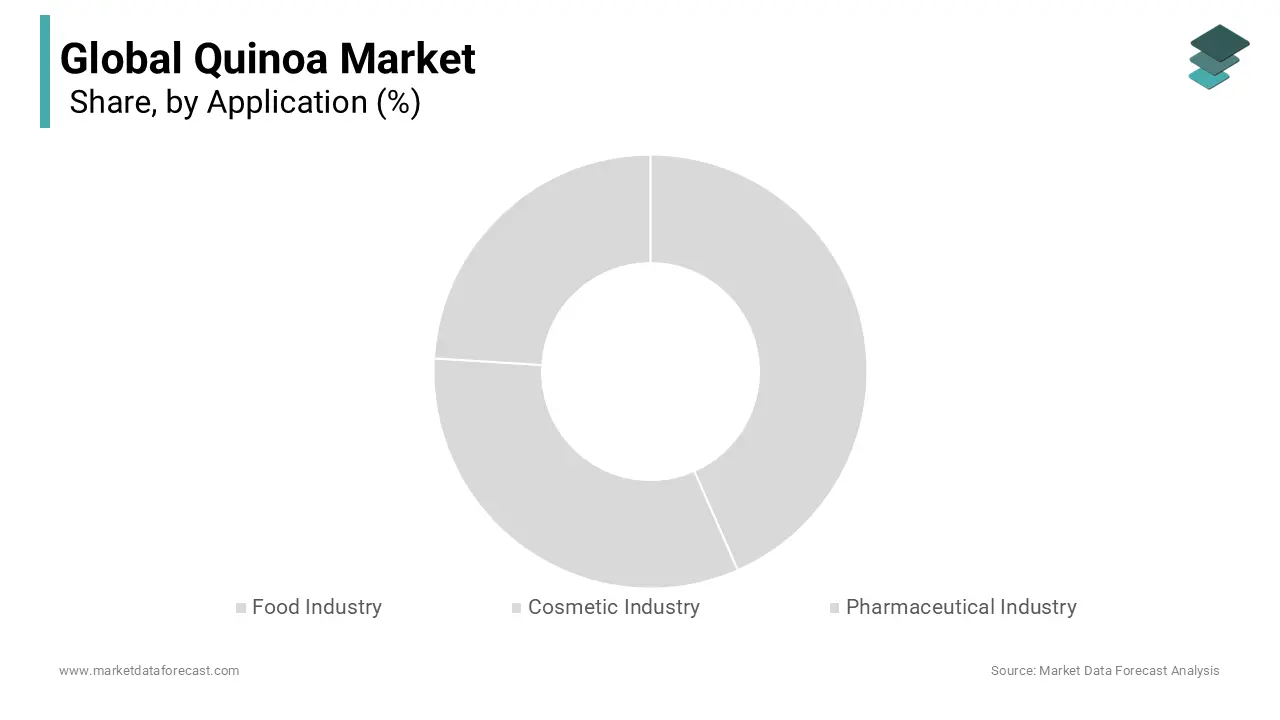
The cosmetics industry segment is expected to grow with an expected CAGR of 10.4% during the forecast period with the rising demand for natural, plant-based ingredients in skincare and haircare formulations. Quinoa protein, rich in amino acids like cysteine and lysine, is increasingly used in anti-aging creams and strengthening shampoos due to its ability to enhance skin elasticity and hair tensile strength.
By Type Insights
The inorganic segment held a prominent share of the quinoa market in 2025 due to higher yields, lower production costs, and broader commercial availability. Conventional farming methods enable larger-scale cultivation, particularly in export-oriented regions like southern Bolivia and the Peruvian coast, where irrigation and synthetic inputs optimize productivity. Additionally, shorter certification cycles and fewer compliance requirements make inorganic production more accessible to small and medium-sized agribusinesses.
The organic quinoa is projected to grow at a CAGR of 12.6% throughout the forecast period owing to the increasing consumer demand for pesticide-free, sustainably produced food, particularly in North America and Western Europe. According to the European Commission, organic food sales in the EU reached €55 billion in 2022, with quinoa among the top ten fastest-growing categories.
By End Users Insights
The packed food segment was the largest by capturing a prominent share of the global quinoa market in 2025 with the commercialization of quinoa into ready-to-cook meals, snack bars, pasta, and breakfast cereals, which offer convenience without compromising nutritional value. Brands like Nestlé, General Mills, and Amy’s Kitchen have integrated quinoa into their product lines, leveraging its “superfood” image to attract urban, time-constrained consumers.
The ingredients segment is projected to grow at a CAGR of 11.8% in the next coming years owing to the increasing use of quinoa flour, protein isolates, and germ oil in industrial food manufacturing and nutraceutical formulations. Furthermore, companies like Roquette and Burcon NutraScience are developing quinoa-based texturized proteins for meat analogs, which is responding to demand from vegan and flexitarian consumers.
REGIONAL ANALYSIS
North America Quinoa Market Analysis
North America was the largest contributor in the global quinoa market with 68.2% of the share in 2025 with the widespread adoption of plant-based diets and functional foods, with over 55 million Americans identifying as flexitarian, according to the Plant Based Foods Association. Additionally, the FDA’s recognition of quinoa as a complete protein has reinforced its inclusion in school nutrition programs and military rations, further institutionalizing its role in national food systems.
Europe Quinoa Market Analysis
Europe was positioned second in the quinoa market with the strong consumer preference for organic and sustainable grains. The European Union imported over 45,000 metric tons of quinoa in 2023, with Germany, France, and the UK as primary importers. Additionally, the Nordic countries have integrated quinoa into public health nutrition programs, with Sweden’s National Food Agency recommending it as a staple for plant-based diets.
Asia Pacific Quinoa Market Analysis
The Asia-Pacific quinoa market is likely to gear up with highest CAGR during the forecast period owing to the rising health awareness and urbanization. In Japan, quinoa consumption has increased by 19% annually since 2020, driven by its inclusion in bento meals and diet-focused products, according to the Japan External Trade Organization. India has launched the “Nutri-Cereals” campaign, promoting quinoa as a solution to malnutrition, with the Indian Council of Agricultural Research distributing seeds to farmers in 12 states. China’s Hainan province has initiated large-scale trials for quinoa cultivation in saline-alkaline soils.
Latin America Quinoa Market Analysis
Latin America quinoa market growth is likely with both the ancestral home and a dynamic production center. Peru and Bolivia remain the world’s largest exporters by shipping over 75,000 metric tons annually, according to the United Nations Conference on Trade and Development. The Andean Community has established regional quality standards to enhance competitiveness.
Middle East and Africa Quinoa Market Analysis
The Middle East and Africa quinoa market growth is likely to grow with the early-stage adoption with high strategic potential. In Saudi Arabia, the Ministry of Environment, Water and Agriculture has included quinoa in its National Food Security Strategy due to its drought tolerance and nutritional value. In South Africa, quinoa is being evaluated as a crop for climate-vulnerable regions under the Southern African Development Community’s resilience program.
COMPETITIVE LANDSCAPE
The major competitive move among the major players in the quinoa market is the attainment of limited land in regions of the world with cultivation capabilities for the crop. Therefore, the demand for the crop is high but the supply is low. Also, innovation in the application of quinoa is a sign of healthy competition among the major players in the quinoa market.
The competitive landscape of the quinoa market is defined by a convergence of traditional producers, multinational food corporations, and specialty ingredient suppliers, each vying for dominance through differentiation in quality, sustainability, and application versatility. While Andean exporters maintain control over heritage varieties and organic certification, global agribusinesses are leveraging R&D and distribution networks to dominate processed and fortified segments. Competition is intensifying in the Asia Pacific and African regions, where governments are promoting quinoa as a climate-resilient crop, inviting both public and private sector investment. Branding around ethical sourcing, non-GMO status, and nutritional superiority has become a key differentiator.
KEY MARKET PLAYERS
The following companies playing a major role in the global quinoa market are
-
Adaptive Seeds
-
Territorial Seed Company
-
Victory Seed Company
-
Hancock Seed Company
-
The Real Seed Collection Ltd
-
Alter Eco
-
Andean Valley Corp
-
Quinoa Foods Company
-
COMRURAL XXI SRL
-
NorQuin
-
QUINOABOL
-
Keen One Quinoa
-
The British Quinoa Company
-
Andean Naturals Inc.
-
Inca Organics
TOP PLAYERS IN THE MARKET
- Nestlé has significantly influenced the Asia Pacific quinoa market through its integration of quinoa into premium health and wellness food products. The company has launched quinoa-enriched cereals, infant nutrition formulas, and ready-to-eat meals across markets such as Japan, Australia, and India, aligning with regional dietary shifts toward functional foods. In 2023, Nestlé introduced a fortified quinoa-based porridge under its CERELAC brand in India, targeting child malnutrition in collaboration with local health authorities. It also partnered with farmers in Himachal Pradesh to pilot sustainable quinoa cultivation, ensuring traceability and quality.
- ADM has expanded its footprint in the Asia Pacific quinoa market by focusing on ingredient innovation and supply chain integration. The company supplies quinoa protein isolates and flours to food manufacturers across South Korea, Thailand, and Australia, supporting the development of plant-based meat alternatives and gluten-free baked goods. In 2022, ADM established a technical collaboration with a Singapore-based food tech startup to optimize quinoa extrusion for texture-modified foods. It also invested in cold-milling technology to preserve nutrient integrity during processing, enhancing product appeal for health-conscious consumers.
- The Quinoa Corporation, headquartered in Peru, has extended its influence into the Asia Pacific by positioning itself as a premium exporter of ethically sourced, high-quality quinoa. The company has secured supply agreements with organic retailers and health food brands in Japan, New Zealand, and Australia, emphasizing traceability and fair-trade certification. In 2023, it launched a direct-to-business e-platform enabling Asian importers to access real-time inventory and sustainability data, improving supply transparency. The corporation also initiated a knowledge exchange program with Indian agricultural universities to support quinoa farming trials in Rajasthan and Telangana.
TOP STRATEGIES USED BY KEY MARKET PLAYERS
Key players in the quinoa market are employing strategic vertical integration, product diversification, and sustainability branding to strengthen their competitive positioning. Companies are investing in direct farmer partnerships to ensure supply stability and ethical sourcing in Andean regions. Expansion into value-added applications such as protein isolates, gluten-free flours, and functional ingredients is enabling premium pricing and broader industrial use. Firms are also enhancing traceability through blockchain and digital certification platforms to meet consumer demand for transparency. Additionally, collaborations with research institutions and government programs are accelerating agronomic innovation and market acceptance in emerging regions by ensuring long-term scalability and resilience in a dynamic global food landscape.
RECENT HAPPENINGS IN THE MARKET
- In January 2023, Nestlé launched a fortified quinoa-based infant porridge under its CERELAC brand in India, developed in consultation with nutrition experts to address micronutrient deficiencies in young children and expand its presence in the functional baby food segment across South Asia.
- In May 2023, ADM partnered with a Singapore-based food technology startup to co-develop extruded quinoa-based meat analogs by leveraging its protein isolation capabilities to meet rising demand for plant-based alternatives in Southeast Asia’s fast-growing alternative protein market.
- In September 2023, The Quinoa Corporation introduced a blockchain-enabled e-platform for Asian importers, providing real-time access to batch-specific origin data, sustainability metrics, and quality certifications by enhancing transparency and trust in its premium quinoa supply chain.
- In February 2025, Nestlé collaborated with farmers in Himachal Pradesh to initiate a pilot quinoa cultivation project, which is supporting agronomic training and sustainable farming practices to develop a localized supply base for its Indian product lines.
- In June 2025, ADM commissioned a cold-milling processing unit in Thailand to preserve the nutritional integrity of quinoa flour that enables higher retention of protein and antioxidants for use in premium health foods across the Asia Pacific region.
MARKET SEGMENTATION
This research report on the global quinoa market has been segmented and sub-segmented based on the application, type, end-user and region.
By Application
- Food Industry
- Cosmetic Industry
- Pharmaceutical Industry
By Type
- Organic
- Inorganic
By End-User
- Ingredient
- Packaged
By Region
- North America
- Europe
- Asia Pacific
- Latin America
- Middle East and Africa