- Product Description Description
- Table of Contents TOC
- List of Table & Figure LOT
- Get Free Sample PDF Sample PDF
Market Size, 2025
$8.92 BnMarket Estimate, 2026
$9.60 BnMarket Forecast, 2034
$17.25 BnCAGR, 2026–2034
7.60%Global Parenteral Nutrition Market Size
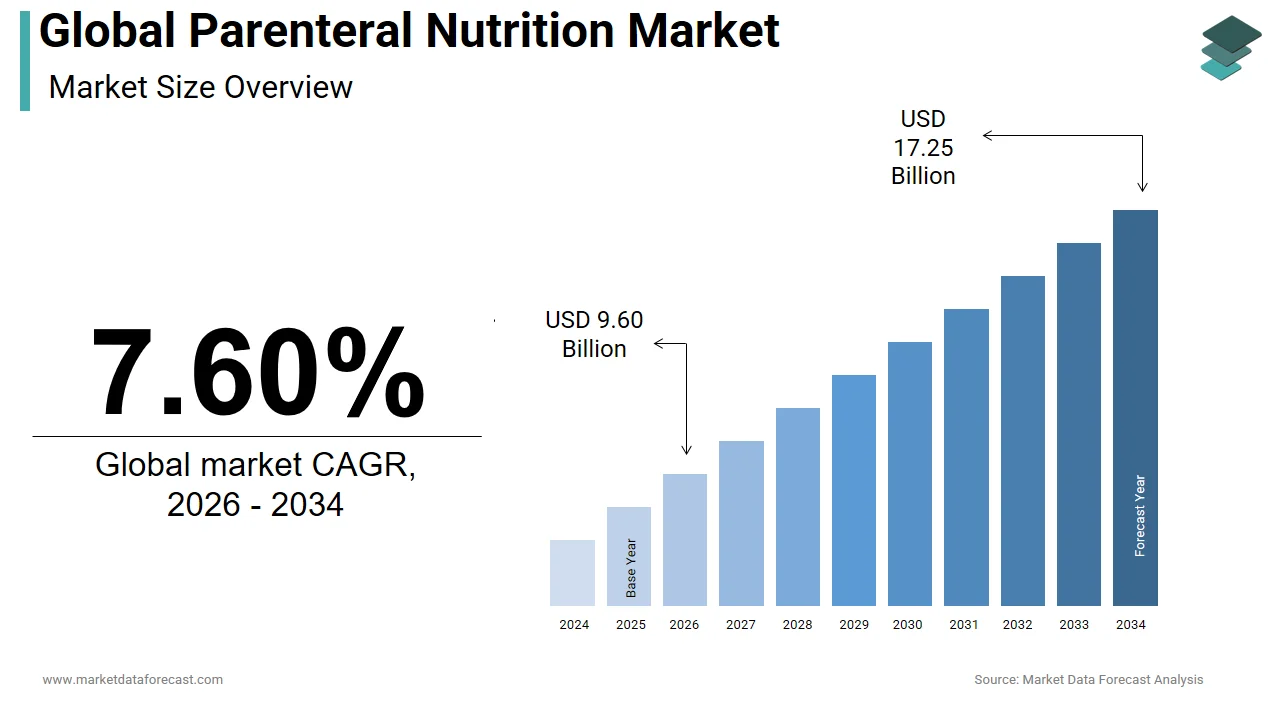
The global parenteral nutrition market was valued at USD 8.92 billion in 2025, is estimated to reach USD 9.60 billion in 2026, and is projected to reach USD 17.25 billion by 2034, growing at a CAGR of 7.60% from 2026 to 2034.
MARKET DRIVERS
Advancements in parenteral nutrition technology, preference for parenteral nutrition over enteral nutrition, favorable reimbursement policies, and a rising geriatric population are primarily fueling the growth of the parenteral nutrition market.
In addition, the benefits provided by parenteral nutrition, like the lesser risk of infection, stimulation of the blood flow to the stomach, preservation the muscle metabolism, and the delivery of nutrients to the body, are igniting the market's growth. On the other hand, the increasing rate of research and development in the market will lead the market to grow.
Furthermore, there is also a rise in awareness about parenteral nutrition attributed to rising concerns about healthcare and nutritional care worldwide. In addition, the covid-19 pandemic also positively affected the market by increasing the number of patients. Malnourished and diseased individuals need parenteral nutrition to stay healthy; it was revealed in a study by specialized nutrition Europe (SNE) that there are around 40% of adults hospitalized and in need of parenteral nutrition assistance.
The use of parenteral nutrition in premature babies to boost the parental nutrition market growth. Infants or premature children suffering from the disease or needing special nutrition management can be administered parenteral assistance to help them cope. As the specialized nutrition of Europe (SNE) anticipated, nearly 300,000 EU children needed parenteral nutrition assistance. Furthermore, as healthcare professionals become more focused on reducing the number of premature deaths, they depend on parenteral nutrition. Premature children are often underdeveloped and low in weight with a low range of immunity, so it is essential to provide them with adequate nutrition. The premature birth rate in the U.S. in 2016 was 9.6%, according to the national center for Healthcare, thus requiring more insistence on reducing the death rates.
MARKET RESTRAINTS
The market's growth may be held back by the side effects associated with parenteral nutrition like memory loss, fatigue, fever, seizures, gain and loss of weight, heart rate changes, etc., and the lack of awareness.
REPORT COVERAGE
| REPORT METRIC | DETAILS |
| Market Size Available | 2025 to 2034 |
| Base Year | 2025 |
| Forecast Period | 2026 to 2034 |
| Segments Covered | By Nutrient Type, Consumer Type, End-Use & Region. |
| Various Analyses Covered | Global, Regional, and Country-Level Analysis, Segment-Level Analysis, Drivers, Restraints, Opportunities, Challenges; PESTLE Analysis; Porter’s Five Forces Analysis, Competitive Landscape, Analyst Overview of Investment Opportunities |
| Regions Covered | North America, Europe, Asia Pacific, Latin America, Middle East & Africa |
| Market Leaders Profiled | Claris Lifesciences Limited, Pfizer, Aculife, Fresenius Kabi AG, Sichuan Kelun Pharmaceutical, B. Braun Melsungen AG, Hospira Inc., Baxter International Inc., Grifols International S.a., and Actavis Inc. |
SEGMENT ANALYSIS
By Nutrient Type Insights
The segment for the single-dose amino acid solution is expected to grow the most during the forecast period due to the rising need for fitness and health among people and the increment in the number of cases of chronic diseases around the world. Moreover, the risks associated with parenteral nutrition can be eliminated through the proper monitoring and review of blood glucose, fluid balance, and blood and urine biochemistry. These are why the segment was leading the market in 2020 and is expected to continue growing during the forecast period.
The lipid emulsion segment is expected to grow along with the carbohydrates segment during the forecast period.
By Consumer Type Insights
Parenteral nutrition can be used for both adult and child patients. This feasibility is because several diseases can be cured with the help of parenteral nutrition like intestinal obstruction, short bowel syndrome, ulcerative colitis, etc., along with people suffering from malnutrition, chronic illness, and severe ill. Therefore, based on their medical condition, adults require parenteral nutrition from time to time.
It is possible to witness a loss of biochemical essential fatty acids in newborns within a week or two of delivery. Therefore, such children require assistance from parenteral nutrition.
By End-Use Insights
The continuously developing infrastructure of hospitals and its capacity to accommodate more patients simultaneously make it the dominating end-user segment. Additionally, more crowd at the hospital also supports the segment. As a result, the segment led the market in 2025 and is expected to continue growing during the forecast period.
REGIONAL ANALYSIS
North America dominated the global parenteral nutrition market in 2025, and it is anticipated to continue its dominance of the market during the forecast period due to the private organizations operating in the healthcare sector of the region along with the government research spending and collaborations among authorities and established medical industry and universities in countries like the U.S and Canada. The United States accounted for the largest market share over the forecast period owing to the availability of advanced healthcare infrastructure, and the technological advancements in the healthcare sector are boosting market growth.
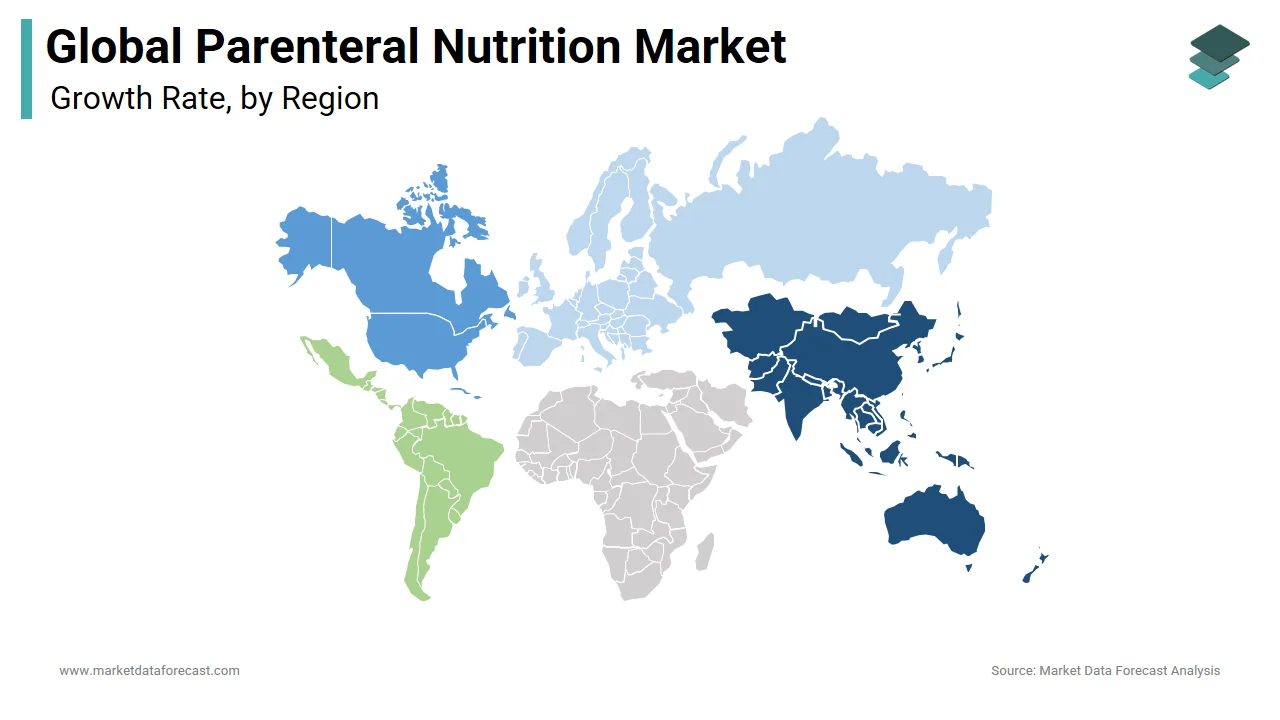
With the government initiatives in favor of the market relating to the healthcare sector along with development and reimbursement policies, the Asia-pacific region is expected to grow during the forecast period. Moreover, developing countries like India, China, South Korea, Japan, etc., are now taking steps towards a better economy, leading the market to grow.
TOP COMPANIES IN THIS MARKET
Some of the companies that are playing a dominating role in the global parental nutrition market include
- Claris Lifesciences Limited
- Pfizer
- Aculife
- Fresenius Kabi AG
- Sichuan Kelun Pharmaceutical
- B. Braun Melsungen AG
- Hospira Inc.
- Baxter International Inc.
- Grifols International S.A.
- Actavis Inc.
GLOBAL PARENTERAL NUTRITION MARKET NEWS
- In June 2022, the annual malnutrition awareness week by the American Society for parenteral and enteral nutrition (ASPEN) will be held from September 19-23, 2022. The purpose of the multi-organizational campaign is to educate the general public and healthcare professionals about the early diagnosis, prevention, and treatment of malnutrition. There are more than 110 organizations all over the world involved in the campaign aimed at making better nutritional care in the healthcare industry.
- In March 2022, Fresenius Kabi announced the FDA approval of their SMOFlipid, an injectable lipid emulsion for pediatric patients who require parenteral nutrition. This lipid composition is the first and the only four-oil lipid used in parenteral nutrition for kids. It has brought many benefits in the field of parenteral nutrition.
MARKET SEGMENTATION
This research report on the global parental nutrition market has been segmented and sub-segmented into the following categories.
By Nutrient Type
- Trace Elements
- Lipid Emulsion
- Single Dose Amino Acid Solution
- Vitamins And Minerals
- Carbohydrates
By Consumer Type
- Adults
- Children And Newborn
By End-Use
- Clinics
- Hospitals
- Others
By Region
- North America
- Europe
- Asia-pacific
- Latin America
- Middle East and Africa