- Product Description Description
- Table of Contents TOC
- List of Table & Figure LOT
- Get Free Sample PDF Sample PDF
Market Size, 2025
$1542 MnMarket Estimate, 2026
$1871 MnMarket Forecast, 2034
$8780 MnCAGR, 2026–2034
21.32%Global Patient Flow Management Solutions Market Size, Growth, Trends & Forecast (2026–2034)
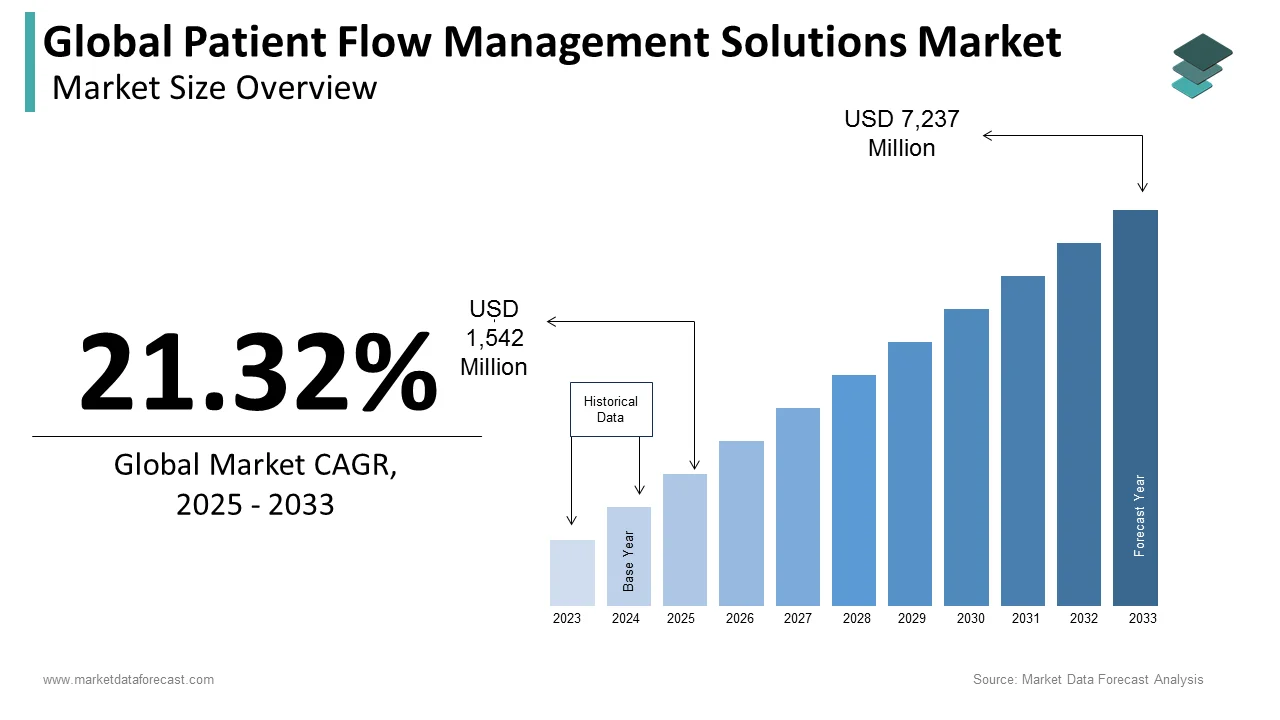
The global patient flow management solutions market size was valued at USD 1,542 million in 2025, is estimated at USD 1,871 million in 2026, and is projected to reach USD 8,780 million by 2034, registering a compound annual growth rate (CAGR) of 21.32% during the forecast period from 2026 to 2034. Market growth is heavily propelled by rising hospital admissions, severe overcrowding in emergency departments, staff and physician shortages, and the urgent need for cost-efficient healthcare delivery.
Key Executive Metrics (At-a-Glance)
- 2025 Base Valuation: USD 1,542 Million
- 2026 Current Valuation: USD 1,871 Million
- 2034 Forecast Valuation: USD 8,780 Million
- Compound Annual Growth Rate (CAGR): 21.32% (2026–2034)
- Dominant Product Segment: Standalone Solutions (with significant growth shifting to Integrated Systems)
- Dominant Type Segment: Event-Driven Solutions (92.5% historical share), with Real-Time Locating Systems (RTLS) growing at a rapid 31.7% CAGR
- Dominant Component Segment: Software Solutions
- Regional Growth Leaders: North America (leading market share), followed by Europe and the rapidly expanding Asia-Pacific region (led by China and India).
Core Market Drivers
- Hospital Overcrowding & Flow Inefficiencies: Rising patient admissions coupled with static healthcare infrastructure, resulting in longer wait times and bed shortages.
- Cost-Containment & High ROI: Regulatory shifts toward value-based care (e.g., Medicare's MSSP and VBP schemes) driving providers to optimize efficiency and minimize length of stay.
- Staffing Pressures: Ongoing shortages of doctors and nurses necessitating automated tools to reduce workloads and streamline department workflows.
Primary Market Restraints & Challenges
- Security Risks & Data Breaches: Rising prevalence of hacking and cyber threats targeting healthcare digital systems.
- High Initial Capital Outlays: Substantial upfront investment costs required for hardware, software, and comprehensive infrastructure upgrades.
- Skills Shortage: Scarcity of trained personnel capable of managing advanced healthcare IT architectures.
Global Patient Flow Management Solutions Market Segmentation Breakdown
| Segment Category | Largest Segment | Fastest Growing Segment / Focus |
|---|---|---|
| By Product | Standalone Solutions | Integrated Systems |
| By Type | Event-Driven Solutions (92.5%) | Real-Time Locating Systems (RTLS - 31.7% CAGR) |
| By Delivery Mode | Web-Based Solutions | Cloud-Based Solutions |
| By Component | Software | IT Support & Maintenance Services |
| By Region | North America | Asia-Pacific (China & India) |
Major Industry Players Profiled
Key companies operating in the global patient flow management solutions market include Central Logic, Inc., Medworxx Solutions, Inc., STANLEY Healthcare, Awarepoint Corporation, Care Logistics, LLC, Allscripts Healthcare Solutions, Inc., Cerner Corporation, McKesson Corporation, TeleTracking Technologies, Inc., Intelligent InSites, Inc., Sonitor Technologies, Inc., and Epic Systems.
Global Patient Flow Management Solutions Market Size
The size of the global patient flow management solutions market was worth USD 1,542 million in 2025. The global market is anticipated to grow at a CAGR of 21.32% from 2026 to 2034 and be worth USD 8,780 million by 2034 from USD 1,871 million in 2026.
The number of hospital admissions is rising, but the healthcare infrastructure is not keeping up, resulting in overcrowding and insufficient flow in the healthcare system. The movement of patients, information, or equipment across the organization, departments, or employees is referred to as flow in a patient care pathway. Overcrowding in the emergency room, increased waiting times, delayed procedures in the operating room schedule, a scarcity of ICUs and medical beds, overworked personnel, poor patient outcomes, and a greater likelihood of complications can result from inadequate patient outcomes flow management.
Healthcare organizations are increasingly implementing patient flow management technologies to control patient flow, decrease staff workload, and satisfy customer expectations. A patient flow management solution is system software that hospital workers use to keep track of patient information engaged in treatment. This solution combines statistical and analytical technologies for efficient workflow in a healthcare business. It primarily focuses on the following aspects increased patient care quality, satisfaction, less paperwork, and enhanced communication between patients and hospital personnel. It also aids hospitals in making better use of their existing capacity. A patient flow management system has become vital for hospitals to simplify patient flow outcomes and cost management.
MARKET DRIVERS
The high return on investment gained by implementing these solutions, the rising need for improved treatment quality, and an increasing focus on patient happiness are the primary factors driving the growth of the patient flow management solutions market.
Patient flow management is expected to be caused by the growing pressure to reduce healthcare costs. For example, new laws such as Medicare's move to a value-based system through its Medicare Shared Savings Program (MSSP) and Value-Based Purchasing (VBP) schemes are putting the burden of rising healthcare expenses on providers. Patient flow management solutions in hospitals, clinics, and other healthcare facilities provide several benefits, including increased interaction between clinical staff and patients, patient-centered care, improved care quality, reduced waiting for time and length of stay, improved patient satisfaction, and reduced paper processing. Also, the market is growing because of a shortage of physicians and nurses, the need for hospitals to save costs, and increased public knowledge about health care. Other factors driving market expansion include increased demand for cloud-based models, increased penetration, increased smartphone usage, product launches, and collaboration and partnerships among key players.
High ROI, an urgency to implement patient flow management solutions, and a lack of nursing personnel and doctors contribute to market growth.
Patient flow management solutions have become vital for hospitals to simplify patient flow outcomes and use their current capacity. In addition, well-established healthcare infrastructure across the regional market is most likely to augment the market growth. An increase in the investment and funding by the government and private organizations in the Patient Flow Management Solution will encourage market growth. Additionally, favorable reimbursement programs in the United States influence regional market growth. Moreover, an increase in healthcare expenditure and a rising need for improved quality of care are further expected to propel the global patient flow management solutions market growth.
MARKET RESTRAINTS
However, the rising prevalence of hacking, which leads to security breaches and large initial expenditures, a scarcity of trained personnel, and insufficient infrastructure to implement patient flow management systems, may limit the global patient flow management solutions market growth throughout the projected period.
REPORT COVERAGE
| REPORT METRIC | DETAILS |
| Market Size Available | 2025 to 2034 |
| Base Year | 2025 |
| Forecast Period | 2026 to 2034 |
| Segments Covered | |
| Various Analyses Covered | Global, Regional and Country-Level Analysis, Segment-Level Analysis, Drivers, Restraints, Opportunities, Challenges; PESTLE Analysis; Porter’s Five Forces Analysis, Competitive Landscape, Analyst Overview of Investment Opportunities |
| Regions Covered | North America, Europe, Asia Pacific, Latin America, Middle East & Africa |
| Market Leaders Profiled | Central Logic, Inc. (U.S.), Medworxx Solutions, Inc. (Canada), STANLEY Healthcare (U.S.), Awarepoint Corporation (U.S.), Care Logistics, LLC (U.S.), Allscripts Healthcare Solutions, Inc. (U.S.), Cerner Corporation (U.S.), McKesson Corporation (U.S.), TeleTracking Technologies, Inc. (U.S.), Intelligent InSites, Inc. (U.S.), Sonitor Technologies, Inc. (U.S.) and Epic Systems, and Others. |
SEGMENTAL ANALYSIS
By Product Insights
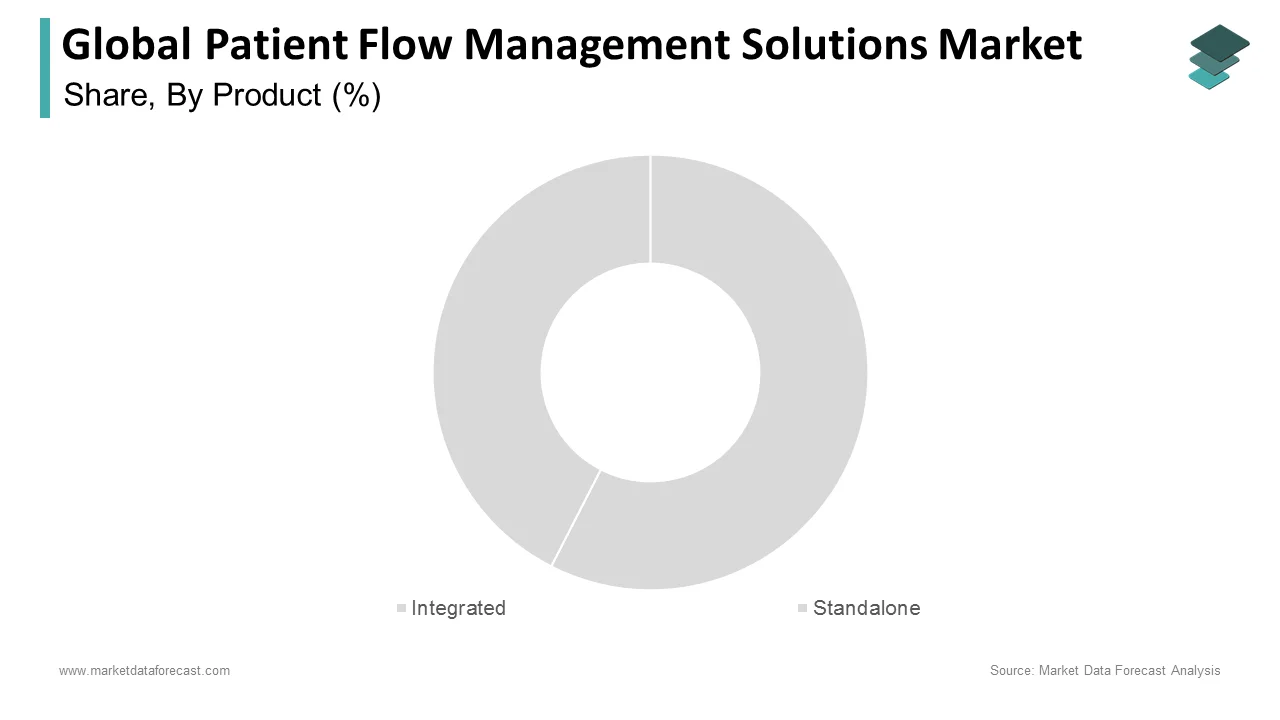
The standalone segment dominated the patient flow management solutions market and is expected to grow during the forecast period. On the other hand, the integrated systems segment is expected to significantly share of the market with an increased CAGR over the forecast period. The integrated system assists hospitals and clinics in planning and implementing activities in response to hospital conditions.
By Type Insights
The event-drive solutions segment led the market and accounted for the largest market revenue share of 92.5% of the global market during the previous years. However, the Real-time locating systems are most likely to have an estimated CAGR share of 31.7% during the forecast period.
By Delivery Mode Insights
The web-based solutions segment has had the largest market share over the forecast period based on delivery mode. The need to decrease the paperwork and time, a web-based management system is utilized to record patient appointments and store patient records. The Web-based solutions are Simple to use, Intuitive, intelligent, and integrated hospital Information systems.
By Component Insights
The software segment accounted for the largest share of the patient flow management solutions systems market based on the component. The patient flow is a multi-step process involving a variety of stakeholders and tasks. Getinge's software solutions provide you with tools to improve consistency and efficiency, allowing hospital personnel to focus on providing the best possible care to patients. The market is growing due to nurses and healthcare staff shortages and improving healthcare quality at a minimal cost.
REGIONAL ANALYSIS
North America Patient Flow Management Solutions Market Analysis
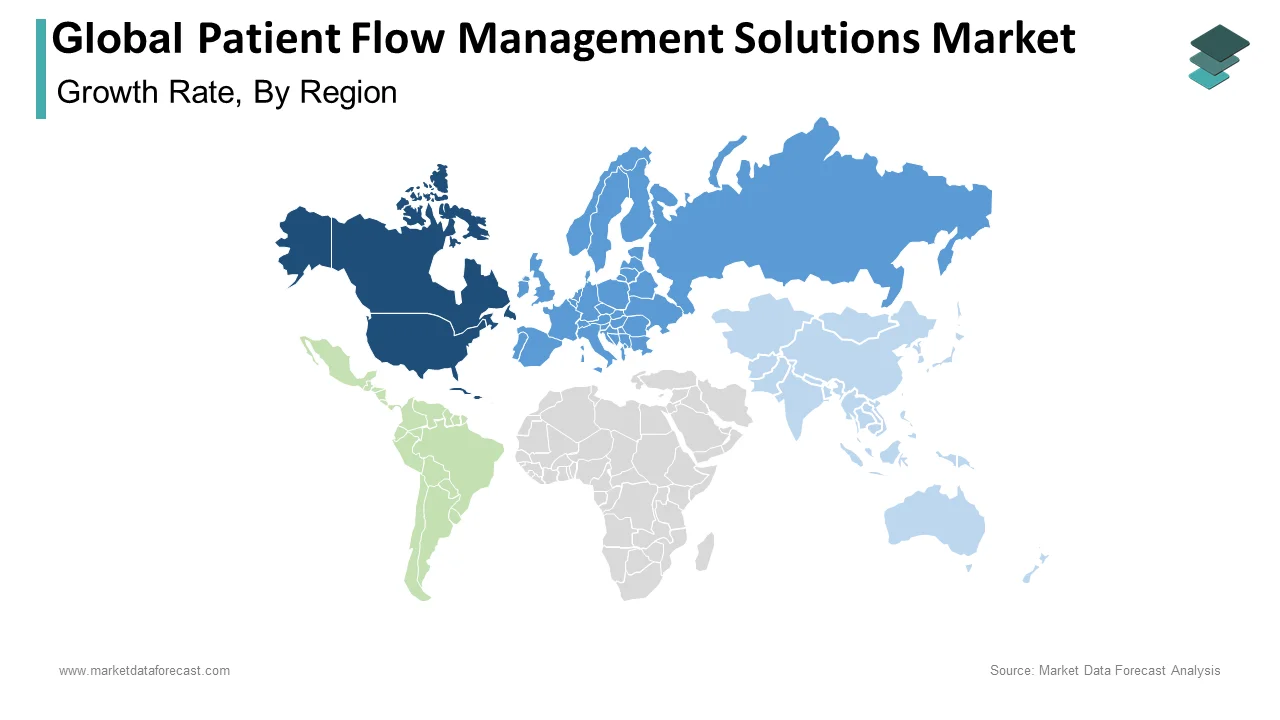
The North American market geographically led the global market and accounted for the largest revenue share in 2024. However, the market is expected to continue its growth during the forecast period. The growth in the region is attributed to the growing healthcare expenditure, technological advancements, and supportive funding and training initiatives. In the regional market, the countries the United States and Canada are majorly contributing the market growth. The United States witnessed the adoption of a patient-centric approach by healthcare providers, and the rising need for cost-limitation measures is propelling the country's market growth.
Europe Patient Flow Management Solutions Market Analysis
Europe recorded a significant share in the patient flow management solutions market during the previous year. Government impetus to HCIT and patient flow management in the European countries is augmenting the market growth. To manage patient flow efficiently, NHS hospitals across Europe are implementing new technology such as computerized bed management systems. The United Kingdom has witnessed rapid growth in the region. The Institute for Healthcare Improvement has worked with more than 60 hospitals in the UK and the US to examine variables that impact patients' smooth and timely movement through hospital departments and enhance and implement patient flow management strategies.
Asia Pacific Patient Flow Management Solutions Market Analysis
In the next five years, the Asia Pacific patient flow management solutions market is expected to have strong growth rates in the worldwide patient flow management system market, with China and India being the fastest-growing markets in the region. The growing adoption of the patient-centric approach in the healthcare providers in the region and the technological advancements are encouraging regional market growth. The patient flow management market in the Asia Pacific is expected to increase during the projected period due to a shortage of qualified workers in the healthcare sector. China, Japan, and India are major contributors to the region. Due to rising patient turnover, rising outpatient satisfaction, and shorter wait times, China is likely to lead the market in the Asia Pacific region. The Indian patient flow management solutions market is anticipated to witness the highest market share in the region over the forecast period owing to the increase in the usage of smartphones and cloud-based models and support from the government through investments.
KEY MARKET PLAYERS
Some of the noteworthy companies operating in the global patient flow management solutions market profiled in the report are
- Central Logic, Inc.
- Medworxx Solutions, Inc.
- STANLEY Healthcare
- Awarepoint Corporation
- Care Logistics, LLC
- Allscripts Healthcare Solutions, Inc.
- Cerner Corporation
- McKesson Corporation
- TeleTracking Technologies, Inc.
- Intelligent InSites, Inc.
- Sonitor Technologies, Inc.
- Epic Systems
GLOBAL PATIENT FLOW MANAGEMENT SOLUTIONS MARKET NEWS
- In October 2019, Epic introduced a new online resource for the exchange and used the information for third-party application developers. The third-party developer’s app for providers and health systems that can access API.
- In June 2019, TeleTracking Technologies had introduced SynapseIQ, which is a powerful analytic solution.SynpseIQ produces profits with 30years of patient flow expertise and is designed to make operational improvement easier.
MARKET SEGMENTATION
This research report on the global patient flow management solutions market has been segmented and sub-segmented based on by product, type, delivery mode, component, and region.
By Product
- Integrated
- Standalone
By Type
- Real-Time Locating System
- Event-Driven Solutions
By Delivery Mode
- Web-based
- Cloud-based
- Premise
By Component
- Hardware
- Software
- Services
- Consulting Services
- Ongoing It Support & Implementation Services
- Post-Sale & Maintenance Services
By Region
- North America
- Europe
- Asia-Pacific
- Latin America
- The Middle East and Africa