- Product Description Description
- Table of Contents TOC
- List of Table & Figure LOT
- Get Free Sample PDF Sample PDF
Market Size, 2025
$396.9 MnMarket Estimate, 2026
$417.2 MnMarket Forecast, 2034
$621.1 MnCAGR, 2026–2034
5.10%Global Penoxsulam Market Size, Growth, Trends & Forecast (2026–2034)
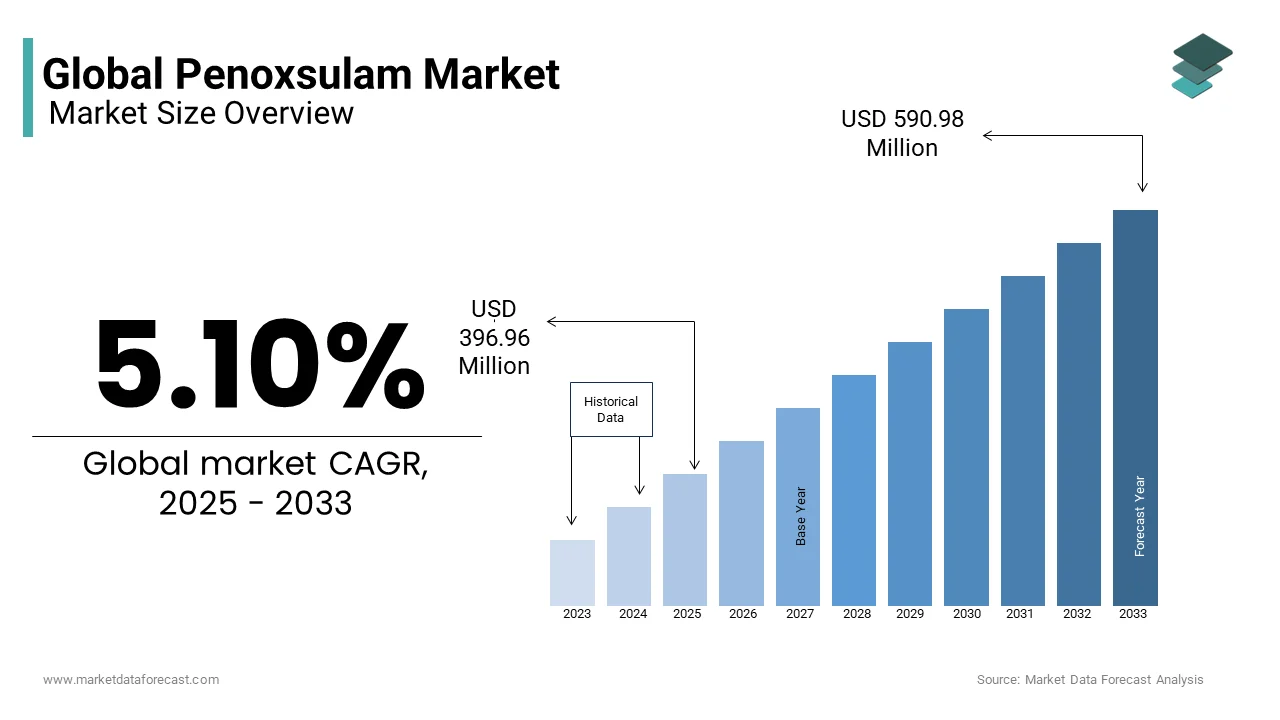
The global penoxsulam market size was valued at USD 396.90 million in 2025, is anticipated to reach USD 417.20 million in 2026, and is projected to scale up to USD 621.11 million by 2034, registering a compound annual growth rate (CAGR) of 5.10% during the forecast period from 2026 to 2034. Backed by its high efficiency in protecting staple crops like rice, compatibility with both terrestrial and aquatic environments, and low active ingredient requirements per hectare, the market continues to expand steadily worldwide.
Key Executive Metrics (At-a-Glance)
- 2025 Base Valuation: USD 396.90 Million
- 2026 Current Valuation: USD 417.20 Million
- 2034 Forecast Valuation: USD 621.11 Million
- Compound Annual Growth Rate (CAGR): 5.10% (2026–2034)
- Dominant Crop Segment: Rice (holding nearly 85% of the overall market share as a core staple food)
- Dominant Regional Market: Asia-Pacific (holding ~55% of the global market share led by high agricultural reliance in India and China)
- Fastest-Growing Regional Market: Asia-Pacific (driven by intensive farming dependencies and large-scale paddy cultivation)
Core Market Drivers
- High Herbicide Efficiency: Superior weed control performance compared to older conventional pesticides without harming local fauna.
- Rising Staple Food Demand: Surging global population growth accelerating the cultivation output and protection needs for rice and other key crops.
- Turf & Amenity Management: Growing investments in well-maintained lawns, commercial landscaping, golf courses, and sports grounds globally.
Primary Market Restraints & Challenges
- Generic Oversupply & Price Pressure: Intense competition from generic technical material manufacturers leading to margin compression.
- Regulatory & Environmental Scrutiny: Strict compliance frameworks governing chemical pesticide use and residue standards across international trade lines.
Global Penoxsulam Market Segmentation Breakdown
| Segment Category | Leading Sub-Segment (2025 Base) | Fastest-Growing Sub-Segment (2026–2034) |
|---|---|---|
| By Crop Type | Rice Fields (capturing ~85% dominant market share) | Aquatics & Specialty Turf Management Applications |
| By Region | Asia-Pacific (accounting for ~55% of the global market share) | Asia-Pacific (fastest-growing regional market led by India & China) |
Major Industry Players Profiled
Key enterprises shaping the competitive global penoxsulam market include Dow Chemical Co. (Corteva Agriscience), Bayer CropScience AG, Syngenta International AG, Chemtura Corp., Monsanto Co., Nufarm Ltd., Shijiazhuang Xingbai Bioengineering Co., and BASF SE.
 Download Free Sample Report
Global Penoxsulam Market Size
The global penoxsulam market size was valued at USD 396.9 million in 2025 and is anticipated to reach a valuation of USD 417.20 million in 2026 and USD 621.11 million by 2034, growing at a CAGR of 5.10%, from 2026 to 2034.
Penoxsulam is a chemical compound having the chemical formula C16H14F5N5O5S with a molecular mass of 483.37 g/mol. It is used in the agricultural field as rice herbicide.
It can be used in both terrestrial and aqueous environments and it has an excellent ability to protect the crops against weed without harming any fauna. These are the factors that encourage farmers to use this herbicide. Penoxsulam is highly effective against various types of weeds.
MARKET DRIVERS
High efficiency of Penoxsulam compared to other kinds of pesticides, rising demand of rice and other crops around the world and increasing demand of well-maintained lawns in commercial and residential buildings are some of the factors driving this market. Besides these, an increasing number of golf courts and sports grounds is also driving this market, substantially.
REPORT COVERAGE
| REPORT METRIC | DETAILS |
| Market Size Available | 2025 to 2034 |
| Base Year | 2025 |
| Forecast Period | 2026 to 2034 |
| CAGR | 5.10% |
| Segments Covered | By Crop Type and Region |
| Various Analyses Covered | Global, Regional & Country Level Analysis, Segment-Level Analysis, DROC, PESTLE Analysis, Porter’s Five Forces Analysis, Competitive Landscape, Analyst Overview on Investment Opportunities |
| Regions Covered | North America, Europe, APAC, Latin America, Middle East & Africa |
| Market Leaders Profiled | Dow Chemical Co., Bayer CropScience AG, Syngenta International AG, Chemtura Corp., Monsanto Co., Nufarm Ltd., Shijiazhuang Xingbai Bioengineering Co., and BASF SE and Others. |
SEGMENT ANALYSIS
By Crop Type Insights
As the demand for food is increasing because of the increasing population. Being staple food, the demand for rice has increased the most, which has led to the increased demand of Penoxsulam pesticide. As a result, rice fields have emerged as the leading segment for the demand for Penoxsulam herbicide accounting for almost 85% of the market.
REGIONAL ANALYSIS
In 2016, Asia-Pacific had the biggest Penoxsulam market accounting for almost 55% of global market share. India and China alone in Asia-Pacific account for more than 50% of the share of the Asia-Pacific market. Asia-Pacific also has the fastest-growing rate in this market because of the fact that the livelihood of a major population of the two biggest democracies in this region, viz. India and China depend on farming.
KEY MARKET PLAYERS
This market is extremely disjointed with numerous big and developing players operating in the business. The major companies dominating the global Penoxsulam market are Dow Chemical Co., Bayer CropScience AG, Syngenta International AG, Chemtura Corp., Monsanto Co., Nufarm Ltd., Shijiazhuang Xingbai Bioengineering Co., and BASF SE.
MARKET SEGMENTATION
This research report on the global Penoxsulam market is segmented and subs-segmented into the following categories.
By Crop Type
- Rice
- Aquatics
- another type of crop
By Region
- North America
- Europe
- Asia-Pacific
- Latin America
- Middle-East & Africa.