- Product Description Description
- Table of Contents TOC
- List of Table & Figure LOT
- Get Free Sample PDF Sample PDF
Market Size, 2025
$29.84 BnMarket Estimate, 2026
$33.99 BnMarket Forecast, 2034
$96.27 BnCAGR, 2026–2034
13.9%Executive Summary: Global Plant Breeding and CRISPR Plants Market
- Market Scope: Comprehensive global analysis of the plant breeding and CRISPR plants market covering advanced biotechnological methods, gene editing techniques, target crop traits, and regional dynamics.
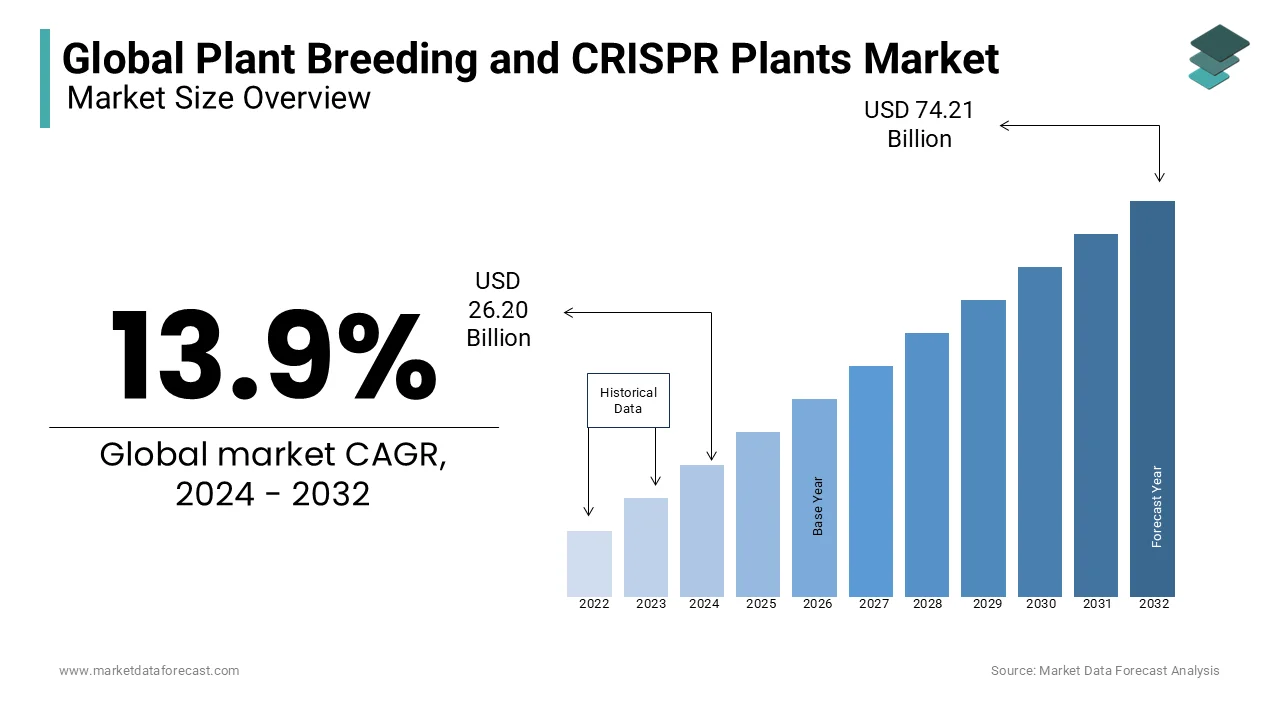
- Market Valuation: Valued at USD 29.84 billion in 2025, reaching USD 33.99 billion in 2026, and projected to scale up to USD 96.27 billion by 2034, expanding at a robust CAGR of 13.9% from 2026 to 2034.
- Primary Growth Drivers: Escalating global demand for improved, high-yielding crop varieties, increasing adoption of molecular and hybrid breeding techniques, stricter regulations on chemical pesticides, and heavy R&D investments by multinational agritech firms.
Key Market Segment Metrics (2026–2034)
| Category | Leading Segment (2025 Position) | Fastest-Growing Segment |
|---|---|---|
| By Type | Biotechnological and hybrid breeding methods (holding a dominant share due to widespread molecular marker and hybrid adoption) | Genome editing / CRISPR technologies (surging rapidly with precision gene-editing advancements and faster trait integration) |
| By Trait | Herbicide tolerance (capturing major market share amid strict chemical pesticide regulations and early-stage pest protection needs) | Yield improvement and disease resistance (expanding rapidly to support climate-resilient global food security) |
| By Application | Cereals and grains (maintaining a prominent share as vital staple foods for growing worldwide populations) | Fruits, vegetables, and oilseeds & pulses (growing fast through targeted nutrition enhancement and commercial seed demand) |
| By Region / Country | Asia-Pacific (leading regional market driven by heavy demand for commercial seeds, expanding farming acreage, and local R&D hubs) | North America & Europe (accelerating with advanced biotechnology infrastructure and modernized regulatory pathways for gene-edited crops) |
Major Market Players & Market Structure
Market Structure: Highly consolidated and innovation-driven agricultural biotechnology sector characterized by cross-border corporate partnerships, joint ventures, intellectual property licensing, and specialized seed production.
Key Companies: KWS Group, Land O'Lakes, Inc., Pacific Biosciences, Syngenta AG, Advanta Seeds Pty Ltd, Bayer AG, Benson Hill Biosystems, Inc., DLF, Eurofins Scientific, and Evogene Ltd.
Global Plant Breeding and CRISPR Plants Market Size
The global plant breeding and CRISPR plants market size was valued at USD 29.84 billion in 2025 and is expected to reach USD 33.99 billion in 2026 to reach USD 96.27 billion by 2034, growing at a CAGR of 13.9% from 2026 to 2034.
MARKET DRIVERS
One of the major driving factors that is helping the growth of the global plant breeding and CRISPR Plants market is the rapid increase in demand for improved crop varieties using modern breeding technologies and the development of technologies for breeding methods. Growing adoption of molecular breeding techniques is also a major driving factor of the plant breeding and CRISPR Plants market, and is also acting as a growing factor for the market.
Another major driving factor that helps the growth of the plant breeding and CRISPR plant market is the increasing regulations on the use of chemical pesticides. Increasing investments in the innovation of new technological advancements are also some of the driving factors that help the growth of the plant breeding and CRISPR Plants market.
MARKET RESTRAINTS
Some restraints affect the growth of the plant breeding and CRISPR plant market. Availability of alternate products in the market is among the major restraints affecting the growth of the global plant breeding and CRISPR plants market. Stringent regulations from the government authorities are also acting as a major challenge to the expansion of the market for plant breeding and CRISPR Plants in terms of revenue rate.
REPORT COVERAGE
| REPORT METRIC | DETAILS |
| Market Size Available | 2025 to 2034 |
| Base Year | 2025 |
| Forecast Period | 2026 to 2034 |
| CAGR | 13.9% |
| Segments Covered | By Type, Trait, Application, and Region. |
| Various Analyses Covered | Global, Regional & Country Level Analysis, Segment-Level Analysis, DROC, PESTLE Analysis, Porter’s Five Forces Analysis, Competitive Landscape, Analyst Overview of Investment Opportunities |
| Regions Covered | North America, Europe, APAC, Latin America, Middle East & Africa |
| Market Leaders Profiled | KWS Group, Land O'Lakes, Inc, Pacific Biosciences, Syngenta AG, Advanta Seeds Pty Ltd, Bayer AG, Benson Hill Biosystems, Inc, DLF, Eurofins Scientific, Evogene Lt,d and Others. |
SEGMENTAL ANALYSIS
By Type Insights
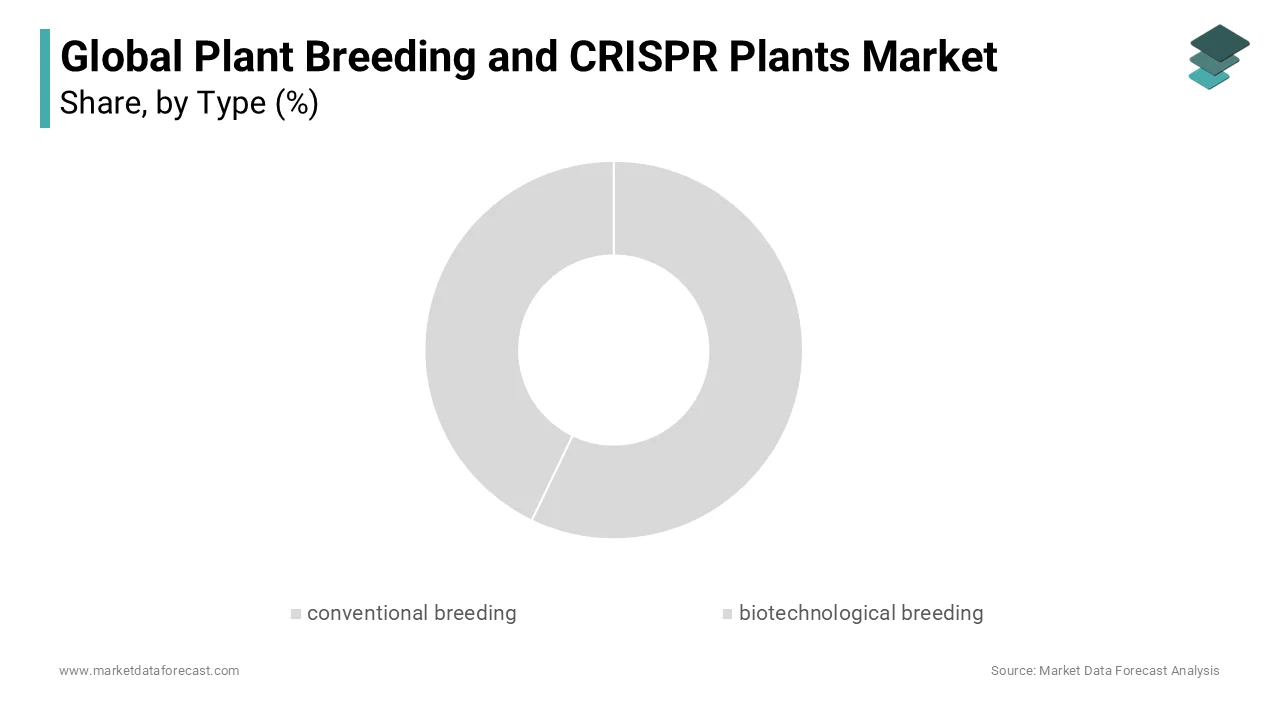
Among these, the biotechnological method holds the major share of the market owing to the increasing adoption of hybrid and molecular breeding techniques.
By Trait Insights
Among the above-mentioned segments, the herbicide tolerance segment holds the major share of the market due to the increasing regulations on the use of chemical pesticides and rising instances of pest attacks during early germination.
By Application Insights
Among these segments, cereals & grains hold the prominent share of the market.
REGIONAL ANALYSIS
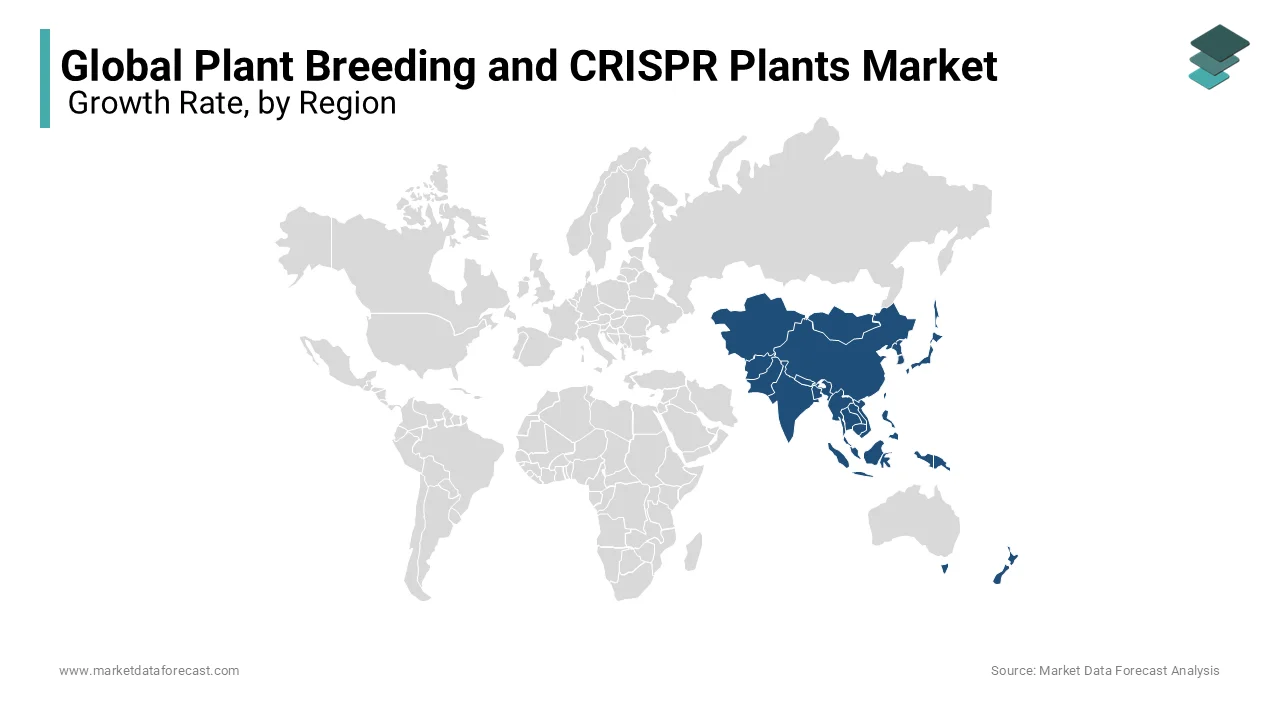
On the based onof the region, the market for plant breeding and CRISPR Plants is studied in the North American region (USA, Canada and Mexico), Europe region (France, Germany, Italy, Spain, United Kingdom, Russia, and the rest of Europe), Asia Pacific region (China, Japan, India, Australia and rest of Asia Pacific), South America region (Brazil, Argentina and rest of South America) and Middle East and Africa region (South Africa and rest of Middle East and Africa).
Among all the regions, the Asia Pacific holds the major share of the plant breeding and CRISPR Plants market because of factors such as increasing demand for commercial seeds in the Asian market. Furthermore, seed manufacturers such as Monsanto, Bayer, and Syngenta have shown interest in the market, where the companies are expanding their R&D centers across the Asia Pacific. The rapid increase of investments by the companies in the region for research & development for the new technological advancements in the field propels the growth of the market in this area.is also expected to increase the market in terms of value during the forecast period.
KEY MARKET PLAYERS
Some of the market players dominate the global plant breeding and CRISPR plants market.
- KWS Group
- Land O'Lakes, Inc
- Pacific Biosciences
- Syngenta AG
- Advanta Seeds Pty Ltd
- Bayer AG
- Benson Hill Ba, France-based
- DLF,
- Eurofins,entific
- Evthe ogene Ltd
Specialized companies will manufacture, at the plant, breeding and CRISPR Plants, and the products will be sold directly by the companies or by third-party users.
RECENT MARKET NEWS
- Some of the recent developments in the plant breeding and CRISPR plant market are mentioned below:
- In the month of October 2018, KWS SAAT SE and J R Simplot company combined founded a new venture named Adrevo B V, which focuses on the development of breeding potato varieties with improved traits.)
- In the month of September 2018, France based company Limagrain has acquired Advanseed company through its subsidiary Vilmorin & Cie where the acquired company has specialization in the breeding, production and distribution of hybrid spinach and leafy vegetables seeds.
- In the month of October 2017, DuPont Pioneer Company and Donald Danforth Plant Science Center collaborated with each other, and the DuPont company agreed to provide access to its intellectual property, scientific expertise, and technology capabilities for the development of improved seed varieties.
MARKET SEGMENTATION
This research report on the global plant breeding and CRISPR market is segmented and sub-segmented based on Type, Trait, Application, and Region.
By Type
- conventional breeding
- biotechnological breeding
- molecular breeding
- hybrid breeding
- genetic breeding
- genome editing
By Trait
- disease resistance
- herbicide tolerance
- yield improvement
- others
By Application
- oilseeds & pulses
- cereals & grains
- fruits & vegetables
- other applications
By Region
- North America
- Europe
- Asia Pacific
- Latin America
- Middle East and Africa