- Product Description Description
- Table of Contents TOC
- List of Table & Figure LOT
- Get Free Sample PDF Sample PDF
Market Size, 2025
$108.49 MnMarket Estimate, 2026
$117.82 MnMarket Forecast, 2034
$227.96 MnCAGR, 2026–2034
8.6%Executive Summary: Global Biofortification Market
- Market Scope: Comprehensive global overview of the biofortification industry, encompassing breeding and biotechnological methods, crop varieties, target micronutrients, and regional agricultural healthcare landscapes.
- Market Valuation: Valued at USD 108.49 million in 2025, reaching USD 117.82 million in 2026, and projected to scale up to USD 227.96 million by 2034, registering a solid CAGR of 8.6% (2026–2034).
- Primary Growth Drivers: Escalating global health awareness and rising demand for nutrient-dense functional foods; increasing incidence of malnutrition, hidden hunger, and micronutrient deficiencies; and expanded funding for advanced agronomic practices and plant breeding tech. Market restraints include consumer awareness gaps and strict regulatory hurdles surrounding genetically modified (GM) crops.
Key Market Segment Metrics (2026–2034)
| Category | Leading Segment (Base Position) | Fastest-Growing Segment |
|---|---|---|
| By Method | Plant Breeding Techniques / Conventional Breeding (favored for broad regulatory acceptance and cost-effectiveness) | Biotechnological & Genetic Modification Methods (scaling via precision trait enhancements) |
| By Crop Type | Sweet Potato & Cassava / Cereals & Grains (anchored by orange-fleshed sweet potato carotene enrichment and staple food security) | Rice, Wheat, and Maize / Corn (expanding rapidly through targeted public health and nutrition programs) |
| By Target Nutrients | Iron and Zinc (critical staples for fighting anemia, immune disorders, and widespread mineral deficiencies) | Vitamins (experiencing high velocity growth driven by dietary needs and animal nutrition/feed additive demand) |
| By Region | Asia-Pacific (dominates the global market share owing to extensive agricultural initiatives and high public health priorities) | Asia-Pacific and North America (posting strong, continuous growth velocities supported by agritech R&D) |
Major Market Players & Market Structure
Market Structure: Specialized and impact-driven ecosystem combining major life-science corporations, agricultural research centers (such as HarvestPlus/CIMMYT partnerships), and analytical testing laboratories.
Key Companies: BASF SE, Bayer AG, Syngenta, HarvestPlus, Agro Biosciences Inc., Charles River, Intertek Group plc, LemnaTec GmbH, and Monsanto Company.
 Download Free Sample Report
Global Biofortification Market Size
The biofortification market size was valued at USD 108.49 million in 2025 and is anticipated to reach USD 117.82 million in 2026 to reach USD 227.96 million by 2034, growing at a CAGR of 8.6% during the forecast period from 2026 to 2034.
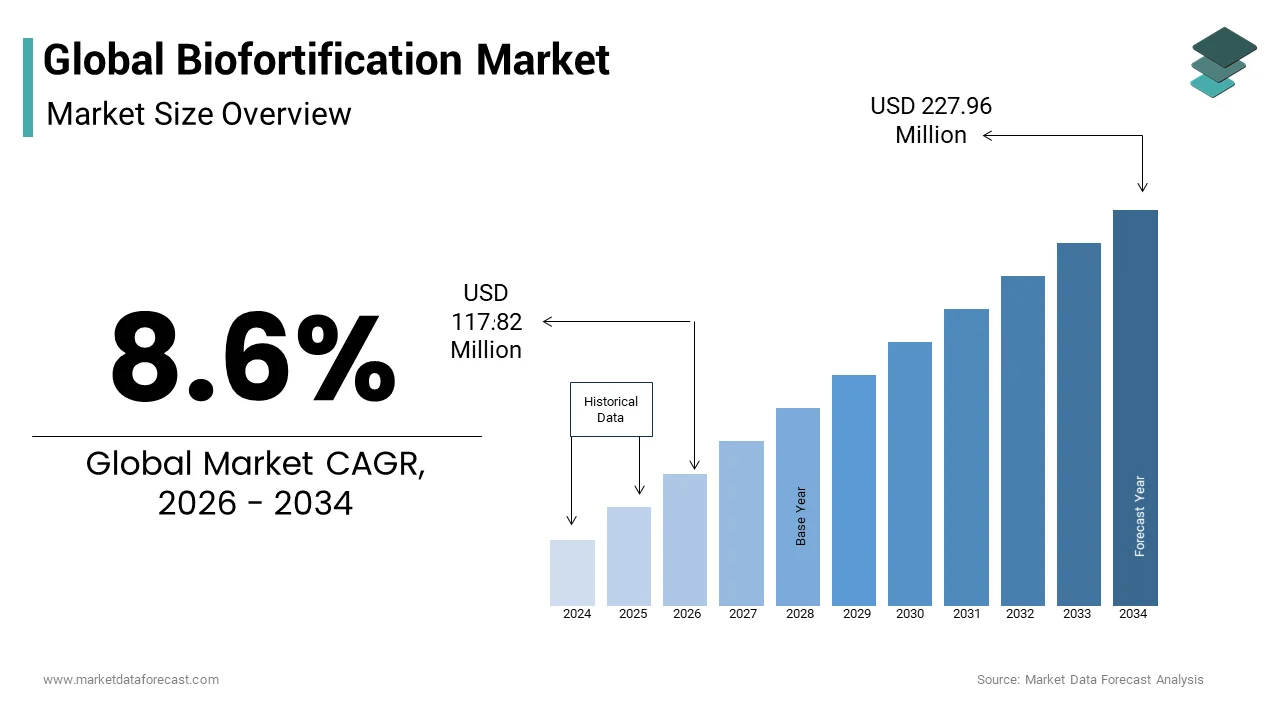
The growth of the biofortification market is driven by increased funding for agronomic practices and technological advances. Biofortification is mainly used for crops such as sweet potatoes, cassava, rice, corn, wheat, beans, pearl millet, tomato, banana, sorghum, and barley. The worldwide biofortification market is anticipated to record a surge in demand because of the rising number of applications of biotechnological tools in the breeding of plants and by the farmers’ interest in increasing their agricultural investments to obtain better yields.
Biofortification is the process of selecting crops to increase their nutritional value. It is carried out by conventional selective breeding or by genetic engineering. It differs from regular fortification in that it aims to make plant foods more nutritious as the plants grow, rather than adding nutrients to the food as it is processed. Biofortification, or the improvement of mmicronutrientmicronutrient-rich stapleditional breeding technology and current biotechnology, has the abilitcanritional content of crops and benefit humans around the globe who suffer from micronutrient deficiencies.
MARKET DRIVERS
The growing demand for foods with high nutritional value increases the demand for fortification and biofortification. The rising need for foods with high nutritional value, increasing health problems, and the increasing incidence of malnutrition and nutritional deficiencies are some of the main factors driving the global biofortification market. Growing consumer health awareness is determined to drive the global biofortification business. With emerging advancements in technologies, as well as increased investments in agricultural development, the global biofortification market is supposed to expand rapidly. The increasing incidence of nutritional deficiencies, as well as the number of children suffering from malnutrition, is likely to drive the demand for biofortification. So, with growing demand, the worldwide biofortification marketplace is anticipated to see positive growth throughout the forecast period.
MARKET RESTRAINTS
However, a lack of awareness about the benefits of biofortified crops is estimated to limit the growth of the biofortification market, while the various constraints placed on the production of genetically modified crops have the potential to undermine the growth of the biofortification business.
IMPACT OF COVID-19 ON THE BIOFORTIFICATION MARKET
Since the coronavirus outbreak in December 2019, the disease has spread to more than 180 countries around the world, and the World Health Organization has declared it a public health emergency. The worldwide effects of coronavirus 2019 are already starting to be felt and could drastically have an effect on the biofortification marketplace in 2020.COVID-19 can affect the worldwide financial system in three important ways: directly affecting manufacturing and demand, disruptions in the supply chain and the marketplace, and economic effects on businesses and financial markets.
REPORT COVERAGE
| REPORT METRIC | DETAILS |
| Market Size Available | 2025 to 2034 |
| Base Year | 2025 |
| Forecast Period | 2026 to 2034 |
| CAGR | 8.6% |
| Segments Covered | By Method, Crop, Target Nutrients, Region |
| Various Analyses Covered | Global, Regional & Country Level Analysis, Segment-Level Analysis, DROC, PESTLE Analysis, Porter’s Five Forces Analysis, Competitive Landscape, Analyst Overview on Investment Opportunities |
| Regions Covered | North America, Europe, APAC, Latin America, Middle East & Africa |
| Market Leaders Profiled | Agro Biosciences Inc., BASF SE, Bayer AG, Charles River, HarvestPlus, Intertek Group plc, LemnaTec GmbH, Monsanto Company, Syngenta. |
SEGMENTAL ANALYSIS
By Crop Insights
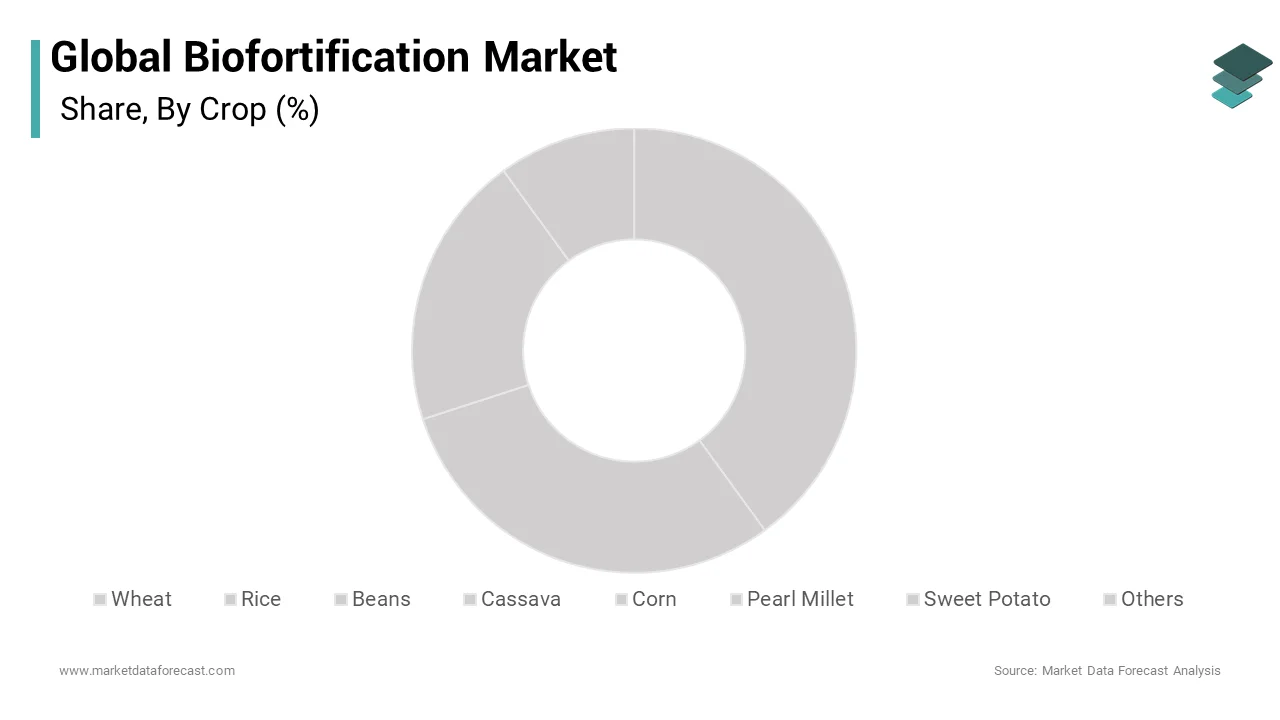
The sweet potato segment accounted for the biggest percentage of the biofortified crop marketplace in 2018. The demand for biofortified crops such as sweet potato and cassava has increased with technological advances to increase nutrient content, particularly in sweet potato orange pulp (OFSP). Sweet potatoes have been an important source of energy in the human diet for centuries due to their high carbohydrate content. However, its vitamin A content from carotene was only recognized in the last century. Through the use of biofortification, the cultivation of sweet potatoes in Africa focuses on higher yields, sweeter taste, and higher dry matter, which increases their concentration of carotene.
By Target Nutrients Insights
Based on the target nutrient, the biofortification market is segmented into iron, zinc, vitamins, and others. The nutrients segment is the quickest developing goal nutrient within the biofortification marketplace. The call for biofortified plants is growing because of the growing need for excessive nutrient content in food. The increasing demand for vitamins as feed additives or premixes from the animal nutrition industry and the growing need for high-quality meat products have also been key factors responsible for the augmented demand for vitamins in the worldwide industry.
REGIONAL ANALYSIS
The North American markets have enormous growth potential. The introduction of new technologies in agricultural activities in countries such as the United States, Canada, Mexico, and others has contributed, in particular, to the growth of regional markets. Asia-Pacific is the dominant region in the global biofortification market and will likely continue to dominate in the future. Also, biofortification has enormous growth potential in agricultural activities and improves the nutritional value of food content. The biofortification market in the APAC region has grown significantly over the past five years, and this trend is foreseen to continue over the next decade. Thus, the growing consumer demand for food ingredients with high nutritional value will drive the demand for biofortified crops in the area, thus driving the growth of the global biofortification market.
KEY MARKET PLAYERS
Some of the market players dominate the global biofertilization market.
- Agro Biosciences Inc.
- BASF SE
- Bayer AG
- Charles River
- HarvestPlus
- Intertek Group plc
- LemnaTec GmbH
- Monsanto Company
- Syngenta
RECENT MARKET NEWS
A dip in India's ranking on the Global Hunger Index (GHI) has rightly caused a sensation in the country. The continuous focus on calories and ignorance of the nutritional aspects of food are responsible for the distressed state of our country's food and nutritional system.
Strong partnerships are key to making healthy diets affordable and addressing global nutritional challenges, says Natalia Palacios, a CIMMYT researcher, at the Africa Green Revolution Forum 2020.
MARKET SEGMENTATION
This research report on the global biofortification market is segmented and sub-segmented into the following categories.
By Method
- Plant Breeding Techniques
- Agronomical Practices
- Biotechnological Methods
By Crop
- Wheat
- Rice
- Beans
- Cassava
- Corn
- Pearl Millet
- Sweet Potato
- Others
By Target Nutrients
- Zinc
- Vitamins
- Iron
- Proteins
- Others
By Region
- North America
- Europe
- Asia Pacific
- Latin America
- Middle East & Africa