- Product Description Description
- Table of Contents TOC
- List of Table & Figure LOT
- Get Free Sample PDF Sample PDF
Market Size, 2025
$17.71 BnMarket Estimate, 2026
$18.66 BnMarket Forecast, 2034
$28.38 BnCAGR, 2026–2034
5.38%Global Pneumatic Components Market Report Summary
The global pneumatic components market was valued at USD 17.71 billion in 2025, is estimated to reach USD 18.66 billion in 2026, and is projected to reach USD 28.38 billion by 2034, growing at a CAGR of 5.38% during the forecast period from 2026 to 2034. The growth of the global pneumatic components market is driven by increasing industrial automation, expanding automotive manufacturing, and rising demand for energy-efficient motion control solutions. Growing adoption of pneumatic systems across food and beverage processing, packaging, electronics manufacturing, and material handling industries is further fueling market growth. Moreover, advancements in smart pneumatic technologies, Industry 4.0 integration, and increasing investments in intelligent factory automation are supporting the expansion of the global pneumatic components market.
Key Market Trends
-
Rising adoption of smart pneumatic systems integrated with IoT and Industry 4.0 technologies for predictive maintenance and real-time monitoring.
-
Growing demand for pneumatic automation across automotive manufacturing and high-speed assembly lines.
-
Increasing use of hygienic pneumatic components in food and beverage processing to comply with stringent safety standards.
-
Strong focus on developing energy-efficient pneumatic systems to reduce compressed air consumption and operational costs.
-
Expansion of industrial automation across emerging economies, driving demand for advanced pneumatic valves, cylinders, and air treatment components.
Segmental Insights
- Based on component type, the pneumatic valves segment was the largest and held a significant share of the global pneumatic components market in 2025. The segment’s dominance is attributed to its critical role in regulating airflow, pressure, and direction within automated manufacturing systems, along with increasing adoption across automotive assembly, packaging machinery, and industrial automation applications.
- Based on application, the machinery segment accounted for 36.4% of the global pneumatic components market share in 2025. The dominance of this segment stems from the extensive use of pneumatic actuators, cylinders, and valves in CNC machines, injection molding equipment, automated assembly systems, and industrial machinery requiring reliable and high-speed motion control.
- The electronics segment is projected to witness the fastest growth during the forecast period owing to increasing automation in semiconductor manufacturing, printed circuit board assembly, cleanroom operations, and precision electronic component handling that require compact, contamination-free pneumatic solutions.
Regional Insights
The global pneumatic components market is witnessing steady growth across major regions, supported by increasing industrial automation, smart manufacturing initiatives, and rising investments in advanced production technologies.
- Asia-Pacific was the largest contributor, accounting for 48.3% of the global pneumatic components market share in 2025, driven by its extensive manufacturing base, rapid industrialization, strong automotive production, expanding electronics industry, and increasing adoption of Industry 4.0 technologies across China, Japan, India, and Southeast Asia.
- Europe remained a significant market, supported by advanced manufacturing capabilities, strong adoption of smart pneumatics, stringent industrial efficiency standards, and the presence of leading pneumatic component manufacturers.
- North America continues to perform well, fueled by reshoring of manufacturing activities, increasing warehouse automation, growing food processing industry, and rising investments in industrial robotics and smart factories.
- Latin America is witnessing steady expansion due to increasing industrial automation, growing automotive manufacturing, and rising investments in mining and food processing industries.
- The Middle East and Africa is also emerging as a promising market, supported by industrial diversification initiatives, expanding manufacturing infrastructure, and increasing investments in automation across oil & gas, logistics, and industrial sectors.
Competitive Landscape
The global pneumatic components market is characterized by the presence of well-established multinational manufacturers competing through technological innovation, smart automation solutions, product reliability, and global distribution capabilities. Leading companies are focusing on developing IoT-enabled pneumatic systems, expanding regional manufacturing facilities, strengthening digital engineering capabilities, and introducing energy-efficient pneumatic solutions aligned with Industry 4.0 requirements. Strategic partnerships, product customization, and investments in sustainable automation technologies continue to strengthen competition across the global pneumatic components market. Prominent players in the global pneumatic components market include Festo SE & Co. KG, Bosch Rexroth AG, SMC Corporation, Airtac International Group, Norgren, Inc., CKD Corporation, Parker Hannifin Corporation, JELPC (Ningbo Jiaerling Pneumatic Machinery Co., Ltd.), Fenghua Yaguang Pneumatic Element Co., Ltd., Zhaoqing Fangda Pneumatic Co., Ltd., Camozzi Group, Wuxi Huatong Pneumatic Manufacture Co., Ltd., Easun Pneumatic Science & Technology, and CNSNS.
Global Pneumatic Components Market Size
The global ethylene market size was valued at USD 17.71 billion in 2025 and is anticipated to reach USD 18.66 billion in 2026 from USD 28.38 billion by 2034, growing at a CAGR of 5.38% during the forecast period from 2026 to 2034.
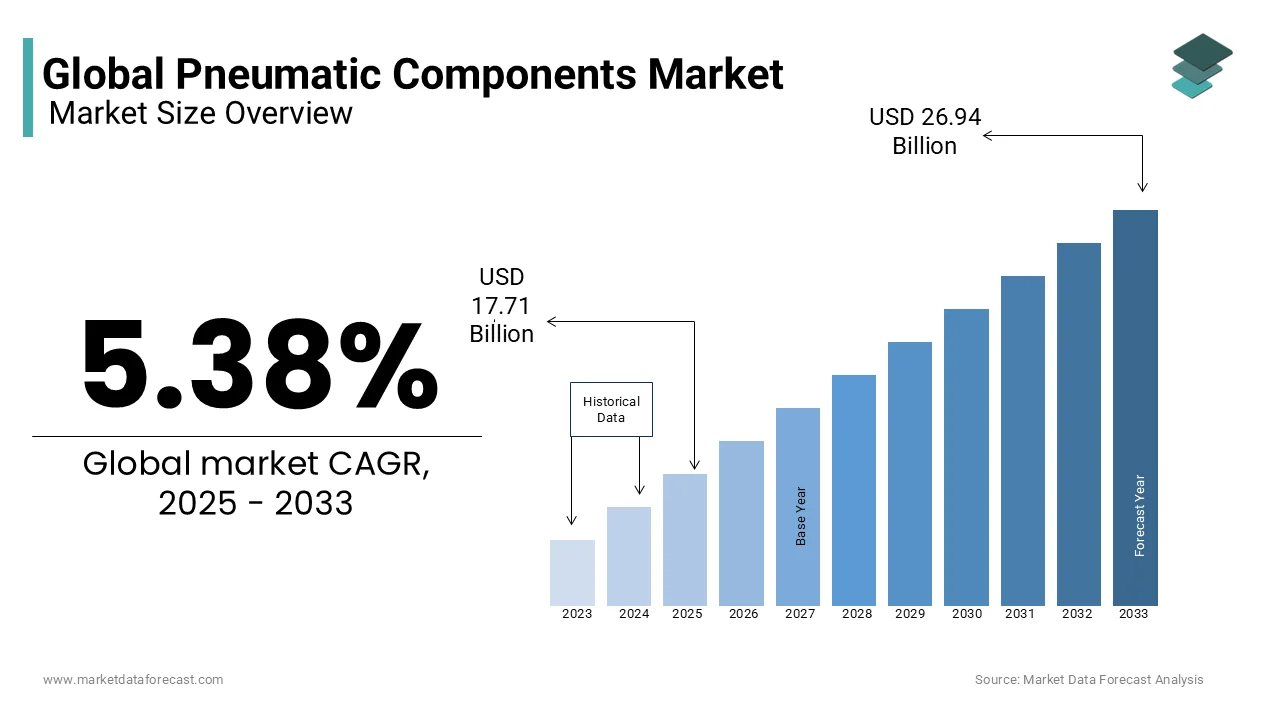
The Pneumatic Components are devices such as valves, cylinders, actuators, compressors, and air preparation units that utilize compressed air to generate mechanical motion in industrial automation systems. These components are fundamental to precise, reliable, and energy-efficient operations across manufacturing, automotive assembly, packaging, and material handling sectors. Unlike hydraulic or electric alternatives, pneumatic systems offer intrinsic safety in explosive environments, resistance to extreme temperatures, and lower maintenance demands. According to the International Organization for Standardization (ISO), over 80% of automated production lines in the automotive industry rely on pneumatic actuation for repetitive tasks such as clamping, pressing, and sorting.
MARKET DRIVERS
Expansion of Automotive Manufacturing and Assembly Automation
The global automotive industry’s shift toward high-speed, precision-based production lines is majorly driving the growth of the Pneumatic Components Market. According to the International Organization of Motor Vehicle Manufacturers (OICA), over 89 million vehicles were produced worldwide in 2023, with each vehicle requiring an average of 150 to 200 pneumatic components during assembly. Robotic welding cells, paint shop conveyors, and door-sealing operations depend heavily on pneumatic actuators for consistent force application and durability under continuous operation. The Society of Motor Manufacturers and Traders (SMMT) reported that modern automotive plants deploy over 5,000 pneumatic cylinders per production line, particularly in body-in-white and final assembly zones.
Rising Adoption of Pneumatics in Food and Beverage Processing
The food and beverage industry increasingly relies on pneumatic components due to their hygienic design, ease of cleaning, and compliance with stringent safety standards, which additionally enhances the growth of the Pneumatic Components Market. As per the European Hygienic Engineering and Design Group (EHEDG), over 70% of filling, capping, and labeling machines in European food plants use pneumatic actuators to avoid contamination risks associated with oil leakage in hydraulic systems. Stainless steel pneumatic valves and rodless cylinders, compliant with 3-A Sanitary Standards, are now standard in dairy, beverage, and pharmaceutical packaging lines. The U.S. Food and Drug Administration (FDA) has documented that pneumatic systems reduce microbial retention by up to 40% compared to electric actuators in wet processing environments. Moreover, the Food and Agriculture Organization (FAO) estimates that global food processing automation will grow by 6.8% annually through 2030, driven by labor shortages and the need for traceability.
MARKET RESTRAINTS
Energy Inefficiency and Environmental Impact of Compressed Air Systems
Pneumatic systems are inherently less energy-efficient than electric alternatives, with energy losses often exceeding 30% during air compression and distribution, which poses a great challenge for the growth of the Pneumatic Components Market. According to the U.S. Department of Energy, compressed air systems account for nearly 12% of total electricity consumption in industrial facilities, yet only 19% of input energy is converted into useful mechanical work. Leakage rates in poorly maintained pneumatic networks can reach 25–30%, as reported by the European Commission’s Energy Efficiency Directive monitoring framework. These inefficiencies increase operational costs and carbon footprints, contradicting corporate sustainability goals.
Increasing Competition from Electromechanical Actuation Technologies
The electromechanical systems are gaining traction in automation due to their superior precision, programmability, and energy efficiency, displacing traditional pneumatic solutions in certain applications, which is directly hampering the growth of the Pneumatic Components Market. According to the Motion Control Association (MCA), the global market for electric actuators grew at a compound annual rate of 9.3% between 2020 and 2023, outpacing pneumatic component growth in high-tech manufacturing sectors. In semiconductor fabrication, where sub-micron positioning accuracy is required, over 95% of linear motion systems now use electric actuators, as noted by the Semiconductor Industry Association (SIA).
MARKET OPPORTUNITIES
Integration of Smart Pneumatics in Industry 4.0 and IoT-Enabled Factories
The evolution of Industry 4.0 presents a transformative opportunity for pneumatic components through the development of intelligent, sensor-equipped systems capable of real-time monitoring and predictive maintenance. According to the Industrial Internet Consortium (IIC), over 60% of new industrial automation projects in Germany and Japan now include smart pneumatic subsystems with embedded pressure, position, and flow sensors. Companies like Festo and SMC have introduced IO-Link-enabled valves and cylinders that transmit performance data directly to central control systems, reducing unplanned downtime by up to 35%, as validated by the German Engineering Federation (VDMA). The International Society of Automation (ISA) reports that predictive maintenance using smart pneumatics can extend component lifespan by 25–40%.
Growth in Emerging Markets with Expanding Industrial Infrastructure
The rapid industrialization in Southeast Asia, India, and parts of Africa is creating substantial demand for cost-effective, durable automation solutions, which is positioning pneumatic components as a preferred choice. According to the United Nations Industrial Development Organization (UNIDO), industrial output in developing economies grew by 5.7% in 2023, with manufacturing investments surging in Vietnam, Bangladesh, and Indonesia. The ASEAN Secretariat noted that over 80% of new packaging and textile machinery installations in the region utilize pneumatic controls due to their simplicity and resilience in variable power and environmental conditions. In India, the Ministry of Heavy Industries reported that pneumatic component imports rose by 22% in 2023, driven by the expansion of automotive and consumer goods manufacturing under the Production-Linked Incentive (PLI) scheme.
MARKET CHALLENGES
Supply Chain Vulnerability for Precision Pneumatic Components
The production of high-performance pneumatic components relies on specialized materials and precision machining, which makes the supply chain susceptible to geopolitical and logistical disruptions shall posing a challenge for the pneumatic components market players. According to the Institute for Supply Management (ISM), 43% of industrial automation firms faced delays in pneumatic valve and cylinder deliveries in 2023 due to semiconductor shortages affecting integrated sensor modules. Japan and Germany, which produce over 60% of the world’s high-end pneumatic valves as per the International Trade Centre (ITC), experienced export bottlenecks during port congestion in 2022–2023. Additionally, rare earth elements used in sealing materials and coatings are subject to export restrictions, as per the U.S. Geological Survey. These dependencies increase lead times and procurement risks for manufacturers in North America and Europe relying on Asian suppliers.
Skilled Labor Shortage in Pneumatic System Design and Maintenance
The optimization of performance and troubleshooting complex networks requires specialized engineering expertise which hinders the growth of the pneumatic components market. According to the European Association of Craft, Small and Medium-Sized Enterprises (UEAPME), 58% of technical schools in EU member states have reduced training in fluid power systems, leading to a deficit of certified pneumatic technicians. The U.S. Bureau of Labor Statistics projects a 14% shortfall in industrial maintenance personnel by 2028, with pneumatics expertise among the most underrepresented skills. The Fluid Power Society (FPS) reports that improper installation and lack of preventive maintenance account for over 50% of pneumatic system failures in manufacturing plants. This knowledge gap hampers system efficiency and increases downtime, discouraging new adopters.
REPORT COVERAGE
| REPORT METRIC | DETAILS |
| Market Size Available | 2025 to 2034 |
| Base Year | 2025 |
| Forecast Period | 2026 to 2034 |
| CAGR | 5.38% |
| Segments Covered | By Component Type, Application, and Region. |
| Various Analyses Covered | Global, Regional, and Country Level Analysis, Segment-Level Analysis, DROC, PESTLE Analysis, Porter’s Five Forces Analysis, Competitive Landscape, Analyst Overview of Investment Opportunities |
| Regions Covered | North America, Europe, APAC, Latin America, Middle East & Africa |
| Market Leaders Profiled | Festo SE & Co. KG, Bosch Rexroth AG, SMC Corporation, Airtac International Group, Norgren, Inc., Ckd Corp., Parker Hannifin Corporation, JELPC (Ningbo Jiaerling Pneumatic Machinery Co., Ltd.), Fenghua Yaguang Pneumatic Element Co, Ltd., Zhaoqing Fangda pneumatic Co. Ltd., Camozzi Group, Wuxi Huatong Pneumatic Manufacture Co, Ltd, Easun Pneumatic Science & Technology, and CNSNS, and Others. |
SEGMENTAL ANALYSIS
By Component Type Insights
The pneumatic valves segment held 44.3% of the global pneumatic components market share in 202,4 as control units in pneumatic systems, regulating the flow, pressure, and direction of compressed air across diverse industrial applications. These components are indispensable in automation sequences requiring precise timing and actuation, such as robotic arms, conveyor sorting, and packaging machinery. According to the German Engineering Federation (VDMA), over 90% of industrial automation cells in Europe integrate solenoid-operated pneumatic valves for process control, with an average of 12 to 18 valves per machine. The U.S. Department of Commerce further notes that the adoption of programmable logic controller (PLC)-linked valve terminals has increased by 37% in American manufacturing plants since 2021, enhancing system responsiveness.
The pneumatic cylinders segment is lucratively growing with an expected CAGR of 6.8% from 2025 to 2033, owing to the rising demand for linear motion systems in high-speed assembly and material handling applications. Cylinders offer unmatched reliability in repetitive push-pull operations, particularly in automotive, food processing, and pharmaceutical packaging lines. The Fraunhofer Institute for Manufacturing Engineering and Automation reports that over 75% of pick-and-place robots in German factories use compact pneumatic cylinders due to their high force-to-size ratio and resistance to shock loads. Additionally, the ASEAN Secretariat documented a 29% increase in cylinder installations in Southeast Asian electronics manufacturing between 2021 and 2023, fueled by rising automation in semiconductor testing and component insertion.
By Application Insights
The machinery sector was the largest and held 36.4% of the pneumatic components market share in 2024 with the widespread use of pneumatics in industrial machines such as CNC presses, injection molding systems, and automated assembly units. Pneumatic actuators and valves are preferred in machinery due to their ability to deliver consistent force under variable loads and their resilience in high-vibration environments. According to the European Association of Automotive Suppliers (CLEPA), over 68% of machine tools in EU manufacturing facilities utilize pneumatic clamping systems to secure workpieces during precision machining. The U.S. Bureau of Economic Analysis reported that capital investment in industrial machinery rose by 8.3% in 2023, directly stimulating demand for integrated pneumatic solutions.
The electronics industry is anticipated to grow at a CAGR of 7.2% from 2025 to 2033 with the expanding automation of semiconductor fabrication, printed circuit board (PCB) assembly, and micro-component handling. Pneumatic systems are critical in cleanroom environments where non-sparking, low-particulate actuators are required to prevent contamination. The Semiconductor Industry Association (SIA) reported that over 55% of wafer transfer and die-bonding processes in U.S. fabs rely on precision pneumatic linear slides and vacuum grippers. In South Korea, Samsung Electronics increased its deployment of miniaturized pneumatic modules by 40% in 2023 to enhance yield rates in advanced chip packaging. Additionally, the Taiwan Institute of Economic Research noted that automation levels in electronics manufacturing have reached 78%, with pneumatics enabling sub-millisecond response times in pick-and-place robotics.
REGIONAL ANALYSIS
Asia Pacific was the top performer in the global pneumatic components market with 48.3% of the share in 2024 with its vast manufacturing base, rapid industrial automation, and government-backed smart factory initiatives. China alone accounts for over 30% of global industrial robot installations, according to the International Federation of Robotics, with each robot utilizing an average of 15 to 20 pneumatic components. Japan remains a technological leader, with SMC Corporation and CKD Corporation supplying over 60% of high-precision valves used in Asian electronics manufacturing. India’s production-linked incentive (PLI) scheme has spurred a 24% increase in domestic machinery production, as per the Ministry of Commerce and Industry, driving demand for cost-effective pneumatic systems. Additionally, ASEAN’s push toward export-oriented manufacturing has led to a surge in pneumatic component imports, with Vietnam recording a 33% year-on-year growth in pneumatic system installations in 2023, according to the Vietnam Chamber of Commerce and Industry.
Europe's pneumatic components market was ranked second by capturing 27.4% of the market share in 2024. The region’s pneumatic industry is characterized by technological sophistication, stringent safety standards, and deep integration with Industry 4.0 frameworks. Germany, the largest market in Europe, produces over 40% of the continent’s pneumatic components, with companies like Festo and Bosch Rexroth leading in smart pneumatics development. The German Engineering Federation (VDMA) reported that 72% of new automation systems in German factories now include IO-Link-enabled pneumatic devices for real-time diagnostics. Additionally, the European Commission’s Green Deal Industrial Plan has accelerated investments in energy-efficient pneumatic systems, with over 500 manufacturing plants retrofitting compressed air networks to meet EU ErP Directive standards.
The North America pneumatic components market is eventually to witness a highest CAGR during the forecast period with the revitalized industrial manufacturing, reshoring initiatives, and growing automation in logistics and food processing. The U.S. Census Bureau recorded a 9.1% increase in durable goods manufacturing output in 2023, directly boosting demand for pneumatic control systems. The Material Handling Industry (MHI) reported that over 65% of new warehouse automation systems in North America use pneumatic actuators for sorting and diverting packages. Canada’s investment in pharmaceutical manufacturing, supported by the Strategic Innovation Fund, has led to a 22% rise in hygienic pneumatic component usage in sterile environments, as documented by Innovation, Science and Economic Development Canada.
Latin America pneumatic component market growth is expected to grow steadily in the coming years. Brazil’s National Confederation of Industry reported that 58% of industrial firms increased automation spending in 2023, with pneumatic systems favored for their durability in tropical climates. The Mexican Automotive Industry Association (AMIA) noted that over 120,000 pneumatic cylinders were installed in new production lines at foreign-owned auto plants in 2023. Chile’s mining sector, a major industrial user, employs pneumatic tools in 70% of underground operations due to their explosion-proof characteristics, as per the Chilean Mining Council.The
Middle East & Africa pneumatic components market growth is driven by industrial diversification efforts in the Gulf Cooperation Council (GCC) and localized manufacturing growth in South Africa. Saudi Arabia’s Vision 2030 includes a $40 billion investment in non-oil industrial capacity, with NEOM’s manufacturing zones incorporating advanced pneumatic automation, as confirmed by the Saudi Authority for Industrial Cities and Technology Zones (MODON).
KEY MARKET PLAYERS
Companies playing a prominent role in the global pneumatic components market include
- Festo SE & Co. KG
- Bosch Rexroth AG
- SMC Corporation
- Airtac International Group
- Norgren, Inc.
- CKD Corporation
- Parker Hannifin Corporation
- JELPC (Ningbo Jiaerling Pneumatic Machinery Co., Ltd.)
- Fenghua Yaguang Pneumatic Element Co., Ltd.
- Zhaoqing Fangda Pneumatic Co., Ltd.
- Camozzi Group
- Wuxi Huatong Pneumatic Manufacture Co., Ltd.
- Easun Pneumatic Science & Technology
- CNSNS
- Others
COMPETITIVE LANDSCAPE
The competition in the pneumatic components market is marked by a blend of technological differentiation, regional specialization, and strategic agility. Global leaders such as Festo, SMC, and Bosch Rexroth compete with regional manufacturers on precision, durability, and digital integration. While established players dominate through innovation in smart pneumatics and energy efficiency, mid-tier firms gain traction by offering cost-effective solutions for emerging markets. The rise of Industry 4.0 has intensified the race to embed intelligence into valves and cylinders, enabling predictive maintenance and real-time diagnostics. Geopolitical shifts and supply chain localization are prompting companies to expand production closer to end-users. Additionally, sustainability mandates are pushing firms to redesign systems for lower air consumption.
Top Players in the Pneumatic Components Market
Festo SE & Co. KG
Festo has established a formidable presence in the Asia Pacific by aligning its pneumatic innovation with the region’s rapid industrial automation drive. The company has expanded its production and R&D facilities in China, India, and South Korea, focusing on smart pneumatics integrated with IoT and Industry 4.0 protocols. In 2023, Festo launched its CPX-AP-I decentralized automation system in Singapore, enabling real-time monitoring of pneumatic valve performance for semiconductor and electronics manufacturers. The company also partnered with technical universities in Japan and Thailand to develop training programs in fluid power engineering, addressing the regional skills gap. Its BionicSoftArm, powered by pneumatic muscle actuators, is being piloted in Japanese cleanroom environments for delicate assembly tasks.
SMC Corporation
SMC Corporation dominates the Asia Pacific pneumatic components landscape through its extensive local manufacturing footprint and deep integration into regional supply chains. Headquartered in Japan, the company operates over 20 production sites across China, India, and Southeast Asia, ensuring rapid delivery and customization for OEMs. In 2023, SMC introduced its next-generation VQ10 series solenoid valves in Taiwan, designed for energy-efficient operation in automated test equipment used in semiconductor packaging. The company also launched a digital catalog with AI-powered selection tools, adopted by over 15,000 engineers across the region within six months. SMC’s collaboration with Thailand’s Eastern Economic Corridor (EEC) has led to the deployment of smart pneumatic systems in new robotics clusters.
CKD Corporation
CKD Corporation has strengthened its foothold in the Asia Pacific by specializing in high-precision pneumatic and fluid control systems for advanced manufacturing. The company has significantly expanded its presence in China and India, where it supplies customized valve and cylinder solutions for automotive assembly and semiconductor equipment. In 2023, CKD unveiled its ZSE2 series electric-pneumatic regulators in South Korea, enhancing process control accuracy in display panel production lines. The company also established a new technical support center in Malaysia to serve the growing demand from electronics manufacturers in Penang and Johor. CKD’s integration of sensing and feedback mechanisms into compact pneumatic modules has made its products essential in automated optical inspection systems.
Top Strategies Used by Key Market Participants
Key players in the pneumatic components market are leveraging product innovation, regional localization, digital integration, strategic partnerships, and sustainability-driven engineering to promote their competitive standing. Companies are investing heavily in smart pneumatics equipped with sensors and IoT connectivity to meet Industry 4.0 demands. Expanding local manufacturing and technical support centers in high-growth regions like the Asia Pacific reduces lead times and enhances customization. Firms are also integrating AI-powered selection tools and digital twins into their service offerings to improve design efficiency. Collaborations with academic institutions and industrial consortia help shape standards and workforce training. Additionally, developing energy-efficient components aligns with global decarbonization goals, strengthening client retention in regulated markets.
RECENT HAPPENINGS IN THE MARKET
- In January 2023, Festo opened a new AI-driven automation hub in Shanghai, integrating pneumatic system testing with machine learning algorithms to optimize performance for Chinese robotics manufacturers.
- In April 2023, SMC Corporation launched its EcoFlow series of energy-saving pneumatic valves in India, designed to reduce compressed air consumption by up to 25% in packaging and textile machinery.
- In August 2023, CKD Corporation partnered with a South Korean semiconductor equipment maker to co-develop ultra-compact pneumatic modules for wafer handling in cleanroom environments.
- In February 2024, Festo introduced the CPX-AP-I decentralized control system in Singapore by enabling real-time diagnostics and remote monitoring of pneumatic valves in high-tech manufacturing.
- In June 2024, SMC Corporation expanded its production facility in Vietnam to double output capacity for solenoid valves, which is catering to rising automation demand in Southeast Asian electronics factories.
MARKET SEGMENTATION
This research report on the global pneumatic components market has been segmented and sub-segmented based on component type, application, and region.
By Component Type
- Air Treatment Components
- Pneumatic Valves
- Pneumatic Cylinders
By Application
- Electronics
- Chemical Industry
- Machinery
- Others
By Region
- North America
- Europe
- Asia Pacific
- Latin America
- Middle East & Africa