- Product Description Description
- Table of Contents TOC
- List of Table & Figure LOT
- Get Free Sample PDF Sample PDF
Market Size, 2025
$6.48 BnMarket Estimate, 2026
$7.01 BnMarket Forecast, 2034
$13.08 BnCAGR, 2026–2034
8.12%Global Position Sensor Market Size, Growth, Trends & Forecast (2026–2034)
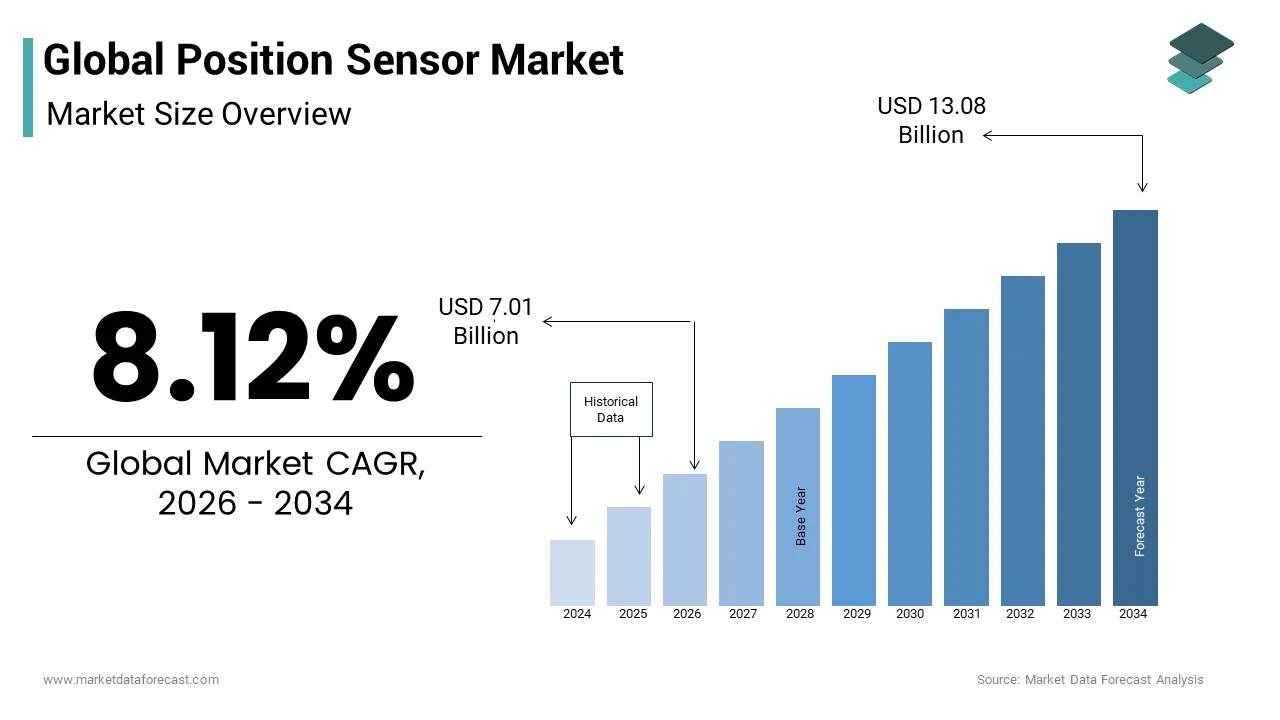
The global position sensor market size was valued at USD 6.48 billion in 2025, is anticipated to reach a valuation of USD 7.01 billion in 2026, and is projected to expand up to USD 13.08 billion by 2034, registering a compound annual growth rate (CAGR) of 8.12% during the forecast period from 2026 to 2034. Growth is primarily propelled by the proliferation of electric vehicles (EVs), the expansion of industrial automation and robotics, and the integration of smart sensors with IoT-enabled predictive maintenance systems.
Key Executive Metrics (At-a-Glance)
- 2025 Base Valuation: USD 6.48 Billion
- 2026 Current Valuation: USD 7.01 Billion
- 2034 Forecast Valuation: USD 13.08 Billion
- Compound Annual Growth Rate (CAGR): 8.12% (2026–2034)
- Dominant Type Segment: Rotary Sensors (accounting for 46.2% share in 2025)
- Dominant Application Segment: Agricultural Vehicles & Self-Propelled Machinery
- Regional Growth Leader: North America (capturing 46.3% market share in 2025)
Core Market Drivers
- EV and ADAS Proliferation: Increasing deployment of electric vehicles and advanced driver assistance systems requiring precise motor commutation, steering angle detection, and throttle control.
- Industrial Automation Expansion: Worldwide growth in industrial robotics installations demanding real-time feedback for closed-loop motion control.
- IoT & Predictive Maintenance Integration: Transition toward Industry 4.0, embedding digital interfaces in sensors to detect minute mechanical wear and prevent downtime.
Primary Market Restraints & Challenges
- High R&D and Development Costs: Substantial capital expenses required to design miniaturized, high-precision sensors for small and medium enterprises.
- Electromagnetic Interference (EMI): Signal degradation risks from strong magnetic fields generated by EV high-voltage batteries and traction motors.
- Rare Earth Supply Chain Volatility: Heavy geopolitical reliance on critical materials like neodymium and samarium-cobalt magnets.
Global Position Sensor Market Segmentation Breakdown
| Segment Category | Key Offerings / Categories | Largest Segment | Fastest Growing Segment |
|---|---|---|---|
| By Type | Linear Position Sensors, Rotary Position Sensors, Others | Rotary Position Sensors (46.2% in 2025) | Linear Position Sensors (12.3% CAGR) |
| By Contact Type | Non-Contact Type, Contact Type | Non-Contact Type | Non-Contact Type |
| By Output | Digital, Analog | Digital | Digital |
| By End Users | Automotive, Electronics, Military & Aerospace, Manufacturing, Packaging, Others | Automotive | Electronics / Medical Robotics |
| By Region | North America, Asia Pacific, Europe, Latin America, Middle East & Africa | North America (46.3% in 2025) | Asia Pacific |
Major Industry Players Profiled
Key market competitors dominating the global position sensor market include Honeywell International Inc., SICK AG, AMS AG, TE Connectivity Ltd., MTS Systems, Vishay Intertechnology, Infineon Technologies, STMicroelectronics, Bourns, Allegro MicroSystems, Inc., Panasonic Corporation, Qualcomm Technologies, Inc., Dr. Johannes Heidenhain GmbH, and Hans Turck GmbH & Co. KG.
 Download Free Sample Report
Global Position Sensor Market Size
The global position sensor market size was valued at USD 6.48 billion in 2025 and is anticipated to reach a valuation of USD 7.01 billion in 2026 and USD 13.08 billion by 2034, growing at a CAGR of 8.12 % during the forecast period from 2026 to 2034.
Position Sensor Market Comprehensive Analysis
The position sensor is electromechanical and electronic device designed to detect the linear or angular displacement of an object relative to a reference point. These sensors are components in automation robotics automotive systems and aerospace applications where precise motion control is paramount. Technologies, such as Hall effect magneto resistive capacitive and optical encoders form the backbone of this industry enabling real time feedback for closed loop control systems. In the automotive sector, the European Automobile Manufacturers Association states that modern vehicles contain over 100 sensors each with position sensors playing a vital role in throttle control steering angle detection and suspension management. The aviation industry also depends on these devices for flight control surfaces with the Federal Aviation Administration mandating redundant sensor systems for safety critical applications. As per the German Engineering Federation, approximately 65% of manufacturing enterprises in Europe have implemented some form of industrial automation driving demand for high accuracy position feedback mechanisms. The transition toward Industry 4.0 and smart factories necessitates sensors with higher resolution durability and connectivity capabilities. This technological evolution reflects broader industrial priorities focused on enhancing operational efficiency reducing downtime and maintaining stringent quality standards in increasingly complex mechanical systems.
MARKET DRIVERS
Proliferation of Electric Vehicles and Advanced Driver Assistance Systems
The rapid adoption of electric vehicles and the integration of advanced driver assistance systems due to the increased complexity of powertrain and chassis control is fuelling the growth of the position sensor market. According to the International Energy Agency, global electric car sales surpassed 14 million units in 2023 representing a significant shift in automotive architecture that requires precise motor control. Electric motors rely on rotary position sensors, such as resolvers and encoders to commutate currents accurately ensuring optimal torque and efficiency. Data from the Society of Motor Manufacturers and Traders indicates that electric vehicles utilize up to twice as many position sensors as conventional internal combustion engine vehicles for applications including pedal position throttle valve and gear selection. The implementation of steer by wire and brake by wire technologies further amplifies demand as these systems eliminate mechanical linkages and depend entirely on electronic signals for operation. The European New Car Assessment Program mandates strict safety standards for autonomous features requiring redundant sensor inputs to prevent system failure. Automotive suppliers are increasingly integrating magnetic position sensors due to their robustness against dust moisture and temperature variations which are common in under hood environments. As vehicle electrification accelerates, the need for high precision compact and cost effective position sensing solutions will continue to drive market expansion across the global automotive supply chain.
Expansion of Industrial Automation and Robotics Infrastructure
The global expansion of industrial automation and robotics infrastructure for high precision position sensors essential is additionally promoting the growth of the position sensor market. According to the International Federation of Robotics, worldwide installations of industrial robots reached 553000 units in 2022. Each robotic arm typically incorporates multiple rotary and linear position sensors to monitor joint angles and end effector positions ensuring precise movement and coordination. Data from the American National Standards Institute indicates that collaborative robots which operate alongside human workers require enhanced safety features including sensitive position monitoring to detect unexpected contacts. The semiconductor industry also contributes significantly with equipment manufacturers relying on nanometer level accuracy for wafer handling and lithography processes. Position sensors enable predictive maintenance by detecting minute deviations in mechanical alignment before they lead to failures. As industries strive for higher throughput and zero defect production, the reliance on advanced sensing technologies becomes indispensable. The trend toward miniaturization in electronics manufacturing further necessitates sensors with smaller footprints and higher resolution capabilities.
MARKET RESTRAINTS
High Development Costs for Miniaturized High Precision Sensors
The substantial research and development costs associated with creating miniaturized high precision position sensors for small and medium sized enterprises is impeding the growth of the position sensor market. Developing sensors that maintain accuracy in sub-millimeter packages while withstanding harsh environmental conditions requires advanced materials science and microelectromechanical systems technology. According to the Semiconductor Industry Association, the average cost of developing a new specialized sensor chip can exceed 50 million dollars due to complex fabrication processes and rigorous testing requirements. Small manufacturers often lack the financial resources to invest in such extensive R&D programs limiting their ability to compete with established giants. The need for continuous innovation to keep pace with shrinking component sizes in consumer electronics and medical devices further escalates development expenses. Additionally, the shortage of skilled engineers proficient in sensor design and signal processing exacerbates the challenge increasing labor costs. The high barrier to entry discourages new participants from entering the niche high precision segment leading to market consolidation. Consequently, many smaller firms are forced to focus on low cost commoditized products where margins are thinner.
Susceptibility to Electromagnetic Interference in Harsh Environments
The susceptibility of certain position sensor technologies to electromagnetic interference is declining the growth of the position sensor market. Hall effect and magneto resistive sensors, while robust can experience signal degradation when exposed to strong magnetic fields generated by high power motors and inverters. In electric vehicles, the high voltage battery packs and traction motors create intense electromagnetic fields that can distort sensor readings if not properly shielded. Optical sensors are immune to magnetic interference but are vulnerable to dust oil and vibration which are prevalent in heavy machinery and manufacturing plants. The need for ruggedized packaging and signal conditioning circuitry increases the complexity and size of the sensor module. Industries, such as mining and oil and gas require sensors that can operate reliably in extreme conditions without frequent calibration. The lack of universal standards for electromagnetic immunity testing complicates the validation process for new sensor designs. Manufacturers must invest heavily in simulation and testing to ensure compliance with international standards. These technical challenges limit the deployment of sensitive position sensors in certain high noise applications forcing engineers to choose less optimal but more robust alternatives.
MARKET OPPORTUNITIES
Integration with Internet of Things and Predictive Maintenance Systems
The integration of position sensors with Internet of Things platforms and predictive maintenance systems, which is likely to promote new opportunities for the growth of the position sensor market. Modern position sensors are increasingly equipped with digital interfaces and embedded processing capabilities allowing them to transmit real time data to cloud-based analytics platforms. Position data can be analyzed to detect wear patterns misalignment and potential failures in mechanical systems before they occur. This capability is particularly valuable in critical industries, such as aerospace and energy where unplanned outages are costly. Sensor manufacturers are developing standardized communication protocols, such as IO Link and Ethernet IP to facilitate seamless integration with existing industrial networks. The ability to provide actionable insights rather than just raw data transforms position sensors from simple components into intelligent nodes in the digital ecosystem. This shift enables new business models based on service subscriptions and performance guarantees. As industries embrace digital transformation, the demand for smart position sensors with diagnostic capabilities will continue to grow offering higher margins and deeper customer engagement.
Adoption in Medical Robotics and Minimally Invasive Surgery
The growing adoption of medical robotics and minimally invasive surgical techniques due to the need for extreme precision and safety is also to elevate new opportunities for the growth of the position sensor market. Surgical robots require highly accurate position feedback to guide instruments within the human body with sub millimeter precision. These systems rely on advanced optical and magnetic position sensors to track the movement of surgical tools and provide haptic feedback to surgeons.. The development of capsule endoscopy and catheter-based interventions also drives demand for miniature position sensors that can operate within confined spaces. Regulatory bodies such as the US Food and Drug Administration require rigorous validation of sensor accuracy and reliability for medical devices. Manufacturers are innovating with biocompatible materials and sterilizable designs to meet these stringent requirements. The aging global population and rising healthcare expenditure support continued investment in robotic surgical platforms.
MARKET CHALLENGES
Supply Chain Volatility for Rare Earth Materials
The volatility in the supply chain for rare earth materials used in high performance magnetic position sensors is a major challenge for the growth of the position sensor market. Neodymium and samarium cobalt magnets are essential for Hall effect and magneto resistive sensors due to their strong magnetic properties. China controls approximately 60% of global rare earth mining and 85% of processing capacity creating significant geopolitical supply risks, according to the study. Trade restrictions and export quotas can lead to sudden price spikes and shortages disrupting production schedules. Data from the European Raw Materials Alliance indicates that the EU imports 98% of its rare earth needs making it highly vulnerable to supply disruptions. The fluctuating prices of these materials make it difficult for sensor manufacturers to maintain stable pricing for their customers. Automotive and industrial clients often require long term fixed price contracts which are challenging to honor amidst raw material volatility. Companies are exploring alternative magnet materials and sensor technologies such as capacitive and optical systems to reduce dependency on rare earths. However these alternatives often come with trade offs in terms of size cost or performance. The lack of diversified supply sources forces manufacturers to hold larger inventories tying up capital. This supply chain insecurity complicates strategic planning and investment decisions in the position sensor industry.
Complexity of Calibration and Standardization Across Industries
The complexity of calibrating position sensors and the lack of universal standardization, across different industries create significant operational challenges for both manufacturers and end users. This factor is another factor to slow down the growth of the position sensor market. Each application whether in automotive aerospace or industrial automation has unique requirements for accuracy resolution and environmental tolerance. The calibration procedures for high precision sensors can take several hours per unit requiring specialized equipment and skilled technicians. The absence of a single global standard for sensor performance metrics makes it difficult to compare products from different suppliers. Data from the International Organization for Standardization shows that there are over 50 different standards related to position sensing depending on the industry and application. This fragmentation increases the cost of compliance and testing for manufacturers who must certify their products for multiple markets. End users face challenges in integrating sensors from different vendors due to incompatible output signals and communication protocols. The need for frequent recalibration in harsh environments adds to the total cost of ownership and maintenance burden. Automotive manufacturers often impose proprietary standards on suppliers further complicating the design process. The lack of interoperability hinders the development of plug and play solutions that could simplify system integration.
REPORT COVERAGE
| REPORT METRIC | DETAILS |
| Market Size Available | 2025 to 2034 |
| Base Year | 2025 |
| Forecast Period | 2026 to 2034 |
| CAGR | 8.12% |
| Segments Covered | By Type, Contact Type, Output, End-user, and Region. |
| Various Analyses Covered | Global, Regional, & Country Level Analysis; Segment-Level Analysis; DROC, PESTLE Analysis; Porter’s Five Forces Analysis; Competitive Landscape; Analyst Overview of Investment Opportunities |
| Regions Covered | North America, Europe, APAC, Latin America, Middle East & Africa |
| Market Leaders Profiled | Honeywell, SICK AG, AMS AG, TE Connectivity, MTS Systems, Vishay, Infineon Technologies, STMicroelectronics, Bourns, Allegro MicroSystems, Panasonic Corporation, Qualcomm Technologies, Inc., Dr. Johannes Heidenhain GmbH, Hans Turck GmbH & Co.KGg |
SEGMENTAL ANALYSIS
By Type Insights
The rotary sensors segment was accounted in holding 46.2% of the position sensor market share in 2025 due to their extensive integration into automotive powertrain and chassis control systems where angular measurement is important. According to the study, modern vehicles utilize an average of 15 to 20 rotary position sensors for applications, including throttle pedal position crankshaft angle camshaft timing and steering wheel angle detection. The transition toward electric vehicles has further amplified this demand as electric motors require precise rotor position feedback for efficient commutation and torque control. Data from the International Energy Agency indicates that global electric car sales reached 14 million units in 2023 with each vehicle requiring high resolution rotary encoders or resolvers for motor control. The robustness of magnetic rotary sensors against harsh under hood conditions such as extreme temperatures vibration and electromagnetic interference makes them the preferred choice for automotive OEMs. The European Automobile Manufacturers Association notes that safety systems like electronic stability control and anti-lock braking rely heavily on accurate wheel speed and steering angle data provided by rotary sensors. As vehicles become more automated, the number of actuators requiring angular feedback increases driving sustained volume growth. The maturity of manufacturing processes for rotary sensors allows for cost effective mass production meeting the stringent price targets of the automotive industry.
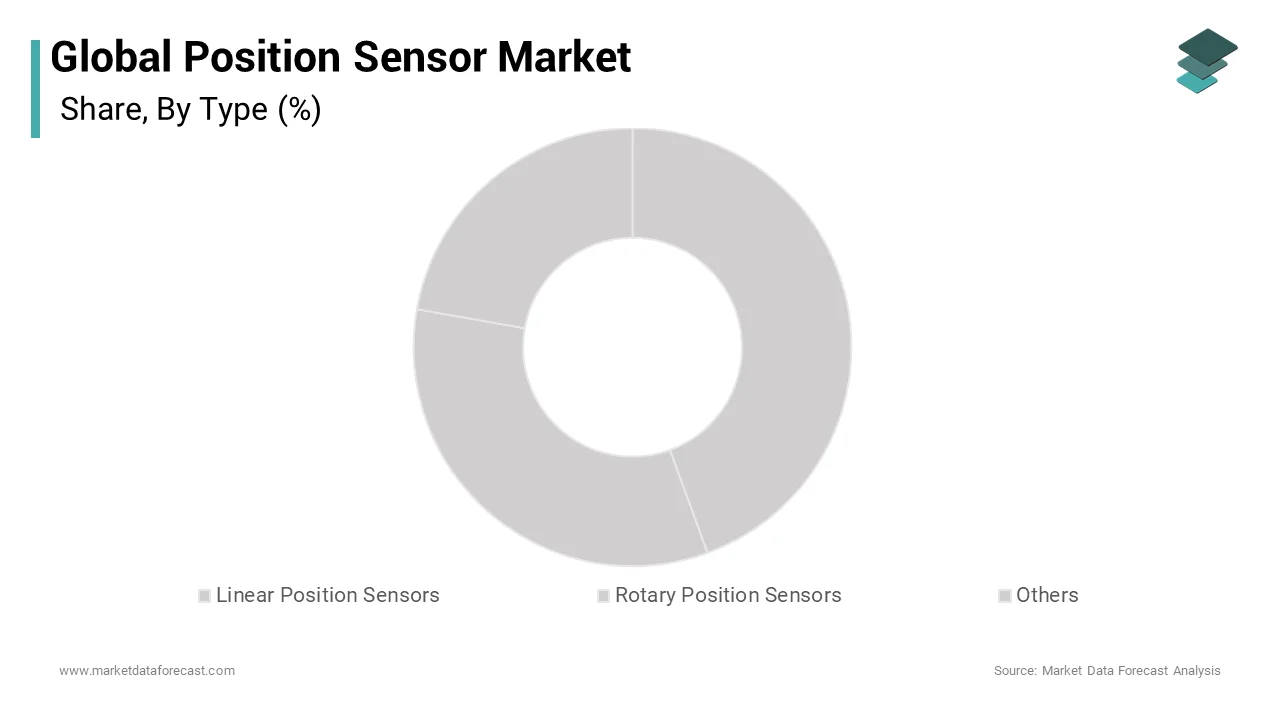
The linear position sensors segment is likely to grow at a fastest CAGR of 12.3% from 2026 to 2034 with the application in electric vehicle battery management and active suspension systems. Linear sensors detect minute changes in battery pack dimensions to prevent mechanical stress and ensure safety. Additionally, the rise of active air suspension systems in premium and electric vehicles necessitates accurate ride height measurement to optimize aerodynamics and comfort. The implementation of brake by wire systems in electric vehicles also drives demand for linear sensors to measure pedal travel and master cylinder position without mechanical linkage. The US Department of Energy emphasizes that precise linear positioning is essential for maximizing the efficiency of electric drivetrains. As automakers strive to improve range and handling, the integration of linear sensors in chassis and powertrain components will accelerate. This technological shift from mechanical to electronic control systems creates a robust growth trajectory for linear position sensors in the automotive sector.
By Application Insights
The agricultural vehicles and self-propelled machinery segment was the largest by accounting for a dominant share of the position sensors market in 2025 with the widespread adoption of precision agriculture technologies and automated steering systems. These sensors enable farmers to maintain straight rows with centimeter level accuracy reducing overlap and saving fuel and seeds. Position sensors are also crucial for controlling hydraulic implements such as planters sprayers and harvesters ensuring consistent depth and spacing. As labor shortages in the agricultural sector intensify, the demand for autonomous and semi autonomous machinery increases. The global food production must increase by 70% by 2050 to feed the growing population driving investment in efficient farming technologies, as per the research. Position sensors play a vital role in optimizing machine performance and resource utilization supporting sustainable agricultural practices.
The livestock position and health monitoring segment is esteemed to register a fastest CAGR of 9.8% during the forecast period with the rise of smart farming practices and stringent animal welfare regulations. The governments worldwide are implementing stricter guidelines for livestock management requiring continuous monitoring of animal behavior and health status. Position sensors embedded in collars ear tags or leg bands track the movement activity and location of individual animals providing insights into estrus cycles illness and grazing patterns. Farmers use this data to optimize breeding schedules detect early signs of disease and improve feed efficiency. The European Union’s Common Agricultural Policy provides subsidies for farmers, who adopt precision livestock farming technologies encouraging wider adoption. Companies, such as Allflex and Moonsyst that offer sensor based solutions that integrate with farm management software to automate decision making. The increasing consumer demand for ethically produced meat and dairy products also drives producers to invest in monitoring systems that demonstrate high welfare standards. As herd sizes grow and labor becomes scarce, the ability to monitor large numbers of animals remotely becomes essential. This trend supports the rapid expansion of position sensors in the livestock sector.
REGIONAL ANALYSIS
North America Market Analysis
North America was the top performer in the global position sensor market by capturing 46.3% of the share in 2025 with the advanced automotive manufacturing and robust industrial automation infrastructure. The United States was the largest contributor with the presence of major automotive OEMs and technology companies drives innovation in sensor technologies for electric vehicles and autonomous systems. Canada contributes to the market growth with its strong aerospace and mining sectors which require high reliability position sensors for important applications. The region benefits from a mature supply chain and skilled workforce facilitating rapid adoption of new technologies. Government initiatives, such as the CHIPS and Science Act in the US promote domestic semiconductor and sensor manufacturing. Strict safety and environmental regulations ensure high quality standards for sensor products.
Europe Market Analysis
Europe position sensor market held second position by holding 31.2% of share in 2025 with the stringent regulatory standards and a strong industrial base in automotive and machinery sectors. Germany position sensor market growth is driven by the automotive industry particularly prominent manufacturers like Volkswagen, BMW, and Mercedes Benz, extensively utilize position sensors for advanced driver assistance systems. France and Italy contribute significantly with their aerospace and packaging machinery sectors driving demand for high precision sensors. The United Kingdom position sensor market growth is likely to grow with the growing demand from the pharmaceutical and aerospace sectors. Eastern European countries, including Poland and Czech Republic are emerging as significant manufacturing hubs for automotive components. The European Green Deal promotes sustainable manufacturing practices driving adoption of energy efficient sensors.
Asia Pacific Market Analysis
Asia Pacific position sensors market growth is expected to grow steadily in coming years with the massive manufacturing bases in China, Japan, South Korea, and India. The Chinese government Made in China 2025 initiative has accelerated automation adoption across automotive electronics and heavy machinery sectors. Japan maintains technological leadership with companies like Keyence and Omron supplying advanced sensor solutions globally. South Korea contributes substantially with its semiconductor and display manufacturing industries requiring ultra high precision sensors. India emerges as a high growth market with government initiatives like Make in India stimulating manufacturing sector expansion. Southeast Asian countries including Thailand and Vietnam are increasing sensor adoption in automotive assembly facilities.
Latin America Market Analysis
Latin America position sensor market growth is growing with the automotive manufacturing in Brazil and Mexico. The Brazilian automotive industry produces approximately 2500000 vehicles annually requiring extensive use of position sensors for engine and transmission control, which is likely to fuel the growth of the market. Argentina and Chile contribute smaller shares with mining and agriculture sectors driving limited sensor adoption. The region faces challenges related to economic volatility and currency fluctuations, which constrain widespread automation adoption. However, increasing competition from Asian manufacturers and rising labor costs are prompting Latin American companies to invest in automation. Government initiatives in Brazil aimed at boosting industrial competitiveness provide supportive frameworks.
Middle East and Africa Market Analysis
The Middle East and Africa position sensors market growth is likely to grow with the diversification efforts away from oil dependency toward manufacturing and industrial development. The construction of mega projects creates demand for automated machinery requiring position sensors. South Africa is primary contributor with mining and automotive sectors driving sensor adoption. The region faces challenges including infrastructure limitations and skills gaps which hinder widespread automation adoption. However, growing awareness of productivity benefits and decreasing sensor costs are gradually improving market prospects. The industrialization remains a priority for African nations with investments in special economic zones.
COMPETITIVE LANDSCAPE
The competitive landscape of the position sensor market is characterized by intense rivalry among established multinational corporations and specialized niche players who compete on technology precision and reliability. Major companies leverage their extensive research and development resources to introduce innovative sensing technologies, such as magneto resistive and optical encoders. These firms benefit from global distribution networks and strong brand recognition which facilitate widespread adoption across diverse industries. Smaller players compete by offering customized solutions and superior customer service targeting specific applications or regional markets. The barrier to entry remains high due to significant capital requirements for technology development and manufacturing infrastructure. Intellectual property protection plays a crucial role with companies holding numerous patents for sensor designs and signal processing algorithms. Price competition is moderate as buyers prioritize reliability and total cost of ownership over initial purchase price. Strategic alliances between sensor manufacturers and system integrators create integrated ecosystems that enhance value propositions.
KEY MARKET PLAYERS
These are among the market players dominating the global position sensor market.
- Honeywell
- SICK AG
- AMS AG
- TE Connectivity
- MTS Systems
- Honeywell International Inc.
- Vishay
- Infineon Technologies
- STMicroelectronics
- Bourns
- Allegro MicroSystems
- Panasonic Corporation
- Qualcomm Technologies
- IIIncDr. Johannes Heidenhain GmbH
- Hans Turck GmbH & Co. KKG
Top Players In The Market
- Honeywell International Inc. is a global leader in sensing technologies providing a comprehensive portfolio of position sensors for aerospace automotive and industrial applications. The company specializes in high reliability Hall effect and magneto resistive sensors that operate effectively in harsh environments. Honeywell recently expanded its manufacturing capabilities in Asia to meet growing demand from the electric vehicle sector. Their focus on miniaturization and energy efficiency has led to the development of next generation sensors with enhanced precision. The company actively collaborates with major automotive OEMs to integrate advanced sensing solutions into autonomous driving systems. Honeywell invests heavily in research and development to innovate new materials and designs that improve sensor durability. Their robust supply chain ensures consistent product availability for global customers.
- TE Connectivity Ltd. offers a diverse range of position sensing solutions including linear and rotary sensors based on inductive capacitive and optical technologies. The company serves critical industries such as medical devices industrial automation and transportation with high performance products. Their strategic focus on smart sensors with embedded connectivity enables real time data transmission for predictive maintenance applications. The company emphasizes sustainability by developing eco friendly manufacturing processes and recyclable materials. TE Connectivity partners with leading technology providers to create integrated solutions that simplify system design for customers. Their global distribution network facilitates rapid delivery and technical support worldwide.
- Allegro MicroSystems Inc. is a prominent supplier of magnetic position sensors known for their high accuracy and robustness in automotive and industrial settings. The company focuses on integrated circuit based solutions that combine sensing elements and signal processing in compact packages. Allegro recently launched a new series of angle sensors designed specifically for electric power steering and motor control applications. Their commitment to innovation drives the development of algorithms that compensate for temperature variations and magnetic interference. The company works closely with semiconductor foundries to ensure reliable production capacity and cost efficiency. Allegro expands its customer base by offering customized solutions tailored to specific application requirements. Their strong emphasis on quality assurance and compliance with international standards builds trust with automotive and industrial clients.
Top Strategies Used By Key Market Participants
Key players in the position sensor market primarily focus on product innovation to develop smaller more accurate and energy efficient sensors. Companies invest significantly in research and development to create advanced materials and microelectromechanical systems that enhance performance. Strategic acquisitions allow firms to expand their technology portfolios and enter new application segments rapidly. Partnerships with automotive and industrial OEMs facilitate the integration of sensors into next generation products and systems. Expanding manufacturing capabilities in emerging markets helps reduce costs and improve supply chain resilience. Developing smart sensors with digital interfaces and connectivity features supports the growth of Internet of Things applications. Emphasizing sustainability through eco-friendly production methods appeals to environmentally conscious customers. Providing comprehensive technical support and customization services strengthens customer relationships and loyalty.
MARKET SEGMENTATION
This research report on the global position sensor market has been segmented and sub-segmented based on type, contact type, output, end user, and region.
By Type
- Linear Position Sensors
- Rotary Position Sensors
- Others
By Contact Type
- Non-Contact Type
- Contact Type
By Output
- Digital
- Analog
By End Users
- Automotive
- Electronics
- Military & Aerospace
- Manufacturing
- Packaging
- Others
By Region
- North America
- Asia Pacific
- Europe
- Latin America
- Middle East & Africa