- Product Description Description
- Table of Contents TOC
- List of Table & Figure LOT
- Get Free Sample PDF Sample PDF
Market Size, 2025
$10.22 BnMarket Estimate, 2026
$11.15 BnMarket Forecast, 2034
$22.38 BnCAGR, 2026–2034
9.1%Global Poultry Healthcare Market Size
The size of the global poultry healthcare market was worth USD 10.22 billion in 2025. The global market is anticipated to grow at a CAGR of 9.1% from 2026 to 2034, reaching USD 22.38 billion by 2034, up from USD 11.15 billion in 2026.
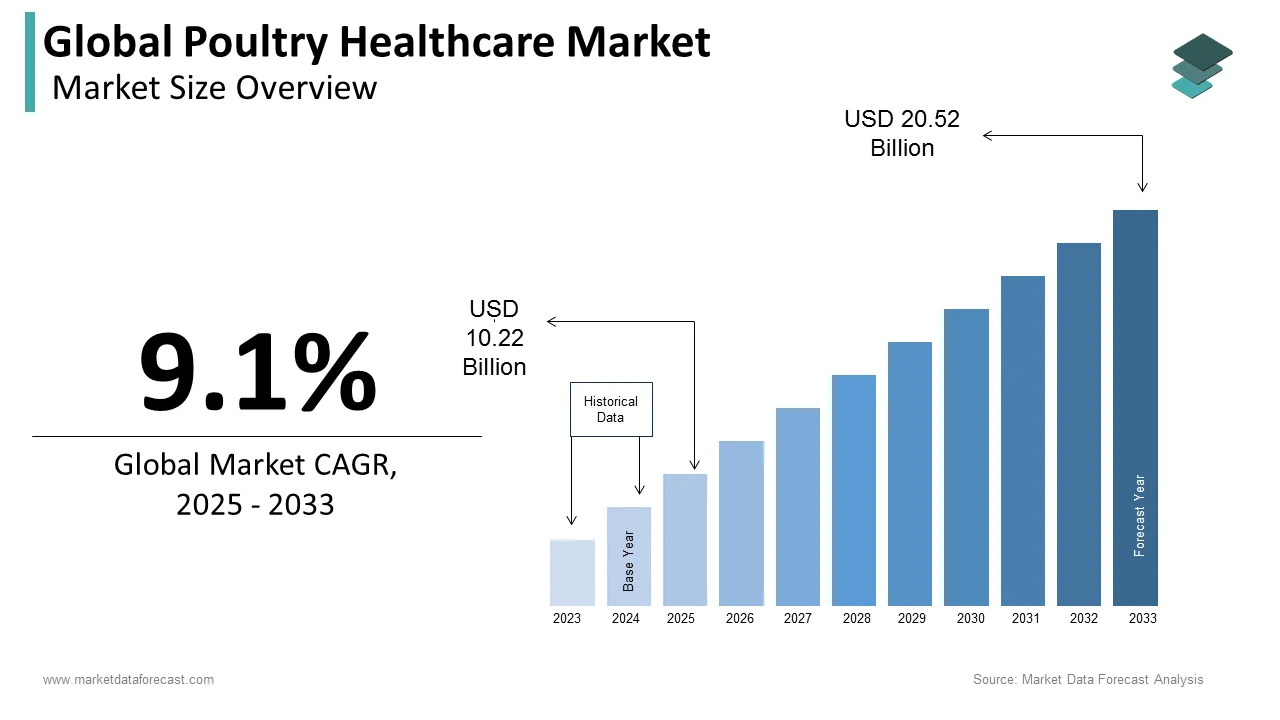
Poultry is a type of animal husbandry in which birds are grown for meat, eggs, and feathers, either commercially or domestically. Chickens, ducks, turkeys, and geese are commercially important poultry, although guinea fowl and squabs are only of local significance. The health of these birds is managed and maintained through poultry healthcare. Poultry eggs and meat are vital sources of high-quality proteins, minerals, and vitamins that help to keep the human diet balanced. Egg-type chicken breeds with rapid growth and excellent feed conversion efficiency are available. As a result, poultry health has become a crucial part of animal farming. Poultry farming is not only a valuable source of secondary income, but it also ensures people's nutritional security. It is a primary protein source in the human diet. Increased demand for protein-rich animal items, particularly chicken products, results from changing lifestyles and diets. According to the International Food Policy Research Institute, by 2020, developing countries will produce around 40% more meat and 60% more milk per capita than in 1990. To accomplish this goal, poultry healthcare plays an important role.
MARKET DRIVERS
The growing prevalence of poultry illnesses and the growing need for vaccinations propels the global poultry healthcare market.
Newcastle disease, avian influenza, bird flu, fowl pox, infectious bronchitis, and aspergillosis are all causing a rise in the need for poultry healthcare. These illnesses not only affect birds but may also spread to people. For example, since 2003, 239 instances of human infection with the avian influenza A (H5N1) virus have been recorded from four countries: Cambodia, China, Vietnam, and Lao PDR as of December 17, 2020. Likewise, according to WHO, persons who come into close contact with infected living or dead birds are more likely to develop H5N1 bird flu. Further, Between 15th January to 4th February of 2021, 9,065,680 animals were reported as losses in loss, and new outbreaks of pathogenic avian influenza in Africa, Asia, and Europe. These increasing diseases raise the demand for vaccines. Several groups are developing vaccinations, parasiticides, anti-infectives, and feed additives to cure these illnesses.
Government initiatives further propel the global poultry healthcare market.
Governments are making efforts to improve the market because poultry health has become crucial for human people, and poultry healthcare plays a significant role in creating higher income and productivity in poultry farming. In India, for example, the National Livestock Mission (NLM) is intended to include all actions necessary to guarantee quantitative and qualitative improvements in livestock production systems and capacity building among all stakeholders. Governments are also attempting to increase poultry product output and address the issues that arise during poultry production. As production grows, so does the demand for good animal healthcare. As a result, governments worldwide are investing in developing improved animal healthcare systems and expanding the poultry healthcare market.
MARKET RESTRAINTS
Counterfeit products and lack of awareness limit the poultry healthcare market growth.
However, the poultry healthcare business is constrained by the prevalence of counterfeit products and a lack of awareness. As poultry becomes a more appealing target for market players, counterfeit products are rising. As a result, counterfeit products are readily available, especially in rural markets. Furthermore, many farmers are unfamiliar with the processes involved in poultry healthcare management. Many birds die due to this lack of understanding, and money is lost. As a result, growth in the poultry healthcare industry has slowed.
REPORT COVERAGE
| REPORT METRIC | DETAILS |
| Market Size Available | 2025 to 2034 |
| Base Year | 2025 |
| Forecast Period | 2026 to 2034 |
| Segments Covered | By Product Type, Test Type, and Region. |
| Various Analyses Covered | Global, Regional, and Country-Level Analysis, Segment-Level Analysis, Drivers, Restraints, Opportunities, Challenges; PESTLE Analysis; Porter’s Five Forces Analysis, Competitive Landscape, Analyst Overview of Investment Opportunities |
| Regions Covered | North America, Europe, Asia Pacific, Latin America, Middle East & Africa |
| Market Leaders Profiled | Bayer AG, Boehringer Ingelheim GmbH, Ceva Sante Animale, Merck & Co. Inc., IDEXX Laboratories, Inc., Megacor Diagnostik GmbH, Thermo Fisher Scientific Inc., Virbac and Zoetis Inc., and Others. |
SEGMENTAL ANALYSIS
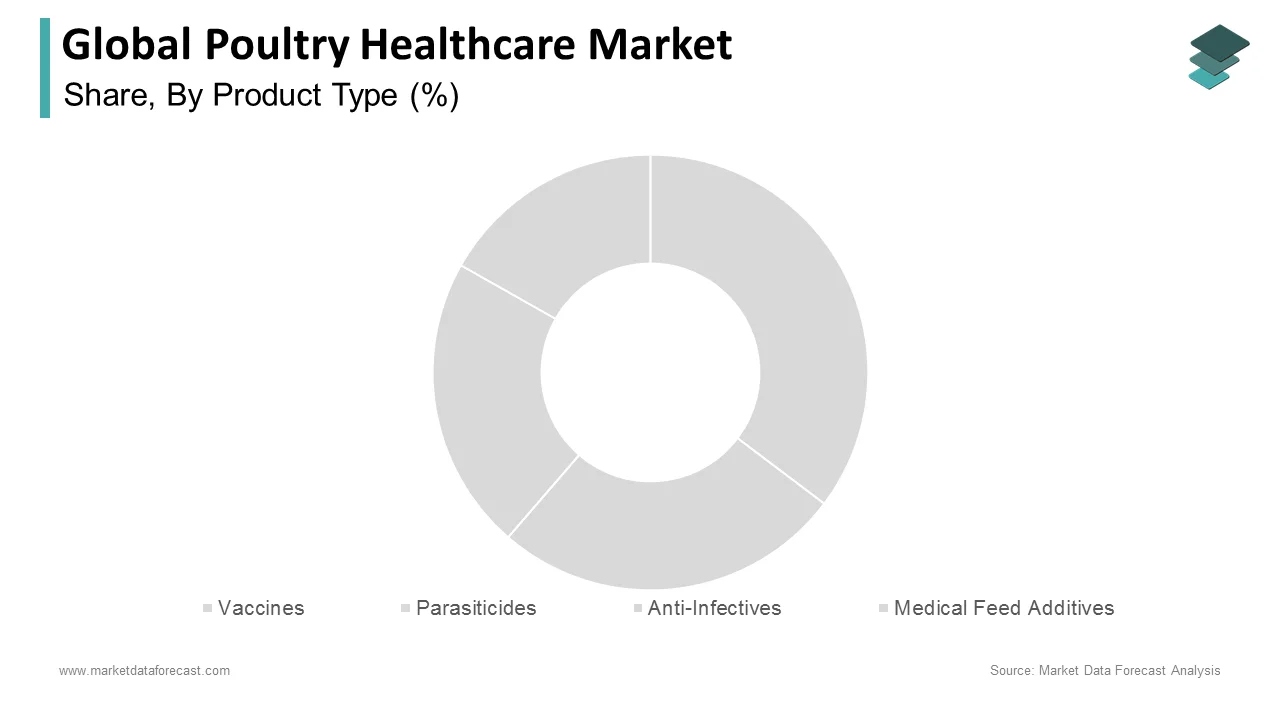
By Product Type Insights
REGIONAL ANALYSIS
KEY MARKET PLAYERS
Some of the notable companies operating in the global poultry healthcare market profiled in this report are
- Bayer AG
- Boehringer Ingelheim GmbH
- Ceva Sante Animale
- Merck & Co. Inc.
- IDEXX Laboratories, Inc.
- Megacor Diagnostik GmbH
- Thermo Fisher Scientific Inc.
- Virbac
- Zoetis Inc.
RECENT MARKET DEVELOPMENTS
-
In February 2021, Merck Animal Health, a part of Merck & Co. known as MSD Animal Health outside of the United States and Canada, completed its acquisition of PrognostiX Poultry Limited d/b/a Poultry Sense Ltd. from its founding stockholders. Poultry Sense Ltd. is a leader in the poultry industry's health and environmental monitoring systems.
-
In October 2020, Kemin Industries inked an exclusive partnership with Pacific GeneTech (PGT) to license PGT's TMH001 Eimeria vaccine for poultry through its subsidiary Kemin Biologics. PGT is a biologics firm that develops and commercializes next-generation vaccines for animal health and food safety applications with significant unmet or underserved requirements.
MARKET SEGMENTATION
This research report on the global healthcare claims management market has been segmented and sub-segmented into the following categories.
By Product Type
- Vaccines
- Parasiticides
- Anti-Infectives
- Medical Feed Additives
- Others
By Test Type
- ELISA (Enzyme-Linked Immunosorbent Assay) Test
- PCR (Polymerase Chain Reaction) Test
- Molecular Diagnostic Test
- Other Test Types
By Region
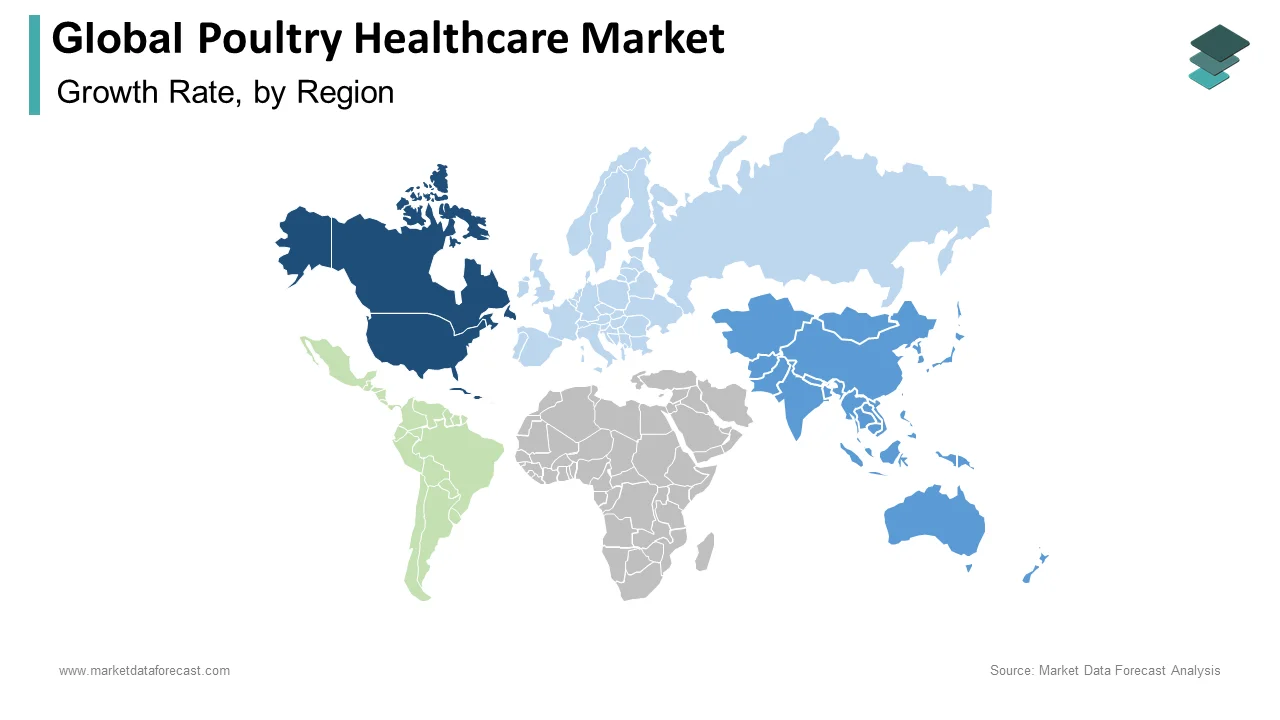
- North America
- Europe
- Asia-Pacific
- Latin America
- The Middle East and Africa