- Product Description Description
- Table of Contents TOC
- List of Table & Figure LOT
- Get Free Sample PDF Sample PDF
Market Size, 2025
$23.50 BnMarket Estimate, 2026
$25.52 BnMarket Forecast, 2034
$49.38 BnCAGR, 2026–2034
8.6%Executive Summary: Global Radar Sensors Market
- Market Scope: Comprehensive global radar sensors market analysis covering types, ranges, applications, vertical industries, frequencies, components, technologies, regional leadership frameworks, and adoption metrics.
- Market Valuation: Valued at USD 23.50 billion (2025), estimated at USD 25.52 billion (2026), and projected to reach USD 49.38 billion by 2034, growing at a CAGR of 8.6% (2026–2034).
- Primary Growth Drivers: Strict automotive safety regulations mandating advanced driver assistance systems (ADAS), increasing transport-related safety frameworks (e.g., EU General Safety Regulation), and industrial automation initiatives requiring non-contact precision level and environmental measurements.
Key Market Segment Metrics (2026–2034)
| Category | Leading Segment (2025 Position) | Fastest-Growing Segment |
|---|---|---|
| By Type | Continuous wave radar technology (held a significant share due to cost-effectiveness, simplicity, and high automotive/industrial adoption) | Pulse radar technology (growing at a fastest CAGR of 12.5% for high-resolution imaging and long-range detection) |
| By Range | Short-range radar (accounted for 45.3% share in 2025 due to urban mobility, parking assistance, and collision avoidance systems) | Long-range radar (estimated at a CAGR of 14.2% driven by highway autonomy and adaptive cruise control systems) |
| By Application | Advanced driver assistance systems (accounted for 51.2% share in 2025 supported by stringent safety mandates) | Health monitoring (swiftly emerging at a fastest CAGR of 18.5% due to aging populations and non-invasive remote patient monitoring) |
| By Vertical | Automotive vertical (accounted for 32.1% share in 2025 due to high vehicle production scales and universal radar integration) | Aerospace and defence vertical (witnessing a fastest CAGR of 11.8% driven by rising global defense spending and security upgrades) |
| By Region | North America (accounted for 43.2% share in 2025 backed by technological innovation, R&D investments, and automotive/defense sectors) | Asia-Pacific (driven by rapid urbanization, massive automotive manufacturing, and intelligent connected vehicle pushes) |
Major Market Players & Market Structure
Market Structure: Highly competitive landscape characterized by intense rivalry among established automotive suppliers and tech firms, focusing on innovations like 4D imaging radar, semiconductor fabrication integration, and rigorous regulatory compliance.
Key Companies: Robert Bosch GmbH, Continental AG, Airbus Defense and Space, BAE Systems, Leonardo S.p.A., NXP Semiconductors N.V., Israel Aerospace Industries Ltd, Raytheon Corporation, Inc., General Dynamics Corporation, Infineon Technologies AG, Lockheed Martin Corporation, and Rockwell Collins.
Global Radar Sensors Market Size
The global radar sensors market size was valued at USD 23.50 billion in 2025 and is anticipated to reach USD 25.52 billion in 2026 to reach USD 49.38 billion by 2034, growing at a CAGR of 8.6% during the forecast period from 2026 to 2034.

MARKET OVERVIEW AND DEFINITION
The radar sensors are electronic devices that emit radio waves to detect the presence distance speed and direction of objects. These sensors operate across various frequency bands including millimeter wave and microwave spectrums to provide precise environmental mapping. They are components in autonomous vehicles industrial automation and smart infrastructure systems due to their ability function reliably in adverse weather conditions, where optical sensors often fail. The technology has evolved from simple proximity detection to complex imaging capabilities enabling high resolution object classification. As per the European Commission, over 25000 road fatalities occurred in the European Union in recent years which has accelerated the mandate for advanced driver assistance systems in all new vehicles. Furthermore, the International Energy Agency states that transport accounts for approximately 25% of global energy related carbon dioxide emissions driving the need for efficient traffic management systems powered by accurate sensing technologies. The integration of radar sensors into smart city frameworks allows for real time traffic flow optimization reducing congestion and emissions. As per a research, nearly 75% of the European population lives in urban areas creating a dense environment where precise spatial awareness is essential for public safety and operational efficiency. This foundational reliance on accurate data collection underpins the expanding utility of radar sensors beyond automotive applications into healthcare monitoring and perimeter security sectors across the continent.
MARKET DRIVERS
Automotive Safety Regulations Mandate Advanced Driver Assistance Systems Integration
The implementation of strict automotive safety standards for the widespread adoption of radar sensors in passenger and commercial vehicles, which is propelling the growth of the radar sensor market. The European Union has enacted legislation requiring all new vehicle types to be equipped with advanced driver assistance systems, such as automatic emergency braking and blind spot detection. These mandatory features rely heavily on radar technology due to its robustness in diverse weather conditions, including heavy rain fog and snow where camera based systems may struggle. The General Safety Regulation which came into full effect in 2022 mandates that all new cars and vans must include intelligent speed assistance and emergency lane keeping systems. This regulatory framework has compelled original equipment manufacturers to integrate multiple radar units per vehicle to ensure comprehensive 360 degree coverage. The push towards Level 3 and Level 4 autonomy further amplifies this demand as these systems require redundant sensing layers to guarantee passenger safety. The automotive sector remains the largest consumer of radar sensors in Europe driven by legal compliance rather than mere consumer preference.
Industrial Automation and Industry 4.0 Initiatives Drive Precision Monitoring Needs
The rapid transformation of manufacturing facilities through Industry 4.0 initiatives creates substantial demand for radar sensors in industrial automation and process control applications. The industrial automation and Industry 4.0 initiatives are accelerating the growth of the radar ssensors market. Radar technology offers non-contact measurement capabilities that are essential for monitoring liquid levels solid bulk materials and machinery health in harsh industrial environments. As per the European Commission the digital transformation of industry could add up to 110 billion euros annually to the European economy by 2030 incentivizing factories to adopt smart sensing solutions. Radar sensors are particularly valued in the chemical and pharmaceutical sectors, where they provide accurate level measurements in tanks containing corrosive or hazardous substances without physical contact. In logistics and warehousing, radar sensors facilitate automated guided vehicles and inventory tracking by detecting obstacles and measuring distances with millimeter precision. The surge in automation requires reliable sensing technologies that can operate continuously without degradation. Radar sensors fulfill this need by offering long term stability and low maintenance requirements compared to ultrasonic or optical alternatives. The integration of these sensors into Internet of Things networks allows for real time data analytics enabling manufacturers to optimize production lines and reduce downtime significantly.
MARKET RESTRAINTS
High Development Costs and Complex Integration Processes Restrain Market Expansion
The substantial financial investment required for research and development alongside the technical complexities of integrating radar sensors into existing is impacting negatively on the growth of the radar sensors market. Designing high frequency radar chips especially those operating in the 77 gigahertz and 79 gigahertz bands demands specialized semiconductor fabrication processes that are costly and limited to few foundries globally. Small and medium sized enterprises in Europe often lack the capital resources to invest in custom radar solutions forcing them to rely on off the shelf components that may not meet specific application requirements. Furthermore, the integration of radar sensors into legacy industrial systems or older vehicle platforms requires extensive software calibration and hardware modifications. This prolonged development cycle delays time to market and increases overall project costs. Additionally, the shortage of skilled engineers proficient in radio frequency design and signal processing exacerbates the challenge. These barriers limit the accessibility of advanced radar technology to only large corporations with deep pockets slowing down broader market penetration.
Electromagnetic Interference and Spectrum Congestion Pose Operational Reliability Issues
The increasing density of wireless devices and the resulting electromagnetic interference in urban and industrial environments is additionally declining the growth of the radar sensors market. As the number of connected devices grows, the radio frequency spectrum becomes increasingly congested leading to potential signal collisions and degraded sensor performance. As per the European Conference of Postal and Telecommunications Administrations the allocation of frequency bands for automotive radar such as the 77 to 81 gigahertz range is shared with other services including satellite communications and fixed links in certain regions. This sharing creates risks of mutual interference which can cause false detections or missed targets in safety critical
MARKET OPPORTUNITIES
Emergence of 4D Imaging Radar Technology Unlocks High Resolution Applications
The advent of four dimensional imaging radar technology by providing elevation data alongside traditional range azimuth and velocity measurements is setting up new opportunities for the growth of the radar sensors market. This enhanced capability allows for the creation of detailed point clouds similar to lidar but at a fraction of the cost and with better performance in adverse weather. As per the Society of Automotive Engineers, 4D imaging radar can achieve angular resolution of less than 1 degree enabling the distinction between closely spaced objects such as pedestrians and cyclists in complex urban environments. This technological leap addresses the limitations of conventional radar which often struggles with static object classification and vertical positioning. The European New Car Assessment Programme has indicated that future safety ratings may reward vehicles equipped with superior sensing capabilities encouraging automakers to adopt 4D radar systems. Beyond automotive applications this technology opens doors in drone navigation and security surveillance where precise three dimensional mapping is crucial. The European Defence Agency has identified imaging radar as a key technology for border monitoring and unmanned aerial vehicle operations due to its ability to detect low flying objects against cluttered backgrounds. The integration of artificial intelligence with 4D radar data further enhances object recognition capabilities allowing for more sophisticated decision making in autonomous systems.
Expansion of Smart City Infrastructure Projects Creates New Deployment Avenues
The aggressive expansion of smart city initiatives in traffic management public safety and environmental monitoring applications is another factor to escalate the growth of the radar sensors market. Municipalities are increasingly investing in intelligent transportation systems to alleviate congestion improve road safety and reduce emissions. Radar sensors are ideal for these applications as they can accurately measure vehicle speed count traffic flow and detect pedestrians regardless of lighting or weather conditions. This privacy centric feature makes radar an attractive option for public space monitoring, where citizen consent and data anonymity are critical concerns. Radar enabled smart streetlights and intersection controllers can dynamically adjust signal timing based on real time traffic conditions reducing idle time and fuel consumption. Furthermore, radar sensors are being used to monitor bridge structural health and detect landslides in vulnerable areas. The European Environment Agency emphasizes the role of digital technologies in enhancing urban resilience against climate change impacts.
MARKET CHALLENGES
Supply Chain Volatility and Semiconductor Shortages Disrupt Production Timelines
The persistent volatility in the global semiconductor supply chain is to pose as a challenge for the growth of the radar sensors market. Radar sensors rely heavily on specialized chips, including radio frequency transceivers and digital signal processors, which are subject to fluctuating availability and pricing. This dependency exposes European manufacturers to geopolitical tensions trade restrictions and logistical hurdles that can disrupt supply lines. The recent global chip shortage demonstrated how quickly production can halt when component availability dwindles with some automotive plants reducing output by 20% due to missing electronics. The raw materials required for semiconductor fabrication such as silicon wafers and rare earth elements also face supply constraints driven by increasing global demand. The Joint Research Centre of the European Commission warns that the transition to green and digital technologies will increase the demand for critical raw materials by six times by 2030. This surge in demand coupled with limited mining and processing capacity creates upward pressure on prices and lead times. Manufacturers must navigate these uncertainties by diversifying suppliers and holding larger inventories which ties up capital and reduces operational flexibility. The lack of local fabrication facilities for advanced nodes means that any disruption in international shipping or political relations can have immediate and severe consequences for the radar sensor market.
Stringent Regulatory Compliance and Certification Hurdles Delay Market Entry
The complex web of regulatory requirements and certification processes is likely to hinder the growth of the radar sensors market. Each application domain whether automotive industrial or consumer electronics has its own set of standards for electromagnetic compatibility safety and performance that must be met before a product can be sold. The obtaining compliance with directives, such as the Radio Equipment Directive and the Automotive General Safety Regulation involves rigorous testing and documentation that can take months or even years. For automotive applications, sensors must undergo extensive validation to prove they function correctly under extreme temperatures vibrations and electromagnetic interference scenarios. Failure to meet any single requirement can result in product recalls or bans from the market causing financial losses and reputational damage. Small innovators often struggle to navigate this regulatory landscape due to limited legal and technical resources. The European Small Business Portal indicates that regulatory compliance costs can account for up to 15% of total development expenses for small technology firms. Moreover, regulations are constantly evolving to keep pace with technological advancements requiring manufacturers to continuously update their products and re certify them.
REPORT COVERAGE
| REPORT METRIC | DETAILS |
| Market Size Available | 2025 to 2034 |
| Base Year | 2025 |
| Forecast Period | 2026 to 2034 |
| CAGR | 8.6% |
| Segments Covered | By Type, Range, Application, Vertical, Frequency, Component, Technology, and Region |
| Various Analyses Covered | Global, Regional & Country Level Analysis, Segment-Level Analysis, DROC, PESTLE Analysis, Porter’s Five Forces Analysis, Competitive Landscape, Analyst Overview on Investment Opportunities |
| Regions Covered | North America, Europe, APAC, Latin America, Middle East & Africa |
| Market Leaders Profiled | Airbus Defense and Space, BAE Systems, Leonardo S.p.A., NXP Semiconductors N.V., Israel Aerospace Industries Ltd, Raytheon Corporation, Inc., General Dynamics Corporation, Infineon Technologies AG, Lockheed Martin Corporation, and Rockwell Collins |
SEGMENTAL ANALYSIS
By Type Insights
The continuous wave radar technology segment held a significant share of the global Radar Sensors Market in 2025 due to its widespread adoption in automotive and industrial applications. The primary driver for this dominance is the cost effectiveness and simplicity of Continuous Wave systems compared to pulse radar alternatives. Continuous Wave radars are particularly effective for speed measurement and proximity detection, which are functions in modern vehicles. This high volume integration is driven by the regulatory mandate for Advanced Driver Assistance Systems across multiple jurisdictions. The technology’s ability to operate continuously without the complex timing mechanisms required by pulse radar reduces manufacturing costs significantly. According to the Semiconductor Industry Association the production cost of Continuous Wave radar chips is approximately 30% lower than their pulsed counterparts making them attractive for mass market vehicles. Furthermore the reliability of Continuous Wave sensors in adverse weather conditions ensures consistent performance which is a key requirement for safety critical applications. The industrial sector also contributes to this dominance as Continuous Wave radars are extensively used for level measurement in tanks and silos. The German Engineering Federation states that nearly 60% of industrial level sensing applications in Europe prefer Continuous Wave technology due to its robustness and low maintenance needs.
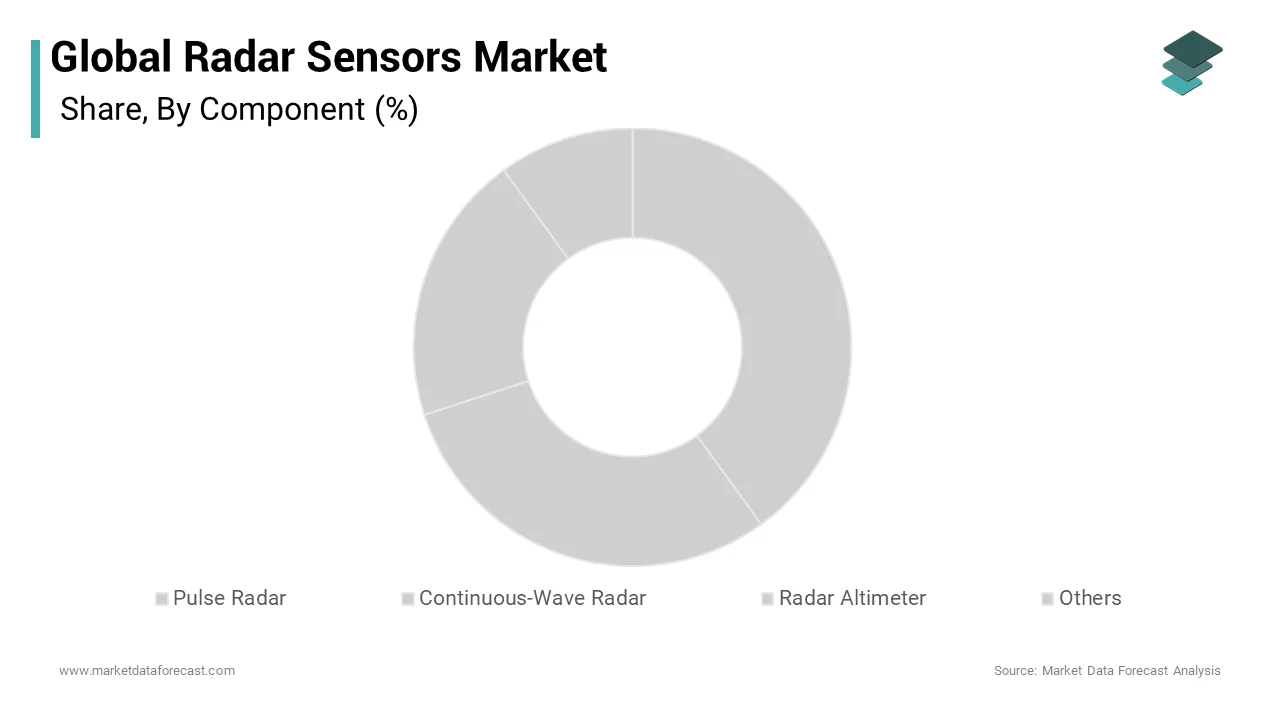
The pulse radar technology segment is likely to grow at a fastest CAGR of 12.5% throughout the forecast period owing to the increasing demand for high resolution imaging and long range detection capabilities in autonomous vehicles and defense applications. Unlike Continuous Wave systems Pulse radar can determine both the distance and velocity of objects with greater precision making it ideal for complex environments. The adoption of Level 4 autonomous driving technologies requires sensors capable of detecting objects at distances exceeding 200 meters, which Pulse radar efficiently provides. The defense sector further accelerates this growth as modern surveillance systems require detailed target classification that only Pulse radar can deliver. Additionally, advancements in semiconductor technology have reduced the size and power consumption of Pulse radar units making them viable for commercial use.
By Range Insights
The short range radar segment was accounted in holding 45.3% of the Radar Sensors Market share in 2025 owing to its extensive deployment in urban mobility and indoor automation scenarios. The proliferation of short-range sensors is fueled by the mandatory inclusion of parking assistance and collision avoidance systems in passenger vehicles. These sensors typically operate within a range of 0.5 to 30 meters providing precise data for low speed maneuvers where accuracy is paramount. The compact size and low power consumption of short-range radar modules make them ideal for integration into bumpers and side mirrors without affecting vehicle aesthetics. The European Automobile Manufacturers Association indicates that the average number of short range radar units per vehicle has increased from two to four in recent years to enhance surrounding awareness. Beyond automotive applications short range radar is gaining traction in smart home devices and healthcare monitoring systems. This versatility across consumer and automotive sectors ensures that short range radar remains the most widely used category.
The long range radar segment is estimated CAGR of 14.2% from 2026 to 2034 with the role long range sensors play in highway autonomy and adaptive cruise control systems. As vehicles move towards higher levels of automation the need to detect obstacles and traffic conditions at distances beyond 150 meters becomes essential for safe decision making. The new regulations regarding highway pilot systems require vehicles to maintain situational awareness up to 250 meters ahead which necessitates advanced long range radar solutions. The development of 77 gigahertz and 79 gigahertz frequency bands have enabled long range radars to achieve higher resolution and better object separation. The European Commission’s Horizon Europe program has allocated over 500 million euros to research projects focused on enhancing long range sensing technologies for autonomous transport. Additionally, the expansion of high-speed rail networks in Asia and Europe drives demand for long range radar in train collision avoidance systems. The combination of regulatory pressure for safer highway driving and technological advancements in signal processing powers the rapid expansion of the long-range radar segment.
By Application Insights
The advanced driver assistance systems segment was accounted in holding 51.2% of the Radar Sensors Market share in 2025 with the stringent safety regulations and consumer demand for vehicle safety features. The integration of radar sensors into ADAS is mandatory in many regions to reduce road accidents and fatalities. This legislative push has resulted in a surge in radar sensor installations with over 100 million units deployed in ADAS applications globally in 2023. The effectiveness of radar in detecting moving objects and measuring their speed makes it indispensable for features like adaptive cruise control and blind spot monitoring. Consumer awareness of safety benefits also contributes to this dominance as buyers increasingly prioritize vehicles with comprehensive safety suites. Insurance companies in Europe offer discounts for cars equipped with advanced safety systems further incentivizing adoption.
The health monitoring segment is swiftly emerging at a fastest CAGR of 18.5% throughout the forecast period owing to the aging population in developed countries and the increasing preference for non-invasive remote patient monitoring solutions. Radar sensors can detect vital signs, such as heart rate and respiration without physical contact offering comfort and convenience for elderly care and sleep tracking. As per the World Health Organization, the number of people aged 60 years and older is expected to double by 2050 creating a substantial demand for assisted living technologies. Radar based monitoring systems allow caregivers to track patients’ health status continuously without compromising privacy or requiring wearable devices. Hospitals and care homes are increasingly adopting radar sensors to monitor patient movements and detect falls instantly. The European Health Data Space initiative supports the integration of such digital health tools into mainstream healthcare systems. Furthermore, advancements in signal processing algorithms have improved the accuracy of radar based vital sign detection making it a reliable alternative to traditional methods.
By Vertical Insights
The automotive vertical segment was accounted in holding 32.1% of the Radar Sensors Market share in 2025 with the massive scale of vehicle production and the universal integration of radar sensors in modern cars for safety and convenience features. As per the International Organization of Motor Vehicle Manufacturers, approximately 85 million vehicles were produced worldwide in 2023 with a vast majority incorporating at least one radar sensor. The transition towards electrification and autonomy in the automotive sector further amplifies the need for sophisticated sensing solutions. European automakers are at the forefront of this trend with companies like Volkswagen and BMW integrating multiple radar units in their latest electric vehicle models. The European Automobile Manufacturers Association reports that the average value of electronics per vehicle has increased to 40% of the total car cost with radar sensors being a significant component. Government incentives for electric vehicles in Europe and North America also boost production volumes thereby driving radar sensor demand. The European Commission’s Fit for 55 package aims to reduce carbon emissions from transport by 55% by 2030, accelerating the shift to electric and autonomous vehicles. This policy framework ensures sustained growth in the automotive vertical.
The aerospace and defence vertical segment is deemed to witness a fastest CAGR of 11.8% from 2026 to 2034 owing to the increasing geopolitical tensions and the subsequent rise in defense spending across major economies. Modern military operations rely heavily on advanced radar systems for surveillance target acquisition and missile guidance. European nations are upgrading their air defense capabilities in response to regional security threats driving demand for high performance radar sensors. The European Defence Agency notes that collaborative defense projects involving radar technology increased by 20% in 2023. Additionally, the commercial aerospace sector is recovering from pandemic related disruptions with increased aircraft production boosting demand for aviation radar. The International Air Transport Association forecasts that air passenger traffic will return to pre pandemic levels by 2024 leading to higher orders for new aircraft equipped with advanced weather and terrain avoidance radars. The development of unmanned aerial vehicles for both military and civilian use also contributes to this growth. The European Union Aviation Safety Agency has introduced new regulations for drone operations requiring robust sense and avoid systems, which often utilize radar technology.
REGIONAL ANALYSIS
North America Market Analysis
North America radar sensors market was accounted in holding 43.2% of the share in 2025 with the strong technological innovation and high adoption rates in the automotive and defense sectors. The growth of the market in this region is driven by the presence of major technology companies and automotive manufacturers investing heavily in autonomous driving research. The implementation of federal safety standards has accelerated the integration of Advanced Driver Assistance Systems in vehicles sold in the United States. The region benefits from a robust ecosystem of semiconductor suppliers and radar technology developers fostering continuous innovation. Canada also contributes to the regional market with its focus on smart infrastructure and mining automation. The Canadian government’s investment in digital infrastructure projects supports the deployment of radar sensors for traffic management and environmental monitoring. The Society of Automotive Engineers in the US plays a key role in setting standards for radar performance ensuring high quality and reliability. The presence of leading automotive OEMs and tier one suppliers in the region creates a strong demand for advanced radar solutions. Furthermore, the growing interest in urban air mobility and drone delivery services in cities like Los Angeles and Toronto that drives additional demand for compact and efficient radar sensors.
Europe Market Analysis
Europe radar sensors market was ranked second by capturing 22.1% of the share in 2025 with the stringent regulatory frameworks and a strong automotive manufacturing base. The European Union’s General Safety Regulation has been a pivotal driver mandating the inclusion of advanced safety features in all new vehicles. Germany, France, and Sweden are key contributors within the region due to their advanced industrial bases and commitment to automotive innovation. The European Green Deal initiatives promote sustainable transport solutions encouraging the development of efficient and safe autonomous vehicles. Europe is also a leader in industrial automation with companies adopting radar sensors for process optimization and predictive maintenance. The German Engineering Federation reports that the industrial sensor market in Europe is growing steadily driven by Industry 4.0 adoption. The region’s focus on privacy and data protection favors radar technology over camera based systems in public spaces. The European Data Protection Board guidelines support the use of anonymous sensing technologies like radar for smart city applications. Additionally, Europe’s strong defense industry collaborates on cross border projects to develop next generation radar systems. The European Defence Fund provides financial support for research and development in sensor technologies enhancing the region’s competitive edge.
Asia Pacific Market Analysis
The Asia Pacific radar sensors market growth is driven by rapid urbanization and expanding automotive production. China, Japan, and South Korea are the primary contributors to the regional market with China being the largest automotive producer globally. As per the China Association of Automobile Manufacturers, China produced over 27 million vehicles in 2023 creating immense demand for automotive radar sensors. The Chinese government’s push for intelligent connected vehicles has led to significant investments in sensor technology and infrastructure. Japan and South Korea are leaders in semiconductor manufacturing providing critical components for radar systems. India is emerging as a key market with increasing vehicle sales and government initiatives to improve road safety. The region’s growing middle class and increasing disposable income contribute to higher vehicle ownership rates. Additionally, the expansion of e commerce in Asia Pacific drives the need for automated logistics and warehousing solutions using radar technology.
Latin America Market Analysis
Latin America radar sensors market growth is propelled with the increasing automotive sales and infrastructure modernization efforts. Brazil and Mexico are the largest contributors with their established automotive industries. The region faces challenges related to economic volatility and limited regulatory mandates for advanced safety systems compared to Europe and North America. However multinational automotive companies operating in Latin America are introducing vehicles with global safety standards, which includes radar sensors. Mexico benefits from its proximity to the United States and participation in trade agreements that facilitate the export of vehicles equipped with advanced technologies. Urbanization in major cities like Sao Paulo and Mexico City creates opportunities for smart traffic management solutions. Local manufacturers are beginning to explore partnerships with global radar technology providers to meet the evolving needs of the automotive sector.
Middle East and Africa Market Analysis
The Middle East and Africa radar sensors market growth driven by infrastructure development and security concerns. The Gulf Cooperation Council countries particularly the United Arab Emirates and Saudi Arabia are investing heavily in smart city projects and autonomous transport initiatives. The harsh desert environment in the region makes radar sensors attractive due to their reliability in dust and high temperatures where optical sensors may fail. Security and surveillance are major drivers in the region with governments deploying radar systems for border monitoring and critical infrastructure protection. The African Union’s Agenda 2063 emphasizes infrastructure development which includes modern transportation systems. However, economic constraints and limited local manufacturing capacity hinder rapid market growth. International collaborations and foreign direct investment play a crucial role in introducing radar technology to the region.
COMPETITIVE LANDSCAPE
The competition in the Radar Sensors Market is characterized by intense rivalry among established automotive suppliers and emerging technology firms striving for dominance in the autonomous driving sector. Major players leverage their extensive manufacturing capabilities and long standing relationships with original equipment manufacturers to secure large volume contracts. However, new entrants are disrupting the sector by offering innovative solutions such as four dimensional imaging radar that provide superior performance at competitive prices. Intellectual property rights play a crucial role as companies patent novel signal processing techniques and antenna designs to protect their innovations. Price pressure remains significant due to the commoditization of basic radar functions forcing manufacturers to differentiate through added features like enhanced resolution and longer detection ranges.
KEY MARKET PLAYERS
These are a few of the promising companies in the global radar sensors market.
- Airbus Defense and Space
- BAE Systems
- Continental AG
- Robert Bosch GmbH
- Leonardo S.p.A.
- NXP Semiconductors N.V.
- Israel Aerospace Industries Ltd
- Raytheon Corporation, Inc.
- General Dynamics Corporation
- Infineon Technologies AG
- Lockheed Martin Corporation
- Rockwell Collins
Top Players In The Market
- Robert Bosch GmbH stands as a pivotal force in the global radar sensor landscape leveraging its extensive automotive expertise to deliver high precision sensing solutions. The company actively develops advanced 77 gigahertz radar systems that support critical safety features such as adaptive cruise control and emergency braking. Bosch recently expanded its production capabilities in Germany to meet the surging demand for fourth generation radar sensors which offer improved resolution and detection range. Their strategic focus includes integrating artificial intelligence into sensor data processing to enhance object classification accuracy.
- Continental AG contributes significantly to the market by providing comprehensive radar sensor portfolios tailored for diverse automotive and industrial applications. The company specializes in developing compact and cost effective radar modules that facilitate widespread adoption of advanced driver assistance systems. Continental recently launched its fifth-generation radar platform which features enhanced performance in complex urban environments and adverse weather conditions. They have strengthened their market position through strategic partnerships with semiconductor manufacturers to secure supply chains and accelerate product development. Continental also invests heavily in research and development to create software defined radar solutions that can be updated over the air. This approach allows vehicles to improve their sensing capabilities throughout their lifecycle.
- Denso Corporation plays a crucial role in the radar sensor market by delivering reliable and high performance sensing technologies primarily for the automotive sector. The company focuses on creating millimeter wave radar systems that provide accurate distance and velocity measurements for collision avoidance and pedestrian detection. Denso recently announced significant investments in its Japanese facilities to increase production capacity for next generation radar sensors supporting Level 3 autonomy. They prioritize miniaturization and energy efficiency in their designs making their sensors ideal for electric vehicles where power consumption is critical. Denso collaborates with technology firms to integrate radar data with camera and lidar inputs for robust sensor fusion architectures. This multi sensor approach enhances overall system reliability and safety.
Top Strategies Used By Key Market Participants
Key players in the Radar Sensors Market predominantly employ strategic collaborations and technological innovation to maintain competitive advantage. Companies frequently partner with semiconductor manufacturers to secure stable supply chains for critical components such as radio frequency chips. This vertical integration helps mitigate risks associated with global chip shortages and reduces production costs. Another major strategy involves heavy investment in research and development to create fourth generation imaging radar systems that offer higher resolution and better object classification. Firms also focus on expanding their manufacturing footprints in key regions like Europe and Asia to cater to local demand and reduce logistics expenses. Additionally, many participants are developing software defined radar solutions that allow for over the air updates enhancing product longevity and customer value. Mergers and acquisitions are also common as companies seek to acquire specialized talents and proprietary technologies to accelerate their product roadmaps and diversify their application portfolios beyond automotive sectors.
MARKET SEGMENTATION
This research report on the global radar sensors market has been segmented and sub-segmented based on the component, range, end-use, and region.
By Type
- Pulse Radar
- Continuous-Wave Radar
- Radar Altimeter
- Others
By Range
- Short-Range
- Medium-Range
- Long-Range
By Application
- Advanced Driver Assistance Systems (ADAS)
- Monitoring and Communication
- Security and Surveillance
- Traffic Monitoring
- Environment and Weather Monitoring
- Hump Yard and Rail Crossing
- Health Monitoring
- Others
By Vertical
- Automotive
- Aerospace and Defense
- Healthcare
- Maritime
- Manufacturing
- Oil and Gas
- Others
By Frequency Band
- HF, VHF, and UHF
- L, S, C, and X
- Ku, K, Ka, V, and W
By Component
- Antenna
- Transmitter
- Receiver
- Others
By Technology
- Imaging Radar
- Non-Imaging Radar
By Region
- North America
- Europe
- Asia-Pacific
- Latin America
- Middle East and Africa