- Product Description Description
- Table of Contents TOC
- List of Table & Figure LOT
- Get Free Sample PDF Sample PDF
Market Size, 2025
$585.23 MnMarket Estimate, 2026
$617.89 MnMarket Forecast, 2034
$954.03 MnCAGR, 2026–2034
5.58%Global Rapid Liquid Printing Market Size, Growth, Trends & Forecast (2026–2034)
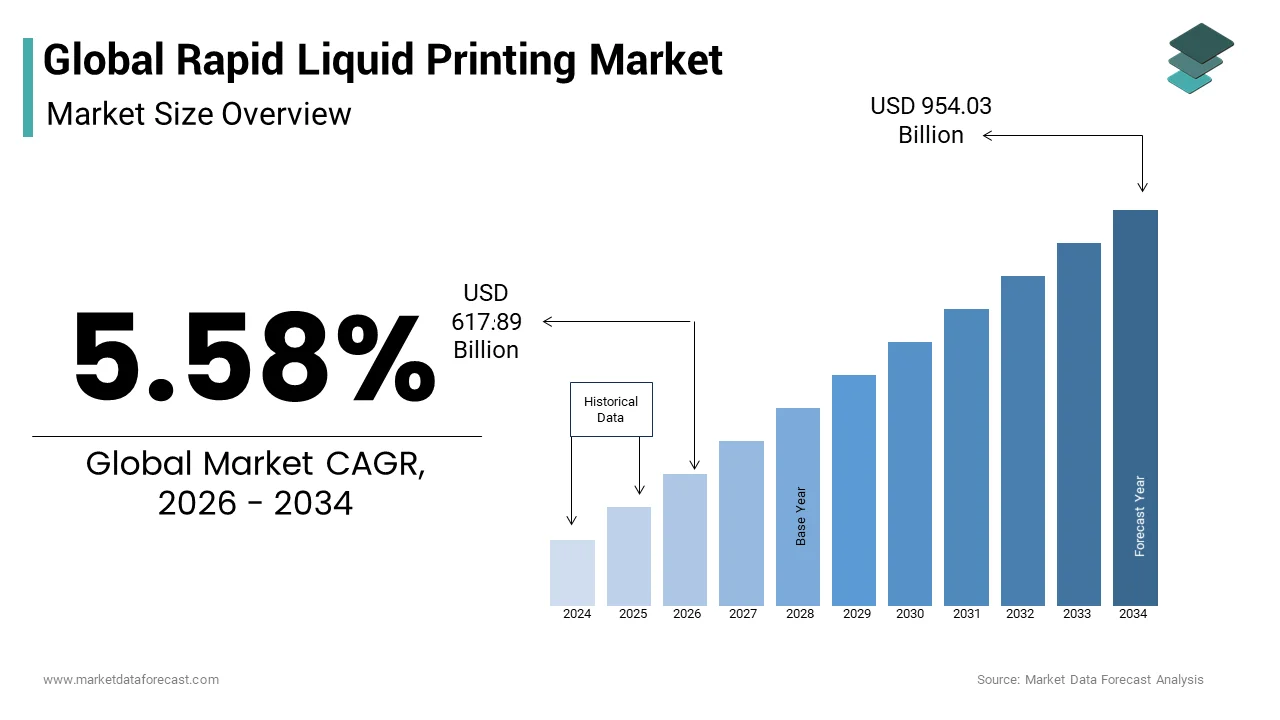
The global rapid liquid printing market size was valued at USD 585.23 million in 2025, is anticipated to reach USD 617.89 million in 2026, and is projected to expand to USD 954.03 million by 2034, growing at a compound annual growth rate (CAGR) of 5.58% during the forecast period from 2026 to 2034. Market growth is heavily propelled by increasing demand for complex geometries in soft robotics, medical device manufacturing, and accelerated product development cycles across the automotive and aerospace sectors.
Key Executive Metrics (At-a-Glance)
- 2025 Base Valuation: USD 585.23 Million
- 2026 Current Valuation: USD 617.89 Million
- 2034 Forecast Valuation: USD 954.03 Million
- Compound Annual Growth Rate (CAGR): 5.58% (2026–2034)
- Leading Regional Market: North America (holding 40.3% market share in 2025)
- Key Geographic Regions: North America, Europe, Asia-Pacific, Latin America, and Middle East & Africa
Core Market Drivers & Opportunities
- Soft Robotics & Healthcare: Growing need for intricate, flexible structures and biocompatible medical devices that mimic human tissues.
- Automotive & Aerospace Prototyping: Compressed development cycles driving rapid iteration of functional parts and aerodynamic components.
- Mass Customization & AI: Expansion into custom consumer goods (footwear, wearables) and integration with AI-driven generative design.
Primary Market Restraints & Challenges
- Material Limitations: Restricted range of polymers and resins compatible with gel-medium extrusion and gel maintenance complexity.
- Scalability & Workforce Hurdles: Build chamber constraints for high-volume production and scarcity of skilled professionals with fluid dynamics expertise.
Market Segmentation: Largest and Fastest-Growing Sectors
| Segment Category | Largest Segment | Fastest-Growing Segment |
|---|---|---|
| By Offering | Printers (45.3% share) | Materials (28.5% CAGR) |
| By Application | Prototyping | Functional/End-Use Part Manufacturing (24.2% CAGR) |
| By Vertical | Healthcare (35.6% share) | Consumer Goods (26.8% CAGR) |
| By Region | North America (40.3% share) | Asia-Pacific |
Major Industry Players Profiled
Key market participants shaping the rapid liquid printing landscape include 3D Systems, Inc., Desktop Metal Inc., Carbon Inc., Stratasys Ltd., Autodesk, Inc., BMW AG, Dassault Systèmes, EOS, ExOne, Materialise, Native Shoes, and Steelcase Inc..
Global Rapid Liquid Printing Market Size
The global rapid liquid printing market size was valued at USD 585.23 million in 2025 and is anticipated to reach a valuation of USD 617.89 million in 2026 and reach USD 954.03 million by 2034, growing at a CAGR of 5.58% during the forecast period from 2026 to 2034.
Introduction to the Rapid Liquid Printing Market
The rapid liquid printing is an additive manufacturing technology that fabricates three dimensional objects by extruding material directly into a supportive gel medium rather than building layer by layer on a solid platform. As per data from the Society of Manufacturing Engineers, additive manufacturing technologies can reduce product development cycles by up to 50% when compared to subtractive machining processes. The ability of rapid liquid printing to handle diverse materials including silicones epoxies and polyurethanes without curing constraints opens new avenues for soft robotics medical devices and automotive components. The European Commission promotes that advanced manufacturing technologies are essential for maintaining industrial sovereignty and reducing dependency on overseas supply chains. This technology aligns with Industry 4.0 principles by integrating digital design files directly with physical production enabling mass customization and on demand manufacturing capabilities that respond dynamically to consumer needs.
MARKET DRIVERS
Demand for Complex Geometries in Soft Robotics and Medical Devices
The escalating requirement for intricate and flexible structures in soft robotics and biomedical applications is levelling up the growth of the rapid liquid printing market. Rapid liquid printing allows for the seamless integration of varying material densities within a single part enabling the creation of robotic grippers that mimic human touch and dexterity. The number of 3D printed medical device approvals has increased annually since 2020, reflecting a regulatory shift toward accepting additive manufacturing for patient specific implants and surgical guides. The printed silicone structures exhibit superior biocompatibility and mechanical resilience compared to molded equivalents due to the absence of mold release agents and seam lines. This capability is for producing custom prosthetics and orthotics that require precise anatomical fitting and comfort. The technology’s ability to print overhangs and internal channels without support structures reduces post processing time and material waste which is critical for high value medical applications. Healthcare providers are increasingly leveraging this technology to create patient specific models for surgical planning enhancing procedural accuracy and reducing operation times.
Acceleration of Product Development Cycles in Automotive and Aerospace
The intense pressure to reduce time in the automotive and aerospace sectors drives the integration of rapid liquid printing into early stage design and prototyping workflows, which is additionally enhancing the growth of the rapid liquid printing market. According to the Society of Automotive Engineers, vehicle development cycles have compressed from 5 years to less than 3 years in many segments necessitating faster iteration of physical prototypes for validation. Traditional molding processes require weeks to create tooling whereas rapid liquid printing can produce functional parts in hours allowing engineers to test form fit and function rapidly. As per data from Boeing, the use of rapid prototyping technologies has reduced the lead time for certain cabin interior components by 60% enabling quicker response to airline customization requests. Rapid liquid printing offers distinct advantages over other additive methods by producing parts with smooth surfaces that require minimal finishing, which is essential for aerodynamic testing and ergonomic assessment. The ability to print large scale components, such as dashboard panels or seat structures in a single build reduces assembly complexity and potential failure points. Automotive manufacturers are utilizing this technology to create lightweight lattice structures that maintain strength, while reducing material usage contributing to fuel efficiency goals.
MARKET RESTRAINTS
Limited Material Compatibility and Formulation Challenges
The restricted range of commercially available materials suitable for printing is solely restraining the growth of the rapid liquid printing market. According to the American Chemical Society, only a small fraction of existing polymers and resins possess the specific rheological properties required for stable extrusion into a supporting gel medium without premature curing or deformation. Most current applications are limited to silicones and specific polyurethanes leaving gaps in high temperature engineering plastics and metal composites that are standard in traditional manufacturing. Developing new material chemistries requires extensive research and development investment which smaller technology providers often lack. The viscosity and curing kinetics must be precisely balanced to ensure the material flows smoothly from the nozzle yet solidifies quickly enough to maintain shape within the gel. This delicate balance limits the ability to switch between materials rapidly during production runs increasing downtime and operational complexity. Furthermore, the lack of standardized material certifications for industries such as aerospace and medical devices creates hesitation among quality assurance managers who require proven track records before approving new processes.
High Operational Costs and Gel Maintenance Requirements
The operational complexity associated with managing and maintaining the supportive gel medium introduces significant cost and logistical challenges is another factor hindering the growth of the rapid liquid printing market. The supporting gel must be carefully conditioned and filtered to remove particulate contaminants and air bubbles, which can compromise print quality and structural integrity. This maintenance process requires specialized equipment and trained personnel adding to the overall operational expenditure beyond the initial capital investment in the printer. The gel degrades over time due to exposure to printed materials and environmental factors necessitating regular monitoring and replenishment to ensure consistent performance. Additionally, the removal of printed parts from the gel requires careful washing and cleaning steps to prevent residue accumulation, which can affect surface finish wand dimensional accuracy. These post processing steps add labor hours and extend the total production timeline reducing the perceived speed advantage of the technology. Small and medium sized enterprises often lack the resources to manage these complex workflows effectively leading to higher defect rates and material waste.
MARKET OPPORTUNITIES
Expansion into Custom Consumer Goods and Footwear
The growing consumer demand for personalized and customized products is likely to foster the new opportunities for the growth of the rapid liquid printing market. Rapid liquid printing enables the cost-effective production of custom fitted shoe midsoles and insoles that conform precisely to an individual’s foot geometry providing superior comfort and performance. The ability to print complex lattice structures with varying stiffness levels allows for tailored cushioning and support characteristics that traditional foam molding cannot achieve. Retailers can offer in store scanning and printing services creating an immersive customer experience that bridges the gap between digital design and physical product. This direct-to-consumer model reduces inventory holding costs and minimizes waste from unsold stock aligning with sustainability goals. The technology’s capacity to use recycled materials in the printing process further appeals to environmentally conscious consumers. Brands leveraging this capability can differentiate themselves in a crowded market by offering bespoke solutions at near mass production prices.
Integration with Artificial Intelligence for Generative Design
The emergence of rapid liquid printing with artificial intelligence and generative design algorithms offers unprecedented opportunities to optimize part performance and material efficiency is ascribed to boost the growth of the rapid liquid printing market. Rapid liquid printing is uniquely suited to realize these complex AI generated geometries because it does not require support structures and can print in any orientation within the gel medium. This synergy allows engineers to input performance constraints, such as load bearing requirements and weight limits letting the algorithm generate optimal forms that are then directly printed. The resulting parts often exhibit superior mechanical properties due to continuous material distribution without weak points from layer adhesion. Industries, such as automotive and aerospace can leverage this combination to create lightweight components that enhance fuel efficiency and reduce emissions. The iterative nature of AI driven design complements the rapid prototyping capabilities of liquid printing enabling quick validation of multiple design variants.
MARKET CHALLENGES
Scalability Issues for Mass Production Volumes
Transitioning from prototyping to high volume mass production due to limitations in build chamber size and throughput capacity is a major challenge for the growth of the rapid liquid printing market. Rapid liquid printing machines typically have limited build envelopes, which restricts the size and quantity of parts that can be produced in a single run. The scaling up requires parallel operation of multiple printers, which increases capital expenditure and floor space requirements significantly. The process of removing parts from the gel and cleaning the medium creates a hurdles that limits overall throughput compared to continuous manufacturing methods. Maintaining consistent quality across multiple machines and batches requires rigorous process control and calibration, which is difficult to achieve in large scale operations. The lack of standardized automation solutions for part removal and gel recycling further hinders scalability efforts. Manufacturers face difficulties in justifying the return on investment for large fleets of printers when traditional methods offer lower marginal costs at high volumes.
Lack of Skilled Workforce and Technical Expertise
The scarcity of professionals with specialized knowledge in rapid liquid printing processes and material science is additionally to decline the growth of the rapid liquid printing market. Rapid liquid printing requires a unique blend of expertise in fluid dynamics chemistry and computer aided design that is not commonly taught in traditional engineering curricula. The technology demands precise control over parameters such as extrusion pressure gel viscosity and curing rates which require experienced operators to troubleshoot and optimize. The lack of standardized training programs and certification bodies exacerbates the talent shortage forcing companies to invest heavily in internal training initiatives. High turnover rates in the tech sector further complicate workforce stability leading to knowledge loss and operational disruptions. Educational institutions are slow to update curricula to include emerging additive technologies leaving graduates ill-prepared for modern manufacturing roles.
REPORT COVERAGE
| REPORT METRIC | DETAILS |
| Market Size Available | 2025 to 2034 |
| Base Year | 2025 |
| Forecast Period | 2026 to 2034 |
| CAGR | 5.58% |
| Segments Covered | By Offering, Application, Vertical, and Region |
|
Various Analyses Covered | Global, Regional & Country Level Analysis, Segment-Level Analysis, DROC, PESTLE Analysis, Porter’s Five Forces Analysis, Competitive Landscape, Analyst Overview on Investment Opportunities |
| Regions Covered | North America, Europe, APAC, Latin America, Middle East & Africa |
| Market Leaders Profiled | 3D Systems, Inc., Autodesk, Inc., BMW AG, Dassault Systèmes, EOS, ExOne, Materialise, Native Shoes, Steelcase Inc., Stratasys Direct, Inc., and Others. |
SEGMENTAL ANALYSIS
By Offering Insights
The printers segment was the largest by holding 45.3% of share in 2025 due to the high capital expenditure required for specialized hardware capable of extruding materials into gel mediums. The initial infrastructure investment necessary for industries transitioning from traditional additive manufacturing methods to this novel technology. The rapid liquid printing systems require precise robotic arms and fluid delivery mechanisms, which command premium pricing compared to standard fused deposition modeling units. Manufacturers are compelled to purchase these proprietary systems to access the unique capability of producing support free complex geometries. The hardware serves as the gateway to the ecosystem locking customers into specific vendor platforms for materials and software updates. This capital-intensive nature ensures that the printer segment remains the largest revenue contributor, as early adopters in automotive and aerospace sectors prioritize acquiring physical assets to establish in house prototyping capabilities.
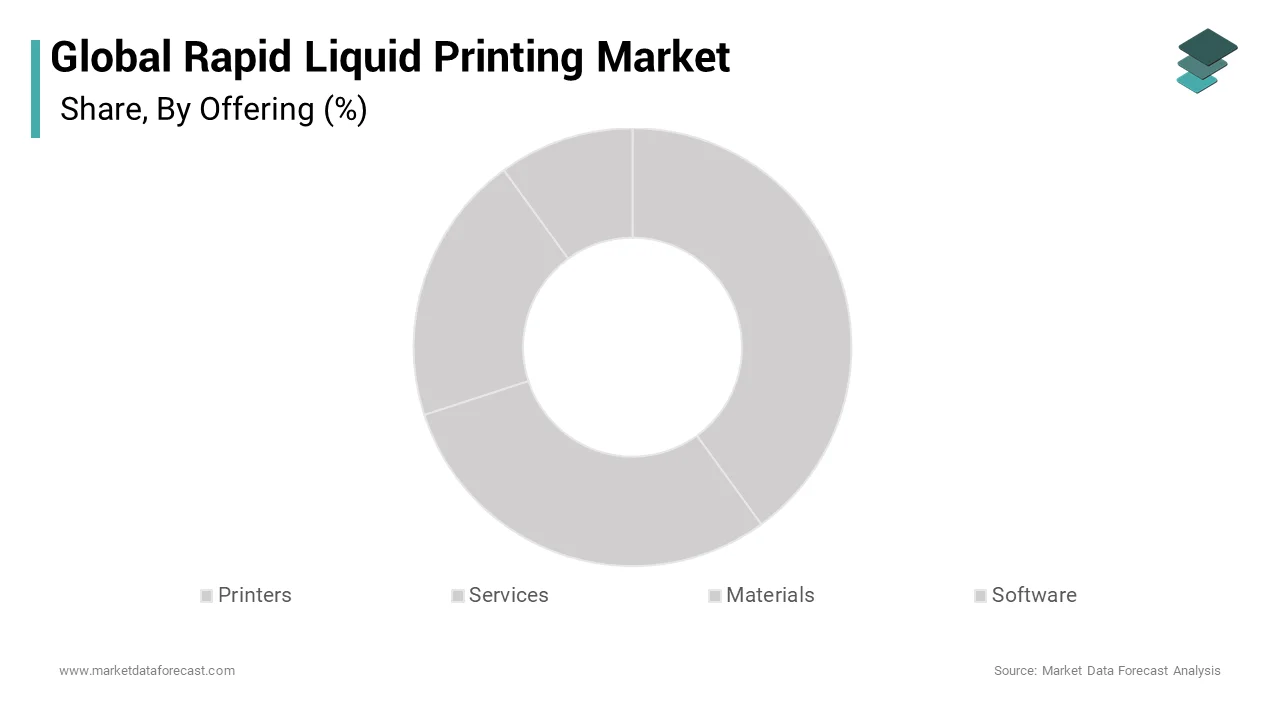
The materials segment is anticipated to witness a fastest CAGR of 28.5% throughout the forecast period with the need for specialized resins and silicones compatible with gel based extrusion processes. The recurring revenue model associated with consumables, which outpaces one time hardware sales as production volumes increase. The development of new photopolymers and elastomers with tailored rheological properties is accelerating to meet the demands of diverse applications, such as soft robotics and medical devices. Rapid liquid printing requires materials that cure rapidly upon exposure to light or chemical triggers while maintaining flow stability during extrusion, which limits the use of off the shelf commodities. Companies are investing heavily in formulating bio based and recyclable materials to align with sustainability goals which further drives innovation and adoption. The dependency on vendor specific material formulations creates a captive market where users must purchase certified supplies to ensure print quality and machine warranty validity.
By Application Insights
The prototyping segment held a significant share of the rapid liquid printing market in 2025 due to the technology’s ability to produce high fidelity models with smooth surface finishes and complex internal structures rapidly. The urgent need for design validation in product development cycles where speed and accuracy are paramount. Companies that utilize advanced prototyping technologies reduce time by up to 40% allowing them to respond faster to consumer trends and competitive pressures. Rapid liquid printing eliminates the need for support structure removal, which significantly reduces post processing time compared to traditional stereolithography or selective laser sintering. The automotive manufacturers use rapid liquid printed prototypes for ergonomic testing of interior components and aerodynamic assessment of exterior parts because the smooth surface quality mimics final production finishes. The ability to print overhangs and intricate lattice structures without additional scaffolding enables designers to explore geometries that were previously impossible to prototype efficiently.
The functional part manufacturing segment is expected to register a fastest CAGR of 24.2% during the forecast period with the increasing reliability of printed materials and the demand for end use components. The advancement in material science, which has enabled the production of parts with mechanical properties suitable for operational environments, such as automotive interiors and consumer electronics. According to the National Association of Manufacturers the shift toward mass customization requires manufacturing technologies that can produce durable end use parts without the economic burden of tooling changes. Rapid liquid printing allows for the creation of flexible seals gaskets and dampers that benefit from the isotropic strength provided by the gel supported printing process. The functional parts produced via rapid liquid printing exhibit superior fatigue resistance compared to layer by layer printed equivalents due to the absence of interlayer weaknesses. Industries, such as healthcare are increasingly adopting this method for producing custom orthotics and prosthetic sockets that require specific flexibility and durability characteristics. The ability to integrate multiple material densities within a single print run enables the creation of complex assemblies that function immediately after printing.
By End-Use Industry Insights
The healthcare industry segment was the largest by accounting for 35.6% of the rapid liquid printing market share in 2025 with the need for patient specific medical devices and biocompatible prototypes. The technology’s ability to produce soft flexible structures that mimic human tissue, which is essential for surgical planning models and custom prosthetics. The number of 3D printed medical device clearances has increased significantly with a focus on personalized implants and surgical guides that improve patient outcomes. Rapid liquid printing allows for the creation of anatomical models with varying stiffness levels that help surgeons practice complex procedures reducing operation time and risk. The biocompatibility of silicone based materials used in rapid liquid printing makes them suitable for direct contact applications such as wound care devices and wearable sensors. Healthcare providers value the speed at which custom devices can be produced enabling rapid response to patient needs in emergency situations.
The consumer goods segment is likely to grow at a fastest CAGR of 26.8% from 2026 to 2034 with the trend toward personalization and sustainable manufacturing practices. The primary growth driver is the demand for customized footwear accessories and wearable technology that require complex geometries and comfortable flexible materials. Rapid liquid printing enables the cost effective production of custom fitted shoe midsoles and earbuds that conform precisely to individual anatomy providing superior comfort and performance. The adoption of additive manufacturing for footwear components has reduced waste by eliminating the need for cutting patterns and excess material. The technology’s ability to print lattice structures with varying density allows for tailored cushioning and support characteristics that traditional molding cannot achieve. Retailers are exploring in store printing services to offer immediate customization enhancing the customer experience. The use of recycled and bio based materials in rapid liquid printing aligns with corporate sustainability goals appealing to environmentally conscious consumers.
REGIONAL ANALYSIS
North America Market Analysis
North America rapid liquid printing market was the top performer by holding 40.3% of share in 2025 with the strong research and development activities and early adoption of advanced manufacturing technologies. The United States dominates the regional market due to the presence of leading technology developers, such as the Massachusetts Institute of Technology and major industrial players in aerospace and healthcare. The Department of Defense supports additive manufacturing initiatives to enhance supply chain resilience and produce lightweight components for military applications. North American companies lead in the adoption of industrial grade 3D printing technologies for functional part production. The region benefits from a robust ecosystem of venture capital funding startups focused on novel printing techniques and material formulations. Regulatory frameworks, such as those from the Food and Drug Administration facilitate the approval of 3D printed medical devices encouraging innovation in the healthcare sector. Strong intellectual property protection laws attract global talent and investment fostering a conducive environment for technological breakthroughs.
Europe Market Analysis
Europe rapid liquid printing market held second position by holding 30.3% of share in 2025 with the strong industrial bases in Germany, France, and the United Kingdom. The stringent sustainability regulations and the Industry 4.0 initiative, which promotes digitalization and advanced manufacturing processes. The Horizon Europe program allocates substantial funding for research into sustainable manufacturing technologies including additive manufacturing methods that reduce waste and energy consumption. German manufacturers are increasingly integrating additive manufacturing into their production lines to enhance flexibility and efficiency. The European Union’s Green Deal encourages the use of bio based materials and circular economy principles, which aligns with the capabilities of rapid liquid printing to minimize material waste. Research institutions such as the Fraunhofer Institute collaborate with industry partners to develop new materials and processes.
Asia-Pacific Market Analysis
Asia-Pacific rapid liquid printing market growth is likely to have a significant growth opportunities in coming years with the rapid industrialization and expanding manufacturing capabilities in China, Japan, and South Korea. The region benefits from low production costs and government initiatives to modernize manufacturing infrastructure. China is investing heavily in additive manufacturing as part of its Made in China 2025 strategy aiming to become a global leader in advanced technologies. As per data from the Chinese Ministry of Industry and Information Technology, the country has established numerous additive manufacturing innovation centers to support research and commercialization. Japan focuses on precision engineering and robotics where rapid liquid printing is used for creating soft actuators and sensors. South Korea’s strong electronics industry drives demand for customized components and rapid prototyping services. The region’s large consumer base supports the growth of personalized consumer goods applications. Increasing awareness of sustainable manufacturing practices encourages adoption of technologies that reduce material waste. Government subsidies and tax incentives for technology adoption further accelerate market expansion.
Latin America Market Analysis
Latin America rapid liquid printing market growth is driven by growing interest in medical applications and educational initiatives. Brazil and Mexico are the primary contributors due to their developing industrial sectors and increasing investment in healthcare infrastructure. The region is focusing on improving manufacturing competitiveness through technology adoption and skills development. Brazil’s healthcare sector is exploring rapid liquid printing for producing custom prosthetics and surgical models to improve patient care in public hospitals. The automotive industry in Mexico is beginning to adopt rapid prototyping tools to support vehicle assembly plants. Educational institutions are incorporating additive manufacturing into curricula to build a skilled workforce. Economic challenges and limited access to capital remain barriers but international partnerships and government programs are helping to overcome these obstacles.
Middle East and Africa Market Analysis
The Middle East and Africa rapid liquid printing market growth is driven primarily by healthcare initiatives and diversification efforts in Gulf Cooperation Council countries. Saudi Arabia and the United Arab Emirates are leading investors in advanced technologies as part of their economic vision plans to reduce reliance on oil revenues. The healthcare sector in the region is adopting 3D printing for surgical planning and custom implants to improve medical outcomes. The limited activity exists in South Africa and Egypt focused on research and education. The region faces challenges related to infrastructure and skilled labor but investments in technology hubs and training programs are addressing these gaps. International collaborations with European and North American firms facilitate knowledge transfer and technology adoption.
COMPETITIVE LANDASCAPE
The Rapid Liquid Printing Market exhibits a highly specialized competitive landscape characterized by a mix of established additive manufacturing giants and innovative startups focused on niche applications. Major corporations leverage their extensive resources and global distribution networks to integrate liquid printing technologies into broader portfolios offering comprehensive solutions to industrial clients. These entities compete primarily on technological sophistication material diversity and system reliability rather than price alone. Smaller agile firms differentiate themselves through unique proprietary processes and specialized material chemistries that address specific industry needs such as soft robotics or biomedical devices. Intense competition drives continuous innovation in printer speed build volume and post processing automation to enhance overall efficiency. Regulatory compliance and certification for medical and aerospace applications serve as significant barriers to entry ensuring that only qualified manufacturers can participate in high value sectors. Strategic alliances between hardware providers and material scientists accelerate development cycles and foster ecosystem growth.
KEY MARKET PLAYERS
These are some of the notable players in the global rapid liquid printing market.
- 3D Systems, Inc.
- Autodesk, Inc.
- BMW AG
- Desktop Metal Inc
- Carbon Inc
- Dassault Systèmes
- EOS
- ExOne
- Materialise
- Native Shoes
- Steelcase Inc.
- Stratasys Direct, Inc
Top Players In The Market
- Desktop Metal Inc is a leading innovator in additive manufacturing technologies with a strong focus on industrial scale production systems. The company has integrated rapid liquid printing capabilities through strategic acquisitions and internal research to expand its portfolio beyond metal printing. Desktop Metal recently launched new software solutions that optimize print parameters for gel-based extrusion processes enhancing speed and material efficiency. This move allows the firm to serve diverse industries including automotive and consumer goods with high throughput manufacturing options. The organization invests heavily in developing proprietary materials compatible with liquid printing ensuring superior mechanical properties and surface finish. Its global distribution network supports widespread adoption of these advanced technologies among enterprise customers seeking scalable additive manufacturing solutions.
- Carbon Inc specializes in digital light synthesis and has expanded into rapid liquid printing to address the demand for flexible and elastomeric parts. The company leverages its expertise in photopolymer chemistry to develop specialized resins that cure rapidly within supportive gel mediums. Carbon recently partnered with major footwear brands to produce customized midsoles using rapid liquid printing techniques, which reduce waste and improve comfort. This collaboration demonstrates the commercial viability of the technology for mass customization applications. The firm continues to refine its hardware designs to increase build volume and print speed making it suitable for higher volume production runs. Carbon’s integrated approach combining hardware software and materials provides a seamless experience for users transitioning from prototyping to end use part manufacturing.
- Stratasys Ltd is a global leader in 3D printing solutions offering a comprehensive range of technologies including recent advancements in liquid based additive manufacturing. The company focuses on delivering high precision and reliable printing systems for aerospace healthcare and automotive sectors. Stratasys recently introduced new material formulations designed specifically for rapid liquid printing applications enabling the creation of complex soft robotics components. These innovations enhance the functional capabilities of printed parts allowing for multi material integration within single builds. The organization actively collaborates with research institutions to validate the performance of liquid printed materials under various stress conditions. Stratasys strengthens its market position by providing extensive technical support and training programs ensuring successful implementation of these advanced technologies across its global customer base.
Top Strategies Used By Key Market Participants
Key players in the Rapid Liquid Printing Market primarily focus on material innovation and strategic partnerships to maintain competitive advantage. Companies invest heavily in developing proprietary resins and silicones with tailored rheological properties for optimal gel based extrusion. Collaborations with end users in healthcare and automotive sectors help validate applications and drive adoption of functional part manufacturing. Expansion of software capabilities enables better process control and integration with generative design tools for optimized geometries. Manufacturers prioritize scaling production capacities to meet growing demand for mass customization and rapid prototyping services. Intellectual property protection through patents ensures exclusivity in novel printing techniques and material formulations. Educational initiatives and training programs build a skilled workforce capable of operating advanced liquid printing systems effectively.
MARKET SEGMENTATION
This research report on the global rapid liquid printing market has been segmented and sub-segmented based on the offering, application, vertical, nd region.
By Offering
- Printers
- Desktop Printers
- Industrial Printers
- Services
- Materials
- Plastic
- Rubber
- Foam
- Others
- Software
- Design
- Inspection
- Printing
- Scanning
By Application
- Prototyping
- Functional/End-Use Part Manufacturing
- Tooling
By Vertical
- Consumer Products
- Fashion
- Automotive
- Healthcare
- Aerospace & Defense
- Utility
- Construction
- Others
By Region
- North America
- Europe
- Latin America
- The Middle East and Africa