- Product Description Description
- Table of Contents TOC
- List of Table & Figure LOT
- Get Free Sample PDF Sample PDF
Market Size, 2025
$3.53 BnMarket Estimate, 2026
$4.24 BnMarket Forecast, 2034
$18.38 BnCAGR, 2026–2034
20.12%Executive Summary: Global Remote Browser Market
- Market Scope: Comprehensive global remote browser (web isolation) market analysis covering browser types, end-user industry verticals, cloud deployment frameworks, and cybersecurity threat mitigation metrics.
- Market Valuation: Valued at USD 3.53 billion (2025), estimated at USD 4.24 billion (2026), and projected to reach USD 18.38 billion by 2034, registering a robust CAGR of 20.12% (2026–2034).
- Primary Growth Drivers: Growing prevalence of IoT devices and escalating sophisticated cyber-attacks, increasing IT sector support for malware prevention and data encryption, and rising enterprise demand for secure, cloud-based web isolation solutions.
Key Market Segment Metrics (2026–2034)
| Category | Leading Segment (2025 Position) | Fastest-Growing Segment |
|---|---|---|
| By Type | Chrome and Firefox Remote Isolation Segments (accounted for the dominating share of the global market) | Cloud-Native and Universal Browser Isolation Solutions (driven by enterprise transition toward zero-trust models) |
| By End User | Banking and Financial Institutes (led the market, accounting for major share due to secure transaction processing demands) | IT and Telecom & Healthcare (scaling rapidly with distributed workforces and high-value data protection needs) |
| By Region | North America (held the major share of the global market supported by advanced digital infrastructure and zero-trust mandates) | Asia-Pacific (anticipated to witness the highest CAGR driven by rising internet speeds and escalating cyber-attack incidents) |
Major Market Players & Market Structure
Market Structure: Highly competitive global cybersecurity landscape featuring established software corporations and specialized isolation vendors competing intensely on cloud architecture scalability, zero-trust integration, threat intelligence, and user experience.
Key Companies: Symantec Corporation, Citrix Systems Inc., Ericom Software, Cyberinc, Tucloud Federal Inc., Bomgar Corporation, Cigloo Inc., Menlo Security, Light Point Security, Bromium Inc., and Authentic8 Inc.
Global Remote Browser Market Size
The global remote browser (web isolation) market was valued at USD 3.53 billion in 2025 and is anticipated to be worth USD 18.38 billion by 2034, from USD 4.24 billion in 2026, growing at a CAGR of 20.12% from 2026 to 2034.

Remote browsers are specialized isolation technologies that execute web browsing sessions on remote servers rather than local endpoints, thereby preventing malicious code from reaching user devices. This security architecture renders the browser a neutral delivery channel for visual content while keeping threats contained in the cloud. According to the Verizon Data Breach Investigations Report, 74% of all breaches involve the human element, often triggered through web-based attacks such as phishing or drive-by downloads. According to the Federal Bureau of Investigation, business email compromise and web-based fraud resulted in adjusted losses exceeding 2.9 billion dollars in a single year, and this indicates the financial devastation caused by unsecured browsing activities. These statistics demonstrate that traditional endpoint protection is insufficient against sophisticated web-borne threats. Consequently, organizations are increasingly adopting remote browser isolation to create an impenetrable barrier between users and the internet. By stripping away executable code and delivering only safe visual pixels to the end user, this technology eliminates the risk of zero-day exploits and malware infiltration. The shift toward zero-trust security models further accelerates adoption as enterprises secure remote workforces and protect sensitive data from complex cyber threats originating from the web.
MARKET DRIVERS
Escalating Sophistication of Web-Based Cyber Threats
The increasing sophistication and frequency of web-based cyber-attacks directly fuels the expansion of the global remote browser market as traditional defenses fail to stop advanced threats. Cybercriminals constantly evolve their tactics using zero-day exploits and fileless malware that bypass signature-based detection systems installed on local devices. According to the Ponemon Institute, the average cost of a data breach reached 4.45 million dollars globally, with web application attacks being a primary vector for initial access. This financial impact compels organizations to adopt proactive security measures that prevent threats from ever touching the corporate network. According to the Anti-Phishing Working Group, phishing sites increased by 25% in the last year alone, demonstrating the relentless volume of malicious web content targeting employees. Remote browsers mitigate this risk by executing all web code in an isolated container, ensuring that any malicious script remains trapped in the cloud. This isolation prevents credential theft and ransomware installation, which are common outcomes of successful web attacks. As attackers target the browser as the new perimeter, security teams recognize that isolation is the only way to guarantee safety. Consequently, the persistent evolution of web threats sustains strong demand for remote browsing technologies that offer absolute protection regardless of the attack vector.
Expansion of Remote Work and Zero Trust Architectures
The widespread adoption of remote work models and the implementation of zero-trust security frameworks significantly propel the remote browser market growth. Employees accessing corporate resources from unmanaged devices and home networks introduce significant security risks that traditional perimeter defenses cannot address. According to Gartner, 60% of large enterprises will implement zero-trust principles, requiring strict verification for every user and device regardless of location. Remote browser isolation aligns perfectly with this model by ensuring that no code executes on the endpoint, thereby maintaining security even on personal devices. According to the International Labour Organization, remote work has become permanent for 16% of companies globally, creating a dispersed workforce that requires consistent security policies. Remote browsers provide a uniform, secure browsing experience across all locations and devices, eliminating the variability of local security configurations. This consistency is crucial for compliance and data protection in regulated industries. Organizations value the ability to enforce security policies centrally without relying on endpoint agent performance. Consequently, the structural shift toward distributed workforces and zero-trust architectures drives sustained investment in remote browser solutions as a foundational component of modern enterprise security.
MARKET RESTRAINTS
High Latency and User Experience Degradation
Significant technical challenges related to latency and user experience degradation restrict the widespread adoption of remote browser isolation solutions among end users. Rendering web pages on remote servers and streaming them as video or pixel data to local devices introduces delays that can frustrate users accustomed to instant local browsing. According to the Society for Human Resource Management, 40% of employees report decreased productivity due to slow or laggy IT tools, which leads to resistance against new security implementations. This user friction often results in shadow IT practices where employees bypass security controls to maintain workflow efficiency. According to the Internet Engineering Task Force, real-time interactive web applications such as video conferencing or complex dashboards suffer from noticeable lag when processed through remote isolation layers. This performance gap makes remote browsers unsuitable for certain high-bandwidth or low-latency use cases. Users may experience choppy video playback or delayed input response, which hampers their ability to perform tasks effectively. The perception of reduced performance creates a barrier to full organizational rollout. Consequently, the trade-off between enhanced security and degraded user experience limits market penetration as organizations struggle to balance protection with operational efficiency and employee satisfaction.
Substantial Infrastructure Costs and Complexity
Substantial financial investments required for infrastructure setup and ongoing maintenance is another major restraint for small and medium-sized enterprises considering remote browser adoption. Implementing remote browser isolation requires robust cloud computing resources, high-bandwidth connectivity, and specialized software licensing, which can be prohibitively expensive. According to the National Federation of Independent Business, 30% of small businesses cite high technology costs as the primary barrier to adopting advanced cybersecurity measures. This financial burden forces smaller organizations to rely on less effective free or basic security tools, leaving them vulnerable to sophisticated attacks. Additionally, the complexity of integrating remote browser solutions with existing identity management and security information and event management systems requires specialized expertise. According to the Information Systems Security Association, 50% of organizations lack the internal skills to manage complex cloud-based security architectures effectively. This skills gap leads to prolonged deployment times and higher consulting costs. Ongoing maintenance and scaling requirements further add to the total cost of ownership. Consequently, the high entry barrier and operational complexity limit the market to larger enterprises with deeper pockets, leaving a significant portion of the market underserved due to financial and technical constraints.
MARKET OPPORTUNITIES
Integration with Secure Web Gateways and SASE Platforms
The integration of remote browser isolation with secure web gateways and secure access service edge platforms presents a significant opportunity for vendors to offer consolidated security solutions. Organizations are increasingly seeking to simplify their security stacks by combining multiple functions into a single unified platform to reduce management overhead and costs. According to the Enterprise Strategy Group, 70% of enterprises plan to adopt SASE architectures within the next two years to streamline network and security operations. This trend creates a lucrative avenue for remote browser vendors to partner with or acquire SWG providers to offer integrated packages. According to the Cloud Security Alliance, consolidating security services reduces the risk of configuration errors and policy gaps, which are common when managing disparate tools. Integrated solutions provide seamless policy enforcement and unified visibility across all web traffic, enhancing overall security posture. Vendors can leverage this opportunity to upsell advanced features such as data loss prevention and threat intelligence alongside isolation capabilities. The demand for simplified procurement and management drives adoption of bundled offerings. Consequently, the convergence of remote browsing with broader network security frameworks creates new revenue streams and strengthens customer retention through comprehensive value propositions.
Growth in Regulated Industries and Compliance Requirements
The stringent regulatory requirements in highly regulated industries such as healthcare, finance, and government create substantial opportunities for remote browser market expansion. These sectors handle sensitive personal and financial data that must be protected from web-based threats to comply with laws such as HIPAA, GDPR, and PCI DSS. According to the Healthcare Information and Management Systems Society, 80% of healthcare organizations face increasing pressure to demonstrate robust cybersecurity measures to avoid hefty fines and reputational damage. Remote browser isolation provides a verifiable method of preventing data exfiltration and malware infection, which aids in compliance audits. According to the Financial Industry Regulatory Authority, financial institutions are mandated to implement advanced controls to protect client data from cyber threats, including those delivered via the web. Remote browsers ensure that no data resides on the endpoint, reducing the risk of leakage through compromised devices. This capability simplifies compliance reporting and risk management for regulated entities. As regulations become stricter, the demand for provable security measures grows. Consequently, the need to meet rigorous compliance standards drives adoption in these high-value sectors, offering vendors stable, long-term contracts and recurring revenue opportunities.
MARKET CHALLENGES
Compatibility Issues with Complex Web Applications
The inability of some remote browser solutions to fully support complex modern web applications is a major challenge for the remote browser market. Many enterprise applications rely heavily on client-side processing plugins and specific browser features that may not function correctly when rendered remotely. According to the World Wide Web Consortium, over 60% of modern web applications use advanced JavaScript frameworks and HTML5 features that require precise local execution for optimal performance. When these applications are forced through remote isolation layers, they may exhibit broken functionality, missing elements, or incorrect behavior. This incompatibility disrupts critical business workflows and forces IT teams to create complex exceptions or whitelist certain sites, which undermines security. According to the Software and Information Industry Association, legacy enterprise applications often lack the flexibility to adapt to remote rendering environments, leading to operational bottlenecks. Users may encounter errors when uploading files, printing documents, or using multi-factor authentication tokens that rely on local hardware interaction. Resolving these compatibility issues requires continuous development and testing, which strains vendor resources. Consequently, the technical limitations in supporting diverse and complex web ecosystems challenge vendors to deliver seamless experiences without compromising security integrity.
Privacy Concerns and Data Visibility Risks
The centralization of web browsing activity on remote servers raises significant privacy concerns and data visibility risks that challenge market adoption among privacy-conscious organizations and users. Routing all web traffic through a third-party provider means that the vendor has potential visibility into sensitive user activities and corporate data. According to the Electronic Frontier Foundation, 55% of consumers are concerned about third-party access to their browsing history and personal data due to potential misuse or surveillance. This concern is amplified in industries handling confidential intellectual property or classified information, where even metadata exposure can be risky. Additionally, the General Data Protection Regulation imposes strict requirements on data processing and storage, requiring vendors to demonstrate rigorous compliance and data sovereignty. According to the European Data Protection Board, cross-border data transfers associated with cloud-based browsing services face heightened scrutiny and legal challenges. Organizations must ensure that vendors do not log or retain sensitive content, which requires transparent policies and technical safeguards. Any breach or misuse of data by the provider can result in severe legal and reputational consequences. Consequently, the inherent privacy risks associated with centralized browsing processing create trust barriers that vendors must overcome through robust encryption and strict data governance practices.
REPORT COVERAGE
| REPORT METRIC | DETAILS |
| Market Size Available | 2025 to 2034 |
| Base Year | 2025 |
| Forecast Period | 2026 to 2034 |
| Segments Covered | By Type, End User, and Region. |
| Various Analyses Covered | Global, Regional, and Country-Level Analysis, Segment-Level Analysis, Drivers, Restraints, Opportunities, Challenges; PESTLE Analysis; Porter’s Five Forces Analysis, Competitive Landscape, Analyst Overview of Investment Opportunities |
| Regions Covered | North America, Europe, APAC, Latin America, Middle East & Africa |
| Market Leaders Profiled | Symantec Corporation, Citrix Systems Inc., Ericom Software, Cyberinc, Tucloud Federal Inc., Bomgar Corporation, Cigloo Inc., Zscaler, Forcepoint, Menlo Security, Light Point Security, Bromium Inc. and Authentic8 Inc. |
SEGMENTAL ANALYSIS
By Type Insights
The chrome browser segment dominated the market by holding the leading share of the global market in 2025 due to its overwhelming dominance in the global enterprise environment, which necessitates compatible isolation solutions. Organizations standardize on Chrome for its extensive extension ecosystem and seamless integration with cloud productivity suites, making it the primary target for remote browser isolation vendors. According to StatCounter, Chrome commands over 65% of the global desktop browser market share, ensuring that security providers prioritize compatibility with this platform to address the largest user base. This widespread adoption drives demand for remote browsing solutions that can seamlessly isolate Chrome sessions without disrupting user workflows or breaking essential web applications. According to the Google Cloud Security Blog, over 80% of Fortune 500 companies use Chrome Enterprise as their default browser, creating a massive installed base requiring protection. Remote browser vendors optimize their rendering engines to support Chrome-specific protocols and extensions, ensuring high-fidelity performance. The familiarity of the interface reduces training costs and resistance to adoption among employees. Consequently, the ubiquity of Chrome in corporate environments sustains its dominance as the primary type supported by remote browser isolation platforms.
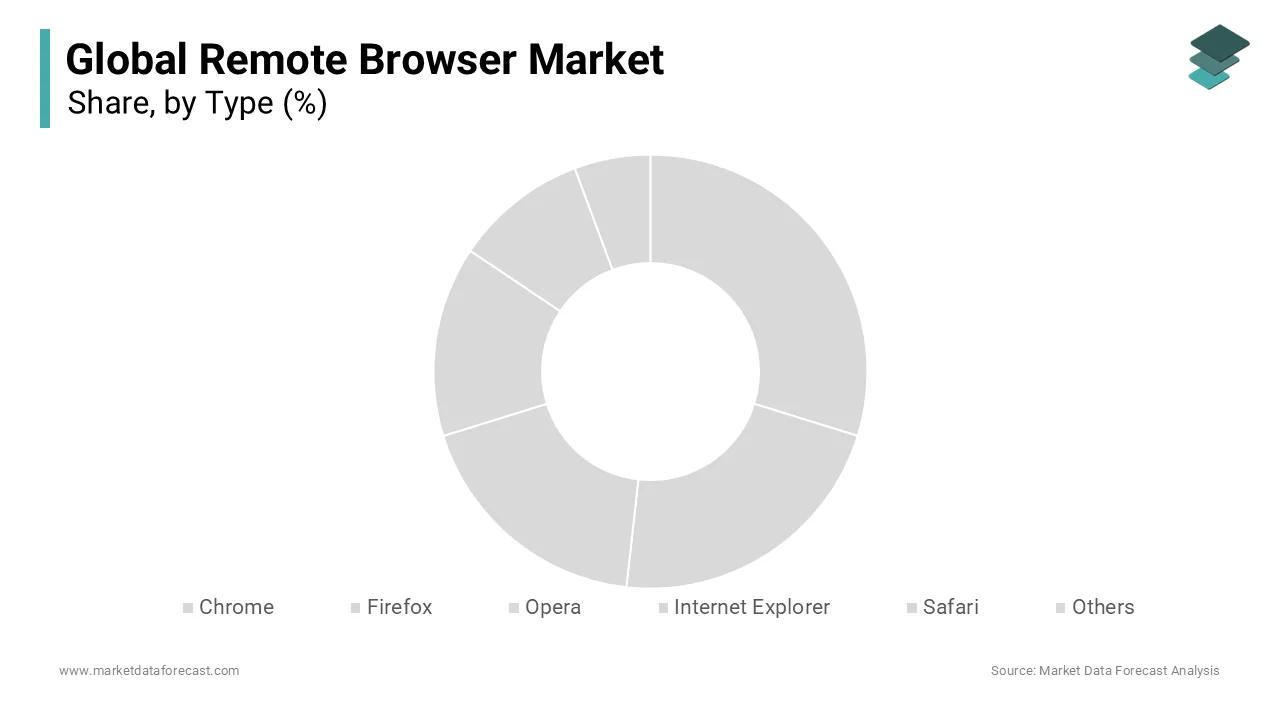
On the other hand, the other segment is projected to register the highest CAGR of 19.5% in the global remote browser market over the forecast period as enterprises increasingly migrate from legacy browsers to modern secure alternatives. Microsoft has aggressively promoted Edge as the default browser for Windows 10 and 11 users, leveraging its integration with Azure Active Directory and Microsoft 365 security services. According to NetMarketShare data, Edge usage in enterprise environments has grown by 30% year over year as organizations consolidate their technology stacks around Microsoft ecosystems. This shift drives demand for remote browser solutions that specifically support Edge isolation capabilities to maintain seamless single sign-on and conditional access policies. According to the Microsoft Security Response Center, Edge offers built-in security features such as Application Guard, which complements remote browser isolation by providing an additional layer of defense. Vendors are rapidly developing specialized connectors for Edge to ensure optimal performance and compatibility. The growing preference for integrated security suites from major cloud providers accelerates the adoption of Edge-compatible remote browsing tools. Consequently, the strategic push by Microsoft and the resulting enterprise migration fuel the exceptional growth of this segment.
By End-User Insights
The banking and financial services segment accounted for the dominant share of the global market in 2025 due to stringent regulatory requirements and the critical need to prevent financial fraud and data breaches. Financial institutions handle vast amounts of sensitive customer data and monetary transactions, making them prime targets for web-based attacks such as phishing and credential stuffing. According to the Financial Services Information Sharing and Analysis Center, the financial sector experiences 300 times more cyberattacks than other industries, necessitating robust defensive measures like remote browser isolation. This high threat landscape compels banks to adopt isolation technologies that prevent malware from reaching employee devices and stealing login credentials. According to the Basel Committee on Banking Supervision, operational resilience frameworks require banks to implement advanced cybersecurity controls to protect against third-party risks, including web-based threats. Remote browsers ensure that no executable code runs on local endpoints, thereby mitigating the risk of keyloggers and screen scrapers. The ability to demonstrate compliance with regulations such as PCI DSS and GDPR through verifiable security architectures drives adoption. Consequently, the imperative to protect customer assets and maintain regulatory compliance sustains the dominance of the banking and financial services sector in the remote browser market.
However, the healthcare segment is predicted to record a promising CAGR of 20.8% over the forecast period in the global market as digital health initiatives expand and ransomware attacks intensify. Hospitals and clinics are increasingly relying on web-based electronic health records and telemedicine platforms, which increase the attack surface for cybercriminals. According to the Healthcare Information and Management Systems Society, healthcare organizations faced an average of 1,400 cyberattacks per week, making them the most targeted industry for ransomware. This alarming frequency drives healthcare providers to adopt remote browser isolation to protect patient data and ensure continuity of care. According to the Office for Civil Rights, data breaches in healthcare affected over 100 million individuals in recent years, prompting stricter enforcement of HIPAA security rules. Remote browsers prevent malware from encrypting local files or exfiltrating protected health information by keeping all web interactions isolated in the cloud. The ability to securely access patient records from various devices without risking infection is crucial for modern healthcare delivery. Consequently, the urgent need to safeguard patient privacy and maintain operational resilience fuels the rapid adoption of remote browsing solutions in the healthcare sector.
REGIONAL ANALYSIS
North America Remote Browser Market Analysis
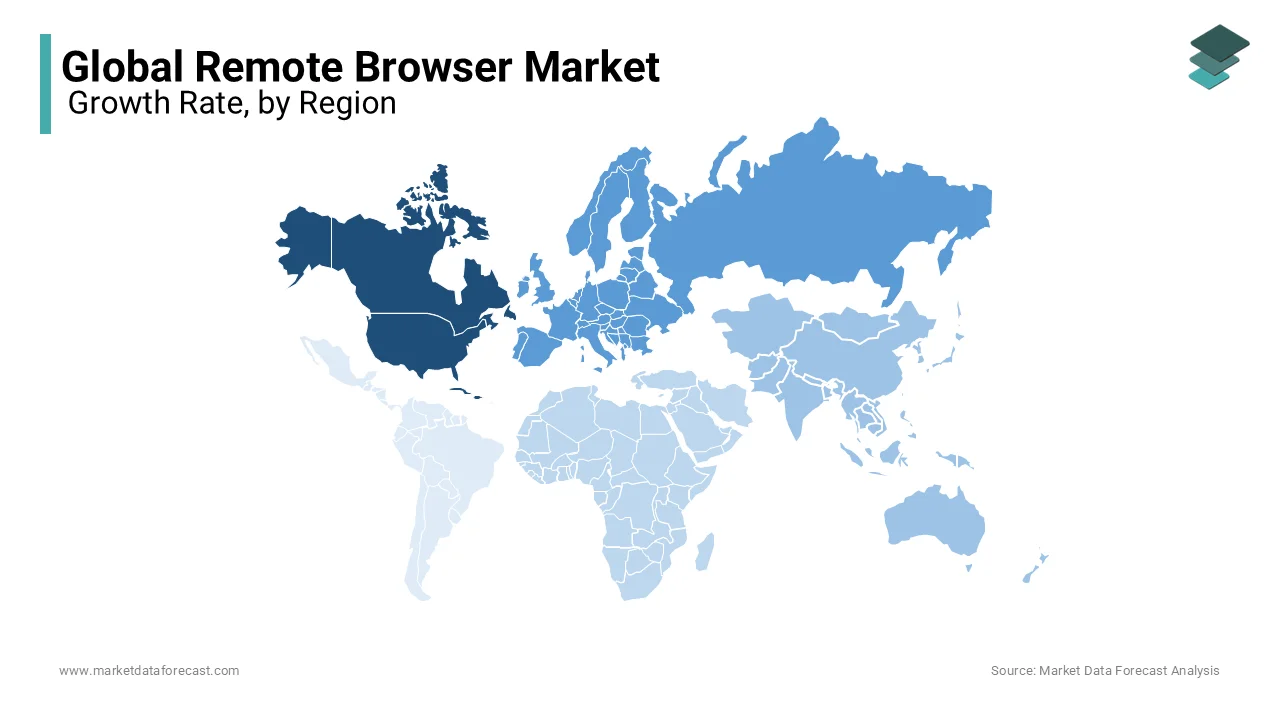
North America held the highest share of the global market in 2025 and is likely to maintain its dominant position and experience steady expansion over the next few years driven by high cybersecurity awareness, stringent regulatory frameworks, and the presence of major technology vendors. The region accounts for the largest share of global revenue due to the early adoption of zero-trust security models and advanced threat protection strategies. According to the National Institute of Standards and Technology, over 60% of US federal agencies are mandated to implement zero-trust architectures, which heavily favors remote browser isolation as a key component. This government directive creates a substantial baseline demand for isolation technologies across public and private sectors. According to the Federal Trade Commission, consumer protection guidelines emphasize the importance of safeguarding consumer data from web-based threats, leading to increased investment in secure browsing solutions by retail and financial institutions. The mature IT infrastructure and high broadband penetration facilitate the seamless deployment of cloud-based isolation services. Major vendors headquartered in the region continue to innovate and expand their product offerings. Consequently, North America’s regulatory leadership and technological maturity sustain its market dominance while setting global standards for secure web access.
Europe Remote Browser Market Analysis
Europe is projected to experience robust growth and increased adoption of privacy-centric security solutions over the next few years, characterized by strict data privacy laws and a strong focus on digital sovereignty. The General Data Protection Regulation imposes rigorous requirements on data processing and storage, which drives organizations to adopt remote browser solutions that ensure data does not reside on local endpoints. According to the European Union Agency for Cybersecurity, ransomware attacks in Europe increased by 40% in the last year, prompting businesses to seek proactive defense mechanisms like browser isolation. This surge in cyber threats accelerates adoption across various industries, including manufacturing and healthcare. According to the German Federal Office for Information Security, remote browser isolation is recommended as a best practice for protecting against web-based attacks, influencing procurement decisions across the continent. The region’s emphasis on privacy and security compliance makes remote browsing an attractive solution for multinational corporations operating under strict legal frameworks. Local vendors and partnerships with global players enhance market accessibility. Consequently, Europe’s regulatory rigor and rising threat landscape sustain its significant market share with a focus on privacy-centric security solutions.
Asia-Pacific Remote Browser Market Analysis
Asia-Pacific is anticipated to emerge as the fastest-growing regional market with accelerating deployment rates over the next few years driven by rapid digital transformation, increasing internet penetration, and rising cybercrime rates. Countries such as India, China, and Singapore are investing heavily in cybersecurity infrastructure to protect their growing digital economies. According to the Asian Development Bank, cybercrime costs in the Asia-Pacific region are expected to reach 1.5 trillion dollars annually, creating an urgent need for effective security measures. This financial impact drives enterprises to adopt advanced solutions like remote browser isolation to mitigate risks. According to the Singapore Cyber Security Agency, stricter cybersecurity standards are mandated for critical information infrastructure operators, encouraging the adoption of isolation technologies. The expanding workforce and increasing reliance on web-based applications further fuel demand. Mobile-first strategies in many Asian countries also drive interest in secure browsing solutions that work across diverse devices. Consequently, Asia-Pacific offers immense growth potential as organizations modernize their security postures to combat evolving threats and support digital business initiatives.
Latin America Remote Browser Market Analysis
Latin America is poised for progressive market penetration and heightened investment in cybersecurity infrastructure over the next few years, characterized by increasing digital adoption and growing awareness of cyber threats. Brazil and Mexico are leading the region in cybersecurity investments as businesses seek to protect themselves from rising ransomware and phishing attacks. According to the Inter-American Development Bank, digital economy growth in Latin America has accelerated by 15% annually, increasing the attack surface for cybercriminals. This expansion drives demand for scalable security solutions like remote browser isolation. According to the Brazilian General Data Protection Law enforcement reports, strict penalties for data breaches motivate companies to invest in preventive security measures. Financial institutions and government agencies are early adopters seeking to comply with international security standards. Limited local expertise drives reliance on managed security services and cloud-based solutions, which remote browsing facilitates. Consequently, Latin America presents significant growth opportunities as organizations prioritize cybersecurity to support their digital transformation journeys and protect sensitive data.
Middle East and Africa Remote Browser Market Analysis
The Middle East and Africa region is expected to witness steady commercial traction and expanding digital security frameworks over the next few years driven by government digitalization initiatives and increasing cyber threats. Gulf Cooperation Council countries are investing in smart city projects and digital government services, which require robust web security. According to the Saudi National Cybersecurity Authority, cyberattacks in the Kingdom increased by 20%, prompting stricter regulatory requirements for critical sectors. This regulatory push drives adoption of advanced security technologies, including remote browser isolation. According to the African Union cybersecurity framework reports, continental cooperation leads to increased investment in digital infrastructure and security tools. Oil and gas companies in the region are also adopting isolation technologies to protect industrial control systems accessed via web interfaces. Limited local infrastructure in some African countries favors cloud-based solutions that do not require heavy on-premises hardware. Consequently, the Middle East and Africa represent emerging markets with potential for growth as digital adoption expands and cybersecurity awareness rises.
COMPETITIVE LANDSCAPE
The competition in the Remote Browser Market is characterized by intense rivalry among specialized cybersecurity firms and large network security providers striving to offer superior isolation performance and user experience. Major players leverage their extensive cloud infrastructure and global presence to deliver low-latency browsing services that meet the demands of distributed enterprises. These vendors compete on the basis of rendering fidelity, compatibility with complex web applications, and integration capabilities with existing security ecosystems. Smaller niche firms differentiate themselves by offering innovative features such as advanced data loss prevention and behavioral analytics tailored for specific industry needs. The market sees frequent technological advancements as companies strive to optimize video streaming and interactive content delivery within isolated environments. Strategic acquisitions and partnerships are common as larger entities seek to absorb innovative technologies and expand their product portfolios. Customer retention relies heavily on demonstrating measurable improvements in security posture and operational efficiency without disrupting workflows. Price competition is moderate as organizations prioritize effectiveness and reliability over cost savings due to the critical nature of web security. The entry of new competitors with novel rendering engines challenges traditional vendors to continuously innovate. Overall, the competitive landscape drives rapid improvements in performance and usability, ensuring that users have access to increasingly efficient and secure remote browsing solutions.
KEY MARKET PLAYERS
The leading companies operating in the global remote browser market include:
- Symantec Corporation
- Citrix Systems Inc.
- Ericom Software
- Cyberinc
- Tucloud Federal Inc.
- Bomgar Corporation
- Cigloo Inc.
- Zscaler
- Forcepoint
- Menlo Security
- Light Point Security
- Bromium Inc.
- Authentic8 Inc.
TOP PLAYERS IN THE MARKET
- Menlo Security significantly contributes to the Remote Browser Market by pioneering remote browser isolation technology that renders web content in a secure cloud environment. The company protects enterprises from zero-day threats and phishing attacks by ensuring no executable code reaches user endpoints. Recent actions include the integration of its isolation platform with major secure web gateways and cloud access security brokers to provide unified protection. This strategic alignment allows organizations to consolidate their security stacks while maintaining robust defense mechanisms. Menlo Security actively collaborates with leading identity providers to enhance conditional access policies based on real-time threat intelligence. The company also invests heavily in improving rendering performance to minimize latency and ensure a seamless user experience. By focusing on preventing data exfiltration and malware infection through the browser, Menlo Security strengthens its position as a trusted leader in enterprise web security solutions for global organizations.
- Zscaler plays a pivotal role in the Remote Browser Market through its comprehensive cloud security platform that includes advanced remote browser isolation capabilities. The company leverages its global network of data centers to deliver low-latency secure browsing experiences for distributed workforces. Recent efforts involve enhancing its Zero Trust Exchange platform with AI-driven threat detection features that identify and block sophisticated web-based attacks in real time. Zscaler actively partners with major cloud providers to ensure seamless integration and optimal performance for customers using hybrid IT environments. The company emphasizes scalability and ease of deployment, which appeals to large enterprises seeking to secure millions of users globally. Its continuous innovation in data loss prevention and user and entity behavior analytics complements its isolation services. By providing a holistic security approach, Zscaler enables organizations to safely access the internet and cloud applications without compromising on performance or security standards.
- Forcepoint strengthens its presence in the Remote Browser Market by offering human-centric security solutions that combine remote browser isolation with data loss prevention technologies. The company focuses on protecting sensitive information from accidental or malicious leakage during web browsing sessions. Recent actions include the launch of enhanced isolation modules that support complex web applications and legacy systems without breaking functionality. Forcepoint actively integrates its browser isolation tools with its existing endpoint and network security products to create a cohesive defense strategy. The company prioritizes user experience by optimizing video streaming and interactive content delivery within isolated browsers. It also provides detailed analytics and reporting features that help security teams understand user behavior and potential risks. By emphasizing the protection of intellectual property and customer data, Forcepoint addresses critical compliance needs for regulated industries. This focus on data-centric security ensures that organizations can adopt remote browsing technologies with confidence in their ability to safeguard valuable assets.
TOP STRATEGIES USED BY KEY MARKET PARTICIPANTS
Key players in the Remote Browser Market primarily employ strategic partnerships with established security vendors to integrate isolation capabilities into broader secure access service edge platforms. Companies frequently collaborate with secure web gateway and cloud access security broker providers to offer unified solutions that simplify management and reduce complexity for enterprise clients. This integration strategy allows vendors to leverage existing customer relationships and distribution channels to accelerate market penetration. Another major strategy involves investing heavily in research and development to improve rendering performance and reduce latency, which are critical barriers to adoption. Vendors focus on optimizing video streaming and interactive content delivery to ensure a seamless user experience that rivals local browsing. Additionally, companies emphasize compliance with global data privacy regulations to attract customers in highly regulated industries such as finance and healthcare. Marketing efforts highlight the return on investment through reduced incident response costs and improved productivity. By combining technological innovation with strategic alliances and regulatory compliance, key participants effectively strengthen their competitive positions and drive sustainable growth in the remote browser industry.
MARKET SEGMENTATION
This research report on the global remote browser market has been segmented & sub-segmented based on type, end-user and region.
By Type
- Chrome
- Firefox
- Opera
- Internet Explorer
- Safari
- Others
By End User
- Banking
- Financial
- Healthcare
- Retail
- IT and telecom
- Education
- Others
By Region
- North America
- Asia Pacific
- Europe
- Latin America
- Middle East and Africa