- Product Description Description
- Table of Contents TOC
- List of Table & Figure LOT
- Get Free Sample PDF Sample PDF
Market Size, 2025
$4.17 BnMarket Estimate, 2026
$4.60 BnMarket Forecast, 2034
$9.96 BnCAGR, 2026–2034
10.14%Global Reverse Osmosis Membrane Market Size, Growth, Trends & Forecast (2026–2034)
The global reverse osmosis membrane market size was valued at USD 4.17 billion in 2025, is estimated to reach USD 4.60 billion in 2026, and is projected to scale up to USD 9.96 billion by 2034, registering a compound annual growth rate (CAGR) of 10.14% during the forecast period from 2026 to 2034. Driven by escalating clean water scarcity, tightening wastewater regulations, and large-scale municipal desalination projects, RO membranes remain the foundational technology for global water purification.
Key Executive Metrics (At-a-Glance)
- 2025 Base Valuation: USD 4.17 Billion
- 2026 Current Valuation: USD 4.60 Billion
- 2034 Forecast Valuation: USD 9.96 Billion
- Compound Annual Growth Rate (CAGR): 10.14% (2026–2034)
- Dominant Material Segment: Thin-Film Composite (holding ~61.9% market share due to high flux rates and superior durability)
- Dominant Filter Module: Spiral Wound Membrane (capturing ~41.8% market share for efficient filtration configuration)
- Dominant Region: Asia-Pacific (accounting for ~37.9% market share, anchored by rapid urbanization and large infrastructure initiatives)
Core Market Drivers
- Rising Water Scarcity: Depleting freshwater resources forcing municipalities and industries to rely heavily on seawater desalination.
- Stringent Regulatory Mandates: Environmental laws enforcing strict industrial and municipal wastewater treatment and zero liquid discharge (ZLD) frameworks.
- Public Health Initiatives: Government programs and WHO guidelines promoting clean drinking water standards to mitigate waterborne diseases.
Primary Market Restraints & Challenges
- High Initial Capital & Operating Costs: Expensive installation outlays and high energy consumption requirements for running large desalination plants.
- Environmental Concerns: Brine discharge management and potential negative ecological impacts on coastal marine environments.
Global Reverse Osmosis Membrane Market Segmentation Breakdown
| Segment Category | Leading Sub-Segment (2025 Base) | Fastest-Growing Sub-Segment (2026–2034) |
|---|---|---|
| By Material | Thin-Film Composite (dominant 61.9% share for robust industrial separation) | Thin-Film Composite / Advanced Polymer Variants (high-flux performance) |
| By Filter Module | Spiral Wound Membrane (dominant 41.8% share for compact purification units) | Hollow Fiber & Spiral Wound configurations |
| By Application | Reverse Osmosis Purification Systems (dominant 57.9% share) | Desalination Systems (fastest-growing due to coastal water scarcity) |
| By Region | Asia-Pacific (leading 37.9% regional share anchored by nations like China and India) | Asia-Pacific & Middle East & Africa (fastest-growing hubs for major water infrastructure) |
Major Industry Players Profiled
Key global enterprises shaping the reverse osmosis membrane market include DuPont Water Solutions, LG Chem, Toyobo Co. Ltd., Keenen Technologies, General Electric, Dow Water Solutions, Axeon Water Technologies, Vontron Membranes, Samco Technologies, and Koch Separation Solutions.
Global Reverse Osmosis Membrane Market Size
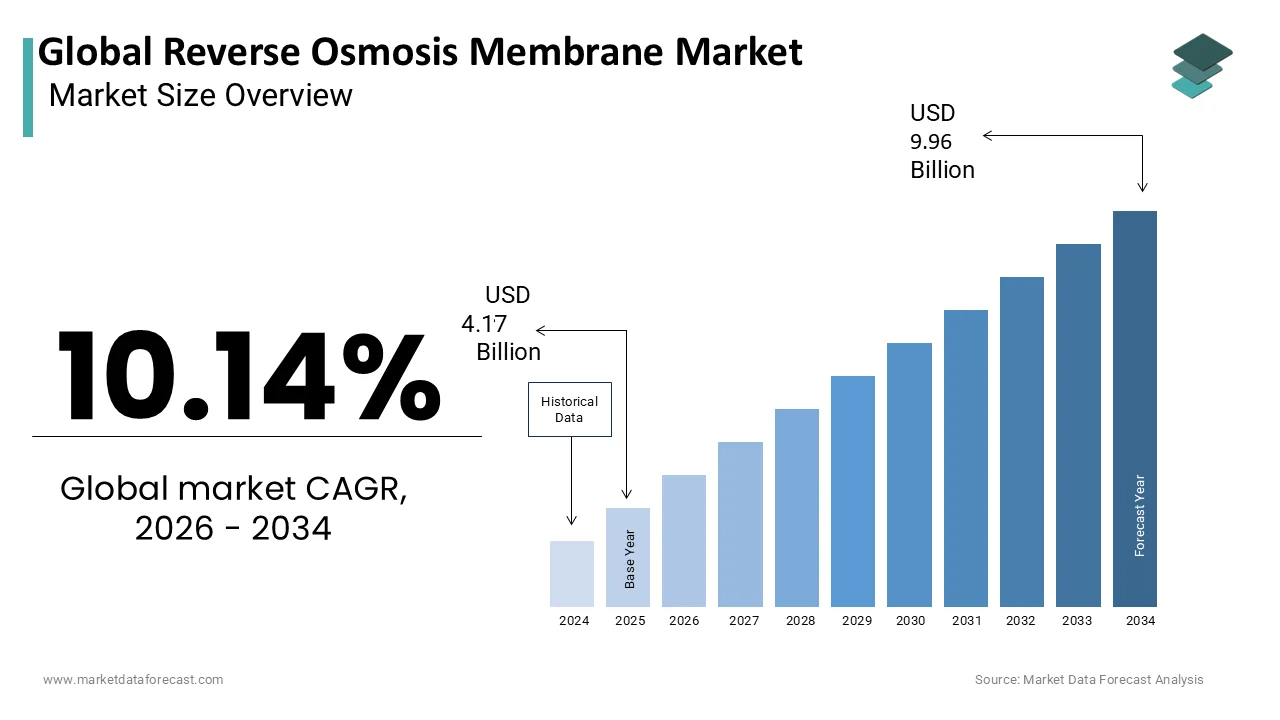
The global reverse osmosis membrane market was valued at USD 4.17 billion in 2025, and the global market size is predicted to reach USD 4.60 billion in 2026 and USD 9.96 billion by 2034, growing at a CAGR of 10.14% from 2026 to 2034.
MARKET DRIVERS
The growing clean water scarcity worldwide is driving the growth of the reverse osmosis membrane market. Water covers 70% of the planet but only 3% of the world’s water is freshwater. According to a report by the World Wildlife Fund, an estimated 1 billion are lacking access to water worldwide and approximately 50% of the worldwide population will be facing water shortages by 2050. Factors such as population growth, climate change, and inefficient water management have made water scarcity a global challenge. The growing water scarcity has fuelled the demand for technologies such as reverse osmosis membranes. Such technologies can purify and desalinate water and then can be used for various purposes including drinking, industrial processes, and agriculture.
The growth of the reverse osmosis membrane market is majorly driven by the increasing demand for the reverse osmosis membrane in water and wastewater treatment. The growing shortage of water and the changing government regulations that require the treatment of industrial and municipal wastewater are further propelling the growth of the reverse osmosis membrane market. The rising need for industrial operations wastewater and development in emerging economies such as APAC, the Middle East and Africa, and Latin America are fuelling the growth rate of the global market. The rising popularity and growing adoption of the reverse osmosis membrane for various purposes are favoring the global market growth.
In addition, new-age technologies and innovations are happening in the market, creating opportunities for entrants in the reverse osmosis membrane market. The growing demand for pure drinking water and government initiatives towards drinking water and rules and regulations laid by the government towards wastewater treatment are further promoting the market growth. Governments of various nations are taking initiatives toward clean water due to the increasing global waterborne diseases. Also, the World Health Organization issued a guideline for the drinking water standards, which in turn increased awareness about the cleanliness and purity of water.
MARKET RESTRAINTS
High initial installation costs for reverse osmosis membrane is one of the major factors hampering the global market growth. High energy consumption by the reverse osmosis desalination plants, environmental concerns as reverse osmosis membranes contributes negatively to the marine environment with brine discharge affecting coastal ecosystems and competition from alternative water treatment technologies are further hindering the growth of the global market.
REPORT COVERAGE
| REPORT METRIC | DETAILS |
| Market Size Available | 2025 to 2034 |
| Base Year | 2025 |
| Forecast Period | 2026 to 2034 |
| Segments Covered | By Material, Filter Module, Application and Region |
| Various Analyses Covered | Global, Regional and country Level Analysis, Segment-Level Analysis, DROC, PESTLE Analysis, Porter’s Five Forces Analysis, Competitive Landscape, Analyst Overview on Investment Opportunities |
| Regions Covered | North America, Europe, Asia Pacific, Latin America, Middle East and Africa |
|
Market Leaders Profiled | Dupont Water Solutions, LG, Toyobo Co. Ltd., Keenen Technologies, General Electric, Dow Water Solutions, Axeon Water Technologies, Vontron Membranes, Samco Technologies and Koch |
SEGMENTAL ANALYSIS
By Material Insights

Based on material, the thin-film composite segment held 61.9% of the global market share in 2025 and is projected to grow at a CAGR of 8.1% during the forecast period. The growing demand for desalination plants, technological advancements, and expanding industrial water treatment are propelling the growth of the thin-film composite segment in the global market. The cellulose-based segment had a considerable share of the worldwide market in 2025and is expected to grow at a CAGR of 6.4% during the forecast period owing to the growing focus on sustainable water treatment solutions and rising demand for reliable and affordable membranes.
By Filter Module Insights
Based on the filter module, the spiral wound membrane segment captured 41.8% of the global market share in 2025and is expected to grow at a CAGR of 7.9% during the forecast period. The growing demand for spiral wounds in water purification, desalination, and municipal water treatment is primarily propelling the growth of the spiral wound segment in the global market. The plate and frame segment held 26.7% of the global market share in 2025and is estimated to witness a healthy CAGR during the forecast period.
By Application Insights
Based on application, the reverse osmosis purification system segment had 57.9% of the global market share in 2025 and is expected to register a promising CAGR during the forecast period owing to the rising popularity of reverse osmosis purification systems.
The desalination system segment is expected to grow at the highest CAGR during the forecast period.
REGIONAL ANALYSIS
The Asia Pacific region occupied 37.9% of the global market share in 2025and is anticipated to grow at the highest CAGR during the forecast period. The domination of the APAC market is majorly driven by the developing infrastructure for the market in the countries of Asia Pacific such as China, India, Japan, and South Korea, accounting for the increasing population in these countries. Factors such as water scarcity concerns, rapid urbanization, growing industrial development, and government initiatives are further fuelling the growth rate of the APAC market. China led the reverse osmosis membrane market in the Asia-Pacific region with 25% of the share in 2024. The Indian market is anticipated to showcase a CAGR of 10.2% during the forecast period.
North America occupied 26.3% of the global market share in 2025and is expected to grow at a prominent CAGR during the forecast period. The growing water purification needs, technological advancements, stringent water quality regulations, rising emphasis on clean water technologies, and innovation are propelling the reverse osmosis membrane market in North America. The U.S. had the largest share of the North American market in 2025and is projected to grow at a CAGR of 5.2% from 2025 to 2033.
The European market is anticipated to register a steady CAGR during the forecast period. On the other hand, South America, the Middle East, and Africa are predicted to grow at a stable growth rate during the forecast period.
KEY MARKET PLAYERS
Dupont Water Solutions, LG, Toyobo Co. Ltd., Keenen Technologies, General Electric, Dow Water Solutions, Axeon Water Technologies, Vontron Membranes, Samco Technologies, and Koch are some of the key players in the reverse osmosis membrane market. The race between the players in the market is moderately high due to the increasing innovation in the membranes and increasing demand for innovative and better products. Therefore, players in the reverse osmosis membrane market have also incorporated new product inventions as their key move to enhance their reverse osmosis membrane share and stay competitive in the market.
RECENT HAPPENINGS IN THE MARKET
- In January 2020, DuPont Water Technologies recently unveiled dry-tested marine water reverse osmosis components, providing for quite a seamless transition between wet to dry tests while somehow enhancing shelf life as well as storage versatility. Its objective is to produce longer working advantages while achieving membrane performance standards.
- In October 2020, Koch announced the partnership with Waste 3R Engineering & Solutions. The collaboration agreement will empower local Bangladesh markets to accomplish recycling and reuse by combining Koch's membrane systems and components with Waste 3R Engineering & Solution's strong local base and technical experience, which will enable service for the end-users more closely and efficiently.
MARKET SEGMENTATION
This research report on the global reverse osmosis membrane market has been segmented and sub-segmented based on material, filter module, application, and region.
By Material
- Cellulose-Based
- Thin Film Composite
By Filter Module
- Plate and Frame
- Tubular Shape
- Spiral Wound
- Hollow Fiber
By Application
- Desalination System
- Reverse Osmosis Purification System
By Region
- North America
- Asia Pacific
- Europe
- South America
- The Middle East and Africa