- Product Description Description
- Table of Contents TOC
- List of Table & Figure LOT
- Get Free Sample PDF Sample PDF
Market Size, 2025
$0.97 BnMarket Estimate, 2026
$1.05 BnMarket Forecast, 2034
$2.02 BnCAGR, 2026–2034
8.5%Executive Summary: Global Rhizobium-Based Biofertilizers Market
- Market Scope: Comprehensive market evaluation of the global rhizobium-based biofertilizers sector, analyzing product forms (liquid, carrier-based), application modes (seed treatment, soil treatment), crop types (pulses & oilseeds, cereals & grains, fruits & vegetables), and regional performance across Asia-Pacific, North America, Europe, Latin America, and the Middle East & Africa.
- Market Valuation: Valued at USD 0.97 billion in 2025, reaching USD 1.05 billion in 2026, and projected to scale up to USD 2.02 billion by 2034, registering a steady CAGR of 8.5% throughout the forecast period from 2026 to 2034.
- Primary Growth Drivers: Escalating demand for nitrogen-fixing microbial biofertilizers, favorable government policies and subsidies promoting organic farming, and increasing consumer awareness regarding chemical-free organic food products and environmental sustainability.
Key Market Segment Metrics
| Category | Leading Segment (Base Year Position) | Fastest-Growing / High-Impact Segment |
|---|---|---|
| By Form, Application, & Crop | Liquid Formulations, Seed Treatment (dominant for ease of use and high effectiveness), & Cereals and Grains | Liquid Biofertilizers (high-impact growth segment due to extended shelf life and viability over traditional carrier-based alternatives) |
| By Region | Asia-Pacific & North America (APAC leads in market share driven by vast agricultural base and emphasis on organic farming; North America dominates via high adoption systems) | Latin America (projected to register the highest annual growth rate at 13.0% CAGR, driven by large arable land availability and strong expansion in agricultural production) |
Major Market Players & Market Structure
Market Structure: Fragmented yet competitive global marketplace comprising established biotechnology firms, specialized agricultural input manufacturers, and strategic state distribution partnerships focused on improving microbial stability and shelf life.
Key Companies: Novozymes A/S, Rizobacter Argentina SA, Lallemand Inc., UPL Limited, Chr. Hansen Holding A/S, Symborg, Kiwa Bio-Tech, T. Stanes & Company Limited, IPL Biologicals Limited, and Valent BioSciences.
Global Rhizobium-Based Biofertilizers Market Size
The global rhizobium-based biofertilizers market size was valued at USD 0.97 billion in 2025 and is anticipated to reach USD 1.05 billion in 2026 to reach USD 2.02 billion by 2034, growing at a CAGR of 8.5% from 2026 to 2034.

Rhizobium is a genus of gram-negative nitrogen-fixing soil bacteria. Rhizobium is one of the essential symbiotic bacteria that fix nitrogen. Here, the bacteria seek shelter and feed on the plants. In turn, they help by providing fixed nitrogen to the plants. Rhizobium plays an important role in fixing atmospheric nitrogen levels and improving soil fertility. Rhizobium-based biofertilizers have been shown to increase legume crop yields by 10-35%. Plants belonging to the Leguminous family (subfamilies, Caesalpinioideae, Mimosoideae, Papilionoideae, and Fabaceae) have a symbiotic association with Rhizobium. Rhizobium-based biofertilizers have direct and indirect mechanisms to promote plant growth.
The rapid growth of the global rhizobium-based biofertilizer market is driven by the high demand for biofertilizers based on nitrogen-fixing microbes. The favorable policies put in place by the government for organic farming are increasing the growth of the global Rhizobium-based biofertilizers market. Many governments in developing countries, such as India, China, Indonesia, Brazil, etc. Encourage the use of rhizobium-based biofertilizers. Recent initiatives by various regional bodies in the establishment of microbial research institutes are stimulating their growth. Rhizobium-based biofertilizers are mainly used for their symbiotic nitrogen-fixation capacity, which helps to increase nitrogen levels in the soil.
MARKET DRIVERS
Strong demand for biofertilizers based on nitrogen-fixing microbes is driving the market. The increase in organic farming and the growing demand for organic food are the major factors driving the growth of the global Rhizobium-based Biofertilizers Market. The organic food market is growing at a rapid rate, which is creating a high demand for rhizobium-based biofertilizers. This increased consumer awareness of growing health risks and increasing levels of residues in food and other environmental issues has led consumers to prefer food products without chemicals. Biofertilizers and organic fertilizers are in high demand due to the rise of the organic food sector, as they are required for organic farming.
MARKET RESTRAINTS
The limited use of rhizobium-based biofertilizers among farmers is hampering market growth. Rhizobium-based biofertilizers have a limited shelf life and pose a high risk of contamination. When exposed to high temperatures, microbes in biofertilizers become non-viable. It is, therefore, very important to keep them in a cool and dry place. The main problem with agricultural inoculation technology is the survival of microorganisms during storage. In addition, the high demand for synthetic fertilizers and the reduced availability of research, development, and testing laboratories are hampering the growth of the rhizobium-based biofertilizers market. A quality management system is also needed to deliver better microbial products to farmers. Lack of awareness about rhizobium-based biofertilizers among farmers of underdeveloped and developing countries is hindering the growth of the market.
REPORT COVERAGE
| REPORT METRIC | DETAILS |
| Market Size Available | 2025 to 2034 |
| Base Year | 2025 |
| Forecast Period | 2026 to 2034 |
| CAGR | 8.5% |
| Segments Covered | By Form, Mode Of Application, Crop Type, Region |
| Various Analyses Covered | Global, Regional & Country Level Analysis, Segment-Level Analysis, DROC, PESTLE Analysis, Porter’s Five Forces Analysis, Competitive Landscape, Analyst Overview on Investment Opportunities |
| Regions Covered | North America, Europe, APAC, Latin America, Middle East & Africa |
| Market Leaders Profiled | Novozymes A/S, Rizobacter Argentina SA, Lallemand Inc., Unicrop Biochem, Jaipur Bio-Fertilizers, National Fertilizer Ltd, Green Vision Life Sciences, UPL Limited, Vegalab SA, Chr. Hansen Holding A/S, Kiwa Bio-Tech, T. Stanes & Company Limited, IPL Biologicals Limited, Symborg, Kan Biosys, Mapleton Agri Biotech Pty Ltd, Nutramax Laboratories Inc., Seipasa, Manidharma Biotech Pvt Ltd, Biomax Naturals, AgriLife, Valent BioSciences, Agrinos, Valagro, Varsha Bioscience and Technology India Pvt Ltd., and Criyagen. |
SEGMENTAL ANALYSIS
By Form Insights
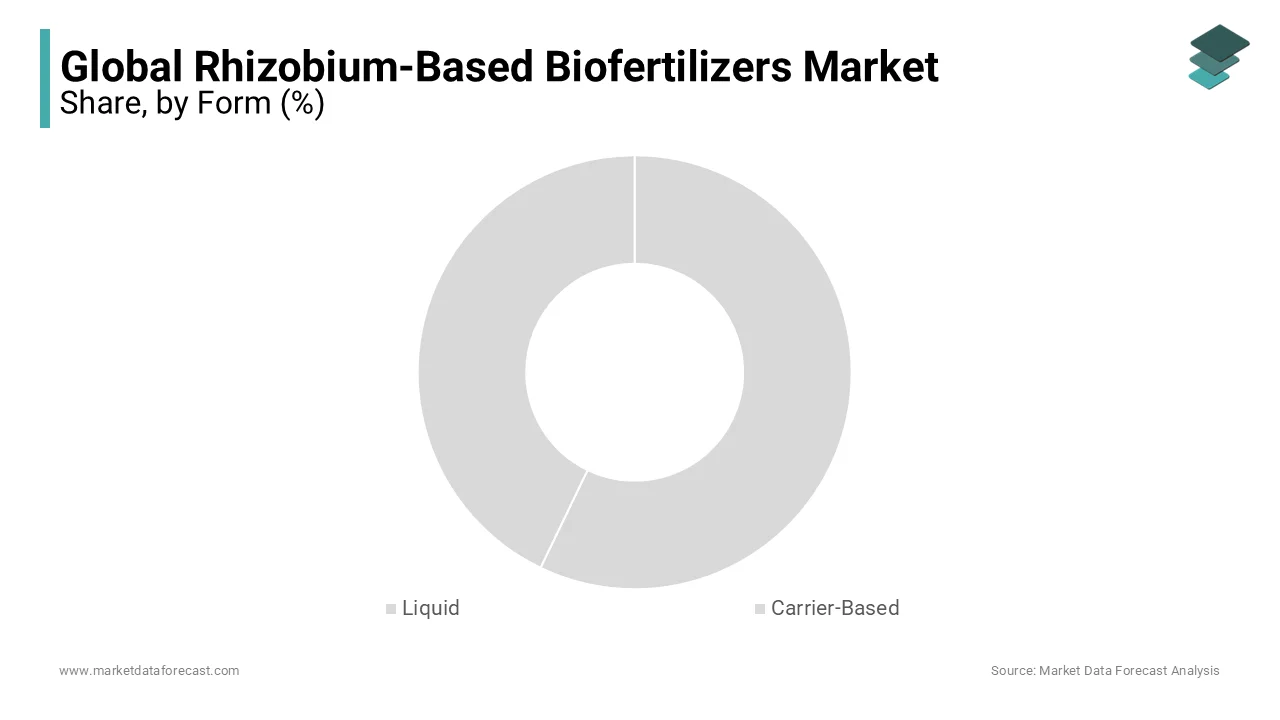
The liquids segment accounted for the largest share of the biofertilizer market. Liquid biofertilizer technology is being promoted as a viable alternative to carrier-based biofertilizers. Rhizobium-based liquid biofertilizers also have a longer shelf life.
By Mode Of Application Insights
The seed treatment segment is expected to have the highest annual yields during the forecast period. In seed treatment, rhizobium-based biofertilizers are applied as coatings to the seeds. This is the most common method of applying biofertilizers because it is easy and generally effective under most conditions.
By Crop Insights
Cereals and Grains represent the dominant crop segment. Rhizobium-based biofertilizers are widely used for the efficient production of different grains and cereals, such as wheat, oats, and rice, as they help to improve their performance in poor soil conditions.
REGIONAL ANALYSIS
North America Market Analysis
The North American market is expected to dominate the market during the forecast period owing to the growing demand for organic products, the growing acceptance of rhizobium-based biofertilizers among rural farmers, and the high adoption of organic farming systems. Advanced irrigation, such as drip and sprinkler irrigation.

Asia-Pacific is the largest market, with the dominant market share. The growing emphasis on organic farming, along with the large population, is the main driver behind the demand for rhizobium-based biofertilizers in the region.
In 2019, Europe was the world's second-largest consumer of rhizobium-based biofertilizers, accounting for 30% of the global rhizobium-based biofertilizers market.
Due to the imposition of strict regulations on the use of fertilizers and Chemicals in Europe, the use of chemical fertilizers tends to be replaced by organic fertilizers.
The Rhizobium-based Biofertilizers market in the Middle East and Africa was valued at USD 64.5 million in 2019 and is expected to grow at an annual rate of 6.4% during the forecast period. Due to the availability of large arable land and strong population growth, the Latin American market is expected to grow at the highest annual rate of 13.0% during the forecast period.
COMPETITIVE LANDSCAPE
KEY MARKET PLAYERS
Major Key Players in the global rhizobium-based biofertilizers market are
- Novozymes A/S
- Rizobacter Argentina SA
- Lallemand Inc.
- Unicrop Biochem
- Jaipur Bio-Fertilizers
- National Fertilizer Ltd
- Green Vision Life Sciences
- UPL Limited
- Vegalab SA, Cand, and hr. Hansen Holding A/S
- Kiwa Bio-Tech, T. Stanes & Company Limited
- IPL Biologicals Limited
- Symborg
- Kan Biosys
- Mapleton Agri Biotech Pty Ltd
- Nutramax Laboratories Inc.
- Seipasa
- Manidharma Biotech Pvt Ltd
- Biomax Naturals
- AgriLife
- Valent BioSciences
- Agrinos
- Valagro
- Varsha Bioscience
- Technology India Pvt Ltd.
- Criyagen
RECENT MARKET NEWS
- In 2020, Kiwa Bio-Tech established a partnership with Huaxialitai Co., Ltd., a Chinese state-owned company with a vast fertilizer distribution network across the country. Huaxialitai will begin selling Kiwa's fertilizer products under the conditions of the agreement.
- In 2018, Van Iperen International B.V., the Netherlands' leading specialty fertilizer and high-performance agricultural solutions producer, signed a distribution deal with Vegalab SA. This deal will aid the company's expansion into the European biofertilizers sector.
MARKET SEGMENTATION
This market Research Report on the global rhizobium-based market is segmented and sub-segmented into the following categories.
By Form
- Liquid
- Carrier-Based
By Mode Of Application
- Soil Treatment
- Seed Treatment
By Crop Type
- Pulses and Oilseeds
- Cereals and Grains
- Fruits and Vegetables
- Others
By Region
- North America
- Asia Pacific
- Europe
- Middle East & Africa
- Latin America