- Product Description Description
- Table of Contents TOC
- List of Table & Figure LOT
- Get Free Sample PDF Sample PDF
Market Size, 2025
$1,716.12 MnMarket Estimate, 2026
$2,042.04 MnMarket Forecast, 2034
$18,184.27 MnCAGR, 2026–2034
18.95%Global Robotic Surgery Market Report Summary
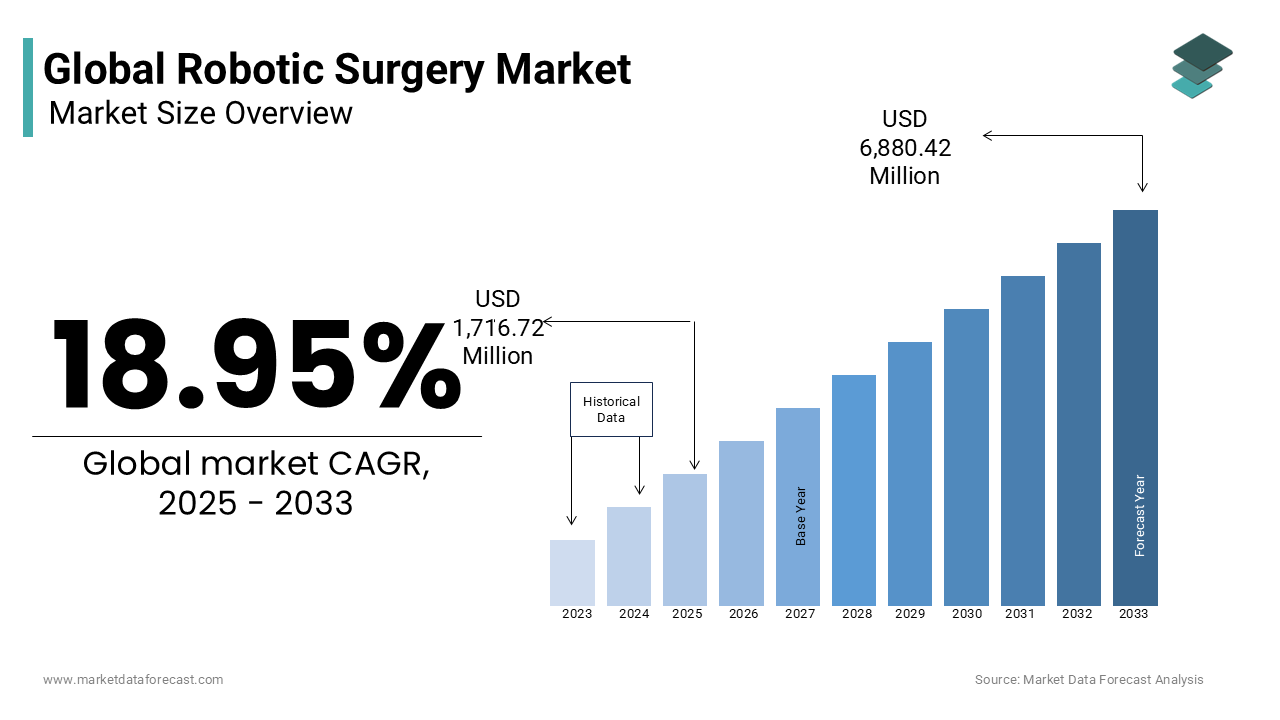
The global robotic surgery market was valued at USD 1,716.72 million in 2025, is estimated to reach USD 2,042.04 million in 2026, and is projected to reach USD 18,184.27 million by 2034, growing at a CAGR of 18.95% during the forecast period from 2026 to 2034. The growth of the global robotic surgery market is driven by the increasing demand for minimally invasive procedures, expanding adoption of robotic-assisted surgical systems, and rising investments in advanced healthcare technologies. Growing reimbursement support, continuous technological advancements in robotic platforms, and increasing hospital investments in precision surgery are further fueling market growth. Moreover, the integration of artificial intelligence, machine learning, and digital surgical analytics with robotic systems is accelerating the expansion of the global robotic surgery market.
Key Market Trends
-
Rising adoption of minimally invasive robotic-assisted surgical procedures across multiple specialties.
-
Increasing integration of artificial intelligence and machine learning into robotic surgery platforms.
-
Growing expansion of robotic surgery systems in emerging healthcare markets.
-
Rising investments in surgeon training programs and robotic surgery centers of excellence.
-
Increasing adoption of compact robotic systems for ambulatory surgery centers and outpatient procedures.
Segmental Insights
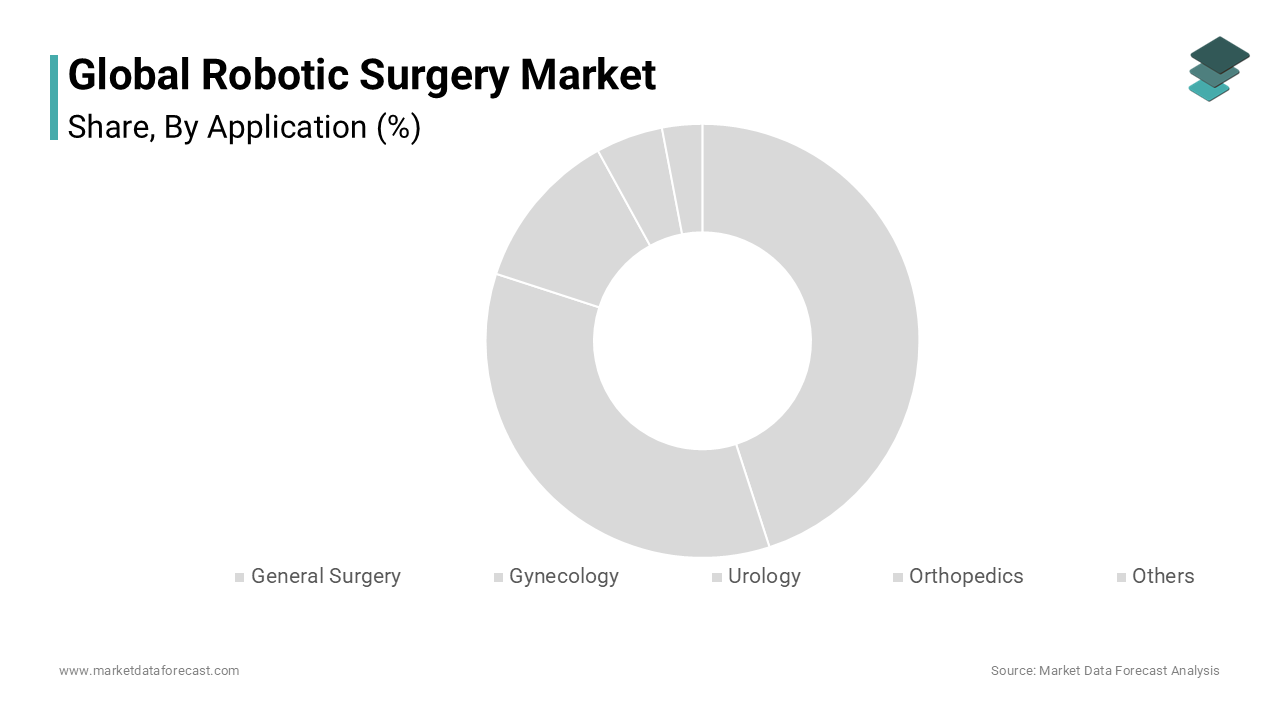
- Based on application, the urology segment accounted for 34.3% of the global robotic surgery market share in 2025. The segment’s dominance is attributed to the widespread adoption of robot-assisted radical prostatectomy, superior surgical precision, improved postoperative outcomes, reduced complications, and faster patient recovery.
- The orthopedics segment is projected to witness the fastest growth during the forecast period, registering a CAGR of 18.7%. The rapid growth of this segment is driven by increasing adoption of robotic-assisted knee and hip replacement procedures, enhanced implant positioning accuracy, reduced revision surgeries, and growing demand for precision orthopedic interventions.
- Based on end user, the hospitals segment held the largest share of the global robotic surgery market in 2025. The dominance of this segment is driven by high capital investment capacity, availability of specialized surgical teams, expanding robotic surgery programs, and increasing adoption of advanced surgical technologies in tertiary care hospitals. Meanwhile, the ambulatory surgery centers (ASCs) segment is expected to witness the fastest growth, registering a CAGR of 15.3%, owing to the increasing shift toward outpatient robotic procedures and growing demand for cost-effective surgical care.
Regional Insights
The global robotic surgery market is witnessing strong growth across major regions, supported by increasing healthcare investments, technological advancements, and rising adoption of minimally invasive surgery.
- North America dominated the global robotic surgery market by accounting for 48.3% of the market share in 2024. The region’s leadership is driven by widespread adoption of robotic surgical systems, favorable reimbursement policies, advanced healthcare infrastructure, increasing robotic-assisted procedures, and the presence of leading medical device manufacturers.
- Europe continues to perform strongly, supported by favorable reimbursement frameworks, increasing adoption of robotic surgery in Germany, the United Kingdom, and France, and expanding clinical research activities.
- Asia-Pacific is emerging as the fastest-growing regional market due to increasing healthcare investments, expanding robotic surgery training programs, rising hospital infrastructure development, and growing adoption in China, Japan, India, and South Korea.
- Latin America is witnessing steady growth with increasing robotic system installations in Brazil, Mexico, and Chile, supported by expanding private healthcare infrastructure and improving reimbursement policies.
- The Middle East & Africa region is also experiencing significant growth, driven by rising investments in digital healthcare, increasing adoption of robotic surgery in GCC countries, and expanding advanced surgical capabilities in Saudi Arabia, the UAE, and South Africa.
Competitive Landscape
The global robotic surgery market is highly competitive, with leading medical technology companies focusing on technological innovation, artificial intelligence integration, advanced imaging capabilities, and strategic collaborations with healthcare providers. Companies are investing heavily in next-generation robotic platforms, surgeon training initiatives, cloud-based surgical analytics, and flexible commercial models to improve affordability and expand adoption. Continuous advancements in precision surgery, digital ecosystems, and AI-assisted decision support are intensifying competition across the global robotic surgery market. Prominent players in the global robotic surgery market include Intuitive Surgical, Medtronic, CMR Surgical, Stryker, Zimmer Biomet, Medrobotics Corporation, Asensus Surgical, Smith & Nephew, Renishaw, and Johnson & Johnson.
Global Robotic Surgery Market Size
The global robotic surgery market was valued at USD 1,716.72 million in 2025, is estimated to reach USD 2042.04 million in 2026, and is projected to reach USD 18,184.27 million by 2034, growing at a CAGR of 18.95% from 2026 to 2034.
Robotic surgery is the use of computer-assisted, motorized systems that enable surgeons to perform complex procedures with enhanced precision, flexibility, and control. These systems translate the surgeon’s hand movements into smaller, more accurate motions of micro-instruments inside the body, often through minimally invasive approaches. The most widely adopted platform, the da Vinci Surgical System by Intuitive Surgical, operates in over 70 countries and has been utilized in more than 12 million procedures globally as of 2023, according to the American College of Surgeons.
MARKET DRIVERS
Rising Demand for Minimally Invasive Procedures and Faster Patient Recovery
The increasing preference for minimally invasive surgical techniques is driving the growth of the Robotic Surgery Market. Robotic assistance enhances the feasibility of complex minimally invasive procedures by providing 3D high-definition visualization, tremor filtration, and wristed instrument articulation. The patients undergoing robotic prostatectomy experience a 35% lower rate of postoperative complications and a hospital stay shortened by an average of 1.8 days compared to open surgery.
Expansion of Reimbursement Coverage and Institutional Adoption in Developed Healthcare Systems
The growing inclusion of robotic procedures under public and private insurance frameworks has significantly lowered financial barriers to adoption is accelerating the growth of Robotic Surgery Market. In the United States, the Centers for Medicare & Medicaid Services expanded coverage for robotic-assisted joint replacement and thoracic surgeries in 2022, recognizing their clinical efficacy and long-term cost benefits. In Germany, the Federal Joint Committee (G-BA) approved reimbursement for robotic colorectal surgery in 2023, following clinical evidence demonstrating a 22% reduction in surgical site infections. Similarly, Japan’s Ministry of Health, Labour and Welfare updated its fee schedule to include robotic-assisted gastrectomy, contributing to a 27% increase in robotic procedure volume across 2022–2023.
MARKET RESTRAINTS
Prohibitive Acquisition and Maintenance Costs of Robotic Systems
The high capital and operational expenditures associated with robotic surgery platforms in resource-constrained healthcare settings is restricting the growth of Robotic Surgery Market. According to the Journal of the American Medical Association, the initial purchase price of a standard robotic surgical system ranges from $1.5 million to $2.5 million, with annual maintenance contracts costing between $100,000 and $170,000. Additional expenses include specialized training for surgical teams, instrument replacement (with individual robotic arms priced at $1,500–$2,500 each), and infrastructure upgrades for operating room integration.
Limited Availability of Trained Surgical Personnel and Standardized Training Protocols
The scarcity of surgeons proficient in robotic techniques constrains widespread implementation is another factor hindering the growth of Robotic Surgery Market. According to the Accreditation Council for Graduate Medical Education, only 38% of U.S. general surgery residency programs offer formal robotic surgery training, which is resulting in a skills gap among newly licensed surgeons. The learning curve for robotic prostatectomy, for instance, requires 15 to 25 supervised procedures to achieve competency, as documented by the European Association of Urology. In India, a 2023 study published in The Lancet Regional Health Southeast Asia found that just 12% of practicing urologists had completed certified robotic training, despite the installation of over 120 systems. Moreover, the absence of globally standardized certification processes complicates credentialing and quality assurance.
MARKET OPPORTUNITIES
Integration of Artificial Intelligence and Machine Learning for Intraoperative Decision Support
The integration of robotic platforms with artificial intelligence (AI) is a significant opportunity for the growth of Robotic Surgery Market. Researchers at Johns Hopkins University have developed AI algorithms capable of real-time tissue differentiation during robotic surgery, achieving 94% accuracy in identifying tumor margins in preclinical models, as published in Nature Biomedical Engineering in 2023. The system, known as Smart Tissue Autonomous Robot (STAR), demonstrated superior suturing consistency compared to human surgeons in intestinal anastomosis trials. Additionally, the U.S. Food and Drug Administration has cleared AI-powered modules like the Johnson & Johnson’s Ottava platform’s intraoperative analytics suite, which provides predictive feedback on instrument path optimization.
Expansion into Emerging Markets with Rising Healthcare Infrastructure Investment
Developing economies in Asia, Latin America, and the Middle East are increasingly investing in advanced surgical infrastructure, which is likely to expand the growth of Robotic Surgery Market. According to the World Bank, healthcare spending in India grew at a compound annual rate of 7.6% between 2018 and 2023, with the government allocating $15 billion under the National Health Mission for technology modernization. Similarly, Saudi Arabia’s Vision 2030 includes a $30 billion investment in digital health and smart hospitals, with robotic surgery as a key pillar. As per the Gulf Health Council, the number of robotic systems in GCC countries rose from 42 in 2020 to 107 in 2023.
MARKET CHALLENGES
Regulatory Heterogeneity and Lengthy Approval Processes Across Jurisdictions
The inconsistent regulatory requirements and prolonged approval timelines in emerging countries is challenging the growth of Robotic Surgery Market. According to the International Medical Device Regulators Forum, obtaining market authorization for a new robotic platform can take 18 to 36 months in regions like China and Brazil, compared to 12 months in the United States under the FDA’s 510(k) pathway. According to the Global Harmonization Task Force, 68% of medtech firms face redundant clinical trials when seeking approvals in multiple countries, increasing development costs by up to 40%. This fragmentation slows the introduction of next-generation platforms and limits patient access to cutting-edge technologies in regions where regulatory capacity remains underdeveloped.
Cybersecurity Vulnerabilities in Networked Surgical Systems
The growing risks of cyberattacks and data breaches, as robotic surgery platforms become increasingly connected to hospital networks and cloud-based analytics systems is a challenging factor for the growth of Robotic Surgery Market. According to the U.S. Department of Health and Human Services, medical devices, including robotic surgical systems, accounted for 22% of all healthcare-related cybersecurity incidents reported in 2023. The FDA has issued multiple safety communications warning of potential vulnerabilities in networked surgical robots, including unauthorized access to control interfaces and manipulation of instrument calibration data.
REPORT COVERAGE
| REPORT METRIC | DETAILS |
| Market Size Available | 2025 to 2034 |
| Base Year | 2025 |
| Forecast Period | 2026 to 2034 |
| Segments Covered | By Application, End User and Region. |
| Various Analyses Covered | Global, Regional, & Country Level Analysis; Segment-Level Analysis, Drivers, Restraints, Opportunities, Challenges, PESTLE Analysis, Porter’s Five Forces Analysis, Competitive Landscape, Analyst Overview of Investment Opportunities |
| Regions Covered | North America, Europe, Asia Pacific, Latin America, Middle East, and Africa |
| Key Market Players | Intuitive Surgical, Medtronic, CMR Surgical, Stryker, Zimmer Biomet, Medrobotics Corporation, Asensus Surgical, Smith & Nephew, Renishaw, and Johnson & Johnson. |
SEGMENTAL ANALYSIS
By Application Insights
The urology segment dominated the global robotic surgery market by capturing 34.3% of share in 2025 with the widespread adoption of robot-assisted radical prostatectomy (RARP) for the treatment of localized prostate cancer, a condition affecting over 1.4 million men annually worldwide, according to the World Health Organization. The precision of robotic systems in nerve-sparing techniques has made them the gold standard in prostate surgery, significantly improving postoperative outcomes. According to a multi-institutional study published in European Urology in 2023, patients undergoing RARP experienced a 28% higher rate of continence recovery at 12 months and a 33% improvement in erectile function compared to those treated with open surgery.
The orthopedics segment is projected to expand at a CAGR of 18.7% from 2026 to 2034 with the increasing use of robotic systems in total knee and hip arthroplasty, where precision in implant alignment directly influences longevity and patient satisfaction. The Stryker Mako and Zimmer Biomet ROSA platforms have demonstrated a 35% reduction in implant malpositioning, as documented in a multicenter trial published in The Lancet Rheumatology. The growing body of clinical evidence supporting improved functional outcomes and reduced revision rates. Furthermore, the U.S. Centers for Medicare & Medicaid Services has begun tracking implant survivorship as a quality metric, incentivizing hospitals to adopt technologies that minimize early failure.
By End User Insights
The hospitals segment was accounted in holding a dominant share of the Robotic Surgery Market in 2025 due to the capacity to absorb high capital expenditures, access specialized surgical talent, and manage complex perioperative care. Academic medical centers and large tertiary hospitals serve as primary adoption hubs, often housing multiple robotic platforms across different specialties. According to the American Hospital Association, over 70% of U.S. hospitals with 300 or more beds have at least one robotic surgical system. For example, robotic hysterectomies in hospital settings have been shown to reduce hospitalization duration by 1.6 days on average, according to a 2023 analysis by the Agency for Healthcare Research and Quality. Additionally, hospitals benefit from economies of scale in training, maintenance, and instrument procurement.
The ambulatory surgery centers (ASCs) segment is swiftly emerging with an anticipated CAGR of 15.3% during the forecast period with the shift of low-complexity robotic procedures in urology, gynecology, and select orthopedic interventions into outpatient settings. According to the Centers for Disease Control and Prevention, over 65% of all surgical procedures in the United States were performed in ASCs in 2023, up from 54% in 2018, reflecting systemic dehospitalization trends. Robotic platforms like the da Vinci SP and Medtronic Hugo RAS are being optimized for compact footprints and faster turnover, making them suitable for ASC environments. Private insurers are increasingly incentivizing ASC utilization through differential reimbursement policies. UnitedHealthcare, for instance, offers 20% higher profit margins for approved robotic procedures performed in accredited centers.
REGIONAL ANALYSIS
North America Robotic Surgery Market Analysis
North America was the top performer of the global robotic surgery market by capturing 48.3% of share in 2024. The United States was the largest contributor with over 1,800 active robotic surgical systems and performing more than 1.2 million procedures annually. According to the U.S. Bureau of Economic Analysis, healthcare expenditure reached $4.5 trillion in 2023, with technology adoption accounting for a growing share. Additionally, the Joint Commission’s emphasis on surgical quality metrics has encouraged hospitals to invest in robotic systems to improve outcomes and maintain accreditation status.
Europe Robotic Surgery Market Analysis
Europe Market growth is likely to grow with Germany, the United Kingdom, and France leading in both adoption and clinical research. Reimbursement policies vary significantly Germany’s diagnosis-related group (G-DRG) system fully covers robotic prostatectomy, while the UK’s National Institute for Health and Care Excellence (NICE) has issued positive guidance for robotic colorectal and gynecological procedures. As per European Society of Minimally Invasive Surgical Technologies, robotic surgery volume increased by 19% annually between 2020 and 2023.
Asia Pacific Robotic Surgery Market Analysis
Asia Pacific Market growth is likely to grow with rapid expansion occurring in Japan, South Korea, India, and China. India and China are major contributors for the Robotic Surgery Market in this region. In India, Apollo Hospitals and Fortis have established robotic surgery as a premium offering in metropolitan areas, performing over 15,000 procedures in 2023. The Indian Council of Medical Research notes that robotic training programs have expanded to 22 institutions, improving workforce readiness. Government initiatives like China’s “Healthy China 2030” plan include funding for smart hospitals, accelerating procurement.
Latin America Robotic Surgery Market Analysis
Latin America Market growth is likely to grow with Brazil, Mexico, and Chile. As per the Pan American Health Organization, Brazil has over 60 robotic systems installed, primarily in private hospitals in São Paulo and Rio de Janeiro. Mexico’s 2022 health technology assessment framework included robotic surgery for gynecological oncology, facilitating insurance reimbursement.
Middle East & Africa Robotic Surgery Market Analysis
Middle East & Africa Market growth is likely to have a significant growth opportunities with Saudi Arabia, the UAE, and South Africa driving regional uptake. As per the Gulf Health Council, the GCC countries operate over 70 robotic systems, concentrated in Dubai, Riyadh, and Doha. Saudi Arabia’s Vision 2030 includes a $30 billion digital health transformation program, with robotic surgery as a strategic priority. The King Faisal Specialist Hospital in Riyadh performed over 3,000 robotic procedures in 2023, focusing on oncology and urology. In South Africa, private hospitals like Netcare and Mediclinic have adopted robotic platforms for high-income patients and medical tourists.
COMPETITIVE LANDSCAPE
The competition in the robotic surgery market is transitioning from a monopolistic landscape to a dynamically contested arena characterized by technological innovation and strategic positioning. While Intuitive Surgical maintains a first-mover advantage, emerging players like Medtronic and Johnson & Johnson are challenging dominance through modular designs, cost efficiency, and digital integration. Differentiation increasingly hinges on platform adaptability, data analytics, and surgeon-centric design rather than hardware alone. The race to incorporate artificial intelligence, real-time tissue recognition, and predictive analytics is intensifying, with companies vying to establish proprietary ecosystems.
KEY MARKET PLAYERS
A few of the major companies in the global robotic surgery market include
- Intuitive Surgical (USA)
- Medtronic (Ireland)
- CMR Surgical (UK)
- Stryker (USA)
- Zimmer Biomet (USA)
- Medrobotics Corporation (USA)
- Asensus Surgical (USA)
- Smith & Nephew (UK)
- Renishaw (UK)
- Johnson & Johnson (USA)
Top Players in the Robotic Surgery Market
Intuitive Surgical, Inc.
Intuitive Surgical remains the pioneer and most established player in the robotic surgery landscape, with its da Vinci Surgical System widely adopted across the Asia Pacific region. The company has deepened its presence through strategic collaborations with leading hospitals in Japan, South Korea, Australia, and India, supporting training programs and clinical integration. In 2023, Intuitive launched a regional innovation hub in Singapore to accelerate the development of next-generation platforms tailored to local surgical workflows. It also expanded its da Vinci SP (Single Port) system installations in urology and head and neck procedures across major medical centers in Tokyo and Seoul.
Medtronic plc
Medtronic has intensified its footprint in the Asia Pacific robotic surgery market through the global rollout of its Hugo™ Robotic-Assisted Surgery (RAS) platform, positioning itself as a flexible, modular alternative to established systems. The company received regulatory approval for Hugo in Japan and Australia in 2022 and has since established training centers in Mumbai, Sydney, and Seoul to support surgeon credentialing. In 2023, Medtronic partnered with Apollo Hospitals in India to launch a joint robotics excellence program, focusing on gynecology and colorectal surgery. The company’s emphasis on cost-effective disposables and a subscription-based business model has enhanced affordability for mid-tier private hospitals. Additionally, Medtronic’s integration of advanced haptic feedback and AI-driven analytics into Hugo’s ecosystem is differentiating its offering in a competitive, technology-driven surgical environment.
Johnson & Johnson (Verb Surgical / Ottava)
Johnson & Johnson, through its subsidiary Verb Surgical and the newly launched Ottava platform, is emerging as a transformative force in the robotic surgery space across Asia Pacific. Although entering the market later than competitors, J&J is leveraging its vast distribution network and strong relationships with hospital procurement systems in countries like China, Thailand, and Malaysia. In early 2024, the company initiated clinical trials for Ottava in collaboration with National University Hospital in Singapore, focusing on general and bariatric surgery. Its strategy emphasizes open architecture, allowing third-party developers to integrate AI and imaging tools, fostering an ecosystem approach.
Top Strategies Used by Key Market Participants
Key players in the robotic surgery market are deploying multimodal strategies to consolidate their positions, including technological differentiation, strategic partnerships, geographic expansion, and ecosystem development. Companies are investing heavily in AI integration, haptic feedback, and machine learning to enhance precision and reduce surgeon fatigue. Training and education initiatives are being expanded to address the shortage of skilled operators. Firms are also adopting flexible commercial models such as robotics-as-a-service and bundled pricing to lower entry barriers for hospitals. Collaborations with academic institutions and national health systems are accelerating clinical validation and regulatory approval.
MARKET SEGMENTATION
The research report on the global robotic surgery market has been segmented and sub-segmented based on categories.
By Application
- General Surgery
- Gynecology
- Urology
- Orthopedics
- Others
By End User
- Hospitals
- Ambulatory Surgery Centers
- Others
By Region
- North America
- Europe
- Asia-Pacific
- Latin America
- Middle East and Africa