- Product Description Description
- Table of Contents TOC
- List of Table & Figure LOT
- Get Free Sample PDF Sample PDF
Global Rye Market Summary
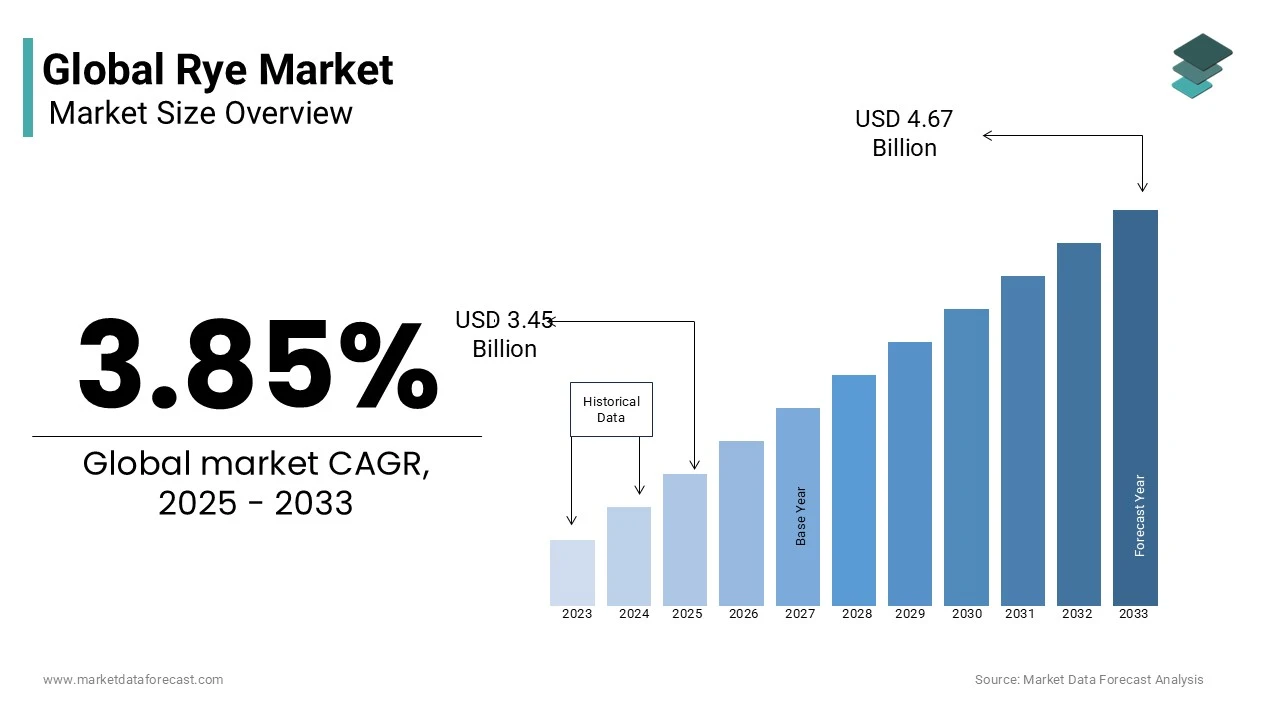
The global rye market size was valued at USD 3.33 billion in 2024 and is projected to reach USD 3.45 billion in 2025 and USD 4.67 billion by 2033, expanding at a CAGR of 3.85% from 2025 to 2033. The growth of the global rye market is driven by rising demand for whole grains in functional foods, expanding applications of rye in bakery and alcoholic beverages, and growing consumer preference for high-fiber diets. Increasing awareness about the health benefits of rye, such as improved digestion and cardiovascular health, is further supporting market expansion.
Key Market Trends
- The rising popularity of whole-grain rye-based bakery products, such as bread and crackers.
- Expanding use of rye in whiskey and vodka production, fueling beverage demand.
- Growing consumer inclination toward plant-based and functional nutrition.
- Strong adoption of organic rye farming in developed economies.
- Technological improvements in grain storage and processing are enhancing yield efficiency.
Segmental Insights
- Based on type, the whole rye segment dominated the global rye market in 2024, supported by demand for bakery products and minimally processed grains.
- Based on application, the food segment held the largest share of 54.3% in 2024, driven by wide use in bread, cereals, and ready-to-eat products.
Regional Insights
- Europe was the top-performing region, capturing 72.3% of the global rye market share in 2024, due to strong cultural consumption patterns and large-scale production in countries such as Germany, Poland, and Russia.
- North America is experiencing steady growth, led by increasing demand for rye whiskey and healthy bakery alternatives.
- Asia-Pacific is expected to grow steadily, driven by rising awareness of functional foods and premium alcohol beverages.
- Latin America and Middle East & Africa represent smaller but emerging markets with growing adoption in food and beverage applications.
Competitive Landscape
Key players operating in the global rye market include Agrex Inc., Vandaele Seeds Ltd, The Soufflet Group, Olam International Ltd, Louis Dreyfus Company, Archer Daniels Midland (ADM), and Agrozan Commodities DMCC. These companies are focusing on supply chain expansion, advanced grain processing, and partnerships with food and beverage manufacturers to strengthen their market positions.
Global Rye Market Size
The global rye market size was valued at USD 3.33 billion in 2024 and USD 4.67 billion by 2033 from USD 3.45 billion in 2025, growing at a CAGR of 3.85% from 2025 to 2033.
Rye is a hardy cereal grain predominantly grown in cooler temperate regions across Europe, Russia, and parts of North America. Unlike more commoditized grains such as wheat or corn, rye holds niche significance due to its resilience in marginal soils and low-input agricultural systems. It serves dual purposes in food production in traditional breads like pumpernickel and as animal feed and bioenergy feedstock.
MARKET DRIVERS
The increasing consumer demand for whole-grain and functional foods with proven health benefits is accelerating the growth of the rye market. Rye is inherently high in soluble and insoluble fiber, particularly arabinoxylans, which have been linked to improved glycemic control and digestive health. A 2022 clinical study published in The American Journal of Clinical Nutrition demonstrated that daily consumption of whole-grain rye reduced postprandial insulin responses by up to 28% compared to refined wheat products. This metabolic advantage has spurred its inclusion in specialty breads, breakfast cereals, and dietary supplements across Western Europe and North America. Furthermore, as per data from the International Life Sciences Institute, over 60% of consumers in Germany and Sweden actively seek out rye-containing products for their purported cardiovascular and gut health benefits.
The adaptability of rye to adverse climatic and soil conditions is hindering the growth of the rye market. Rye demonstrates superior winter hardiness, withstanding temperatures as low as -25°C, and exhibits strong resistance to drought and waterlogging, as documented by the Nordic Genetic Resource Center in 2023. Additionally, its deep root system enhances soil structure and reduces nitrogen leaching by up to 30% compared to spring-sown crops, as per a 2021 agronomic assessment by the Joint Research Centre of the European Commission.
MARKET RESTRAINTS
The limited processing infrastructure dedicated to rye-specific milling and refining, which hampers its integration into mainstream food supply chains is hampering the growth of the rye market. According to the German Cereal Research Institute, fewer than 15% of commercial mills in the EU are optimized for rye flour production, leading to inefficiencies and higher processing costs. This scarcity is particularly acute in Western Europe, where wheat dominates industrial capacity.
The declining acreage under rye cultivation in key producing regions due to competition from higher-yielding crops such as rapeseed and wheat will additionally to hinder the growth of the rye market. In Poland, rye cultivation decreased by 18% between 2015 and 2022, falling to 680,000 hectares, as per data from Statistics Poland. Farmers are increasingly shifting to oilseeds, which offer better profitability and stronger demand from the biodiesel sector. According to the Leibniz Institute of Agricultural Development in Transition Economies, the gross margin for rye is approximately 18% lower than that of wheat under comparable conditions.
MARKET OPPORTUNITIES
The development of rye-based biorefineries for sustainable biomaterials and bioethanol production is greatly influencing the growth of rye market. Rye’s high starch and cellulose content make it suitable for second-generation biofuel conversion in countries pursuing carbon neutrality. The country’s state-owned fuel company, OKQ8, blends rye-derived ethanol into E85 fuel by reducing lifecycle greenhouse gas emissions by up to 80% compared to fossil gasoline, according to a 2023 lifecycle analysis by RISE Research Institutes of Sweden. Additionally, lignin extracted from rye straw is being explored for biodegradable plastics and adhesives.
The growing popularity of heritage and ancient grains in premium organic and artisanal food is leveraging the growth of rye market. Rye, especially traditional varieties like Petkus and Winter White, is gaining traction among craft bakers and specialty food brands seeking authentic, regionally rooted ingredients. The grain’s association with Nordic cuisine and “New Nordic Diet” principles has elevated its status in high-end gastronomy and export markets. Furthermore, the Slow Food Foundation has cataloged over 12 endangered rye landraces in Eastern Europe by fostering conservation initiatives that link biodiversity with premium branding.
REPORT COVERAGE
| REPORT METRIC | DETAILS |
| Market Size Available | 2024 to 2033 |
| Base Year | 2024 |
| Forecast Period | 2025 to 2033 |
| Segments Covered | By Type, Application and Region |
| Various Analyses Covered | Global, Regional, & Country Level Analysis; Segment-Level Analysis, Drivers, Restraints, Opportunities, Challenges, PESTLE Analysis, Porter’s Five Forces Analysis, Competitive Landscape, Analyst Overview of Investment Opportunities |
| Regions Covered | North America, Europe, Asia Pacific, Latin America, Middle East, and Africa |
| Key Market Players | Agrex Inc., Vandaele Seeds Ltd, The Soufflet Group, Olam International Ltd, Louis Dreyfus Company, Archer Daniels Midland (ADM), Agrozan Commodities DMCC |
SEGMENTAL ANALYSIS
By Type Insights
The whole segment dominated the global rye market share in 2024 with its widespread use in traditional agriculture and food systems in Eastern and Northern Europe, where whole rye grain is directly milled into flour or used in porridges and breads. Additionally, whole rye retains superior nutritional integrity compared to processed variants, with studies from the University of Helsinki indicating that intact rye kernels preserve up to 92% of their native beta-glucans and lignans bioactive compounds linked to reduced inflammation and improved metabolic health.
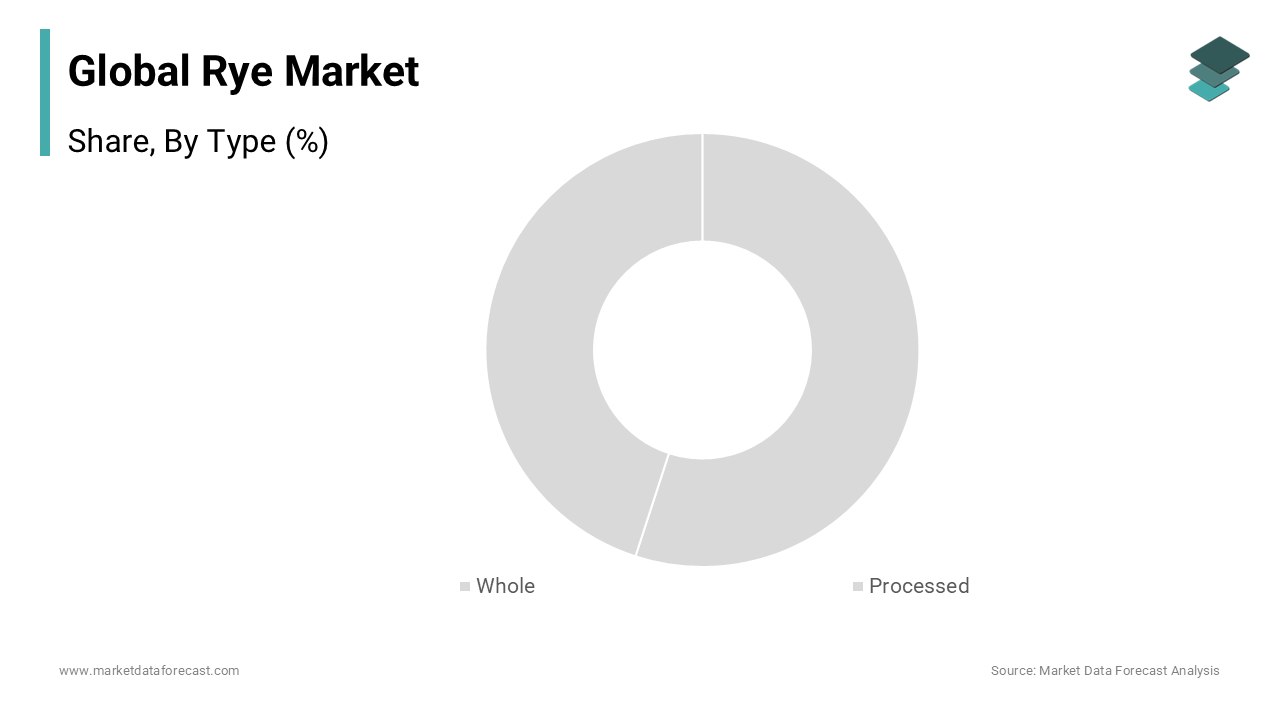
The processed rye segment is expanding at a CAGR of 6.3% during the forecast period with the innovation in convenience foods and functional ingredients. Rye bran and endosperm fractions are increasingly refined into specialty flours, crisp noodles, and gluten-friendly composites for use in health bars and infant nutrition. Moreover, advancements in enzymatic processing have mitigated rye’s inherent baking challenges. A 2022 study by the VTT Technical Research Centre of Finland demonstrated that optimized fermentation techniques improved dough stability in processed rye by 37% by enabling broader industrial adoption.
By Application Insights
The food application segment was accounted in holding 54.3% of the global rye market share in 2024 with the cultural entrenchment of rye-based breads and baked goods across Central and Northern Europe, where dietary traditions favor dense, sourdough-fermented loaves with high rye content. Furthermore, the grain’s functional properties such as high water-binding capacity and extended shelf life make it ideal for artisanal and industrial baking. According to the European Bakers’ Federation, over 40% of dark bread produced in Germany and Finland contains at least 50% rye flour.
The beverage segment is anticipated to grow with an expected CAGR of 7.1% during the forecast period with the rising popularity of rye-based alcoholic drinks. In Sweden, production of rye whiskey increased fivefold between 2018 and 2023 by reaching 1.8 million liters annually, as reported by the Swedish Alcohol and Drug Policy Association. Distillers prize rye for its spicy, robust flavor profile and high fermentable sugar yield, which enhances ethanol efficiency. Additionally, non-alcoholic rye beverages are gaining traction; in Finland, sales of rye-based kvass and malted drinks grew by 29% from 2021 to 2023, as per the Finnish Food Authority.
REGIONAL ANALYSIS
Europe Rye Market Insights
Europe was the top performer of the global rye market by capturing 72.3% of the share in 2024 with its long-standing agronomic suitability and culinary heritage in countries like Germany, Poland, and Russia, where rye has been a dietary staple for centuries. The persistence of rye in European diets is reinforced by public health initiatives. Moreover, the Common Agricultural Policy provides targeted support for rye cultivation in less-favored areas, ensuring its continued presence in regional farming systems.
North America Rye Market Insights
North America rye market was accounted in holding 14.3% of the share in 2024. While rye cultivation has declined in the U.S. heartland due to competition from corn and soybeans, recent years have seen a revival driven by craft distilling and specialty baking. Additionally, health-conscious urban consumers are increasingly adopting rye breads and cereals, with Whole Foods Market noting a 33% rise in rye product listings from 2020 to 2023.
Asia Pacific Rye Market Insights
Asia Pacific rye market growth is likely to grow with dietary diversification and import-led consumption. China and Japan are the primary importers, sourcing rye flour and whole grain for use in premium bakery chains and health-focused urban diets. Japanese consumers have developed a taste for European-style rye breads, with import volumes rising to 120,000 tons in 2023, a 19% increase from 2020, according to Japan’s Ministry of Agriculture, Forestry and Fisheries. South Korea has also seen a 25% growth in rye-based functional foods between 2021 and 2023, spurred by government-backed campaigns promoting whole grains to combat rising metabolic disorders, as noted by the Korean Society of Food Science and Nutrition. However, domestic cultivation remains negligible due to unsuitable climatic conditions.
Latin America Rye Market Insights
Latin America rye market growth is likely to grow eventually in the coming years. Argentina and Brazil are the only countries with minor rye production for experimental and niche organic farming. However, domestic consumption is minimal, with wheat and maize dominating staple diets. Additionally, urban wellness trends in cities like São Paulo and Bogotá have led to a small but growing interest in imported rye breads and cereals. The region’s agroecological diversity and increasing focus on crop diversification may unlock limited opportunities in high-altitude Andean zones where rye’s cold tolerance offers agronomic advantages.
Middle East & Africa Rye Market Insights
Middle East & Africa rye market growth is driven by the minimal domestic production and highly specialized demand. South Africa is the sole notable consumer, importing rye primarily for use in premium bakery products and animal feed for elite livestock operations. The grain is used in specialty breads catering to expatriate and affluent urban populations, with retailers like Woolworths reporting a 15% year-on-year increase in rye product sales from 2021 to 2023. In North Africa, rye has no traditional role in diets dominated by wheat and barley. However, experimental cultivation in Morocco’s Atlas Mountains, supported by the National Institute of Agricultural Research, has shown promise under climate stress conditions.
COMPETITIVE LANDSCAPE
KEY MARKET PLAYERS
Some of the companies that are playing a dominating role in the global rye market include
- Agrex Inc.
- Vandaele Seeds Ltd
- The Soufflet Group
- Olam International Ltd
- Louis Dreyfus Company
- Archer Daniels Midland (ADM)
- Agrozan Commodities DMCC
The competitive landscape of the rye market is a blend of agricultural traders, ingredient specialists, and technology providers for each vying for influence across fragmented value chains. Competition is less price-driven and more focused on quality, traceability, and functional performance. European agribusinesses dominate supply, while North American and Asian firms are increasingly investing in specialty applications. Technological differentiation in milling and fermentation, serves as a key battleground.
Top Players in the Rye Market
Cargill plays a pivotal role in the global rye supply chain with significant logistical and processing infrastructure across Europe and North America that supports its expanding footprint in the Asia Pacific region. While traditionally focused on bulk grain trading, Cargill has recently intensified its engagement with specialty food manufacturers in Japan and South Korea by supplying high-purity rye flour and clean-label rye extracts tailored for functional bakery applications. In 2023, the company launched a dedicated grain innovation hub in Singapore to develop customized cereal solutions for Asian palates, emphasizing digestive health and low glycemic response. Its investments in cold-chain logistics and food safety certifications have further enhanced its reliability as a supplier in highly regulated markets.
Archer Daniels Midland (ADM) has strategically expanded its presence in the Asia Pacific rye market by leveraging its global sourcing network and ingredient innovation capabilities. The company supplies specialty rye fractions including soluble fiber concentrates and protein isolates to functional food and beverage producers in Australia and New Zealand, where demand for gut-health-promoting ingredients is rising. Additionally, ADM has increased its procurement from European rye growers to ensure consistent quality for Asian importers.
Bühler Group is a Swiss-based technology leader in grain processing, which is significantly influences the Asia Pacific rye market by enabling local manufacturers to adopt advanced milling and baking technologies. In 2023, the company introduced its EcoMill Rye system, which reduces energy consumption by 22% while improving flour yield and baking performance, as verified by independent trials at the University of Hohenheim. Bühler has also partnered with food research institutes in Japan to optimize sourdough fermentation protocols for high-rye-content breads by addressing texture and shelf-life challenges.
Top Strategies Used by Key Market Participants
Key players in the rye market are deploying vertical integration, product differentiation, technological innovation, strategic partnerships, and geographic expansion to consolidate their positions. Companies are investing in end-to-end supply chains from seed development to finished food products to ensure quality control and traceability. Others are focusing on value-added rye ingredients such as resistant starches and arabinoxylans to meet demand in functional foods. Advanced processing technologies are being adopted to overcome rye’s baking limitations. Strategic collaborations with research institutions are validating health claims, while expansions into high-growth regions like Asia Pacific are capturing emerging consumer interest.
RECENT MARKET DEVELOPMENTS
- In April 2024, Cargill launched a specialized rye ingredient portfolio for the Asia Pacific functional food sector, introducing fiber-enriched rye concentrates tailored for bakery and cereal applications in Japan and South Korea, enhancing its value-added offerings and strengthening its regional supply chain integration.
- In June 2022, Lantmännen, the Swedish agri-cooperative, opened a new export hub in Gothenburg dedicated to organic rye shipments to Japan and Australia, streamlining logistics and certification processes to meet rising demand for sustainably sourced grain in the Asia Pacific.
MARKET SEGMENTATION
The research report on the Rye Market has been segmented and sub-segmented based on categories.
By Type
- Whole
- Processed
By Application
- Food
- Feed
- Beverage
By Region
- North America
- Europe
- Asia-Pacific
- Latin America
- Middle East and Africa