- Product Description Description
- Table of Contents TOC
- List of Table & Figure LOT
- Get Free Sample PDF Sample PDF
Market Size, 2025
$12.07 BnMarket Estimate, 2026
$18.85 BnMarket Forecast, 2034
$668.09 BnCAGR, 2026–2034
56.20%Executive Summary: Global Smart Beacon Market
- Market Scope: Comprehensive global evaluation of wireless low-power Bluetooth transmitters (smart beacons) covering hardware, software, and service offerings across vertical end-use applications like retail, logistics, education, and transportation.
- Market Valuation: Valued at USD 12.07 billion in 2025, reaching USD 18.85 billion in 2026, and projected to scale up to USD 668.09 billion by 2034, expanding at a massive CAGR of 56.2% during the forecast period.
- Primary Growth Drivers: Increasing digitization, widespread adoption of smart devices, rising investments in proximity marketing solutions, improved tag functionality, and the growth of organized commerce and retail sales.
Key Market Segment Metrics
| Category | Leading Segment / Details | High-Growth / Key Highlights |
|---|---|---|
| By Connectivity | Bluetooth Low Energy (BLE) (core wireless low-power technology transmitting signals to nearby smart devices) | Hybrid Connectivity (alternative connectivity option supporting multi-protocol environments) |
| By Beacon Standard | iBeacon (pioneered by Apple Inc. in 2013 across US stores) | Eddystone (launched by Google LLC in 2015, widely adopted especially for Android users) |
| By Offering | Hardware, Software, and Services (encompassing physical transmitters, developer toolkits, SDK data collectors, and proximity solutions) | Integrated solutions enhancing retail personalization, attendance tracking, and spatial data analytics |
| By Region | North America & Europe (established, mature regional markets with high smartphone penetration and extensive retail beacon deployments) | Asia-Pacific (fast-growing regional hub experiencing significant traction and high market potential in countries like India and Australia) |
Major Market Players & Industry Landscape
Market Structure: Highly dynamic market featuring specialized wireless technology providers, proximity marketing firms, and location-based software developers engaging in advanced tag functionality and cross-platform integrations.
Key Companies: Estimote, Aruba, Kontakt.Io, Cisco, Bluvision, Onyx Beacon, Leantegra, Gimbal, Accent Systems, Swirl Networks, Sensoro, Jaalee Technology, Beaconinside, Blesh, and Blueup.
 Download Free Sample Report
Global Smart Beacon Market Size
The global smart beacon market was worth USD 12.07 billion in 2025. The global market is predicted to reach USD 18.85 billion in 2026 and USD 668.09 billion by 2034, growing at a CAGR of 56.2% during the forecast period.

Beacons are small wireless transmitters using low-power Bluetooth technology to send signals to nearby smart devices. With its offerings in the form of service, hardware, and software, the market is likely to expand its applications in end-user verticals like retail, sports, transportation, and logistics. The growing need for spatial data, which can be used to analyze the current demographic trend, is driving the growth of the smart beacon market in various applications. One of the most popular uses of beacon technology in higher education is submitting administrative tasks, such as monitoring attendance. Presence control using beacons increases efficiency and saves time. It also replaces a physical attendance sheet with spatially and automatically detected presence information. For example, the Hong Kong Polytechnic University uses iBeacons for engagement and other functions through an in-house developed mobile app.
MARKET DRIVERS
Smart beacons have seen tremendous growth over the past four years due to the increasing digitization and adoption of smart devices.
However, due to their high application areas, the worldwide market is expected to show a double-digit growth rate during the forecast period. Increased investment in proximity marketing, improved tag functionality, increased privacy and security concerns, and increased organized commerce are major factors affecting the growth of the global tags market, which is expected to either stimulate or hinder the growth of the Smart Beacon industry.
Due to the increasing growth in retail sales, smartphones have completely revolutionized how people shop. To enhance customers' overall experience, increase revenue, and improve operational efficiency, retailers are actively implementing the location-based proximity marketing solution known as Beacon Technology. Beacon technology is an incredibly efficient way to create a consistent online and in-store experience. By tracking a customer's movements in the store, retailers can provide specific information and discounts based on the products the customer viewed. This can lead to higher conversion rates. Gamers, such as Swirl Networks Inc., have found that more than 70% of shoppers believe that the tag triggered content and increased their likelihood of buying from the store.
Additionally, to solve the personalization problem, retailers are using technology to better understand their customers. Stores like Target and CVS have installed beacons, wireless devices that communicate with customers' Bluetooth-enabled cell phones while they shop. An estimated mid-size Target store uses 1,000 labels. Retailers ensure that the majority of their customers can be traced. This even includes customers who don't download their app. Therefore, a hidden industry of third-party location marketing companies is helping retailers. These companies take the tracking code from the customer's tag and bundle it into a developer toolkit. Companies like Reveal Mobile collect SDK data on hundreds of frequently used applications. In the United States, another company called InMarket covers about 38% of Millennials, about a quarter of all smartphones, and tracks 50 million people monthly.
REPORT COVERAGE
| REPORT METRIC | DETAILS |
| Market Size Available | 2025 to 2034 |
| Base Year | 2025 |
| Forecast Period | 2026 to 2034 |
| CAGR | 56.2% |
| Segments Covered | By Connectivity, Beacon Standard, Offering, End User, and Region |
|
Various Analyses Covered | Global, Regional & Country Level Analysis, Segment-Level Analysis, DROC, PESTLE Analysis, Porter’s Five Forces Analysis, Competitive Landscape, Analyst Overview on Investment Opportunities |
| Regions Covered | North America, Europe, APAC, Latin America, Middle East & Africa |
|
Market Leaders Profiled | Estimote, Aruba, Kontakt.Io, Cisco, Bluvision, Onyx Beacon, Leantegra, Gimbal, Accent Systems, Swirl Networks, Sensoro, Jaalee Technology, Beaconinside, Blesh, Blueup, and Others. |
REGIONAL ANALYSIS
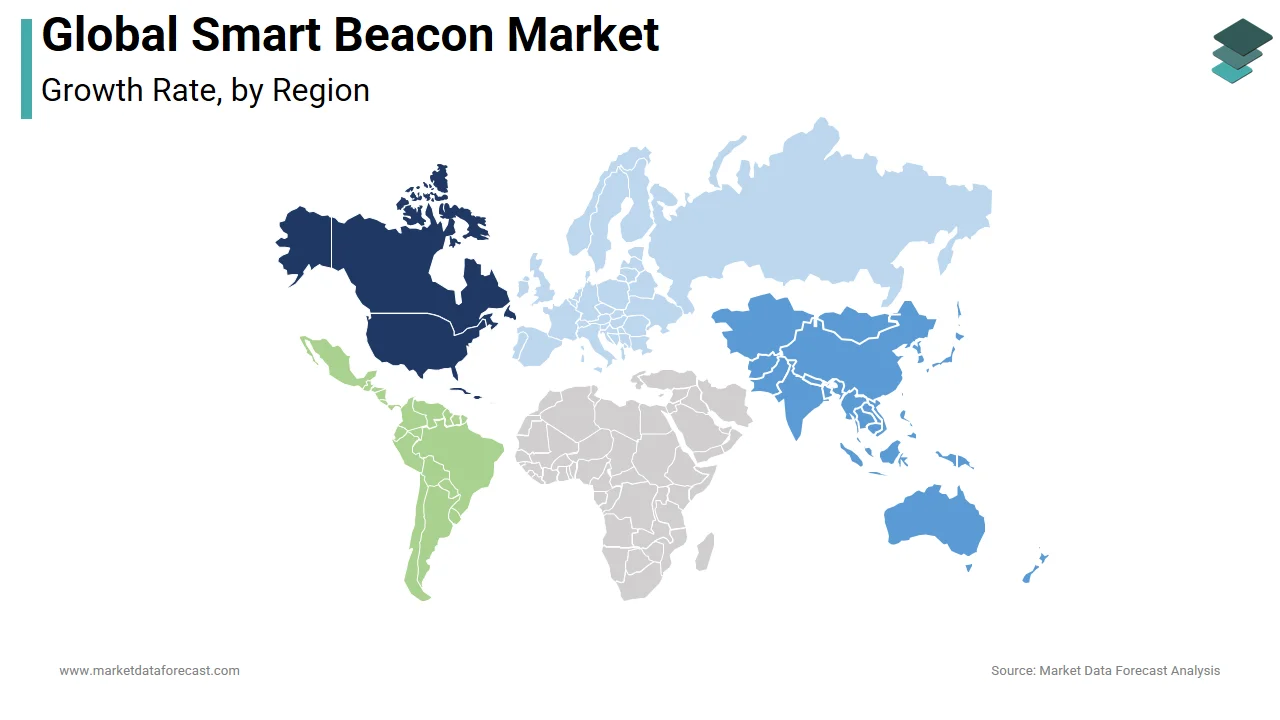
Among these, the Asia-Pacific region is expected to experience significant growth due to the increasing traction of beacon technology in India and Australia for various applications. The market is still at an early stage and has much potential in this region. North America and Europe are considered as developed regions in this industry.
KEY MARKET PARTICIPANTS
The major players operating in the global smart beacon market include Estimote, Aruba, Kontakt.Io, Cisco, Bluvision, Onyx Beacon, Leantegra, Gimbal, Accent Systems, Swirl Networks, Sensoro, Jaalee Technology, Beaconinside, Blesh and Blueup.
RECENT MARKET HAPPENINGS
- In October 2019, Uber announced the introduction of an updated version of its colorful Beacon device, Beacon 2.0. The digital display is supposed to be placed on the car's dash and glow in a specific color that racers have chosen in the app to help them find the right car in crowded situations. The Beacon's digital display also reminds drivers to wear seat belts, close doors carefully, and pull off the curb.
- In 2013, Apple, Inc. enabled iBeacon in 254 stores in the US. Eddystone was launched by Google LLC in 2015 and is now widely adopted in the market. It is specially developed for Android users.
MARKET SEGMENTATION
This research report on the global smart beacon market has been segmented and sub-segmented based on the connectivity, beacon standard, offering, end user, and region.
By Connectivity
-
Bluetooth Low Energy (BLE)
-
Hybrid
By Beacon Standard
-
iBeacon
-
Eddystone
By Offering
-
Hardware
-
Software
-
Services
By End User
-
Transportation and Logistics
-
Retail
-
Meeting and Public Spaces
-
Hospitality
-
Healthcare
-
Automotive
-
Banking, Financial Services and Insurance (BFSI)
-
Education
-
Sports
-
Aviation
By Region
-
North America
-
The United States
-
Canada
-
Rest of North America
-
-
Europe
-
The United Kingdom
-
Spain
-
Germany
-
Italy
-
France
-
Rest of Europe
-
-
The Asia Pacific
-
India
-
Japan
-
China
-
Australia
-
Singapore
-
Malaysia
-
South Korea
-
New Zealand
-
Southeast Asia
-
-
Latin America
-
Brazil
-
Argentina
-
Mexico
-
Rest of LATAM
-
-
The Middle East and Africa
-
Saudi Arabia
-
UAE
-
Lebanon
-
Jordan
-
Cyprus
-