- Product Description Description
- Table of Contents TOC
- List of Table & Figure LOT
- Get Free Sample PDF Sample PDF
Market Size, 2025
$12.63 BnMarket Estimate, 2026
$14.61 BnMarket Forecast, 2034
$46.74 BnCAGR, 2026–2034
15.65%Global Smart Microgrid Controller Market Size, Growth, Trends & Forecast (2026–2034)
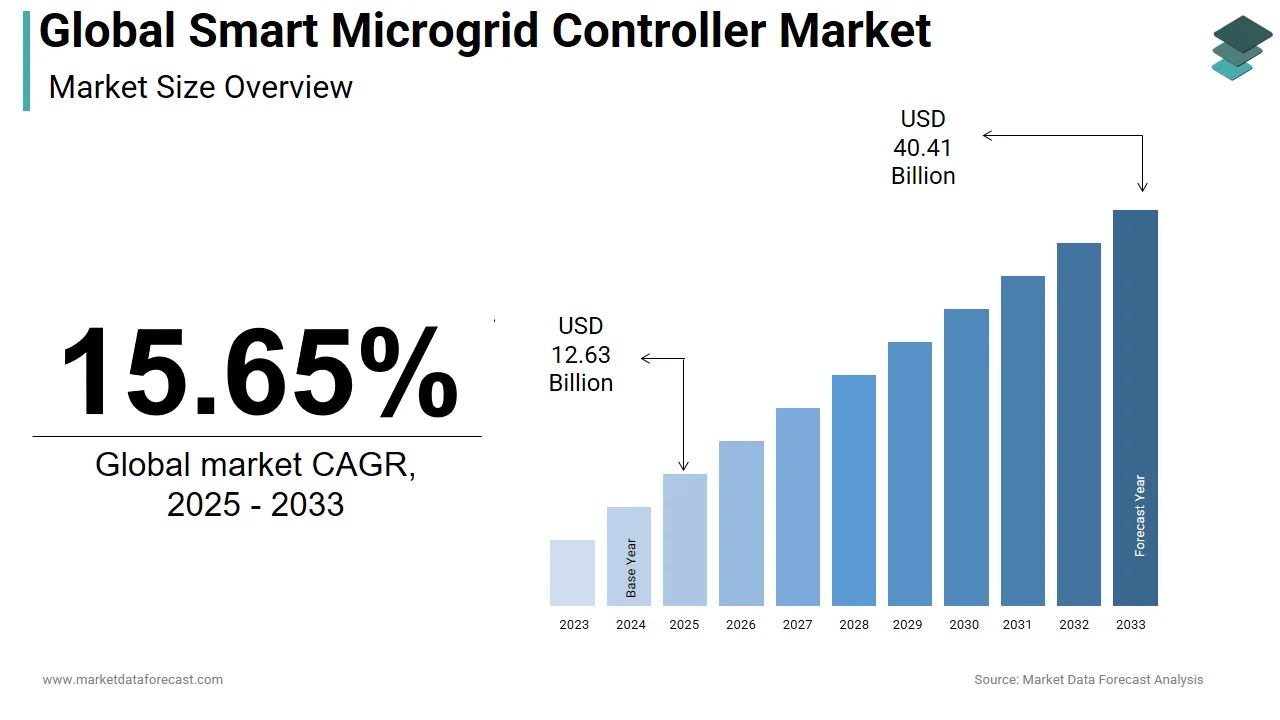
The global smart microgrid controller market size was valued at USD 12.63 billion in 2025, is anticipated to reach USD 14.61 billion in 2026, and is projected to scale up to USD 46.74 billion by 2034, registering a compound annual growth rate (CAGR) of 15.65% during the forecast period from 2026 to 2034. Driven by the shift toward renewable energy sources, increasing demand for grid resilience, and automated optimization of distributed energy resources (DERs), the industry continues to expand steadily worldwide.
Key Executive Metrics (At-a-Glance)
- 2025 Base Valuation: USD 12.63 Billion
- 2026 Current Valuation: USD 14.61 Billion
- 2034 Forecast Valuation: USD 46.74 Billion
- Compound Annual Growth Rate (CAGR): 15.65% (2026–2034)
- Dominant Offering Segment: Hardware (capturing primary market share due to its foundational role in physical microgrid installations and controller deployment)
- Dominant Vertical Segment: Commercial & Industrial (holding major market share backed by high capital availability and rapid ROI requirements)
- Fastest-Growing Vertical Segment: Commercial (propelled by corporate sustainability goals and uninterrupted power needs)
- Dominant Region: Asia-Pacific (accounting for the largest market share supported by rural electrification programs, industrial expansion, and high renewable investments)
Core Market Drivers
- Renewable Integration & Grid Resilience: Rising global transition toward distributed renewable energy sources, energy storage systems, and reduced carbon footprints alongside a growing need for power reliability.
- Automated Energy Optimization: Crucial role of smart controllers in monitoring, forecasting, managing, and optimizing energy supply and demand without human intervention.
- Advanced Technological Collaboration: Strategic partnerships combining hardware assets and software platforms (such as virtual power plants and API-driven simulation controllers) to enhance microgrid stability.
Primary Market Restraints & Challenges
- High Capital Expenditure: Substantial upfront deployment and maintenance costs associated with building and integrating advanced smart microgrid hardware and software infrastructure.
Global Smart Microgrid Controller Market Segmentation Breakdown
| Segment Category | Leading Sub-Segment (2025 Base) | Fastest-Growing Sub-Segment (2026–2034) |
|---|---|---|
| By Connectivity | Network Connected / On-grid (dominant leader preferred for economic efficiency and backup stability) | Remote / Off-grid (driven by rural electrification and islanded microgrid initiatives) |
| By Offering | Hardware (dominant market share leader providing essential physical infrastructure) | Software (fastest-growing due to AI and cloud-based energy analytics integration) |
| By Vertical | Commercial (commanding major segment share) | Commercial & Utilities (fastest-growing adoption category) |
| By Region | Asia-Pacific (leading global market share) | Asia-Pacific & North America (fastest-growing regional markets driven by smart grid modernization) |
Major Industry Players Profiled
Key enterprises shaping the competitive global smart microgrid controller market include Schneider Electric, General Electric, ABB, Siemens, Schweitzer Engineering Laboratories, Eaton Corporation, Honeywell International, Lockheed Martin, S&C Electric, and Power Analytics.
 Download Free Sample Report
Global Smart Microgrid Controller Market Size
The global smart microgrid controller market was worth USD 12.63 billion in 2025. The global market is predicted to grow from USD 14.61 billion in 2026 and 46.74 billion by 2034, growing at a CAGR of 15.65% from 2026 to 2034.
A microgrid is a contiguous section of the network made up of interconnected Distributed Energy Resources (DER) and loads under common control. DERs can distribute renewables, storage devices, generators, electric vehicles, and demand response. Smart Microgrid controls can optimize DER power and loads to provide reliable and cost-effective operation for end users without human intervention. As part of the study, remote and network-connected microgrid controllers were included. The use of microgrid controllers has been considered by the main end users, such as communities, commercial/industrial companies, public service companies, and educational institutions, among others.
MARKET DRIVERS
The growing demand for microgrids drives the growth of this market, the shift towards using renewable energy sources, and the reduction of the carbon footprint.
This growth is due to its crucial role in monitoring, forecasting, managing, and optimizing energy supply and demand for a micro-grid network. Grid-connected microgrids are more reliable than isolated microgrids because they are connected to significant utility grids.
The intelligent microgrid controller is a connected grid installed to supply power per the requirements of the appropriate end-user. The micro sources can act as a current source with the maximum capacity for energy transfer to the grid. Due to its economical function, most homeowners and small businesses prefer the grid-connected microarray controller to meet their power needs. Panasonic implemented and introduced a hybrid urban microgrid system with entire solutions needed for the market India. Integrated solar microgrids incorporate efficient, reliable, intelligent energy storage solutions to drive adoption in urban residential and commercial areas. The solution enables network interaction, remote monitoring, data analysis, and optimization of power consumption.
In addition, in September 2019, SimpliPhi Power, a manufacturer of energy storage systems, collaborated with Heila Technologies on a scalable, distributed smart microgrid that combines household power into a virtual power plant. Heila Technologies is a software and hardware developer integrating multiple microgrid storage and generation assets to provide a dynamic platform aggregating multiple SimpliPhi battery systems cited by customers in a virtual power plant. An integrated microgrid intelligent controller maintains network stability and operational endurance at a lower cost. An intelligent microgrid controller automates the control of all microgrid components to meet energy demand and maintain stable operating conditions with minimal intervention from operational and human resources personnel. Control software maximizes electrical reliability, integrates renewable energy, or reduces emissions. In April 2020, HOMER Energy, recently launched by UL, introduced two powerful and customizable API controllers, allowing users to create and simulate their shipping strategy in HOMER Grid software to model distributed power system design behind the counter.
REPORT COVERAGE
| REPORT METRIC | DETAILS |
| Market Size Available | 2025 to 2034 |
| Base Year | 2025 |
| Forecast Period | 2026 to 2034 |
| CAGR | 15.65% |
| Segments Covered | By Connectivity, Offering, Vertical, and Region |
|
Various Analyses Covered | Global, Regional & Country Level Analysis, Segment-Level Analysis, DROC, PESTLE Analysis, Porter’s Five Forces Analysis, Competitive Landscape, Analyst Overview on Investment Opportunities |
| Regions Covered | North America, Europe, APAC, Latin America, Middle East & Africa |
|
Market Leaders Profiled | Schneider Electric, General Electric, ABB, Siemens, Schweitzer Engineering Laboratories, Eaton Corporation, Honeywell International, Lockheed Martin, S&C Electric, Power Analytics and other market players |
REGIONAL ANALYSIS
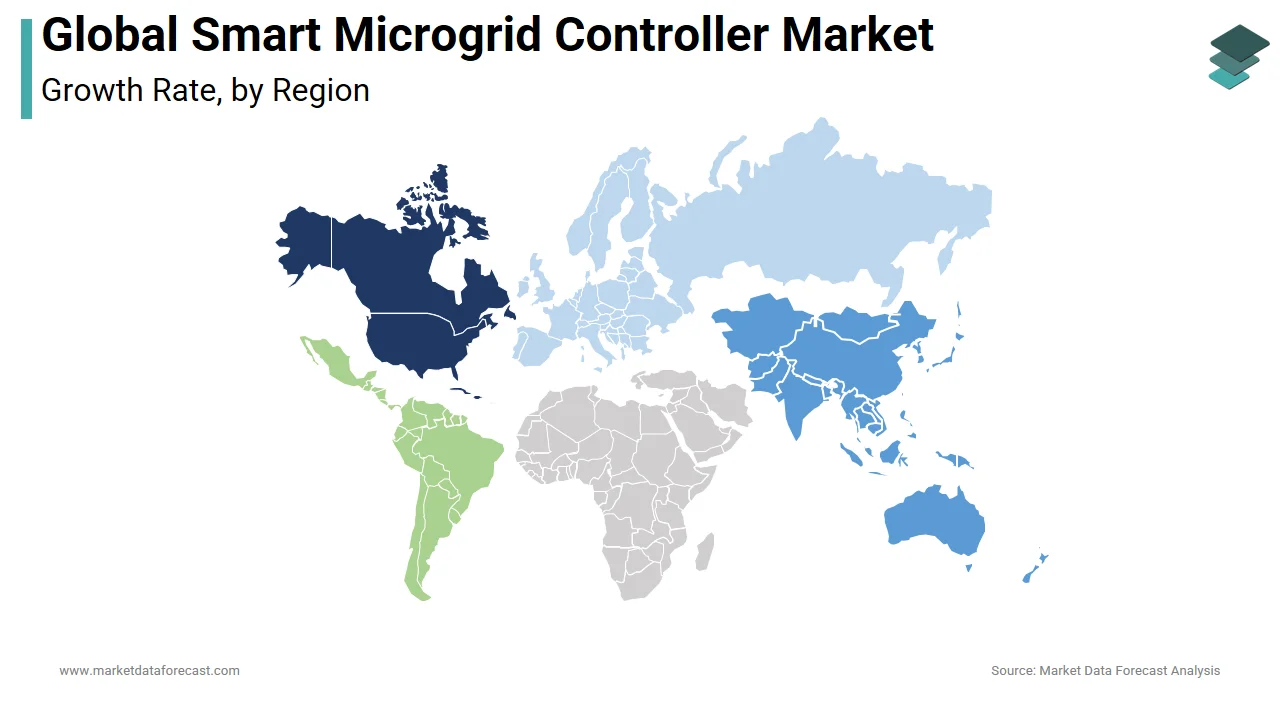
Asia-Pacific accounted for a significant share of the worldwide smart microgrid controller market. Also, the North America and Europe regions are expected to grow due to the progressions in the industrial sector and energy infrastructure in several nations in the region.
KEY PARTICIPANTS IN THE MARKET
Companies playing a major role in the global smart microgrid controller market include Schneider Electric (France), General Electric (USA), ABB (Switzerland), Siemens (Germany), Schweitzer Engineering Laboratories (USA), Eaton Corporation (Ireland), Honeywell International (United States), Lockheed Martin (United States), S&C Electric (United States), Power Analytics (United States).
RECENT HAPPENINGS IN THE MARKET
-
In April 2018, Schneider Electric introduced its EcoStruxure for Energy Access, a comprehensive microgrid project measurement, analysis, and reporting solution.
-
In February 2018, GE worked with the Arenko Group (UK) to build grid-scale energy storage systems in the UK. Arenko has funded a 41 MW battery energy storage system that GE developed.
MARKET SEGMENTATION
This research report on the global smart microgrid controller market has been segmented and sub-segmented based on the connectivity, offering, vertical, and region.
By Connectivity
- Network Connected
- Remote
By Offering
- Hardware
- Software
- Services
By Vertical
- Government
- Utilities
- Commercial
- Industrial
- Educational institutes
- Military and Defense
- Healthcare
- Others (small residential communities, municipalities, and villages)
By Region
-
North America
-
The United States
-
Canada
-
Rest of North America
-
-
Europe
-
The United Kingdom
-
Spain
-
Germany
-
Italy
-
France
-
Rest of Europe
-
-
The Asia Pacific
-
India
-
Japan
-
China
-
Australia
-
Singapore
-
Malaysia
-
South Korea
-
New Zealand
-
Southeast Asia
-
-
Latin America
-
Brazil
-
Argentina
-
Mexico
-
Rest of LATAM
-
-
The Middle East and Africa
-
Saudi Arabia
-
UAE
-
Lebanon
-
Jordan
-
Cyprus
-