Global Smart Parking Market Size, Share, Trends, And Growth Report, Segmented By Hardware (Wireless Sensors, Cameras & LPRS, And Smart Meters, Signage, Parking Gates), Software (Parking Guidance, And Analytics Solutions), Services (Consulting Services, Engineering Services, Mobile App Parking), Type (On Service And Off Service), Application (Commercial, Government, And Transport Transit) and Region (North America , Europe, Asia Pacific, Latin America, Middle East And Africa), Industry Analysis Forecast From 2026 to 2034
Market Size, 2025
$11.73 BnMarket Estimate, 2026
$13.83 BnMarket Forecast, 2034
$51.63 BnCAGR, 2026–2034
17.90%Global Smart Parking Market Size
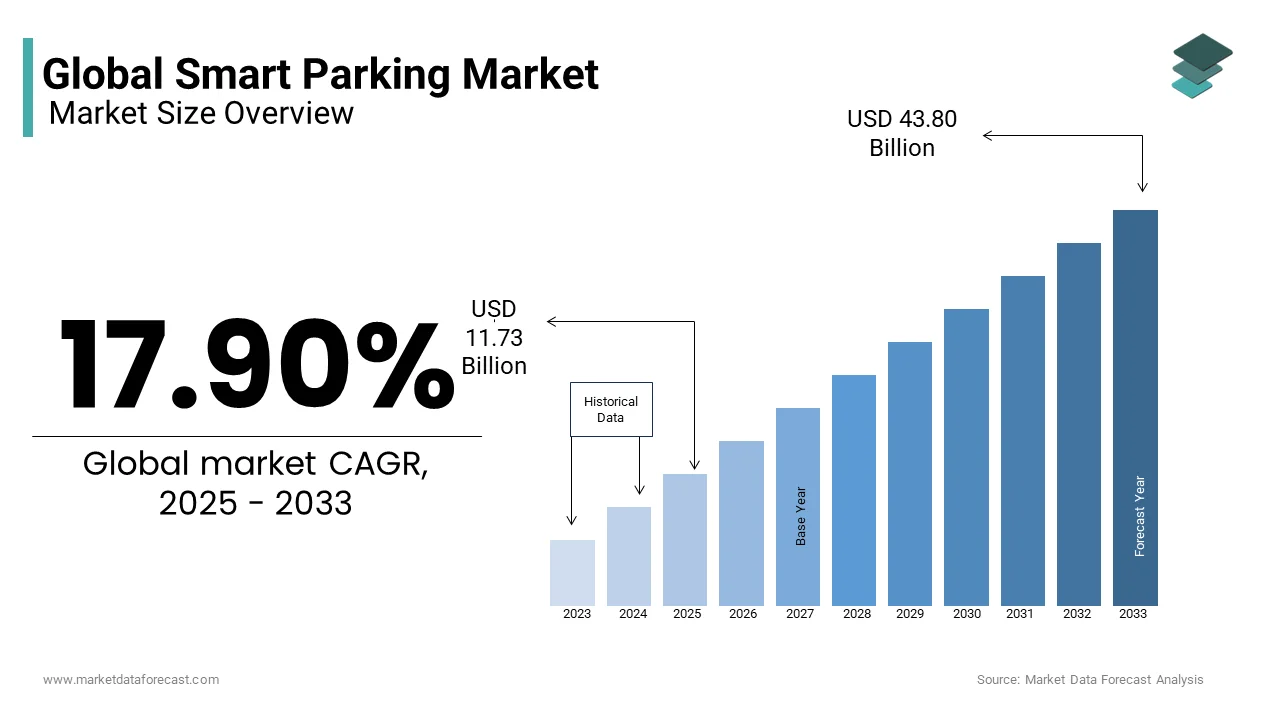
The global smart parking market size was valued at USD 11.73 billion in 2025 and is anticipated to reach USD 13.83 billion in 2026 to reach USD 51.63 billion by 2034, growing at a CAGR of 17.90% during the forecast from 2026 to 2034.
Introduction to the Smart Parking Market
The smart parking is an integrated ecosystem of Internet of Things sensors mobile applications and data analytics platforms designed to optimize parking space utilization in urban environments. This technological framework addresses the chronic inefficiency of traditional parking systems by providing real time visibility into space availability thereby reducing vehicle search time and associated carbon emissions. As urbanization accelerates globally, the pressure on municipal infrastructure intensifies necessitating intelligent solutions that bridge the gap between limited physical space and growing vehicular density. The core objective extends beyond mere convenience it aims to transform parking from a static utility into a dynamic component of smart city infrastructure. According to the United Nations Department of Economic and Social Affairs approximately 56% of the world population currently resides in urban areas a figure projected to increase to 68% by 2050. This demographic shift places unprecedented strain on existing transportation networks. As per the European Environment Agency, transport accounts for nearly 25% of total greenhouse gas emissions in Europe with a significant portion attributed to vehicles circling for parking spots. The integration of smart parking solutions mitigates this environmental burden while enhancing the overall urban mobility experience. By leveraging connectivity and automation, these systems facilitate seamless payment processes and improved traffic flow management establishing a foundational layer for broader intelligent transportation initiatives across metropolitan regions worldwide.
MARKET DRIVERS
Rapid Urbanization and Increasing Vehicle Ownership Rates
The relentless pace of urbanization coupled with rising vehicle ownership rates for the adoption of advanced parking solutions is leveraging the growth of the smart parking market. As cities expand horizontally and vertically, the disparity between available parking infrastructure and the number of registered vehicles widens creating acute congestion and inefficiency. In densely populated metropolitan areas, drivers spend an average of 17 hours per year searching for parking spaces which not only causes frustration but also contributes significantly to fuel wastage and air pollution. According to the International Organization of Motor Vehicle Manufacturers, global vehicle production reached approximately 85 million units in recent years reflecting the sustained demand for personal transportation despite the rise of shared mobility options. This surge in vehicle numbers overwhelms traditional parking management systems that rely on manual monitoring and static signage. As per the World Bank data indicates that urban populations in developing economies are growing at twice the rate of overall population growth further exacerbating infrastructure deficits. The inability of conventional methods to handle this volume necessitates automated systems that can process vast amounts of data in real time. Smart parking technologies offer scalable solutions that adapt to fluctuating demand patterns ensuring optimal space allocation.
Government Initiatives Promoting Smart City Infrastructure Development
The government mandates and strategic investments in smart city frameworks, which is significantly boosting the growth of the smart parking market. Municipal authorities recognize that efficient parking management is a pillar of broader intelligent transportation systems aimed at enhancing urban sustainability and quality of life. Numerous national and local governments have launched comprehensive initiatives to integrate digital technologies into public infrastructure with parking identified as a high impact area for immediate improvement. According to the study, over 140 cities in Europe have committed to smart city projects under various funding mechanisms focusing on IoT enabled services including intelligent parking guidance systems. These policy driven efforts are often supported by substantial financial allocations aimed at modernizing outdated urban facilities. As per the research, federal grants and local bonds increasingly prioritize projects that reduce traffic congestion and lower carbon footprints through technological innovation. The regulatory environment further encourages adoption by setting standards for data interoperability and privacy ensuring that deployed systems meet rigorous security requirements. Additionally, many municipalities implement dynamic pricing models facilitated by smart parking platforms to manage demand during peak hours thereby generating revenue while discouraging unnecessary vehicle use. This alignment of political will financial support and regulatory clarity create a favorable ecosystem for market expansion enabling technology providers to deploy solutions at scale while addressing pressing urban challenges related to mobility and environmental sustainability.
MARKET RESTRAINTS
High Initial Implementation and Maintenance Costs
The substantial capital expenditure required for deploying smart parking infrastructure with the widespread adoption, particularly in budget constrained municipalities, which is hindering the growth of the smart parking market. Installing sensor networks communication gateways and central management platforms involves considerable upfront investment in hardware software and professional services. For large scale deployments, covering extensive urban areas the cost implications can be prohibitive for local governments operating under tight fiscal constraints. The infrastructure gap in the United States alone requires hundreds of billions of dollars in additional investment to meet current needs indicating the competitive nature of funding priorities. When parking improvements compete with essential services such as healthcare education and road maintenance they often face delayed approval or reduced scope. Furthermore, ongoing maintenance costs including battery replacements software updates and hardware repairs add to the long term financial burden. Many potential adopters hesitate due to uncertain return on investment timelines especially in regions with low parking fee structures. The complexity of integrating new systems with legacy infrastructure further escalates costs requiring specialized technical expertise.
Data Privacy Concerns and Cybersecurity Vulnerabilities
The growing apprehensions regarding data privacy and cybersecurity risks is also declining the growth of the smart parking market. These systems collect vast amounts of sensitive information including vehicle location timestamps license plate numbers and user payment details raising significant concerns about potential misuse and unauthorized access. As per the study, strict guidelines govern the collection and processing of personal data requiring organizations to implement robust security measures and obtain explicit consent from users. Non-compliance can result in severe financial penalties and reputational damage deterring some entities from adopting advanced parking solutions. Smart parking networks often rely on wireless communication protocols that can be vulnerable to hacking attempts jamming or spoofing if not properly secured. The interconnected nature of these systems within broader smart city ecosystems amplifies the risk as a breach in one component can potentially compromise others. Users remain skeptical about sharing their movement data fearing surveillance or commercial exploitation without transparent data handling policies. Addressing these concerns requires continuous investment in encryption technologies regular security audits and clear privacy frameworks. Until trust is established through demonstrable security standards and regulatory compliance the hesitation among consumers and municipal authorities will continue to impede the smart parking market growth.
MARKET OPPORTUNITIES
Integration with Electric Vehicle Charging Infrastructure
The emergence of smart parking systems with electric vehicle charging networks is setting up new opportunities for the growth of the smart parking market. As governments enforce stricter emission regulations and consumers increasingly adopt electric vehicles the demand for accessible and efficient charging stations grows exponentially. Smart parking platforms can seamlessly integrate charging point availability data allowing users to locate reserve and pay for charging sessions through unified interfaces. According to the International Energy Agency, the global stock of electric cars surpassed 14 million units in recent years representing a significant shift in automotive trends that necessitates supportive infrastructure. This integration enhances the value proposition of smart parking by addressing range anxiety and improving the overall user experience for electric vehicle owners. As per the European Alternative Fuels Observatory, the number of publicly accessible charging points in Europe exceeded 300000 units creating a dense network that benefits from intelligent management systems. Dynamic pricing algorithms can adjust rates based on charging demand grid load and time of day ensuring efficient energy distribution. Furthermore, data analytics derived from usage patterns enable strategic placement of new charging infrastructure in high demand areas. This synergy between parking management and electromobility infrastructure positions smart parking providers as key enablers of the green transportation revolution opening new revenue channels and fostering long term partnerships with energy utilities and automotive manufacturers.
Adoption of Artificial Intelligence and Predictive Analytics
The incorporation of artificial intelligence and predictive analytics into smart parking solutions for enhancing operational efficiency and user satisfaction, which is also to promote new opportunities for the growth of the smart parking market. Advanced algorithms analyze historical and real time data to forecast parking demand patterns enabling proactive management of space allocation and pricing strategies. This capability allows operators to anticipate peak periods and adjust resources accordingly minimizing congestion and maximizing occupancy rates. In the context of smart parking, AI driven insights facilitate dynamic routing recommendations guiding drivers to available spaces before they enter congested zones thereby reducing search time and emissions. As per research, organizations that fully incorporate AI in their business processes will outperform competitors by 25% in profitability highlighting the competitive advantage of intelligent systems. Predictive maintenance features powered by machine learning detect hardware anomalies in sensors and gates before failures occur reducing downtime and repair costs. Furthermore, personalized user experiences emerge through apps that learn individual preferences and suggest optimal parking locations based on past behavior. These technological advancements elevate smart parking from a reactive utility to a proactive service platform creating new value propositions for both operators and users.
MARKET CHALLENGES
Interoperability Issues Among Heterogeneous Systems
The lack of standardized protocols and interoperability among diverse smart parking systems is acting as a major barrier for the growth of the smart parking market. The numerous vendors offering proprietary hardware and software solutions that often operate in silos preventing efficient data exchange and unified management. This fragmentation complicates efforts by municipalities to create cohesive city-wide parking networks that provide consistent user experiences across different zones and operators. According to the study, the absence of universal communication standards leads to increased complexity and cost when attempting to integrate multiple subsystems within smart city frameworks. Without common interfaces cities face difficulties in aggregating data from various sources limiting the effectiveness of centralized analytics and decision making tools. As per the Smart Cities Council interoperability remains one of the top three barriers to smart city development globally affecting not only parking but also traffic management and public safety systems. Users encounter friction when switching between different parking providers each requiring separate accounts payment methods and applications undermining the convenience promise of smart solutions. Efforts to establish open standards are ongoing but progress is slow due to competitive interests and varying technical specifications among stakeholders. This disjointed landscape forces operators to invest in custom integration solutions increasing deployment timelines and costs. Until industry wide consensus on protocols is achieved the full potential of connected parking ecosystems will remain unrealized limiting market efficiency and user adoption rates across fragmented urban environments.
Resistance to Change and Lack of Technical Expertise
Persistent resistance to change among traditional parking operators and a shortage of technical expertise is also to inhibit the growth of the smart parking market. Many incumbent players accustomed to manual processes and legacy systems hesitate to transition to digital platforms due to perceived operational disruptions and learning curves. This cultural inertia slows down modernization efforts particularly in regions where the parking industry remains highly fragmented with numerous small scale operators. According to the study, approximately 24% of adults in developed nations express low levels of digital literacy indicating a broader societal challenge in adapting to new technologies. This skills gap extends to municipal staff responsible for managing smart infrastructure who may lack the necessary training to maintain and troubleshoot advanced systems. As per the study, the global talent shortage in technology sectors is expected to affect 85 million jobs by 2030, highlighting the difficulty in finding qualified personnel for specialized roles. The complexity of smart parking solutions involving IoT sensors cloud computing and data analytics requires multidisciplinary knowledge that is scarce in traditional parking management teams. Without adequate training programs and change management strategies organizations struggle to realize the benefits of new technologies leading to underutilization or system failures. Furthermore, awareness about the reliability of automated systems compared to familiar manual methods reinforces reluctance to invest. Overcoming these human and organizational barriers requires comprehensive education initiatives and supportive vendor partnerships to build confidence and competence in deploying and operating smart parking infrastructure effectively.
REPORT COVERAGE
| REPORT METRIC | DETAILS |
| Market Size Available | 2025 to 2034 |
| Base Year | 2025 |
| Forecast Period | 2026 to 2034 |
| CAGR | 17.90% |
| Segments Covered | By Hardware, Software, Service, Type, Application, and Region. |
| Various Analyses Covered | Global, Regional and Country Level Analysis; Segment-Level Analysis, DROC, PESTLE Analysis, Porter’s Five Forces Analysis, Competitive Landscape, Analyst Overview of Investment Opportunities |
| Regions Covered | North America, Europe, APAC, Latin America, Middle East & Africa |
| Market Leaders Profiled | Amano McGann, Inc. (U.S.), Smart Parking Limited (Australia), IEM SA (Switzerland), IPS Group Inc. (U.S.), Klaus Multiparking Systems (Germany), PArklayer (India), Omnitec Group (UAE), Mindteck (India), Robert Bosch GmbH (Germany), Dongyang Menics Co., Ltd (South Korea), |
REGIONAL ANALYSIS
North America Market Analysis
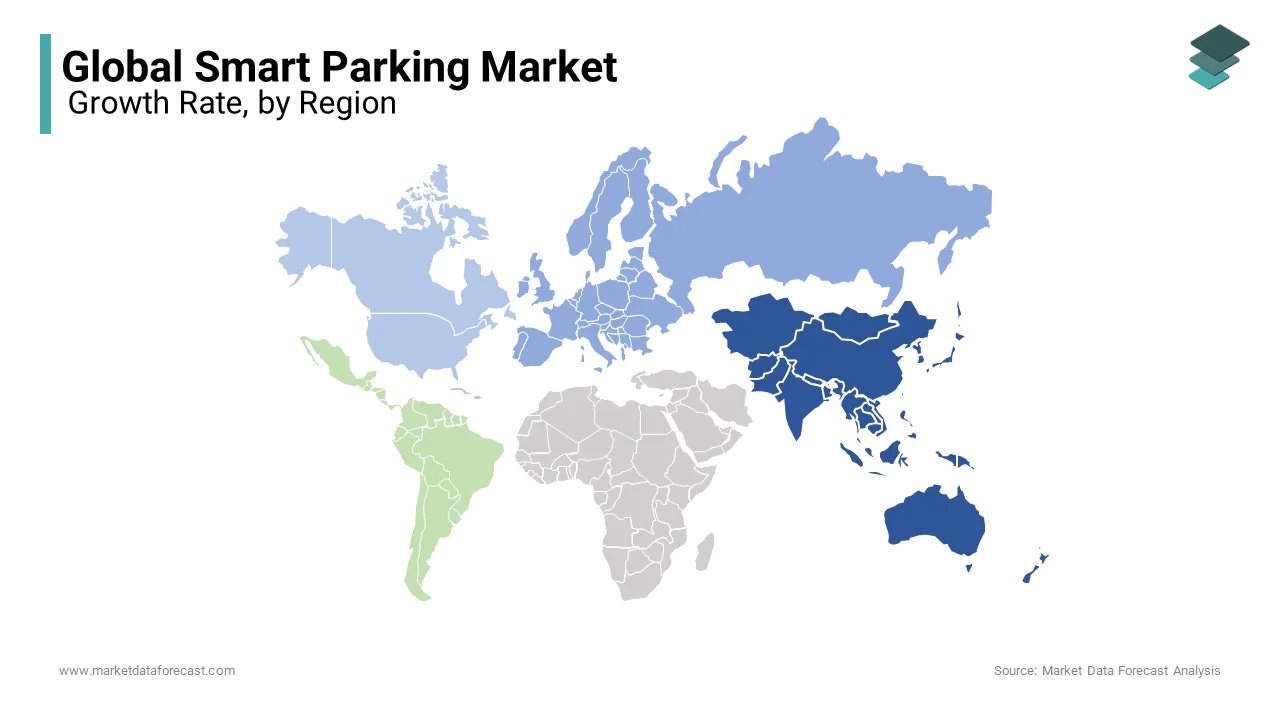
North America was the top performer in the global smart parking market by capturing 45.6% of share in 2025 with the advanced technological adoption and substantial government investment in urban infrastructure modernization. The region benefits from a mature ecosystem of technology providers and strong regulatory support for smart city initiatives. The federal funding for intelligent transportation systems has increased significantly promoting the deployment of smart parking solutions in major metropolitan areas. Cities like San Francisco and Los Angeles have pioneered dynamic pricing models that have reduced traffic congestion by up to 30% demonstrating the effectiveness of these technologies. The similar initiatives in Toronto and Vancouver are gaining momentum driven by sustainability goals and population growth. The presence of key market players and high smartphone penetration rates facilitate rapid user adoption of mobile parking applications. Furthermore, strict emission regulations encourage the integration of electric vehicle charging infrastructure with parking management systems. The region's focus on data privacy and security ensures robust framework development fostering consumer trust. Continued investment in 5G networks enhances connectivity enabling real time data processing and improved system reliability.
Europe Market Analysis
Europe smart parking market was ranked second by holding 32.1% of share in 2025 with the stringent environmental regulations and ambitious smart city agendas across member states. The region emphasizes sustainable urban mobility and efficient resource utilization making smart parking an integral component of broader transportation strategies. According to the European Commission over 140 cities have committed to smart city projects with parking management identified as a priority area for reducing carbon emissions. Countries such as Germany, France, and the United Kingdom lead in deployment due to strong governmental support and established infrastructure. As per the European Environment Agency, transport related emissions remain a significant challenge prompting authorities to adopt technologies that minimize unnecessary vehicle movement. The General Data Protection Regulation ensures high standards for data handling influencing system design and user confidence. High density urban centers in cities like Paris and London face severe parking scarcity driving demand for innovative solutions such as peer to peer platforms and sensor networks. Furthermore, the European Union's Green Deal initiative provides financial incentives for projects that contribute to climate neutrality accelerating market growth. Collaboration between public authorities and private technology providers fosters innovation and scalability.
Asia Pacific Market Analysis
The Asia Pacific smart parking market is steadily growing with the unprecedented urbanization and massive infrastructure development projects in emerging economies. Countries such as China, India, and Japan are investing heavily in smart city frameworks to address growing traffic congestion and parking shortages. According to the study, urban populations in the region are expected to increase by 1 billion people by 2050, creating immense pressure on existing transportation networks. China leads in deployment scale with cities like Beijing and Shanghai implementing extensive sensor networks and mobile payment integrated parking systems. As per the Ministry of Housing and Urban Rural Development in China, smart parking is a key pillar of national urbanization plans aiming to improve quality of life. India is also accelerating adoption through initiatives like Smart Cities Mission which allocates substantial funds for digital infrastructure including parking management. High smartphone penetration and growing middle class consumption drive demand for convenient parking solutions. Furthermore, government partnerships with technology firms facilitate rapid deployment and innovation. The region's focus on leapfrogging legacy systems allows for direct adoption of advanced technologies such as AI and IoT.
Latin America Market Analysis
Latin America smart parking market growth is growing steadily with the urban congestion challenges and increasing digital connectivity. Major cities are initiating pilot projects to address severe traffic issues and improve urban mobility efficiency. The urban congestion costs the region billions of dollars annually in lost productivity and fuel waste prompting governments to explore technological solutions. While budget constraints limit large scale deployments initial implementations focus on high impact areas such as city centers and commercial districts. The mobile internet penetration in Latin America has grown significantly enabling wider adoption of mobile parking applications and digital payment systems. Private sector involvement is increasing as companies recognize the potential for revenue optimization through smart parking management. Regulatory frameworks are evolving to support digital infrastructure development although progress varies by country. Public private partnerships are becoming common models for financing and operating smart parking systems. The region's young demographic profile favors adoption of digital services accelerating market acceptance.
Middle East and Africa Market Analysis
The Middle East and Africa smart parking market growth is driven by the ambitious visionary projects and infrastructure modernization efforts, particularly in Gulf Cooperation Council countries. Nations, such as the United Arab Emirates and Saudi Arabia are leading adoption as part of broader smart city transformations aimed at diversifying economies and enhancing urban livability. According to the Dubai Smart City Initiative the emirate aims to become the happiest city on earth through extensive use of technology including intelligent parking systems that reduce search time and emissions. As per the Saudi Vision 2030 plan massive investments in infrastructure include smart mobility solutions to support growing urban populations and tourism sectors. High disposable incomes and government willingness to invest in cutting edge technology facilitate rapid deployment of advanced systems. In Africa markets such as South Africa and Kenya are beginning to explore smart parking solutions to address urbanization challenges although adoption remains limited by infrastructure gaps. Mobile money platforms in Africa provide a foundation for digital parking payments enabling incremental growth.
COMPETITIVE LANDSCAPE
The competitive landscape of the smart parking market is characterized by a diverse mix of established technology giants specialized IoT providers and emerging startups focusing on niche solutions. Intense rivalry drives continuous innovation as companies strive to differentiate their offerings through superior accuracy ease of use and comprehensive data analytics capabilities. Large multinational corporations leverage their extensive resources and global presence to secure major municipal contracts while smaller agile firms often lead in developing cutting edge sensor technologies or user-friendly mobile interfaces. Strategic alliances play a pivotal role as competitors seek to complement their strengths by partnering with telecommunications firms cloud service providers and automotive manufacturers. The absence of dominant universal standards creates fragmentation allowing multiple players to coexist by catering to specific regional needs or technical requirements. Price competition remains moderate as value is increasingly derived from software services and data insights rather than hardware alone. Intellectual property protection through patents on sensor designs and algorithms serves as a key defensive strategy for maintaining competitive advantage.
KEY MARKET PLAYERS
These are some of the major key players involved in this global smart parking market.
- Amano McGann, Inc. (U.S.)
- Smart Parking Limited (Australia)
- IEM SA (Switzerland)
- Siemens AG
- Bosch GmbH
- ParkMobile LLC
- IPS Group Inc. (U.S.)
- Klaus Multiparking Systems (Germany)
- PArklayer (India)
- Omnitec Group (UAE)
- Mindteck (India)
- Robert Bosch GmbH (Germany)
- Dongyang Menics Co., Ltd (South Korea)
Top Players In The Market
- Siemens AG leverages its extensive expertise in digital infrastructure to deliver comprehensive smart parking solutions that integrate seamlessly with broader smart city ecosystems. The company focuses on developing advanced sensor technologies and data analytics platforms that optimize urban mobility and reduce congestion. Recent initiatives include partnerships with municipal authorities to deploy intelligent parking guidance systems that enhance user experience through real time availability information. Siemens emphasizes sustainability by aligning its parking solutions with electric vehicle charging infrastructure thereby supporting the transition to green transportation. Their involvement extends to providing robust cybersecurity measures ensuring data privacy and system reliability for large scale deployments.
- Bosch GmbH utilizes its strong background in automotive technology and Internet of Things connectivity to offer innovative smart parking services. The company provides end to end solutions ranging from ultrasonic sensors to cloud based management platforms that facilitate seamless parking experiences. Bosch recently expanded its portfolio by integrating artificial intelligence capabilities into its parking assistance systems enabling predictive analytics for space utilization. Their strategic collaborations with city planners focus on reducing traffic emissions by minimizing search times for available spots. Bosch also invests heavily in research and development to enhance the accuracy and durability of its sensing devices. This commitment to technological advancement allows Bosch to maintain a competitive edge by delivering reliable and scalable parking infrastructure solutions tailored to diverse urban environments worldwide.
- ParkMobile LLC specializes in mobile payment and reservation applications that simplify the parking process for drivers across numerous cities. The company has established a vast network of partnerships with municipalities and private parking operators to provide convenient digital access to parking spaces. Recent efforts include enhancing their platform with features such as dynamic pricing and personalized notifications to improve customer engagement and retention. ParkMobile focuses on user centric design ensuring intuitive interfaces that reduce friction during transaction processes.
Top Strategies Used by Key Market Participants
Key players in the smart parking market primarily employ strategic partnerships and mergers to expand their technological capabilities and geographic reach. Companies frequently collaborate with municipal governments and private property owners to deploy integrated solutions that combine hardware sensors with software analytics. Investment in research and development remains a critical strategy enabling firms to incorporate artificial intelligence and machine learning for predictive maintenance and demand forecasting. Many participants focus on interoperability by adopting open standards that allow seamless integration with existing smart city infrastructure. Diversification into adjacent services, such as electric vehicle charging and mobility, as a service platform helps companies create additional revenue streams. Marketing efforts emphasize sustainability benefits and user convenience to drive adoption among environmentally conscious consumers and efficiency driven operators. Continuous improvement of mobile applications ensures high user engagement while data security enhancements build trust among stakeholders concerned about privacy risks in connected urban environments.
MARKET SEGMENTATION
This research report on the global smart parking market is segmented and sub-segmented into the following categories.
By Hardware
- Pucks (Wireless Sensors)
- Cameras & LPRs
- Smart Meters
- Signage
- Parking Gates
By Type
- On-Street
- Off-Street
- Garage Parking
- Lot Parking
By Application
- Commercial
- Government
- Transport Transit
By Region
- North America
- Europe
- Asia Pacific
- Latin America
- Middle East and Africa
Frequently Asked Questions
Why is the smart parking market gaining momentum across modern cities?
The market is gaining momentum due to increasing urbanization, rising vehicle ownership, growing traffic congestion, and the need for efficient parking management solutions.
What is a smart parking system and how does it work?
A smart parking system uses sensors, cameras, IoT devices, mobile applications, and data analytics to monitor parking availability and guide drivers to vacant parking spaces in real time.
Which technology segment is driving innovation in the smart parking market?
IoT-enabled parking management solutions are driving innovation by providing real-time occupancy tracking, automated monitoring, and data-driven parking optimization.
How do smart parking solutions improve urban mobility?
They reduce the time spent searching for parking spaces, decrease traffic congestion, lower fuel consumption, and improve overall transportation efficiency.
Who are the primary users of smart parking technologies?
Municipal authorities, commercial property owners, airports, shopping centers, transportation hubs, smart city developers, and parking operators are the primary users.
What benefits are encouraging cities to invest in smart parking infrastructure?
Smart parking infrastructure helps improve traffic flow, increase parking revenue, enhance user convenience, and support sustainable urban development goals.
How is artificial intelligence transforming the smart parking industry?
AI enables predictive parking analytics, automated space detection, dynamic pricing strategies, and intelligent traffic management for improved parking operations.
What challenges could affect the adoption of smart parking solutions?
High installation costs, cybersecurity concerns, integration complexities, infrastructure limitations, and maintenance requirements could affect adoption.
Which regions are emerging as key growth markets for smart parking technologies?
North America and Europe are leading adopters, while Asia Pacific is emerging rapidly due to smart city initiatives and expanding urban infrastructure investments.
How are smart city projects influencing the growth of the smart parking market?
Smart city projects are accelerating the deployment of connected parking systems, digital payment platforms, and intelligent transportation networks.
Related Reports
Access the study in MULTIPLE FORMATS
Purchase options starting from
$ 2500
Didn’t find what you’re looking for?
TALK TO OUR ANALYST TEAM
Need something within your budget?
NO WORRIES! WE GOT YOU COVERED!
Call us on: +1 888 702 9696 (U.S Toll Free)
Write to us: sales@marketdataforecast.com