- Product Description Description
- Table of Contents TOC
- List of Table & Figure LOT
- Get Free Sample PDF Sample PDF
Market Size, 2025
$2.80 BnMarket Estimate, 2026
$3.14 BnMarket Forecast, 2034
$7.76 BnCAGR, 2026–2034
12%Global Social TV Market Size
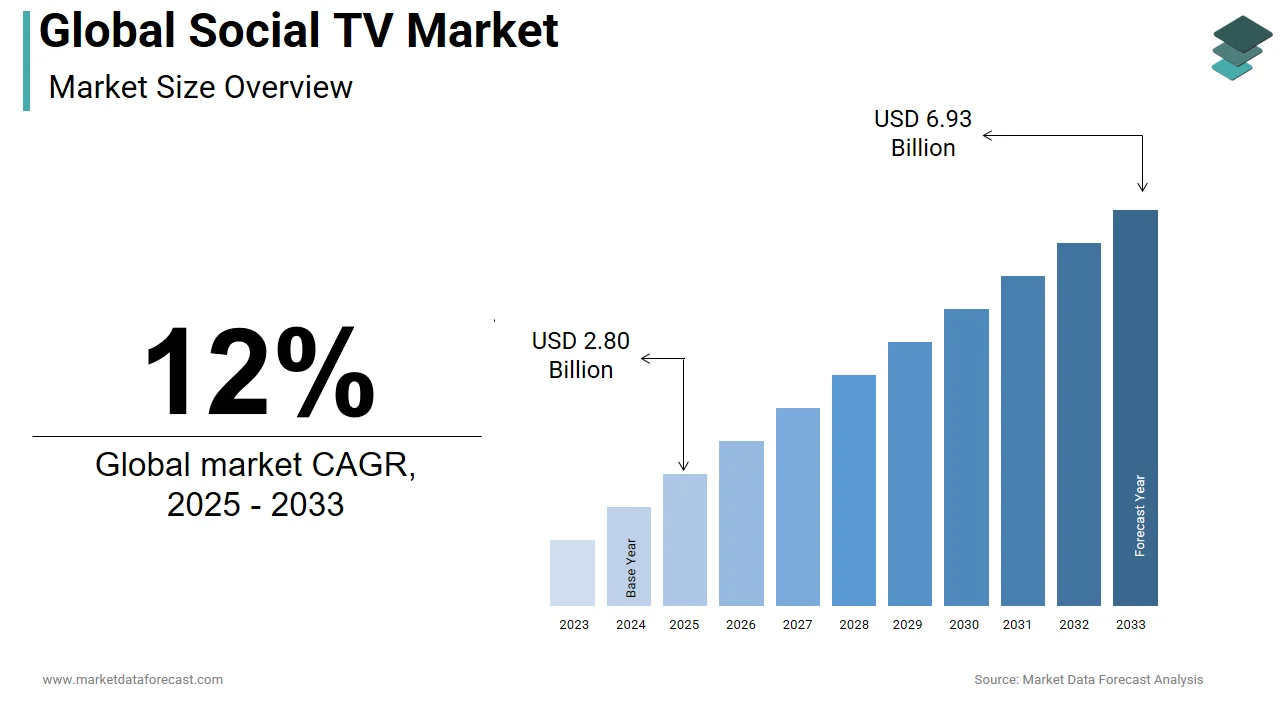
The global social television market was worth USD 2.80 billion in 2025. The global market is expected to reach USD 3.14 billion in 2026 and USD 7.76 billion by 2034, growing at a CAGR of 12% during the forecast period.
Television is an important part of modern society and is considered the most interesting and influential type of media. Social television is the new age technique where television content or programs can be interacted with via social media. Millions of people now share their television experience with other viewers on social media like Facebook, Twitter, and Instagram using smartphones, laptops, computers, smart TVs, and tablets. Television stations are increasingly sharing video clips of television content on social platforms to improve audience engagement. The social television market mainly comprises the platforms that are implemented by related companies to make the public interact via broadcasting channels. Companies like Telescope Inc. and Spredfast Inc. provide a platform or solution for communicating with the public on television shows on social media.
The social television market is destined to dominate the television industry, as TV manufacturers rely heavily on this technology. There is a diversity of players in the social television ecosystem, and the industry is open to experimentation and witnessing many links between broadcasters and social media companies. While some stations merge social television into their own platforms, many people are integrating Twitter into their social TV platforms to improve the experience and personalized participation. Leading media partners like the BBC and CNN have made agreements with social media service providers like Twitter, Facebook, etc., while social media companies are already planning to enter this venture in the coming years.
Social TV is becoming a rising interest among consumers these days, along with smart TV makers, content providers, second-screen application providers, middleware companies, advertising agencies, and others. Viewers are currently looking for something interesting to see and get feedback from friends and family. Social television plays an important role during the decision-making phase when viewers want to search and choose content from various sources. Social television allows viewers to chat during the television program during its broadcast and provides them with various statistics on movies, videos, shows, sporting events, games, actors, etc. Social media allows viewers to socialize virtually around the television.
MARKET DRIVERS
The determining factor in the global social television market is the increasing concentration of broadcasting organizations to improve public participation in television programs or content.
The social television market comprises various innovative technologies that offer assistance for the transmission of TV programs on social networking sites like Facebook, Twitter, etc. Broadcasters use social media to improve consumer engagement and for traditional marketing and promotions. With social media, entertainment companies can maximize their programming content by integrating streaming-focused analytics from around the world. This factor stimulates the global social television market. Recent technological advances in broadband programming on personal computers and "smart" televisions continue to drive market growth.
REPORT COVERAGE
| REPORT METRIC | DETAILS |
| Market Size Available | 2025 to 2034 |
| Base Year | 2025 |
| Forecast Period | 2026 to 2034 |
| CAGR | 12% |
| Segments Covered | By Content Type, Platform, User Engagement, Demographics, Technology & Platform, Application, and Region |
|
Various Analyses Covered | Global, Regional & Country Level Analysis, Segment-Level Analysis, DROC, PESTLE Analysis, Porter’s Five Forces Analysis, Competitive Landscape, Analyst Overview on Investment Opportunities |
| Regions Covered | North America, Europe, APAC, Latin America, Middle East & Africa |
|
Market Leaders Profiled | television (TV) market provides an analysis of the market share of different players, such as Spredfast Inc., Sprinklr Inc., Telescope, Inc., Flowics, Snipperwall, iPowow Ltd, Sprout Social Inc., Socialbakers Ltd., Megaphone Inc., never.no, SentabTV, Talkwalker Inc., and Vizrt Group AS and Others. |
REGIONAL ANALYSIS
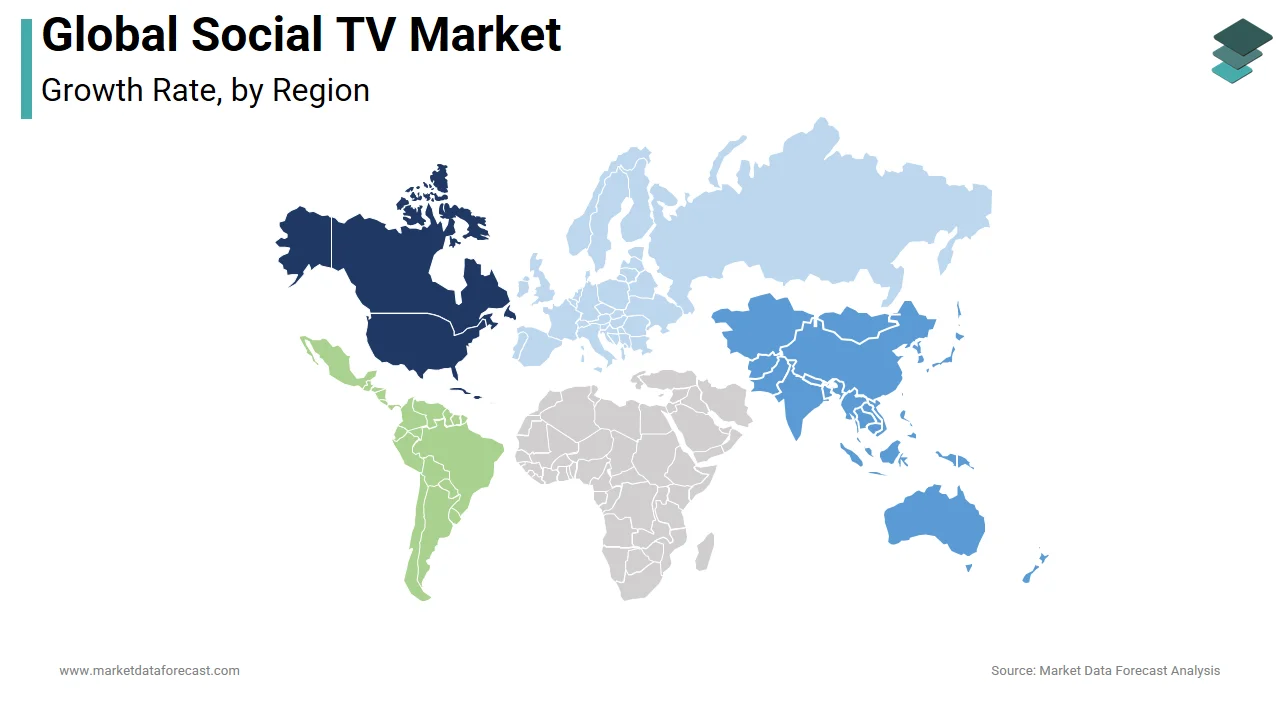
North America and Europe dominate the worldwide market because broadcasters in these regions use social media to improve consumer engagement, traditional marketing campaigns, and promotions. The Asia-Pacific region is supposed to experience the highest growth due to the increase in social network users with the increasing penetration of the Internet and smart devices.
KEY MARKET PARTICIPANTS
The major players operating in the global social television (TV) market include Spredfast Inc., Sprinklr Inc., Telescope, Inc., Flowics, Snipperwall, iPowow Ltd, Sprout Social Inc., Socialbakers Ltd., Megaphone Inc., never.no, SentabTV, Talkwalker Inc., and Vizrt Group AS.
RECENT MARKET HAPPENINGS
-
In September 2018, Twitter shook hands with television entertainment companies FMA Indonesia, Fox Sports Asia, NBC Universal, NDTV, Network 18, NET TV, Red Chillies Entertainment, SBS, Sony Music, Stadium Astro Malaysia, and Vice Media. The hike in Internet penetration is fuelling the growth of the global social television market.
MARKET SEGMENTATION
This research report on the global social TV market has been segmented and sub-segmented into the following categories.
By Content Type
- User-Generated Content (UGC)
- Professional Content
- Live Streaming
- On-Demand Content
By Platform
- Television
- Mobile Applications
- Web-Based Applications
By User Engagement
- Social Interactions
- Content Sharing
- Feedback Mechanisms
- Real-Time Polling
By Demographics
- Age Group
- Gender
- Income Level
By Technology & Platform
- Social EPG/Content Discovery
- Ad Production
- Ad Serving Platform
- Social Curation & Syndication
- Content Detection/Matching
- General Social Analytics
By Application
- Sports
- News
- TV Shows
- Others
By Region
- North America
- Europe
- Asia Pacific
- Latin America
- The Middle East and Africa