- Product Description Description
- Table of Contents TOC
- List of Table & Figure LOT
- Get Free Sample PDF Sample PDF
Market Size, 2025
$322.16 BnMarket Estimate, 2026
$389.81 BnMarket Forecast, 2034
$1,791.18 BnCAGR, 2026–2034
21%Global SaaS (Software-as-a-Service) Market Summary
The global SaaS (software-as-a-service) market was valued at USD 322.16 billion in 2025, is estimated to reach USD 389.81 billion in 2026, and is projected to grow significantly to USD 1,791.18 billion by 2034, expanding at a CAGR of 21% from 2026 to 2034. The growth of the global SaaS market is attributed to increasing cloud adoption across enterprises, rising demand for cost-effective and scalable IT solutions, rapid digital transformation across industries, and the growing integration of artificial intelligence (AI) and machine learning (ML) into SaaS platforms.
Key Market Trends
- Rising adoption of vertical-specific SaaS solutions across healthcare, retail, and BFSI.
- Strong growth in AI-driven SaaS platforms for analytics, automation, and personalization.
- Increasing demand for collaboration and remote working tools post-pandemic.
- Expansion of subscription-based and pay-as-you-go models enhancing affordability for SMEs.
- Growing emphasis on cloud security and compliance-focused SaaS solutions.
Segmental Insights
- Based on deployment type, the public cloud deployment model dominated the global SaaS market with 68.3% share in 2024, supported by scalability, cost efficiency, and wide availability.
- Based on application, the Customer Relationship Management (CRM) segment led with 24.3% share in 2024, reflecting growing adoption for sales optimization and customer engagement.
- Based on enterprise type, the large enterprises segment accounted for 62.3% of the market share in 2024, driven by widespread SaaS adoption for digital transformation initiatives.
Regional Insights
- North America held the dominant position in the global SaaS market with a 43.2% share in 2024, supported by strong enterprise adoption, the presence of leading SaaS vendors, and high cloud infrastructure maturity.
- Europe continues to show steady growth, driven by digital transformation in enterprises and regulatory compliance-focused SaaS adoption.
- Asia-Pacific is projected to be the fastest-growing region, fueled by rapid industrialization, cloud adoption among SMEs, and government-led digital initiatives.
- Latin America is witnessing increased SaaS adoption in e-commerce, retail, and financial services.
- Middle East & Africa are gradually adopting SaaS solutions, supported by smart city projects and growing demand for cost-effective IT solutions.
Competitive Landscape
Key players in the global SaaS (software-as-a-service) market include Microsoft Corporation (U.S.), SAP SE (Germany), IBM Corporation (U.S.), Oracle Corporation (U.S.), HPE (U.S.), ServiceNow (U.S.), TCS (India), Google LLC (U.S.), Cisco Systems, Inc. (U.S.), Infosys (India), Babbel (Germany), Zoho Corporation (India), Workiva (Germany), Tencent Holdings (China), and Trend Micro (Japan). These companies focus on cloud innovation, AI integration, strategic partnerships, and expanding industry-specific SaaS offerings to strengthen their global presence.
Global SaaS (Software-as-a-Service) Market Size
The global SaaS (software-as-a-service) market was valued at USD 322.16 billion in 2025, is estimated to reach USD 389.81 billion in 2026, and is projected to reach USD 1791.18 billion by 2034, growing at a CAGR of 21% from 2026 to 2034.
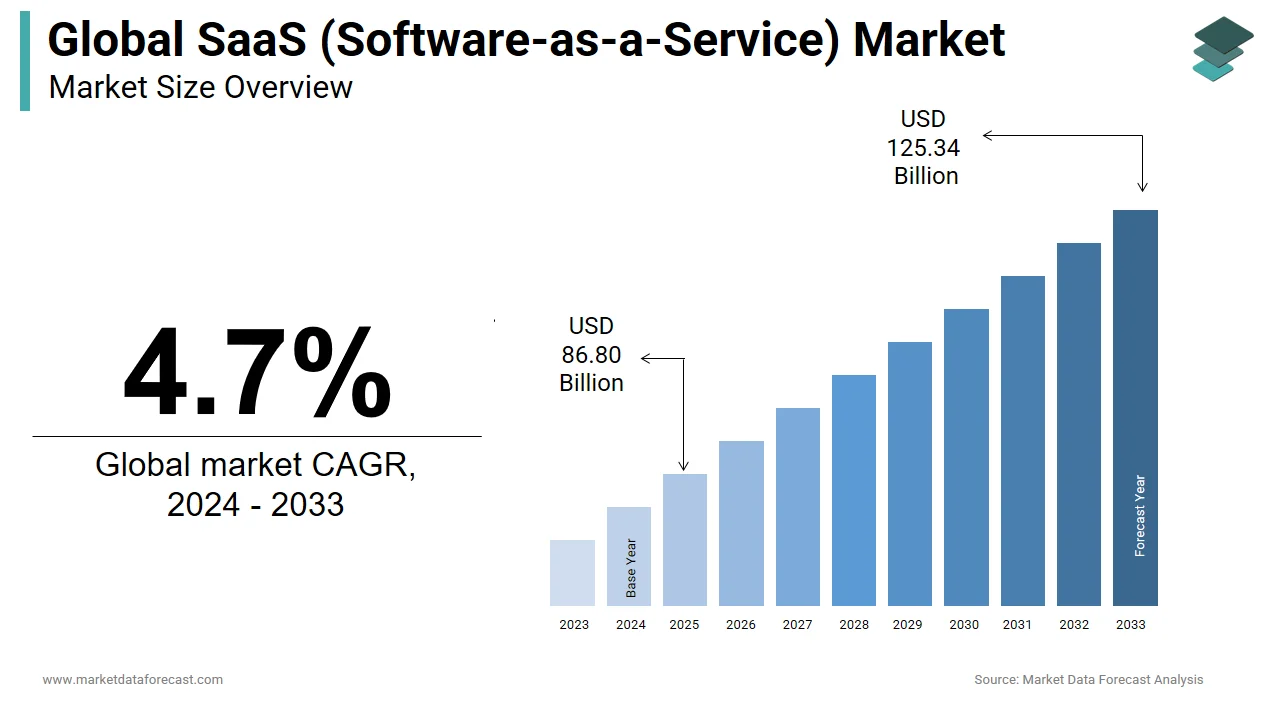
The SaaS (Software-as-a-Service) is a software delivery model wherein applications are hosted centrally by providers and made accessible to users via the internet on a subscription basis. Unlike traditional software models requiring local installation and maintenance, SaaS enables real-time updates, scalable infrastructure, and remote access, fostering operational agility across enterprises.
MARKET DRIVERS
Rising SMB Adoption of Scalable, Cost-Efficient Enterprise Solutions
The escalating demand for scalable and cost-efficient enterprise solutions among small and mid-sized businesses (SMBs) is driving the growth of the SaaS market. These organizations increasingly favor SaaS due to its low upfront capital expenditure, predictable operational costs, and rapid deployment capabilities. Salesforce reports that 91% of companies with more than 100 employees now use cloud-based CRM systems, the majority of which are delivered via SaaS models. This transition is further fueled by the elasticity of SaaS architecture which allows businesses to scale licenses and features in alignment with growth trajectories without overhauling IT infrastructure. The agility offered by subscription-based models enables faster time-to-value by making SaaS indispensable in dynamic market environments.
Growth of SaaS Market Driven by Remote and Hybrid Work Models
The accelerated adoption of remote and hybrid work models, which have fundamentally altered enterprise technology requirements, is leveraging the growth of the SaaS market. The shift, catalyzed by global disruptions and sustained by evolving workforce expectations, necessitates software solutions that support seamless collaboration, data accessibility, and cross-platform integration. Furthermore, global internet penetration now exceeds 67%, according to the International Telecommunication Union, by enabling widespread access to cloud-hosted applications across geographies. The inherent mobility and device-agnostic nature of SaaS platforms make them ideally suited to support decentralized workforces, reinforcing their strategic importance in modern organizational design.
MARKET RESTRAINTS
Data Security and Regulatory Compliance Challenges in the SaaS Market
The escalating concern over data security and regulatory compliance in highly regulated sectors such as healthcare, finance, and government is limiting the growth of SaaS market. According to IBM’s 2023 Cost of a Data Breach Report, the average cost of a data breach in cloud environments reached $4.7 million, with SaaS applications increasingly implicated in third-party compromise incidents. Additionally, the European Union’s General Data Protection Regulation (GDPR) and similar frameworks in jurisdictions like California and Brazil impose stringent requirements on data localization and processing, complicating SaaS deployment for multinational firms. These concerns are exacerbated by the fragmented nature of SaaS ecosystems, where shadow IT and unapproved application usage further amplify vulnerabilities.
Vendor Lock-in and Interoperability Challenges in the SaaS Market
The vendor lock-in and interoperability challenges, which hinder seamless integration across platforms and limit organizational flexibility, are also degrading the growth of the SaaS market. Many SaaS providers employ proprietary data formats and APIs, making data migration and system consolidation complex and costly. This dependency discourages innovation and reduces competitive pressure on providers to enhance service quality. Moreover, the absence of universal interoperability standards results in data silos, undermining the efficacy of enterprise-wide digital strategies.
MARKET OPPORTUNITIES
AI and ML Integration Driving SaaS Market Growth
The integration of artificial intelligence (AI) and machine learning (ML) to deliver intelligent automation and predictive analytics is also to level up the growth of the SaaS market. SaaS platforms are increasingly embedding AI-driven features such as natural language processing, anomaly detection, and automated workflows to enhance user productivity and decision-making. According to a 2023 McKinsey Global Survey on AI, 55% of enterprises have adopted AI in at least one business function, with customer service, sales forecasting, and IT operations being the most common use cases, predominantly accessed via SaaS channels. Platforms like ServiceNow and Adobe Sensei have reported up to 40% improvement in task efficiency following AI integration.
Expansion of SaaS into Emerging and Underserved Markets
The expansion of SaaS solutions into underserved and emerging markets, where digital infrastructure is crucial to level up the growth of the SaaS market. Countries across Southeast Asia, Latin America, and Sub-Saharan Africa are witnessing a surge in internet-enabled businesses and government-led digitalization initiatives. Similarly, African fintech SaaS platforms like Flutterwave and Paga have achieved over 2 million business users collectively, according to company disclosures. These regions present vast untapped potential as localized SaaS solutions address language, regulatory, and payment diversity. Providers who tailor offerings to regional nuances stand to gain first-mover advantages in high-growth economies.
MARKET CHALLENGES
Intensifying Competition and Margin Compression in the SaaS Market
The intensifying competition leading to product commoditization and margin compression is posing a challenge to the growth of the SaaS market. As per Crunchbase data from 2023, over 15,000 active SaaS companies operate in North America alone, with nearly 40% offering overlapping functionalities in domains like HR tech, project management, and marketing automation. This saturation forces providers to engage in aggressive pricing strategies, reducing average revenue per user (ARPU). A 2023 analysis by SaaS Capital revealed that median gross margins among publicly traded SaaS firms declined to 72% from 78% in 2020 due to rising customer acquisition costs and discounting.
Complexity of Multi-Cloud and Hybrid SaaS Environments
The growing complexity of multi-cloud and hybrid SaaS environments, which strain IT governance and increase operational overhead, is additionally degrading the growth of the SaaS market. Enterprises today use an average of 178 SaaS applications, as per a 2023 report by Flexera, with large organizations often exceeding 300. This proliferation creates visibility gaps, inconsistent security policies, and inefficient license utilization. Additionally, managing service-level agreements (SLAs), uptime monitoring, and performance across disparate vendors demands sophisticated tools and skilled personnel, which many organizations lack. The absence of centralized SaaS management platforms exacerbates these issues, leading to fragmented oversight.
REPORT COVERAGE
| REPORT METRIC | DETAILS |
| Market Size Available | 2025 to 2034 |
| Base Year | 2025 |
| Forecast Period | 2026 to 2034 |
| Segments Covered | By Deployment Type, Application, Enterprise Type, Industry, and Region. |
| Various Analyses Covered | Global, Regional and Country-Level Analysis, Segment-Level Analysis, Drivers, Restraints, Opportunities, Challenges; PESTLE Analysis; Porter’s Five Forces Analysis, Competitive Landscape, Analyst Overview of Investment Opportunities |
| Regions Covered | North America, Europe, Asia-Pacific, Latin America, Middle East and Africa |
| Market Leaders Profiled | Microsoft Corporation (U.S.), SAP SE (Germany), IBM Corporation (U.S.), Oracle Corporation (U.S.), HPE (U.S.), ServiceNow (U.S.), TCS (India), Google LLC (U.S.), Cisco Systems, Inc. (U.S.), Infosys (India), Babbel (Germany), Zoho Corporation (India), Workiva (Germany), Tencent Holdings (China), Trend Micro (Japan) |
SEGMENTAL ANALYSIS
By Deployment Type Insights
The public cloud deployment model segment was the largest and held 68.3% of the SaaS market share in 2024, with its inherent advantages in scalability, cost efficiency, and rapid deployment. Enterprises, particularly those undergoing digital transformatio,n are increasingly favoring public SaaS due to its pay-as-you-go pricing and minimal infrastructure overhead. According to the U.S. Census Bureau, over 58% of IT infrastructure spending by businesses shifted toward public cloud services in 2023, reflecting a structural preference for outsourced hosting.
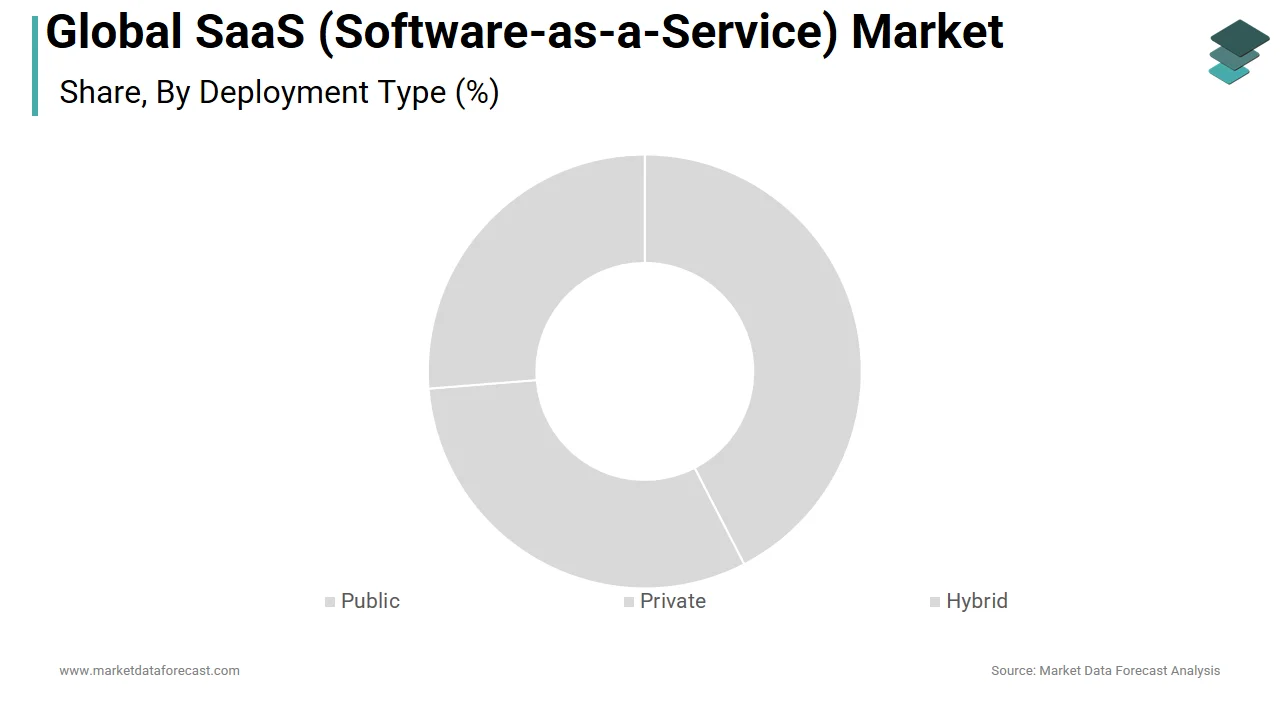
The hybrid deployment model is swiftly emerging with an expected CAGR of 18.7% during the forecast period, with the organizations seeking a balanced approach that combines the agility of public cloud with the control of private infrastructure. Industries such as financial services and healthcare, where data sovereignty and regulatory compliance are paramount, are leading this shift. Furthermore, the rise of edge computing and distributed workforces has intensified demand for localized processing with centralized management. Hybrid SaaS enables precisely this duality.
By Application Insights
The Customer Relationship Management (CRM) segment was the largest by capturing 24.3% of the market share in 2024, with CRM systems playing a role in driving customer acquisition, retention, and personalized engagement across digital channels. According to Salesforce’s 2023 State of the Connected Customer report, 88% of consumers expect companies to accelerate digital capabilities, pushing enterprises to adopt intelligent CRM tools with embedded analytics and AI.
Business Intelligence (BI) and Analytics are growing with an expected CAGR of 19.3% from 2026 to 2034, with the exponential growth of enterprise data and the urgent need for real-time decision-making. Organizations are increasingly embedding analytics into operational workflows, moving beyond static reporting to predictive and prescriptive insights. The integration of AI-driven data modeling has further enhanced accessibilit.y Google Cloud reports that its AI-powered Looker tools reduced query response times by up to 70% in enterprise deployments.
By Enterprise Type Insights
The large enterprises segment accounted in holding 62.3% of the share in the SaaS market with their extensive digital infrastructure needs, global operations, and capacity for large-scale software adoption. These organizations deploy SaaS solutions across multiple functions, including ERP, HR, cybersecurity, and supply chain management, often through enterprise-wide licensing agreements. According to a 2023 McKinsey analysis, Fortune 500 companies now use an average of 127 SaaS applications per organization, which reflects deep integration into core operations. Additionally, large firms are leading adopters of AI-enhanced SaaS tools. Microsoft disclosed in its 2023 earnings call that over 95% of Fortune 500 companies utilize Microsoft 365 with Copilot AI integration. Their ability to negotiate multi-year contracts and invest in custom integrations further entrenches their dominance by enabling SaaS vendors to achieve predictable recurring revenue streams.
The Small and Medium-sized enterprises (SMEs) segment is growing at a CAGR of 17.9% throughout the forecast period with the enterprise-grade technology, enabling SMEs to compete with larger firms without significant capital investment. According to the U.S. Small Business Administration, over 65% of small businesses in the U.S. now use at least one cloud-based business application, a figure that has nearly doubled since 2019. Additionally, government-backed digitalization initiatives in countries like India and Brazil have subsidized cloud access, further accelerating SME adoption.
REGIONAL ANALYSIS
North America SaaS (Software-as-a-Service) Market Insights
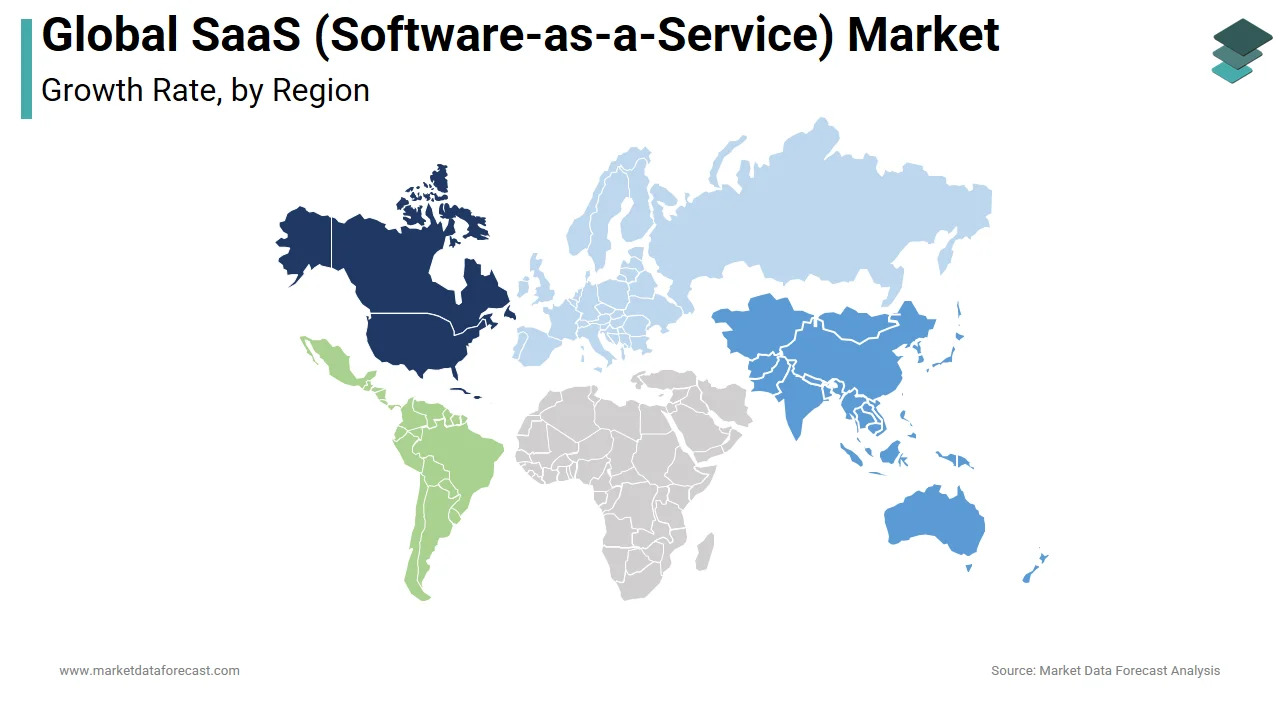
North America SaaS market held 43.2% of the share in 2024 with its mature digital infrastructure, high concentration of technology innovators, and widespread enterprise cloud adoption. According to the U.S. Bureau of Economic Analysis, the information technology sector contributed over $2.1 trillion to the U.S. GDP in 2023, with cloud services representing a growing share. Additionally, venture capital funding for U.S.-based SaaS startups exceeded $35 billion in 2023, as reported by PitchBook, fostering continuous product innovation.
Europe SaaS (Software-as-a-Service) Market Insights
Europe SaaS market was positioned second with 27.3% of share in 2024, with the strong regulatory frameworks and increasing digital transformation across both public and private sectors. Germany and the UK lead in enterprise adoption, with German SMEs showing a 42% year-on-year increase in SaaS utilization, according to Bitkom. Moreover, the EU’s stringent data protection laws, particularly GDPR, have spurred demand for compliant, locally hosted SaaS solutions, prompting vendors like SAP and Deutsche Telekom to expand secure cloud offerings.
Asia Pacific SaaS (Software-as-a-Service) Market Insights
Asia Pacific SaaS market is anticipated to have significant growth opportunities in the coming years. While currently trailing North America and Europe, the region is witnessing the most rapid expansion due to digital acceleration in economies like India, Japan, and South Korea. Government initiatives such as Digital India and Japan’s Society 5.0 are catalyzing public and private sector cloud adoption.
Latin America SaaS (Software-as-a-Service) Market Insights
Latin America SaaS market growth is likely to grow with the growing digital adoption driven by fintech innovation and government digitization programs. Brazil leads the region by contributing over 45% of Latin America’s SaaS consumption, with cloud-based financial and HR platforms seeing exponential growth. According to Brazil’s Ministry of Economy, over 8 million formal businesses have adopted digital invoicing and accounting systems since 2020, many of which are SaaS-based. Additionally, remote work adoption has surged with 38% of Brazilian professionals working remotely at least part-time in 2023, as reported by Fundação Getúlio Vargas.
Middle East and Africa SaaS (Software-as-a-Service) Market Insights
The Middle East and Africa SaaS market growth is likely to grow with the ambitious national digital transformation agendas. The United Arab Emirates and Saudi Arabia are at the forefront, with the UAE’s Smart Dubai initiative achieving 98% government service digitization by 2023, as reported by the Dubai Digital Authority.
COMPETITIVE LANDSCAPE
The SaaS market is characterized by intense competition driven by rapid innovation, evolving customer expectations, and the proliferation of niche vendors. Incumbents like Microsoft, Salesforce, and Adobe face mounting pressure from agile startups offering specialized, AI-driven solutions at competitive pricing. Differentiation increasingly hinges on integration capabilities, data security, and industry-specific customization rather than functionality alone. Vendors are investing in ecosystem development through APIs and partner networks to create lock-in effects.
KEY MARKET PLAYERS
Some of the companies that are playing a dominating role in the global SaaS (software-as-a-service) market include
- Microsoft Corporation (U.S.)
- SAP SE (Germany)
- IBM Corporation (U.S.)
- Oracle Corporation (U.S.)
- HPE (U.S.)
- ServiceNow (U.S.)
- TCS (India)
- Google LLC (U.S.)
- Cisco Systems, Inc. (U.S.)
- Infosys (India)
- Babbel (Germany)
- Zoho Corporation (India)
- Workiva (Germany)
- Tecent Holdings (China)
- Trend Micro (Japan)
Top Strategies Used by Key Market Participants
Key players in the SaaS market are deploying multifaceted strategies to consolidate their competitive advantage. Strategic acquisitions are frequently used to enhance product capabilities, as seen in Microsoft’s integration of Nuance Communications to strengthen its cloud-based AI for healthcare. Partnerships with regional telecom providers and system integrators enable localized deployment and faster customer onboarding. Major vendors are investing heavily in artificial intelligence and machine learning to differentiate their offerings, embedding intelligent automation into core platforms. Geographic expansion through new data centers ensures compliance with data sovereignty laws and reduces latency.
Top Players in the SaaS (Software-as-a-Service) Market
Microsoft
Microsoft has established a dominant footprint in the Asia Pacific SaaS landscape through its cloud-native productivity and enterprise solutions, particularly Microsoft 365 and Dynamics 365. The company has intensified its regional investments by launching new Azure data centers in Malaysia, Indonesia, and New Zealand, enhancing low-latency access for local enterprises. In 2023, Microsoft partnered with Japan’s NTT to co-develop secure hybrid cloud solutions tailored for financial institutions. It also expanded its AI integration within Teams and Power BI, targeting remote collaboration demands.
Salesforce
Salesforce has significantly deepened its presence in the Asia Pacific SaaS market by localizing its Customer 360 platform to align with regional regulatory and business practices. The company opened a new innovation hub in Singapore in early 2023 to accelerate AI and sustainability-focused product development for APAC clients. Salesforce strengthened its ecosystem by integrating with local payment gateways and telecom providers, including a strategic alliance with SoftBank for joint enterprise sales in Japan. It also acquired Slack, which has become a cornerstone for remote workforce engagement across Australian and Southeast Asian markets.
Adobe
Adobe has cemented its influence in the Asia Pacific SaaS market through its Creative Cloud and Experience Cloud platforms, which are widely adopted by enterprises for digital marketing and content personalization. The company launched localized versions of its Marketo Engage and Workfront solutions to cater to mid-market businesses in India, South Korea, and Thailand. In 2023, Adobe collaborated with Telstra to deliver integrated digital experience tools for Australian enterprises. It also introduced AI-powered features in Sensei across its suite, improving automation in customer journey mapping.
GLOBAL SAAS MARKET NEWS
- In January 2023, Microsoft launched its first Azure region in New Zealand, enabling local data residency and low-latency cloud access for public and private sector organizations across the South Pacific.
- In November 2023, Oracle announced the expansion of its Gen 2 Cloud Infrastructure in Japan, adding new availability domains to support high-performance SaaS deployments for financial and government sectors.
MARKET SEGMENTATION
This global SaaS (software-as-a-service) market research report is segmented and sub-segmented into the following categories.
By Deployment Type
- Public
- Private
- Hybrid
By Application
- Customer Relationship Management (CRM)
- Enterprise Resource Planning (ERP)
- Content, Collaboration & Communication
- BI & Analytics
- Human Capital Management
- Others
By Enterprise Type
- Large Enterprises
- SMEs
By Industry
- IT & Telecom
- BFSI
- Retail & Consumer Goods
- Healthcare
- Education
- Manufacturing
- Others (Travel & Hospitality)
By Region
- North America
- Europe
- Asia-Pacific
- Middle East Africa
- Latin America