- Product Description Description
- Table of Contents TOC
- List of Table & Figure LOT
- Get Free Sample PDF Sample PDF
Market Size, 2025
$4.35 BnMarket Estimate, 2026
$4.59 BnMarket Forecast, 2034
$7.04 BnCAGR, 2026–2034
5.5%Executive Summary: Sorting Equipment Market
- Market Scope: Comprehensive global sorting equipment market analysis covering sorter technologies, application segments, regional leadership frameworks, food safety compliance, and automated recycling initiatives.
- Market Valuation: Valued at USD 4.35 billion (2025), estimated at USD 4.59 billion (2026), and projected to reach USD 7.04 billion by 2034, registering a steady CAGR of 5.5% (2026–2034).
- Primary Growth Drivers: Growing importance of factory automation to reduce operational risks, rising labor costs prompting manufacturing shifts, strict government enforcement of food safety regulations, and increased demand for non-destructive inspection technologies.
Key Market Segment Metrics (2026–2034)
| Category | Leading Segment (Position) | Fastest-Growing Segment |
|---|---|---|
| By Product / Technology | Optical Sorters (led the market with a revenue share of over 56%) | Weight/Gravity Sorters (estimated to exhibit the fastest CAGR) |
| By End-Use Industry | Food and Beverage Industry (led end-use segments with over 41% share) | Pharmaceutical Industry (expected to grow at the fastest CAGR during the forecast period) |
| By Region | Europe (led regionally with the largest revenue share of over 33%) | Asia-Pacific (fastest-growing regional market driven by rapid manufacturing automation) |
Major Market Players & Market Structure
Market Structure: Highly competitive global material sorting and processing landscape featuring major technology innovators competing on non-destructive inspection, optical sensing accuracy, and automated resource recovery solutions.
Key Companies: TOMRA, Barco Vision, Daewon GSE, BT-Wolfgang Binder, Bühler Sortex, Sesotec, Raytec Vision, Concept Engineers, and Key Technology.
Global Sorting Equipment Market Size
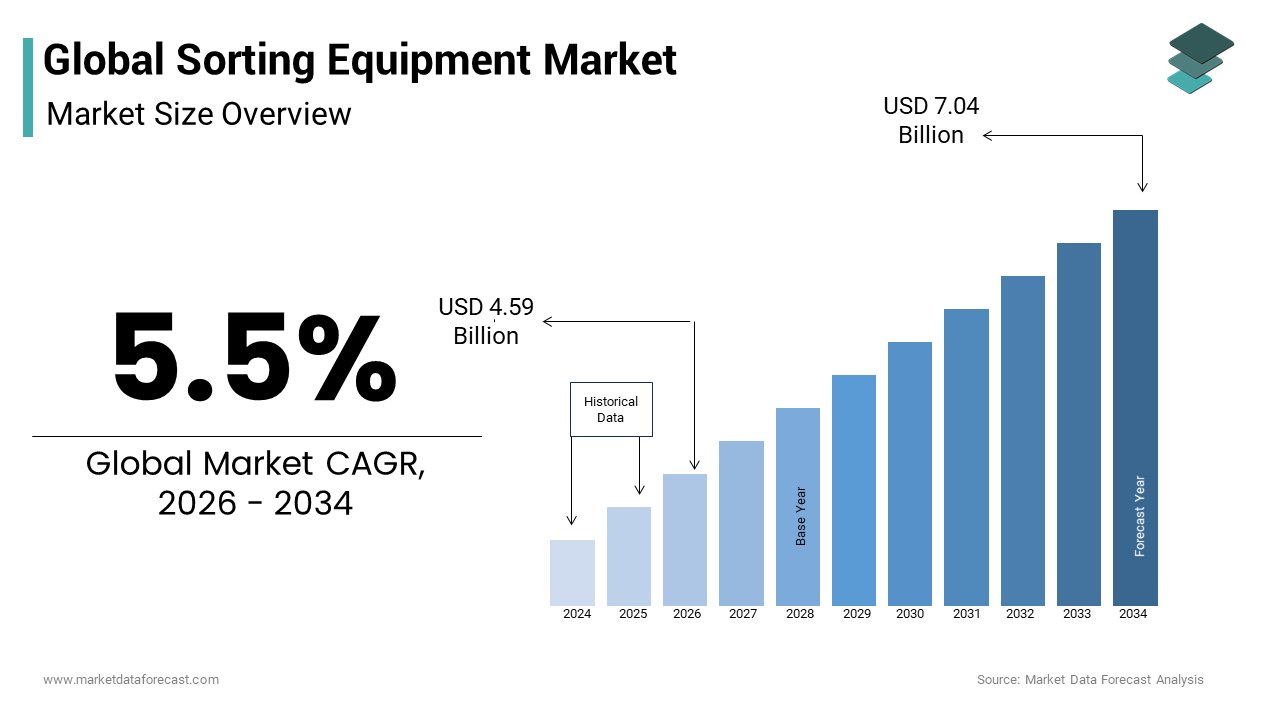
The global sorting equipment market size was valued at USD 4.35 billion in 2025 and is anticipated to reach a valuation of USD 4.59 billion in 2026 and USD 7.04 billion by 2034, growing at a CAGR of 5.5% during the forecast period from 2026 to 2034.
Sorting Equipment Market Comprehensive Analysis
The sorting equipment is advanced mechanical and optical system designed to categorize materials based on specific attributes such as size, weight, color, and composition. These systems are integral to modern industrial operations spanning waste management recycling agriculture mining and food processing sectors. The fundamental purpose of sorting equipment is to enhance operational efficiency reduce manual labor dependency and ensure high purity levels in separated materials. As global industries face increasing pressure to adopt sustainable practices the demand for precise sorting solutions has intensified significantly. According to the United Nations Environment Programme, global waste generation is projected to reach 3.4 billion tonnes by 2050, which necessitates robust sorting infrastructure to manage this volume effectively. Furthermore, the circular economy action plan aims to double the circular material use rate from 12% to 25% by 2030, driving the adoption of sophisticated sorting technologies. The food produced is lost between harvest and retail levels promoting the role of sorting equipment in minimizing post-harvest losses through quality grading. The integration of artificial intelligence and sensor-based technologies has transformed traditional sorting mechanisms into intelligent systems capable of real time decision making.
MARKET DRIVERS
Rising Global Waste Generation Rates Drive Adoption Of Advanced Sorting Systems
The exponential increase in global waste production is accelerating the growth of the sorting equipment market. Municipal solid waste volumes have surged due to rapid urbanization and changing consumption patterns worldwide. This substantial volume creates an urgent need for efficient sorting infrastructure to facilitate recycling and recovery processes. Sorting equipment enables facilities to separate recyclable materials such as plastics, metals, and paper from mixed waste streams with high precision. In Europe, the municipal waste recycling rates reached 48% in recent years but significant variations exist among member states indicating room for improvement through better sorting technologies. These statistics underscore the critical role of automated sorting systems in addressing waste management challenges and supporting circular economy initiatives across developed and developing nations.
Stringent Environmental Regulations Mandate Efficient Material Separation Processes
Governmental policies and environmental regulations worldwide are compelling industries to implement sophisticated sorting equipment to comply with sustainability mandates. The stringent environmental regulations mandate effcinet material separation processes is also propelling the growth of the sorting equipment market. Regulatory frameworks increasingly require higher purity levels in recycled materials and stricter limits on landfill disposal. The European Union Waste Framework Directive sets binding targets for member states to recycle 55% of municipal waste by 2025 and 60% by 2030. Achieving these ambitious goals necessitates the deployment of advanced sorting technologies capable of distinguishing between various material types with minimal contamination. In the United States, the Environmental Protection Agency emphasizes that improved sorting infrastructure is essential for meeting state level recycling goals which vary significantly across regions. China implemented strict waste sorting regulations in major cities like Shanghai requiring residents to separate waste into four categories which has driven demand for industrial sorting equipment to process these segregated streams efficiently. These regulatory pressures create a compliant environment where sorting equipment becomes not just an operational choice but a legal necessity for waste management facilities and manufacturing plants seeking to avoid penalties and maintain operational licenses in regulated markets.
MARKET RESTRAINTS
High Initial Capital Investment Constraints Market Penetration In Developing Regions
The substantial upfront costs associated with acquiring and installing advanced sorting equipment, particularly in emerging countries is hindering the growth of the sorting equipment market. Modern sorting systems equipped with near infrared sensors optical cameras and artificial intelligence algorithms require considerable financial outlay. Additionally, the total cost of ownership includes ongoing maintenance software updates and skilled operator training, which further escalates expenses. In regions like Sub Saharan Africa, where municipal budgets are often strained the priority remains basic waste collection rather than sophisticated sorting infrastructure. Many Southeast Asian nations lack the fiscal capacity to invest in state of the art sorting technologies despite facing growing waste management challenges. This financial barrier limits the adoption rate of advanced sorting equipment in price sensitive areas, where manual sorting remains prevalent despite its lower efficiency and higher health risks for workers.
Technical Complexity And Skilled Labor Shortage Impede Operational Efficiency
The intricate nature of modern sorting equipment demands a workforce with specialized technical expertise, which is also declining the growth of the sorting equipment market. Advanced sorting systems integrate multiple technologies, including machine learning algorithms, sensor calibration, and mechanical engineering principles that require trained personnel for optimal operation and maintenance. According to the International Labour Organization, there is a growing skills gap in the technical sectors with millions of jobs remaining unfilled due to inadequate training programs. In the context of sorting equipment, operators must understand how to interpret sensor data adjust machine parameters and troubleshoot complex mechanical issues. Furthermore, the rapid pace of technological advancement means that existing staff require continuous upskilling to keep pace with new software updates and hardware innovations. Many waste management facilities struggle to recruit and retain qualified technicians leading to suboptimal equipment performance and increased downtime. In developing regions, the situation is more acute as technical education infrastructure often lags behind industrial needs. This shortage of skilled labor results in underutilization of sophisticated sorting capabilities forcing some facilities to operate below their designed capacity.
MARKET OPPORTUNITIES
Integration Of Artificial Intelligence Enhances Sorting Precision And Speed
The incorporation of artificial intelligence and machine learning into sorting equipment by significantly improving accuracy and throughput is to create new opportunities for the growth of the sorting equipment market. AI powered systems can identify and classify materials with greater precision than traditional methods by learning from vast datasets of material characteristics. This enhanced precision reduces contamination in recycled streams thereby increasing the market value of recovered materials. The technology enables real time adaptation to varying waste compositions which is crucial for handling mixed municipal waste streams. In the food processing sector, AI driven sorting equipment can detect subtle defects and quality variations that human inspectors might miss. Furthermore, predictive maintenance capabilities powered by AI allow operators to anticipate equipment failures before they occur reducing unplanned downtime, as noted by Deloitte. These advancements make sorting equipment more attractive to industries seeking to maximize operational efficiency and minimize waste.
Expansion Of Circular Economy Initiatives Creates New Application Verticals
The global shift toward circular economy models for specialized sorting solutions across diverse industries is additional factor to escalate the growth of the sorting equipment market. Circular economy principles emphasize keeping materials in use for as long as possible which requires efficient separation and recovery systems. Beyond traditional waste management sectors, industries such as automotive electronics and textiles are increasingly adopting sorting equipment to recover valuable components from end of life products. Additionally, the construction and demolition sector produces global waste creating opportunities for sorting equipment designed to separate concrete wood metals and other building materials. These emerging application verticals expand the addressable for sorting equipment manufacturers, who can develop customized solutions tailored to the unique requirements of each industry segment supporting broader sustainability goals.
MARKET CHALLENGES
Rapid Technological Obsolescence Requires Continuous Innovation Investment
The fast paced evolution of sorting technologies in research and development to remain competitive is a major challenge for the growth of the sorting equipment market. Sorting equipment incorporating sensors cameras and software algorithms becomes outdated quickly as newer more efficient technologies emerge. This accelerated obsolescence forces companies to frequently upgrade their equipment or risk losing competitive advantage in terms of sorting accuracy and operational efficiency. Small and medium sized enterprises often struggle to match this investment level limiting their ability to introduce cutting edge features. Furthermore, customers hesitate to invest in expensive sorting systems fearing that newer superior models will become available shortly after purchase. This hesitation can delay procurement decisions and slow market adoption rates. The challenge is compounded by the need to ensure backward compatibility between new and existing systems which requires additional engineering resources.
Supply Chain Disruptions Impact Component Availability And Production Timelines
The global supply chain vulnerabilities for sorting equipment manufacturers, who rely on specialized components sourced from multiple international suppliers is also to decline the growth of the sorting equipment market. Sorting systems require high precision sensors optical lenses microprocessors and mechanical parts that are often produced in limited geographic locations. These disruptions extend delivery timelines from the standard 3 to 6 months to sometimes over 12 months, affecting customer satisfaction and project planning. Additionally, geopolitical tensions and trade restrictions can limit access to critical components particularly those involving advanced imaging technologies and control systems. Manufacturers face increased costs due to expedited shipping alternative sourcing strategies and inventory buffering which erode profit margins. The complexity of sorting equipment means that a single missing component can halt entire production lines making supply chain resilience a critical operational concern.
REPORT COVERAGE
| REPORT METRIC | DETAILS |
| Market Size Available | 2025 to 2034 |
| Base Year | 2025 |
| Forecast Period | 2026 to 2034 |
| CAGR | 5.5% |
| Segments Covered | By Product Type, End Use, and Region |
| Various Analyses Covered | Global, Regional & Country Level Analysis, Segment-Level Analysis, DROC, PESTLE Analysis, Porter’s Five Forces Analysis, Competitive Landscape, Analyst Overview on Investment Opportunities |
| Regions Covered | North America, Europe, APAC, Latin America, Middle East & Africa |
| Market Leaders Profiled | TOMRA, Barco Vision, Daewon GSE, BT-Wolfgang Binder, Bühler Sortex, Sesotec, Raytec Vision, Concept Engineers, Key Technology, and Others. |
SEGMENTAL ANALYSIS
By Product Insights
The optical sorter segment was the largest by accounting for 34.7% of the global sorting equipment market share in 2025 due to its superior precision and versatility across multiple industries. The increasing demand for high purity levels in recycled materials and food products, which traditional mechanical sorters cannot achieve consistently. The ability of optical sorters to detect color shape size and material composition simultaneously makes them indispensable in complex waste streams. The facilities utilizing optical sorting technology report an increase in recovery rates compared to manual sorting methods. Furthermore, the integration of near infrared sensors allows these systems to distinguish between different types of plastics such as polyethylene terephthalate and high density polyethylene, which is essential for effective plastic recycling. The optical sorters reduce food waste by accurately removing defective items from production lines. These capabilities ensure that optical sorters remain the preferred choice for industries prioritizing efficiency and quality control thereby sustaining their market dominance through continuous technological advancements and broad application scope.
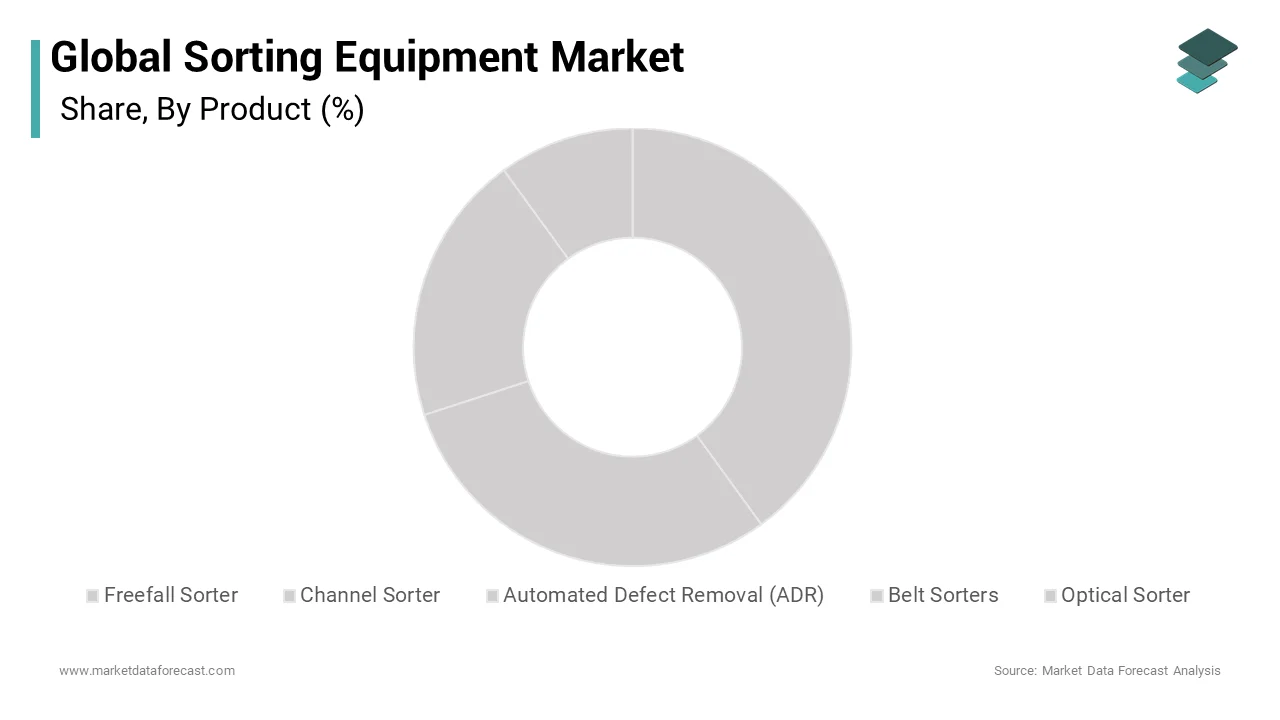
The automated defect removal segment is expected to witness a fastest CAGR of 12.5% during the forecast period driven by rising quality control standards in food and pharmaceutical industries. The growth of the segment is also driven by the need for zero tolerance policies regarding contaminants and defects in consumer products. According to the World Health Organization, foodborne diseases affect approximately 600 million people annually, which has intensified regulatory pressure on manufacturers to implement advanced inspection and removal systems. Automated defect removal systems utilize artificial intelligence and machine learning to identify and eliminate microscopic contaminants that human inspectors might miss. In the food sector, the United States Department of Agriculture mandates strict guidelines for foreign material detection which drives investment in automated removal technologies. The ability to maintain consistent quality while minimizing labor costs makes automated defect removal an attractive solution for high volume production environments accelerating its adoption rate globally.
By End Use Industry Insights
The food industry segment was the largest by accounting for 34.2% of the sorting equipment market share in 2025 owing to stringent safety regulations and the critical need for quality assurance in food processing. The global emphasis on reducing food waste and ensuring consumer safety through precise sorting of raw materials and finished products is also bolstering the growth of the sorting equipment market. According to the Food and Agriculture Organization, approximately 14% of food produced is lost between harvest and retail levels largely due to inadequate sorting and grading processes. Sorting equipment helps mitigate these losses by accurately categorizing produce based on size color and ripeness ensuring optimal market value. The United States Department of Agriculture requires that all processed food items meet specific quality standards which necessitates the use of advanced sorting technologies to remove contaminants and defective items. Additionally, the growing consumer preference for organic and premium quality foods drives demand for sophisticated sorting systems that can differentiate between subtle quality variations. The European Food Safety Authority emphasizes that automated sorting reduces human handling, which minimizes cross contamination risks.
The plastic industry segment is swiftly emerging at a fastest CAGR of 11.8% from 2026 to 2034 with the global circular economy initiatives and recycling mandates. The of the segment is also driven by the urgent need to manage plastic waste effectively and recover valuable materials from mixed streams. According to the Organisation for Economic Co-operation and Development, only 9% of plastic waste is successfully recycled globally promoting a massive opportunity for improved sorting infrastructure. New regulations such as the European Union Single Use Plastics Directive require member states to collect 77% of plastic bottles by 2025, which necessitates advanced sorting capabilities to separate different polymer types. The mechanical recycling requires sorted plastic streams with purity levels above 95% to produce high quality recycled resins. Sorting equipment equipped with near infrared technology can accurately distinguish between polyethylene polypropylene and polystyrene enabling efficient recycling processes. The Ellen MacArthur Foundation estimates that improving plastic sorting and recycling could capture 40 to 50 billion dollars in value annually.
REGIONAL ANALYSIS
North America Market Analysis
North America was the top performer in the global sorting equipment market by holding 34.7% of the share in 2025 with the advanced waste management infrastructure and strict environmental regulations. The region benefits from well-established recycling programs and high awareness regarding sustainability among consumers and industries. According to the study, the United States generated 292.4 million tons of municipal solid waste in recent years with a recycling rate of 32.1% which creates sustained demand for efficient sorting technologies. Canada has implemented extended producer responsibility laws in several provinces requiring manufacturers to fund and manage the recycling of their products which drives investment in sorting facilities. The presence of major technology providers and research institutions in the region facilitates continuous innovation in sorting equipment. Additionally, the food processing industry in the United States, which accounts for nearly 10% of the national manufacturing output relies heavily on sorting equipment to ensure compliance with Food and Drug Administration standards.
Europe Market Analysis
Europe sorting equipment market was ranked second with 21.3% of share in 2025 with the rigorous environmental policies and ambitious circular economy targets. As per the European Union Waste Framework Directive, member states achieve a 55% municipal waste recycling rate by 2025, which directly stimulates demand for advanced sorting infrastructure. The European Commission Circular Economy Action Plan aims to double the circular material use rate to 25% by 2030, requiring substantial upgrades to existing sorting facilities. The Confederation of European Paper Industries states that improved sorting technologies have increased the quality of recovered paper fibers by enhancing their recyclability. Additionally, strict landfill bans in countries such as Sweden and Denmark force municipalities to invest in sorting and recovery technologies rather than disposal.
Asia Pacific Market Analysis
Asia Pacific sorting equipment market growth is likely to grow with the urbanization, industrialization, and increasing government focus on waste management. According to the World Bank, East Asia and Pacific region generates approximately 23% of global waste but has historically lacked adequate sorting infrastructure. China implementation of mandatory waste sorting regulations in major cities like Shanghai and Beijing has created immediate demand for industrial sorting equipment to process segregated waste streams. The Ministry of Ecology and Environment in China reports that the country aims to build 100 new waste to energy plants by 2025, which require pre sorting systems to remove non combustible materials. In India, the Swachh Bharat Mission has allocated significant funds for modernizing waste management facilities including the installation of automated sorting lines.
Latin America Market Analysis
Latin America sorting equipment makret growth is likely to grow with the gradual improvements in waste management practices and increasing environmental awareness. Brazil and Mexico are the key markets in this region driving demand through urban waste management projects and industrial recycling initiatives. Brazil National Solid Waste Policy mandates the elimination of open dumpsites by 2024, which requires municipalities to invest in mechanized sorting and treatment facilities. Mexico has introduced extended producer responsibility schemes for packaging materials which encourages investment in sorting technologies to recover valuable resources. Additionally, the growing food processing industry in countries like Argentina and Chile adopts sorting equipment to meet export quality standards.
Middle East And Africa Market Analysis
The Middle East and Africa sorting equipment market growth is driven by urbanization and government initiatives to improve waste management infrastructure. Countries in the Gulf Cooperation Council are leading this trend with significant investments in smart city projects and sustainable waste management solutions. Saudi Arabia Vision 2030 includes ambitious targets for waste diversion and recycling, which require the deployment of advanced sorting equipment in new waste treatment facilities. In Africa, South Africa and Egypt are making strides in modernizing their waste management sectors with pilot projects incorporating automated sorting technologies. These initiatives through funding programs aimed at improving urban sanitation and resource recovery.
COMPETITIVE LANDSCAPE
The competition in the Sorting Equipment Market is characterized by intense rivalry among established global players and emerging regional manufacturers. Companies compete primarily on technological superiority product reliability and after sales service quality. Innovation serves as the key differentiator with leaders continuously launching advanced systems incorporating artificial intelligence and hyperspectral imaging. Price competition remains moderate as customers prioritize performance and return on investment over initial cost savings. Strategic alliances and joint ventures are common, as firms seek to combine complementary technologies and expand geographic reach. The entry of new players with disruptive technologies poses a challenge to incumbents requiring constant adaptation and improvement. Intellectual property protection plays a crucial role as companies safeguard their proprietary algorithms and sensor designs. Customer retention strategies including customized solutions and comprehensive support packages are essential for maintaining market share.
KEY MARKET PLAYERS
Major Key Players in the Global Sorting Equipment Market are
- TOMRA
- Barco Vision
- Daewon GSE
- Pellenc Sortex AS
- TOMRA Group
- BT-Wolfgang Binder
- Bühler Sortex
- Sesotec
- Raytec Vision
- Concept Engineers
- Key Technology
Top Players In The Market
- TOMRA Group stands as a global leader in sensor based sorting solutions with a strong presence in recycling food and mining sectors. The company specializes in advanced optical sorting technologies that utilize near infrared spectroscopy and artificial intelligence to achieve high purity levels. TOMRA has recently expanded its portfolio by integrating machine learning algorithms into its AUTOSORT series, which enhances material recognition capabilities significantly. The company actively collaborates with waste management facilities worldwide to optimize recovery rates and reduce operational costs. Their commitment to sustainability is evident through continuous innovation in plastic sorting systems that support circular economy goals. TOMRA also invests heavily in research and development to address emerging challenges in electronic waste processing.
- Buhler AG is a prominent player known for its precision sorting equipment primarily serving the food and feed industries. The company offers comprehensive solutions including optical sorters and defect removal systems that ensure product quality and safety. Buhler has recently launched innovative platforms equipped with deep learning capabilities to detect subtle contaminants and defects in grains and nuts. The organization emphasizes sustainable processing by minimizing food waste through accurate grading and sorting mechanisms. Buhler strengthens its market position by providing end to end services from installation to maintenance ensuring optimal performance for clients. Their global network of experts supports customers in adapting to changing regulatory requirements and consumer preferences.
- Pellenc Sortex AS is a specialized manufacturer focusing on optical sorting systems for the recycling and waste management industries. The company is renowned for its robust and customizable solutions that handle complex material streams with high accuracy. Pellenc Sortex has recently introduced advanced sensor technologies capable of distinguishing between different polymer types and colors in plastic waste. This innovation supports recyclers in meeting stringent quality standards required by downstream manufacturers. The company actively participates in industry initiatives promoting circular economy practices and resource efficiency. Pellenc Sortex strengthens its market presence by offering tailored engineering services and comprehensive training programs for operators. Their dedication to reliability and performance makes them a trusted choice for facilities aiming to maximize material recovery.
Major Strategies Used By Key Market Participants
Key players in the Sorting Equipment Market employ several strategic approaches to maintain competitive advantage and drive growth. Product innovation remains a primary strategy with companies investing heavily in research and development to integrate artificial intelligence and machine learning into their systems. These technological enhancements improve sorting accuracy and operational efficiency which attracts customers seeking advanced solutions. Strategic partnerships and collaborations are also prevalent as firms join forces with technology providers and research institutions to accelerate innovation cycles. Expansion into emerging markets represents another critical strategy where companies establish local presence to cater to growing demand in Asia Pacific and Latin America. Mergers and acquisitions enable organizations to broaden their product portfolios and access new customer segments efficiently. Additionally key participants focus on sustainability by developing eco-friendly sorting solutions that align with global environmental regulations. Customer centric service models, including comprehensive maintenance and training programs help build long term relationships and enhance brand loyalty in this competitive world.
MARKET SEGMENTATION
This research report on the global sorting equipment market has been segmented and sub-segmented based on product type, end-user, and regio.n
By Product Type
- Freefall Sorter
- Channel Sorter
- Automated Defect Removal (ADR)
- Belt Sorters
- Optical Sorter
By End Use
- Chemical Industry
- Food Industry
- Pharmaceutical Industry
- Plastic Industry
- Wood Industry
- Agriculture Industry
- Packaging Industry
- Others
By Region
- North America
- Europe
- Asia-Pacific
- Latin America
- The Middle East and Africa