- Product Description Description
- Table of Contents TOC
- List of Table & Figure LOT
- Get Free Sample PDF Sample PDF
Market Size, 2025
$17.01 BnMarket Estimate, 2026
$18.34 BnMarket Forecast, 2034
$33.45 BnCAGR, 2026–2034
7.80%Global Specialty Oils Market Size, Growth, Trends & Forecast (2026–2034)
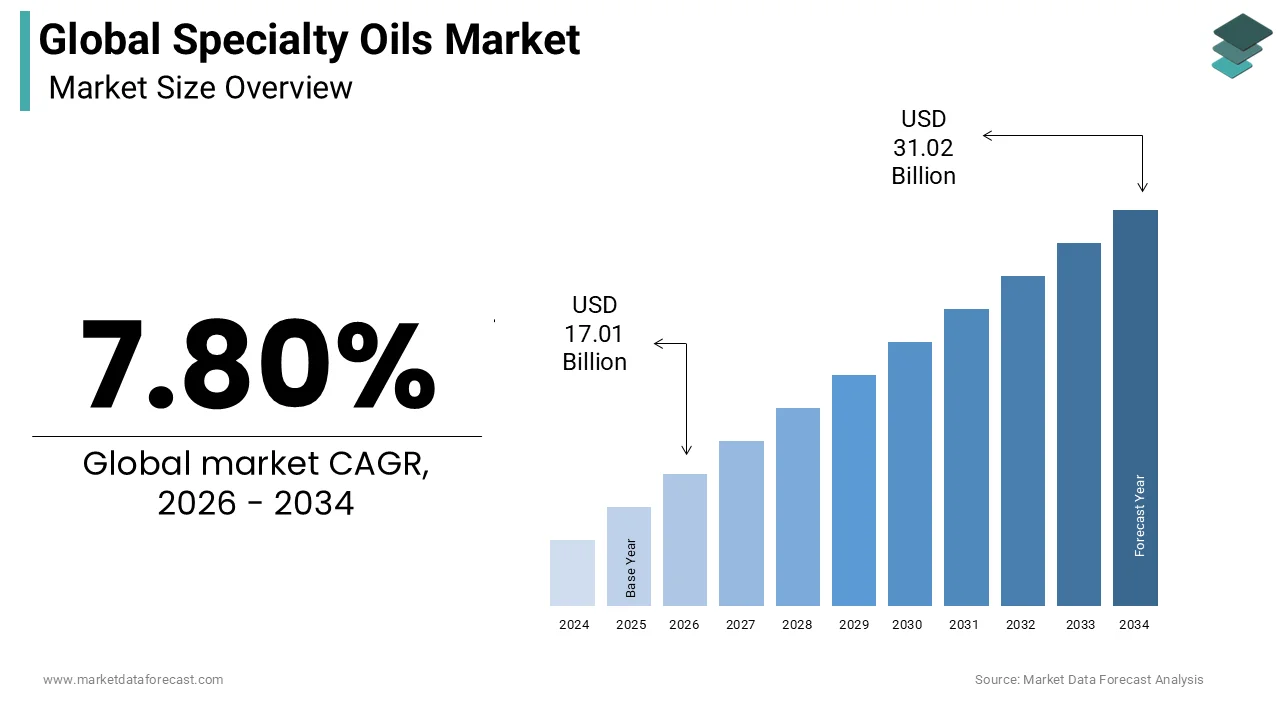
The global specialty oils market size was valued at USD 17.01 billion in 2025, stands at USD 18.34 billion in 2026, and is projected to reach USD 33.45 billion by 2034, registering a compound annual growth rate (CAGR) of 7.80% during the forecast period from 2026 to 2034. Driven by rapid grid modernization, electrical infrastructure expansions, the proliferation of electric mobility, and rising demand for high-performance synthetic lubricants across industrial and personal care sectors, the market is expanding robustly worldwide.
Key Executive Metrics (At-a-Glance)
- 2025 Base Valuation: USD 17.01 Billion
- 2026 Current Valuation: USD 18.34 Billion
- 2034 Forecast Valuation: USD 33.45 Billion
- Compound Annual Growth Rate (CAGR): 7.80% (2026–2034)
- Dominant Type Segment: Mineral Oils (capturing a substantial share in 2025 due to cost efficiency and extensive industrial/transformer use)
- Fastest-Growing Type Segment: Synthetic Oils (anticipated to record the fastest CAGR driven by thermal stability and EV demands)
- Dominant Application Segment: Industrial Applications (leading share in 2025 across manufacturing, metalworking, and hydraulics)
- Fastest-Growing Application Segment: Cosmetics and Personal Care (experiencing rapid growth due to premium skincare formulations)
- Dominant End-Use Segment: Commercial End-Use (holding the majority share in 2025)
- Fastest-Growing End-Use Segment: Institutional End-Use (projected to experience the fastest CAGR from 2026 to 2034)
- Dominant Region: North America (accounting for a 30.3% share in 2025)
Core Market Drivers
- Global Electrification & Grid Modernization: Rapid expansion of electrical transmission networks and renewable energy integration driving demand for transformer and insulating fluids.
- Electric Mobility & Advanced Manufacturing: Proliferation of electric vehicles and automated robotics requiring specialized dielectric cooling fluids and precision lubricants.
Primary Market Restraints & Challenges
- Petrochemical Price Volatility: Inherent vulnerability of specialty oil manufacturing to crude oil price swings and feedstock cost instability.
- Strict Ecological Mandates: Stringent environmental regulations limiting hazardous emissions and toxic chemical usage, requiring costly reformulation into biodegradable alternatives.
Global Specialty Oils Market Segmentation Breakdown
| Segment Category | Leading Sub-Segment | Fastest-Growing Sub-Segment |
|---|---|---|
| By Type | Mineral Oils (Substantial share in 2025) | Synthetic Oils (Fastest CAGR, 2026–2034) |
| By Application | Industrial Applications (Leading share in 2025) | Cosmetics and Personal Care |
| By End Use | Commercial End-Use (Majority share in 2025) | Institutional End-Use (Fastest CAGR) |
| By Region | North America (30.3% share in 2025) | Asia-Pacific (Fastest regional growth) |
Major Industry Players Profiled
Key market leaders shaping the global specialty oils sector include IOI Group, AAK AB, Wilmar International, D & L Industries, Cargill Inc, Mewah International, Manildra, IFFCO Group, Musim Mas, The Nisshin Oilio Group, 3F GROUP, Puratos Group NV, De Wit Specialty Oil, and others.
 Download Free Sample Report
Global Specialty Oils Market Size
The global specialty oils market size was calculated to be USD 17.01 billion in 2025 and is anticipated to be worth USD 33.45 billion by 2034, from USD 18.34 billion in 2026, growing at a CAGR of 7.80% during the forecast period.
Specialty oils are highly refined, formulated, or unique oils designed to meet specific culinary, nutritional, or industrial needs. Unlike commodity lubricants, these advanced fluids are formulated to deliver exceptional thermal stability, oxidative resistance, and superior electrical insulation properties under extreme operational conditions. The global reliance on these specialized chemical solutions is deeply intertwined with modern infrastructure and manufacturing capabilities. According to the International Energy Agency (IEA), global electricity demand is projected to rise at a robust average annual rate of 3.6% through 2030, accelerating infrastructure upgrades and driving long-term demand for advanced grid components like premium transformer oils. Furthermore, the transition toward advanced manufacturing and electric mobility requires specialized metalworking fluids and dielectric coolants to maintain operational efficiency. As per the International Organization of Motor Vehicle Manufacturers (OICA), global vehicle production reached 96.4 million units in 2025, driven by massive manufacturing growth in Asia and a rapidly expanding market share for electric vehicles that require specialized thermal management fluids. In the personal care and cosmetics sector, a study indicates that the global white oil market exceeds $2.6 billion, relying heavily on ultra-pure, non-toxic white mineral oils to meet strict formulation safety standards. These intersecting industrial and consumer trends underscore the critical role of specialty oils in enabling technological advancement and maintaining the reliability of complex mechanical and electrical systems worldwide.
MARKET DRIVERS
Escalating Global Electrification and Grid Modernization Initiatives Drive Demand for Insulating Fluids
The rapid modernization of electrical transmission networks and the proliferation of consumer electronics are accelerating the growth of the specialty oils market. This serves as a primary factor for the consumption of specialty insulating and cooling oils. Transformer oils and dielectric fluids are indispensable for preventing electrical arcing and dissipating heat in high-voltage equipment. According to the International Energy Agency (IEA), global investments in electricity grids have climbed well past 400 billion USD annually, driven by an urgent expansion of transmission lines and substation upgrades to integrate renewable energy. This modernization requires millions of liters of premium mineral and synthetic ester-based insulating fluids to ensure the longevity and safety of new transformers. Furthermore, the miniaturization of electronic components and the exponential growth of data centers necessitate advanced immersion cooling liquids. As per the U.S. Department of Energy (DOE), domestic data center power consumption is projected to double or triple by 2028, signaling a massive cooling hurdle for engineers scaling up the thermal management infrastructure. The shift toward renewable energy installations such as offshore wind farms also demands specialty oils that can withstand extreme environmental conditions and provide reliable lubrication for gearbox systems. This relentless expansion of electrical infrastructure and digital computing hardware guarantees a sustained and robust demand for high-performance specialty oils across the global industrial and technology sectors.
Proliferation of Electric Mobility and Advanced Automotive Manufacturing Accelerates Fluid Consumption
The global automotive industry's transition toward electric mobility and the increasing complexity of modern vehicle manufacturing further boost the expansion of the specialty oils market. This significantly propels the demand for specialized lubricants and thermal management fluids. Electric vehicles require unique dielectric cooling fluids and specialized greases that differ fundamentally from those used in internal combustion engines. The International Energy Agency (IEA) Global EV Outlook reveals that with global annual sales holding above 14 million units, the total electric vehicle fleet on the road has surged deep into the tens of millions, permanently altering baseline automotive engineering requirements. These vehicles utilize battery thermal management systems that rely heavily on high-performance specialty oils to maintain optimal operating temperatures and prevent thermal runaway. Additionally, the manufacturing process of advanced automotive components requires sophisticated metalworking fluids and stamping oils to achieve precise tolerances and superior surface finishes. The trend toward vehicle lightweighting and the integration of advanced driver assistance systems further necessitate low viscosity synthetic lubricants that reduce friction and improve overall energy efficiency. This continuous evolution in automotive design and the massive scale of global vehicle production create an enduring and expanding requirement for highly engineered specialty oils.
MARKET RESTRAINTS
Fluctuations in Raw Material Costs and Petrochemical Feedstock Prices Impede Profit Margins
The inherent vulnerability of specialty oil manufacturers to the extreme volatility of crude oil markets and petrochemical feedstock prices is a significant restraint on the profitability and pricing stability of the specialty oils market. Specialty oils are predominantly derived from highly refined petroleum-based stocks or complex synthetic polymers whose costs are directly tethered to global crude oil benchmarks. According to the World Bank Commodity Markets Outlook, global crude oil benchmarks experience wild single-year price swings often exceeding 30%, which destabilizes petrochemical feedstock costs for downstream manufacturers. When the cost of Group II and Group III base oils or polyalphaolefins spikes unexpectedly, manufacturers face the dilemma of absorbing the increased expenses or passing them onto price-sensitive industrial consumers. Furthermore, the energy-intensive nature of the refining and purification processes required to produce ultra-pure white oils and synthetic esters means that rising natural gas and electricity prices compound the financial burden. The unpredictable cost environment makes long-term financial planning and stable contract pricing exceedingly difficult for both producers and end users. Consequently, the continuous instability of upstream petrochemical markets restricts the ability of specialty oil companies to maintain consistent profit margins and hinders steady market expansion.
Rigorous Ecological Mandates and Waste Disposal Regulations Restrict Formulation Flexibility
The implementation of increasingly stringent environmental regulations concerning the disposal of industrial waste and the limitation of hazardous emissions is a major obstacle to the traditional formulation and application of these oils in the global specialty oils market. Many conventional specialty lubricants and process oils contain additives or base stocks that are classified as toxic or non-biodegradable, posing severe risks to soil and water ecosystems if not disposed of properly. The European Union has enacted comprehensive regulations that severely restrict the use of certain heavy metal additives and mandate the use of readily biodegradable alternatives in environmentally sensitive applications. Compliance with these evolving ecological standards requires extensive and costly research and development to reformulate products without compromising their high-performance characteristics. Manufacturers must invest heavily in advanced filtration technologies and closed-loop recycling systems to minimize environmental impact. This heavy regulatory burden increases operational costs and limits the availability of certain high-performance specialty oils in highly regulated jurisdictions, thereby restraining overall market growth.
MARKET OPPORTUNITIES
Transition Toward Renewable Feedstocks and Biodegradable Formulations Opens Lucrative Avenues
The global industrial shift toward sustainability and circular economy principles offers a massive opportunity for the global specialty oils market. This paves the way for the development and commercialization of bio-based and biodegradable specialty oils. Manufacturers are increasingly utilizing agricultural feedstocks such as rapeseed oil, sunflower oil, and synthetic esters derived from renewable resources to create high-performance lubricants that naturally decompose in the environment. According to the United States Department of Agriculture (USDA), the domestic biobased products industry reduces greenhouse gas emissions by an estimated 12.7 million metric tons of CO2 equivalents annually, validating the environmental advantage of renewable lubricant alternatives. Bio-based specialty oils offer excellent lubricity, high flash point,s and superior biodegradability, making them ideal for use in forestry, marine, and agricultural applications where environmental contamination is a critical concern. Furthermore, the growing demand from original equipment manufacturers to reduce the carbon footprint of their products is driving the adoption of these sustainable fluids. By investing in advanced catalytic processes to improve the oxidative stability and thermal performance of plant-derived oils, companies can capture premium pricing and secure lucrative contracts with environmentally conscious corporations. This strategic pivot toward renewable chemistry not only mitigates the risks associated with fossil fuel volatility but also aligns corporate portfolios with global decarbonization goals.
Rapid Industrialization and Proliferation of Automated Robotics in Developing Regions
The accelerated pace of industrial automation and the widespread integration of advanced robotics in emerging economies create a highly lucrative opportunity for the specialty oils market. Modern automated manufacturing facilities and robotic systems require highly specialized synthetic lubricants and precision fluids to maintain operational accuracy, reduce friction, and extend the lifespan of complex mechanical components. According to the International Federation of Robotics (IFR), annual global industrial robot installations have surpassed 500,000 units, concentrated heavily in Asian manufacturing hubs and driving up demand for high-performance robotic joint lubricants. These sophisticated machines operate under extreme speeds and tight tolerances, necessitating the use of premium low viscosity synthetic oils and specialized greases that prevent wear and ensure seamless movement. Furthermore, the expansion of food and beverage processing plants in these regions requires large volumes of food-grade specialty oils and white oils that comply with strict health and safety standards. By establishing localized blending facilities and technical support centers in these high-growth regions, specialty oil manufacturers can capture significant market share. The continuous modernization of global manufacturing infrastructure ensures a sustained and expanding demand for high-performance lubricants tailored for automated systems.
MARKET CHALLENGES
Vulnerabilities in Global Logistics and Sourcing of Specialized Chemical Additives
The complex global supply chain required to source rare base stocks and highly specialized chemical additives is a formidable challenge for manufacturers seeking to maintain consistent production schedules, which slows down the growth of the specialty oils market. Unlike commodity lubricants, specialty oils require precise formulations that often depend on a limited number of global suppliers for specific performance additives such as extreme pressure agents, anti-wear compounds, and specialized viscosity index improvers. As per the World Economic Forum (WEF), systemic logistics friction has severely impacted chemical intermediate availability, causing volatile lead times for specialty oil blenders. Any delay in the procurement of these essential raw materials can halt the production of high-value specialty fluids, leading to missed delivery deadlines and strained relationships with industrial clients. Furthermore, the geopolitical concentration of certain petrochemical refining capacities means that regional conflicts or trade tariffs can instantly restrict the availability of Group III base stocks or polyalphaolefins. Manufacturers are forced to maintain larger safety stocks of expensive raw materials, which ties up working capital and increases storage risks. Overcoming these logistical vulnerabilities requires complex supplier diversification and advanced inventory management strategies that are difficult to implement effectively across a fragmented global market.
Difficulties in Reprocessing Used Synthetic Fluids and Maintaining Purity Standards
The technical and economic complexities associated with the recycling and reprocessing of used synthetic specialty oils pose a significant challenge to the sustainability goals in the specialty oils market. While mineral-based specialty oils can often be reprocessed using established distillation and clay treatment methods, synthetic fluids such as polyalphaolefins and phosphate esters require highly complex and expensive chemical processing to separate them from degraded additives and contaminants. The presence of highly stable synthetic base stocks makes it difficult to remove microscopic wear metals and oxidation byproducts without destroying the underlying fluid structure. Furthermore, strict quality standards dictate that reprocessed synthetic oils must meet the same performance criteria as virgin products, limiting the acceptable levels of impurities. This technical barrier prevents the widespread adoption of closed-loop recycling systems for high-performance specialty fluids. Consequently, manufacturers and end users struggle to manage the end-of-life disposal of these valuable but difficult-to-recycle materials, creating a persistent environmental and operational challenge for the entire sector.
REPORT COVERAGE
| REPORT METRIC | DETAILS |
| Market Size Available | 2025 to 2034 |
| Base Year | 2025 |
| Forecast Period | 2026 to 2034 |
| CAGR | 7.8% |
| Segments Covered | By Type, Process Type, Application, and Region |
| Various Analyses Covered | Global, Regional & Country Level Analysis, Segment-Level Analysis, DROC, PESTLE Analysis, Porter’s Five Forces Analysis, Competitive Landscape, Analyst Overview of Investment Opportunities |
| Regions Covered | North America, Europe, APAC, Latin America, Middle East & Africa |
| Market Leaders Profiled | IOI Group, AAK AB, Wilmar International, D & L Industries, Cargill Inc, Mewah International, Manildra, IFFCO Group, Musim Mas, The Nisshin Oilio Group, 3F GROUP, Puratos Group NV, De Wit Specialty Oil, a nd Others. |
SEGMENTAL ANALYSIS
By Type Insights
The mineral oils segment dominated the specialty oils market and accounted for a substantial share in 2025. This dominance of the segment was driven by the extensive utilization of mineral oils in industrial machinery and electrical transformer applications. These oils provide exceptional dielectric strength and cooling properties essential for high voltage equipment. The continuous expansion of power generation and distribution networks across developing nations requires millions of liters of highly refined mineral oils to ensure the longevity and safety of electrical assets. Furthermore, the established compatibility of mineral oils with existing industrial machinery seals and materials makes them the default choice for heavy-duty manufacturing and automotive applications. This deep integration into foundational global infrastructure guarantees a massive and sustained baseline consumption volume that solidifies the dominance of mineral oils in the specialty fluids landscape.
The widespread availability and economic viability of mineral oils significantly reinforce their leading position in the global specialty oils market. According to the International Energy Agency (IEA), global crude oil production provides a massive and continuous feedstock base for refining facilities, tracking a reliable daily volume to sustain mineral lubricant basestock blending. The extensive global network of petroleum refineries and blending plants ensures that mineral-based specialty oils can be produced and distributed at a fraction of the cost associated with complex synthetic alternatives. This cost advantage is particularly critical for price-sensitive industrial sectors such as construction, mining, and agriculture, where operational margins are tightly controlled. The combination of low production costs and a mature global supply chain makes mineral oils the most accessible and economically practical solution for the vast majority of industrial and mechanical applications worldwide.
The synthetic oils segment is anticipated to witness the fastest CAGR from 2026 to 2034. In addition, the exceptional thermal stability and oxidative resistance of synthetic oils are driving their rapid adoption in demanding automotive and aerospace applications. These advanced fluids maintain their viscosity and protective properties under extreme temperature fluctuation,s preventing engine wear and sludge formation in high-performance jet engines and turbocharged motors. The ability of synthetic oils to reduce friction and improve fuel efficiency aligns perfectly with global mandates to lower carbon emissions from the transportation sector. This superior performance profile ensures that synthetic oils are growing at the fastest rate as industries prioritize equipment longevity and operational efficiency.
The proliferation of industrial operations in extreme climates and high-stress manufacturing environments is accelerating the consumption of synthetic specialty oils. These fluids do not degrade or lose their viscosity under conditions that would cause conventional mineral oils to fail catastrophically. Furthermore, the miniaturization of electronic components and the exponential growth of data centers require advanced synthetic immersion cooling liquids that can manage intense thermal loads without compromising equipment performance. The critical need for reliability in extreme operational environments guarantees that synthetic oils will continue to experience the fastest growth trajectory in the global specialty oils market.
By Application Insights
The industrial applications segment led the specialty oils market and captured a significant share in 2025. This leading position of the segment was mainly attributed to the massive and continuous consumption of specialized fluids in manufacturing, metalworking, and hydraulic systems. These specialized oils prevent tool wear and thermal deformation of critical components in automotive and aerospace part production. Furthermore, hydraulic systems, which form the backbone of heavy machinery and manufacturing automation, rely heavily on high-performance hydraulic oils to transmit power efficiently while protecting pumps and valves from corrosion and wear. This relentless industrial activity necessitates millions of liters of specialty oils annually to maintain operational efficiency and product quality, solidifying the industrial segment as the undisputed leader in market consumption.
The rapid expansion of global infrastructure projects and the continuous deployment of heavy construction equipment significantly propel the dominance of industrial specialty oils. This massive construction boom drives the demand for heavy-duty excavators, cranes, and bulldozers, which require specialized engine oils, hydraulic fluid,s and gear lubricants to operate under extreme loads and harsh environmental conditions. The harsh operating environments typical of mining and earthmoving applications necessitate the frequent use of premium industrial oils that resist contamination and maintain viscosity under high pressure. The continuous modernization of global infrastructure and the relentless extraction of natural resources ensure that industrial applications remain the primary driver of specialty oil consumption worldwide.
The cosmetics and personal care segment is experiencing the fastest growth owing to a global shift toward premium skincare formulations and the increasing use of natural emollients. Consumers are increasingly willing to pay a premium for products that offer superior moisturizing properties and non-greasy textures, which are perfectly delivered by highly refined specialty oils. Manufacturers are formulating advanced anti-aging serums and luxury lotions that require specialized lipid structures to penetrate the skin effectively and deliver active ingredients. This relentless consumer demand for high efficacy and aesthetically pleasing personal care products guarantees that the specialty oils utilized in these formulations will continue to grow at the fastest rate in the market.
The rapid expansion of the middle class and rising disposable incomes in emerging economies are significantly accelerating the consumption of specialty oils in the personal care sector. Also, the demographic shift translates directly into increased spending on premium health, beauty, and personal grooming products. Furthermore, the pervasive influence of social media and global beauty trends has heightened consumer awareness regarding skincare routines and ingredient transparency, driving demand for products formulated with pure and safe emollients. The continuous penetration of multinational beauty brands into emerging markets, coupled with the rise of local premium brands, ensures a robust and accelerating demand for specialty oils tailored for the cosmetics and personal care industry.
By End Use Insights
In 2025, the commercial end-use segment held the majority share of the specialty oils market because of the high volume consumption of specialized fluids in the hospitality, food service, and large-scale facility maintenance sectors. These facilities require massive quantities of food-grade specialty oils and white oils for equipment lubrication, baking processes, and food preparation to comply with strict health and safety standards. Furthermore, the maintenance of large commercial buildings, including shopping malls, office complexes, and hotels, necessitates the continuous use of specialized HVAC lubricants and elevator hydraulic fluids to ensure optimal system performance and energy efficiency. The sheer scale and operational intensity of the commercial sector guarantee a massive and consistent baseline demand for specialty oils across diverse applications.
Stringent regulatory mandates and industry standards regarding hygiene and equipment maintenance in commercial environments significantly reinforce the dominance of the commercial end-use segment. These regulations compel commercial operators to purchase premium specialty oils that meet exacting safety profiles rather than cheaper industrial alternatives. The high visibility and reputational risks associated with equipment failure or hygiene breaches in the hospitality sector drive operators to prioritize the highest quality specialty oils. This uncompromising focus on safety, reliability, and regulatory compliance ensures that the commercial sector remains the largest consumer of specialty oils globally.
The institutional end-use segment is likely to experience the fastest CAGR between 2026 and 2034. This swift expansion of the segment is propelled by massive global investments in healthcare facilities and educational infrastructure that require specialized maintenance fluids. These institutions rely on ultra-pure specialty oils and vacuum pump fluids to ensure the accuracy of sensitive scientific instruments and maintain sterile environments. Furthermore, the expansion of modern healthcare facilities, including hospitals and research laboratories, demands highly specialized medical-grade lubricants and dielectric fluids for advanced imaging equipment such as MRI machines and CT scanners. The critical nature of these institutional applications and the continuous expansion of public infrastructure guarantee that this segment will experience the fastest growth trajectory in the specialty oils market.
Government mandates and public sector procurement policies prioritizing sustainable and safe operational fluids are significantly accelerating the adoption of specialty oils in the institutional segment. These stringent procurement guidelines compel institutional facility managers to transition from conventional mineral oils to advanced bio-based or synthetic specialty oils that offer superior biodegradability and reduced toxicity. The massive scale of government-owned real estate and the strict enforcement of environmental compliance in public procurement ensure that institutional buyers are rapidly increasing their consumption of premium sustainable specialty oils. This regulatory-driven shift guarantees robust and accelerated growth for the institutional end-use segment globally.
REGIONAL ANALYSIS
North America Specialty Oils Market Analysis
North America outperformed other regions in the global specialty oils market and accounted for a 30.3% share in 2025. This prominence of the segment was driven by advanced manufacturing capabilities and a highly developed automotive sector. The market status in this region is characterized by a strong shift toward high-performance synthetic lubricants and strict adherence to environmental regulations. According to the United States Environmental Protection Agency (EPA), legal frameworks like the Vessel General Permit (VGP) mandate the use of Environmentally Acceptable Lubricants (EALs) in water-adjacent operations, forcing industrial sectors to adopt premium bio-based specialty oils. The region benefits from a massive concentration of aerospace defense and advanced electronics manufacturing, which require highly specialized dielectric fluids and extreme temperature lubricants. As per the Bureau of Economic Analysis (BEA), the United States manufacturing value-added output reaches approximately 3.0 trillion USD annually, creating a massive, stable baseline demand for industrial metalworking and hydraulic oils. Furthermore, the widespread adoption of electric vehicles and the expansion of data center infrastructure are driving unprecedented demand for advanced thermal management fluids. The combination of technological leadership, robust infrastructure, and strict regulatory frameworks ensures that North America remains a dominant and highly lucrative market for specialty oils.
Europe Specialty Oils Market Analysis
Europe was positioned second in the global market and occupied a 24.5% share in 2025. This position of the European market was supported by a strong emphasis on sustainability and advanced automotive engineering. The market status in this region is heavily influenced by comprehensive chemical regulations and a rapid transition toward circular economy principles. According to the European Commission, structural updates to the REACH Authorisation List under the European Green Deal restrict specific hazardous chemical additives, accelerating the industrial transition toward eco-friendly, biodegradable lubricants. This regulatory environment has accelerated the development and adoption of bio-based specialty oils derived from renewable agricultural feedstocks. As per the European Automobile Manufacturers’ Association (ACEA), strict alignment with regional Euro emissions standards dictates the evolution of ACEA Oil Sequences, driving high volume demand for specialized low-viscosity synthetic fluids to optimize fuel economy. Furthermore, the extensive wind energy infrastructure in Northern Europe requires millions of liters of specialized gearbox oils designed to withstand harsh marine environments. The relentless focus on environmental sustainability and high-performance engineering ensures that Europe remains a critical and innovative market for advanced specialty oils.
Asia Pacific Specialty Oils Market Analysis
Asia Pacific is a rapidly expanding region in the global market due to unprecedented industrialization and massive infrastructure development across emerging economies. China and India are leading the charge in manufacturing expansion and urbanization. Consequently, the market status in this region is highly dynamic. According to the Asian Development Bank (ADB), developing Asian economies require 1.7 trillion USD annually through 2030 to bridge critical climate and urbanization gaps, sustaining long-term demand for construction-grade industrial fluids. This massive construction boom directly translates to surging demand for heavy-duty hydraulic fluids and construction equipment lubricants. As per UNIDO, the Asia-Pacific region commands more than 40% of global manufacturing value-added output, acting as the primary global driver for industrial process oils and metalworking fluid consumption. Furthermore, the rapid proliferation of automotive manufacturing plants and the growing middle class are accelerating the demand for premium automotive lubricants and personal care specialty oils. The continuous modernization of industrial infrastructure and the sheer scale of economic expansion ensure that the Asia Pacific will experience the fastest and most robust growth in the global specialty oils market.
South America Specialty Oils Market Analysis
South America holds a steady position in the global market owing to a massive agricultural sector and extensive mining operations. The market status in this region is heavily concentrated on the extraction of natural resources and the processing of agricultural commodities, which require specialized industrial lubricants. According to the Economic Commission for Latin America and the Caribbean (ECLAC), the mining sectors of Chile and Peru generate tens of billions of dollars in annual mineral exports, requiring substantial volumes of specialized heavy-duty gear oils to operate machinery under extreme altitudes. The expansion of food processing facilities and the modernization of port infrastructure further drive the demand for food-grade specialty oils and marine lubricants. Although economic volatility occasionally impacts purchasing power, the fundamental reliance on resource extraction and agriculture ensures a stable and progressive growth trajectory for specialty oils in South America.
Middle East and Africa Specialty Oils Market Analysis
The Middle East and Africa region is likely to expand notably in the global market during the forecast period due to massive petrochemical infrastructure and unprecedented mega construction projects. The market status in this region is heavily concentrated in the Gulf Cooperation Council countries, where vast investments in oil and gas processing and luxury real estate are underway. According to the Organization of the Petroleum Exporting Countries (OPEC), aggressive expansions in Middle Eastern downstream refining and petrochemical capacity are driving increased regional demand for specialized process oils and industrial plant lubricants. As per the World Bank, national vision programs across the Gulf have unlocked a construction pipeline valued at over 1 trillion USD, driving massive, sustained demand for heavy equipment lubricants and infrastructure process fluids. This massive construction activity requires advanced hydraulic fluids and architectural specialty oils for modern skyscrapers and infrastructure. Meanwhile, in Africa, the market is gradually expanding as foreign direct investment in mining and agricultural processing increases the demand for heavy-duty industrial lubricants. The focus on resource extraction and mega project development ensures steady growth for specialty oils in this unique regional market.
COMPETITION OVERVIEW
The competition in the Specialty Oils Market is characterized by intense rivalry among multinational petroleum giants, specialized chemical companies, and regional blenders. Established players leverage their integrated supply chains and extensive research capabilities to offer high-quality base stocks and formulated products at scale. Smaller niche competitors focus on specific applications, such as food-grade lubricants or biodegradable fluids, to differentiate their offerings. Price competition remains moderate as industrial customers prioritize product reliability, technical support, and compliance with regulatory standards over lowest cost options. Strategic acquisitions of smaller formulation houses allow major companies to expand their product portfolios and access new technologies quickly. Intellectual property protection through patents on unique additive packages and synthesis processes secures competitive advantages. Supply chain resilience has become a critical differentiator following recent global disruptions, prompting companies to diversify sourcing and production locations. Customer loyalty is driven by consistent quality and responsive technical service rather than brand recognition alone. The market sees continuous innovation driven by the need for energy-efficient and environmentally friendly solutions. Collaborative ecosystems involving suppliers, manufacturers, and regulators accelerate technological advancements and market expansion.
KEY MARKET PLAYERS
Major Key Players in the Global Specialty Oils Market include
- IOI Group
- AAK AB
- Wilmar International
- D & L Industries
- Cargill Inc
- Mewah International
- Manildra
- IFFCO Group
- Musim Mas
- The Nisshin Oil Group
- 3F GROUP
- Puratos Group NV
- De Wit Specialty Oils
- Oleo-Fats Inc
- Bunge Limited
- Archer Daniels Midland Company
- The Hain Celestial Group Inc
- Apical Group Ltd
- Ventura Foods
- Adams Group
- Liberty Oil Mills Ltd
- Presco PL
Top Strategies Used by Key Market Participants
Key players in the Specialty Oils Market primarily focus on product innovation to develop high-performance synthetic and bio-based formulations that meet stringent environmental and efficiency standards. Companies invest heavily in research and development to create advanced additives that enhance lubricity, thermal stability, and oxidation resistance. Strategic partnerships with original equipment manufacturers enable the co-development of customized fluids tailored for specific machinery and electric vehicle platforms. Market participants prioritize sustainability by transitioning to renewable feedstocks and implementing circular economy practices such as oil reclamation and recycling. Geographic expansion through localized blending facilities and distribution networks ensures timely supply and reduces logistical costs. Digital integration via predictive maintenance tools allows customers to monitor fluid health and optimize change intervals. Pricing strategies balance premium positioning for specialized products with competitive rates for standard industrial grades. These multifaceted approaches drive long-term growth and maintain leadership in the evolving global lubricants landscape.
Leading Players in the Global Specialty Oils Market
- ExxonMobil Corporation stands as a global leader in the specialty oils sector, leveraging its extensive refining capabilities to produce high-quality base stocks and finished lubricants. The company supplies critical synthetic fluids for automotive, industrial, and aerospace applications, ensuring superior performance under extreme conditions. Recent actions include expanding its chemical plant capacity in Texas to increase production of polyalphaolefin synthetics, which are essential for high-performance lubricants. ExxonMobil actively collaborates with original equipment manufacturers to develop custom-formulated oils that enhance fuel efficiency and reduce emissions. Their investment in advanced research facilities focuses on creating next-generation thermal management fluids for electric vehicles. By integrating digital monitoring tools into their service offerings, they provide customers with real-time data on fluid health. These strategic initiatives reinforce their position as a primary supplier of reliable and innovative specialty oil solutions worldwide.
- Royal Dutch Shell plc operates as a major provider of premium specialty lubricants and process oils serving diverse industries, including energy, manufacturing, and personal care. The company utilizes its proprietary PurePlus technology to convert natural gas into ultra-pure base oils, offering exceptional clarity and stability. Recent actions involve launching new ranges of bio-based lubricants derived from sustainable feedstocks to meet growing environmental regulations. Shell partners extensively with industrial clients to optimize machinery performance through customized lubrication programs and technical support services. They have expanded their global blending and packaging network to ensure faster delivery and localized product availability. The company also invests heavily in developing dielectric fluids for electric vehicle battery cooling systems. These efforts demonstrate their commitment to sustainability and technological innovation, strengthening their reputation as a trusted partner in the global specialty oils market.
- Chevron Corporation is a prominent player in the specialty oils market known for its high-performance lubricants and industrial fluids designed for demanding operational environments. The company leverages its ISOSYN technology to produce premium base oils that provide superior wear protection and thermal stability. Recent actions include upgrading its Richmond refinery to enhance the production capacity of Group II and Group III base stocks, which are critical for modern synthetic lubricants. Chevron collaborates with heavy equipment manufacturers to develop specialized hydraulic and gear oils that extend equipment life in the mining and construction sectors. They also focus on expanding their presence in the Asia Pacific region through strategic partnerships and local distribution agreements. By prioritizing product quality and technical expertise, Chevron ensures its specialty oils meet the rigorous standards of global industrial and automotive applications.
MARKET SEGMENTATION
This research report on the global specialty oils market has been segmented and sub-segmented based on type, process type, application, and region.
By Type
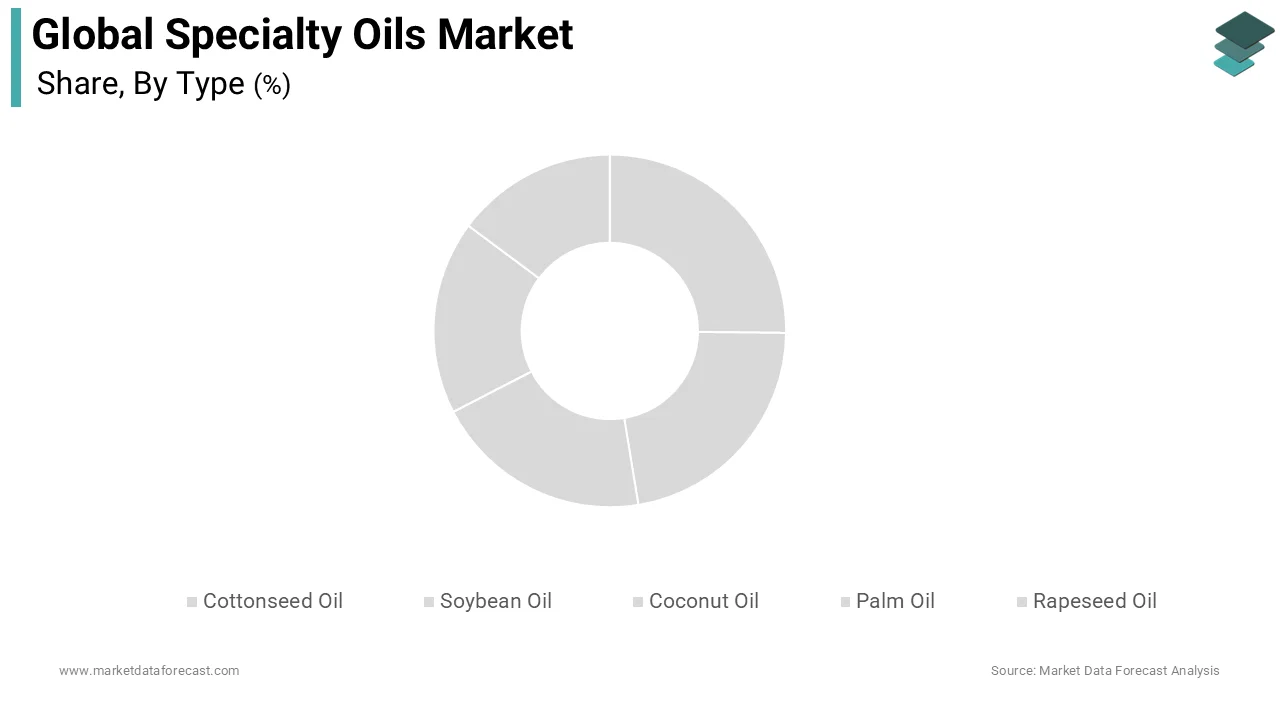
- Cottonseed Oil
- Soybean Oil
- Coconut Oil
- Palm Oil
- Rapeseed Oil
By Process Type
- Cold Pressed
- Hot Pressed
- Others
By Application
- Cosmetics & Personal Care
- Pharmaceuticals
- Food
- Others
By Region
- North America
- Europe
- Asia Pacific
- Middle East and Africa
- Latin America