- Product Description Description
- Table of Contents TOC
- List of Table & Figure LOT
- Get Free Sample PDF Sample PDF
Market Size, 2025
$47.58 BnMarket Estimate, 2026
$51.17 BnMarket Forecast, 2034
$91.60 BnCAGR, 2026–2034
7.55%Executive Summary: Global Surfactants Market
- Market Scope: Comprehensive global market analysis for surface-active agents (surfactants) covering substrate types, chemical classifications, industrial applications, geographical regions, and key competitive profiles.
- Market Valuation: Valued at USD 47.58 billion in 2025, estimated at USD 51.17 billion in 2026, and projected to reach USD 91.60 billion by 2034, growing at a robust CAGR of 7.55% from 2026 to 2034.
- Primary Growth Drivers: Soaring demand from personal care, household, and industrial cleaning sectors; rising inclination toward eco-friendly, bio-based products; low raw material and production expenses; and expanding utility of surfactants as food emulsifiers. Key restraints include stringent environmental regulations, crude oil price volatility, and technical scaling hurdles in commercializing bio-surfactants.
Key Market Segment Metrics (2026–2034)
| Category | Leading Segment (2025 Position) | Fastest-Growing Segment |
|---|---|---|
| By Substrate | Synthetic Surfactants (dominant in high-volume industrial, detergent, and elastomer manufacturing) | Bio-Based Surfactants (surging due to rising consumer preference for organic, highly biodegradable, and low-toxicity formulations) |
| By Type | Anionic & Non-Ionic Surfactants (held the major market revenue share across detergents and personal care items) | Amphoteric Surfactants (projected to be the most rapidly advancing sector on account of superior foam stabilization, biodegradability, and conditioning properties) |
| By Application | Detergents & Cleaning Products (anchored by massive household and industrial cleaning demand) | Personal Care & Food Processing (growing rapidly as brands innovate with natural emulsifiers and cosmetic additives) |
| By Region | Asia Pacific & North America (lead global consumption driven by expanding chemical manufacturing and consumer goods output) | Asia Pacific (expanding at a leading pace backed by rising disposable incomes, industrialization, and urbanization) |
Major Market Players & Market Structure
Market Structure: Highly competitive global specialty and oleochemical manufacturing landscape dominated by major chemical conglomerates competing on production capacity, green chemistry compliance, strategic asset acquisitions, and diverse surfactant substrate portfolios.
Key Companies: Air Products and Chemicals Inc., E.I. du Pont de Nemours and Company, Clariant AG, Akzo Nobel N.V., BASF SE, Kao Corporation, Stepan Company, Solvay, and Huntsman Corporation.
 Download Free Sample Report
Global Surfactants Market Size
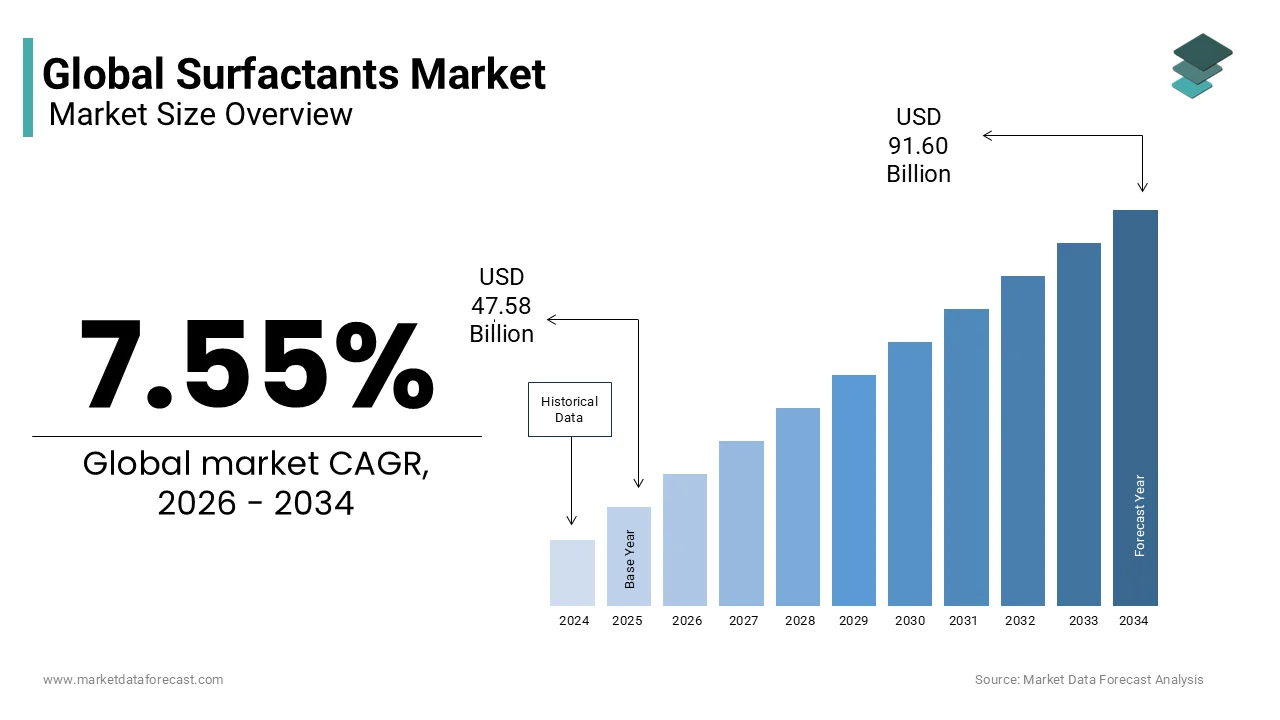
The global surfactants market size was valued at USD 47.58 billion in 2025 and is projected to reach USD 91.60 billion by 2034 from USD 51.17 billion in 2026, growing at a CAGR of 7.55%.
Surfactants also termed surface-active agents, are compounds added to lessen the interfacial tension that is also called surface tension among two liquids or solids and liquids. Surfactants are surface-active agents that decrease the surface tension of the liquid. It assists in escalating the wetting properties of the fluid. Surfactants are majorly employed to separate dirt, oil, and stains from different surfaces. They are major additives in soaps, detergents, cosmetics, personal care products, textile processing, industrial cleaning, and others. Surfactants, also known to be surface-active agents, are the natural compound of both the hydrophilic and hydrophobic groups. The amphoteric surfactant sector is forecasted to be the most rapidly advancing sector on account of its excellent properties like foam stabilization & foaming, biodegradability, and conditioning in others. The features of surfactants like detergency, froth/foam, stabilization, wettability, and dispersion have a great practical approach in so many businesses.
MARKET DRIVERS
The development of the industry can be credited to the rising call from the personal care industry. Surfactants are more and more utilized for household and industrial applications. The surfactant market is projected to develop due to the escalating alertness for eco-friendly products. Low raw material costs, along with lower production expenses, are estimated to assist penetration in the foreseen period. Surfactants offer stability and viscosity to foam and emulsion. This is further determined to drive the call for the product from many end-user businesses in the next seven years. The rising population and changing lifestyle have created a requirement to suffice the food needs of individuals, and the food and beverage business is responding with innovative products. Presently, surfactants are employed as emulsifiers that are significant for the creation and stabilization of the structure in food. These reasons are together assisting in a rise in the demand for surfactants in the food & beverage business, and hence, there is a rise in the surfactants market size.
Strict norms on environmental issues, the compulsion for the accomplishment of eco-friendly chemical procedures by the government, pollution control rules for production procedures, and escalating propensity toward environment-friendly products are the factors that could hinder the development of the surfactants industry. Strict government rules on surfactants are a reason which may impede the expansion of the worldwide surfactants industry.
MARKET OPPORTUNITIES
With the increasing awareness about healthy food, individuals are preferring organic food which is resulting in a demand for bio-surfactants that have high biodegradability, lower toxicity, and activity at high temperatures.
MARKET CHALLENGES
Technological restraints leading to problems related to the commercial production of bio-surfactants is also estimated to hamper the expansion over the forecast period. In addition to that, fluctuating costs of raw materials is another reason that could impact the development of the global industry. Price changes due to increasing environmental worries relating to surfactant toxicity and degradability, along with changing crude oil prices are expected to hinder the market.
REPORT COVERAGE
| REPORT METRIC | DETAILS |
| Market Size Available | 2025 to 2034 |
| Base Year | 2025 |
| Forecast Period | 2026 to 2034 |
| CAGR | 7.55% |
| Segments Covered | By Substrate, Type, Application, and Region |
| Various Analyses Covered | Global, Regional and Country Level Analysis; Segment-Level Analysis; DROC; PESTLE Analysis; Porter’s Five Forces Analysis; Competitive Landscape; Analyst Overview of Investment Opportunities |
| Regions Covered | North America, Europe, APAC, Latin America, Middle East & Africa |
| Market Leaders Profiled | Air Products and Chemicals, Inc., E. I. du Pont de Nemours and Company, Clariant AG, Akzo Nobel N.V., BASF SE, Kao Corporation, Stepan Company, Solvay, Huntsman Corporation, and others. |
KEY MARKET PLAYERS
The major key players in the global surfactants market are Air Products and Chemicals, Inc., E. I. du Pont de Nemours and Company, Clariant AG, Akzo Nobel N.V., BASF SE, Kao Corporation, Stepan Company, Solvay, Huntsman Corporation, and others.
RECENT HAPPENINGS IN THE MARKET
On March 27, 2018, Stepan CDMX, S. de R.L. de C.V. finished the partnership of a portion of BASF's oleochemical surfactants market in Mexico from BASF Mexicana, S.A. de C.V. The Company had declared the acquisition of BASF's Mexican surfactant industry in June 2017. The Mexican surfactant business gained from BASF was a part of BASF's Care Chemicals unit. The deal involves a portion of BASF's associated surfactant business, including associated intellectual property, as well as the surfactant production facility in Ecatepec, Mexico. The surfactant production facility with a warehouse space of over 124,000 sq. Ft. has a production capacity of 50,000 metric tons, along with an ample laboratory office space is situated near Mexico City. Stepan will also absorb most of the present employees at this production facility on completion of the deal.
MARKET SEGMENTATION
This research report on the global surfactants market has been segmented and sub-segmented based on substrate, type, application, and region.
By Substrate
- Bio-Based
- Synthetic
By Type
- Amphoteric
- Non-Ionic
- Anionic
- Cationic
By Application
- Food & Beverage
- Detergents
- Elastomers & Plastics
- Personal Care
- Crop Protection
- Textile
By Region
- North America
- Latin America
- Europe
- Asia Pacific
- Middle East & Africa